
What if the next generation doesn’t need leaders who have all the answers, but leaders who help others learn to make sound decisions? That shift sits at the heart of leadership for the next generation. The challenge isn’t simply passing on experience. It’s preparing people to carry responsibility in a world that keeps changing.
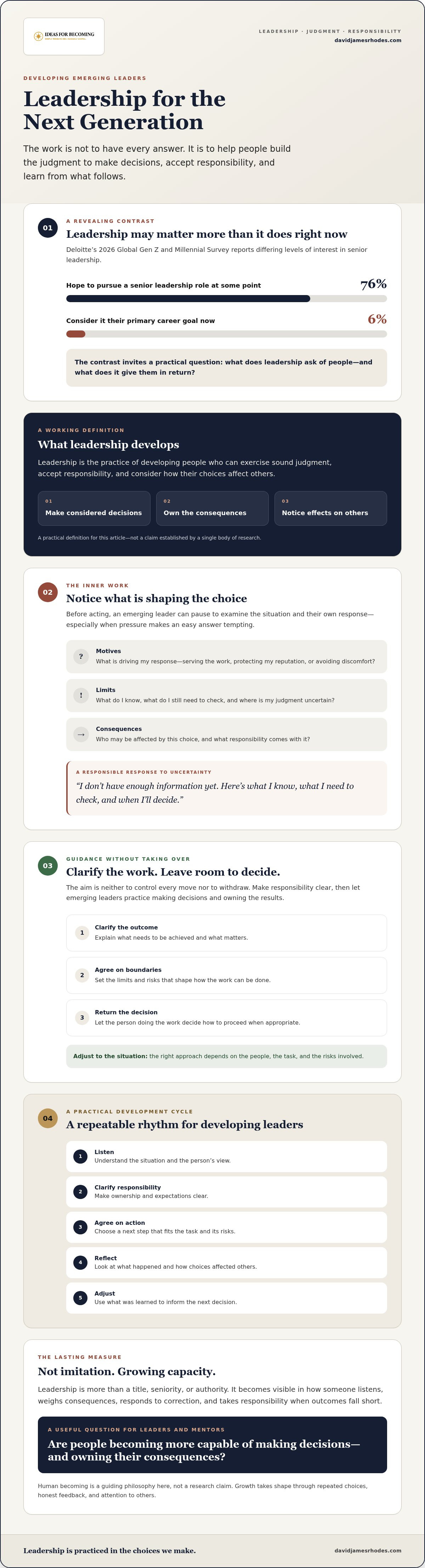
It’s understandable to wonder what emerging leaders expect, and whether familiar advice still applies. Deloitte’s 2026 Global Gen Z and Millennial Survey found that 76% of Gen Z respondents hope to pursue a senior leadership role at some point, yet only 6% consider it their primary career goal now. The gap suggests that ambition may depend on what leadership asks of people and what it gives them in return.
This article offers a practical framework for developing leadership through character, responsibility, and the capacity to keep becoming. You’ll explore qualities that endure across generations, ways to help young people build judgment and self-knowledge, and how to offer guidance without dictating someone else’s path. The work is neither to control nor to withdraw. It is to create room for responsibility, then let emerging leaders grow into it.
Key Takeaways
- Define leadership for the next generation by the judgment and responsibility people develop, not by assumptions about their age group.
- Help emerging leaders notice their motives, limits, and the consequences of their choices, especially under pressure.
- Offer guidance without taking over: clarify what matters, then leave room for young people to make decisions and own the results.
- Use a practical development cycle: listen, clarify responsibility, agree on action, reflect, and adjust.
- See leadership as something shaped through repeated choices and attention to others, while treating human becoming as a guiding philosophy rather than a research claim.
What Leadership for the Next Generation Must Answer
Leadership is passed on through stories, habits, and expectations, but emerging leaders may face different conditions from those their predecessors knew. The task is not to discard experience or assume that younger people think alike. It is to ask which lessons still serve and which methods deserve a closer look.
Working definition: Leadership for the next generation is the practice of developing people who can exercise sound judgment, accept responsibility, and consider how their choices affect others. This is a practical definition for this article, not a claim established by a single body of research. It offers a useful test: are people becoming more capable of making decisions and owning their consequences?
What does leadership for the next generation mean?
Leadership is more than a title, seniority, or authority over others. It shows in how a person responds when a decision matters: whether they listen, weigh consequences, act with care, and take responsibility for the outcome. A formal role may offer an opportunity to lead, but it does not guarantee the judgment to do so.
Leadership also reaches beyond the individual. A decision can affect whether colleagues feel trusted, whether a student is willing to contribute, or whether a team can learn from a mistake. Developing leaders means helping people notice these effects, not simply teaching them to project confidence. Age, familiarity with technology, and generational labels do not establish someone’s ability to lead. People need opportunities to practice, receive honest feedback, and grow.
Why inherited leadership models may need closer examination
Some responsibilities endure: leaders must make decisions, explain them, and remain accountable for their effects on people. The methods used to meet those responsibilities can change. A leader might once have been expected to closely control every task. In a particular team, it may be more useful to clarify the outcome, agree on boundaries, and let the person doing the work decide how to proceed. The right approach depends on the people, the task, and the risks involved.
There is no need to treat a generation as either an improvement or a problem. A broad overview of leadership theories and styles can help readers see that leadership has been understood in different ways. The practical question is whether a familiar method helps people build judgment or simply trains them to wait for instructions.
That distinction matters in a classroom, a family, or a workplace. Guidance should make responsibility clearer, not remove it. The aim is not to reproduce a leader’s exact path, but to help another person become more capable of choosing and answering for their own choices.
The Inner Work Behind Next-Generation Leadership
Good judgment begins with attention. An emerging leader needs to notice not only what a situation demands, but what is driving their response. Is the decision serving the work, protecting their reputation, or avoiding an uncomfortable conversation? Self-knowledge doesn’t remove uncertainty. It can help a person recognize motives, limits, and the likely effects of a choice before acting.
That inner work matters most when an easy answer is tempting. Under pressure, someone might blame a colleague for a mistake, conceal an inconvenient fact, or make a promise they can’t keep. Character becomes visible in what they choose instead. Courage, humility, and accountability aren’t permanent labels or guarantees of good outcomes. They are practices expressed through repeated choices.
How identity and character shape a leader
Identity isn’t simply a description assigned by a title, family, or team. It develops through choices and relationships: how a person treats others, responds to correction, and acts when no one is applauding. A leader who shares credit when work succeeds is making one kind of choice. A leader who acknowledges their part when it fails is making another.
Consider a manager who gives a team an unclear deadline, then criticizes the team for missing it. Taking responsibility might mean acknowledging the unclear instruction, explaining its effect, resetting expectations, and asking what support is needed. The mistake remains real, as does the opportunity to respond differently. There is no guaranteed sequence or timetable for this kind of growth.
Why responsibility matters more than appearing certain
People often mistake confidence for sound judgment. A leader can speak firmly and still be wrong. A more responsible response may be: “I don’t have enough information yet. Here’s what I know, what I need to check, and when I’ll decide.” This acknowledges uncertainty without abandoning the decision.
Accountability continues after a choice. Name what happened, identify who was affected, and take a suitable next step, such as correcting the work or listening to the person who bore the cost. Status and visibility can give someone influence; they don’t prove that the influence is being used well. In leadership for the next generation, responsibility is not the performance of certainty. It is the willingness to answer for consequences.
The U.S. Office of Personnel Management describes formal leadership development programs; that resource concerns development frameworks, not proof that introspection guarantees effective leadership. The distinction matters: research and institutional guidance can inform practice, while the emphasis here on becoming through choices reflects David’s observations and philosophy, not a proven sequence of character development. For more of that perspective, explore David’s thinking on human becoming.
Guidance or Control? The Next-Generation Leadership Tension
Developing someone doesn’t mean making every decision for them. It also doesn’t mean stepping away and calling that independence. The difficult work sits between those extremes: offer enough direction to make responsibility clear, then leave room for the person to think, choose, and answer for their choice. This balance matters in leadership for the next generation, whatever the ages of the people involved.
| Controlling response | Guidance that makes room |
|---|---|
| Gives instructions without explaining the reasoning. | Shares the context and explains the concern behind the advice. |
| Steps in as soon as a decision feels uncomfortable. | Asks what the emerging leader has considered before offering a view. |
| Leaves expectations unclear, then criticizes the result. | Names the boundary, the decision the person can make, and when to check back. |
What helpful mentorship looks like in practice
Suppose a young colleague must respond to a dissatisfied client. Instead of dictating every sentence, a mentor can clarify what must be protected, such as accuracy or a commitment already made. Then ask, “What do you think the client needs to hear?” If the response misses something important, explain why and invite another attempt.
Clear boundaries still matter. The colleague might be trusted to draft the response while a manager reviews it before it is sent. That is not control disguised as support. It is an honest limit matched to the responsibility at hand. The aim is to transfer judgment gradually, not leave someone guessing about what they can decide.
How to share experience without prescribing someone else’s path
Experience can illuminate a decision, but it cannot decide on another person’s behalf. A mentor might say, “I once handled a similar situation this way, and here’s what I learned. Your circumstances may be different.” This offers a useful lesson without turning one person’s history into a rule for everyone.
Honest accounts can include mistakes, consequences, and what the speaker would reconsider. But hardship is not a requirement for growth, and a painful experience should not be romanticized as necessary. Support can help someone learn without making them repeat avoidable errors. For a related reflection, read developing resilience in young leaders.
Guidance respects the relationship as well as the task. It offers perspective without claiming ownership of another person’s future. The emerging leader still has to choose. The mentor’s responsibility is to make the choice clearer, safer where possible, and genuinely theirs.
A Practical Framework for Developing Emerging Leaders
Leadership develops through practice, not explanation alone. A useful sequence is simple: listen, clarify responsibility, agree on action, reflect, and adjust. This cycle can support leadership for the next generation in a classroom, workplace, family, or individual setting. Adapt it to the person, the task, and the risks involved.
How to support judgment through real responsibility
Give an emerging leader work that matters, with boundaries clear enough to make the responsibility fair. Before a student coordinates a group project, for example, agree on the outcome, deadline, and choices they can make independently. Identify decisions that require a check-in, too. Make support available without quietly taking the task back.
Then pay attention to how the decision was made, not only whether it produced the desired result. An outcome may depend on circumstances outside the person’s control. Ask what information they considered, who they consulted, and what they would change next time. This helps distinguish sound judgment from good luck.
How to make reflection useful rather than abstract
Reflection works best when it returns to a real choice, conversation, or responsibility. Keep the questions concrete:
- What happened? Describe the decision or interaction before assigning blame.
- What mattered? Name the responsibility, people, or limits that shaped the choice.
- What will you do differently? Identify a specific adjustment for a similar situation.
In a workplace, this might follow a project handoff. In an educational setting, it could follow a group decision. For an individual, it might mean reviewing how they handled a commitment to someone else. Leadership extends beyond a job title; it also appears in how a person treats responsibilities across different parts of life. Read more about leadership through the integration of life and work.
Listen before offering a solution. Clarify what the person owns, agree on a next action, then return to what happened and adjust the approach. The framework is not a rigid formula, but a steady way to connect intention with action and consequence.
For a broader perspective on putting leadership into practice, explore David’s leadership and life advisory.
From Leadership Advice to a Way of Becoming
Leadership isn’t formed by advice alone. It takes shape through repeated choices: how someone uses authority, responds to a mistake, and attends to the people affected by a decision. Responsibility gives those choices weight. Reflection helps a person learn from them. Together, these practices offer a grounded answer to what leadership for the next generation can mean in daily life.
What it means to keep becoming as a leader
Becoming is continued development, not the discovery of a perfect identity. A person can lead well in one situation and still have more to learn in another. There is no final version that removes the need to listen, reconsider, or make amends. The question “Who are you becoming?” brings attention back to the person taking shape through ordinary decisions and relationships.
David James Rhodes uses human becoming as a philosophical perspective, not as a research finding or a guaranteed formula for leadership. In that view, the work is not to find a flawless path, but to become more capable of creating a way forward. Readers who want to explore this idea further can read The Way and reflect on the process of becoming.
A considered next step for readers and mentors
Choose one responsibility you hold, or one conversation you’ve been postponing. Before acting, name what matters, consider who may be affected, and decide what you can take responsibility for. Afterward, look honestly at what happened and what you might do differently. Keep the reflection close to the actual choice. Small acts of attention are more useful than grand promises about who you will become.
If you’re guiding someone else, ask what support would help before assuming you know. They may need context, a clear boundary, room to decide, or simply someone willing to listen. Offer what fits, then leave space for them to own their next step.
Leadership is both personal and relational. It asks us to keep learning while taking the effects of our actions seriously. For a broader view of David’s philosophy and work, explore David James Rhodes’s work.
Carry Leadership Forward Through Daily Choices
Leadership for the next generation is not a formula for producing identical leaders. It is the steady work of helping people build judgment, accept responsibility, and consider how their choices affect others. Guidance matters, but so does room to think, act, reflect, and learn.
Character shows in observable choices, especially under pressure. Self-knowledge helps emerging leaders notice what is shaping a decision, while honest reflection connects intentions with consequences. For mentors, the task is to offer context and support without taking ownership of another person’s path.
David James Rhodes brings a personal perspective shaped by more than four decades of experience across 156 countries. His work also includes advisory focused on education and the next generation. Experience informs his perspective; it isn’t proof of a universal formula. The lasting question is simpler: who are you becoming through the responsibilities you accept and the way you treat others?
Choose one conversation or responsibility to approach with greater care. The next step need not be perfect. It can be thoughtful, honest, and yours to take.
Frequently Asked Questions
What qualities will the next generation of leaders need?
Character, accountability, listening, and adaptability are useful qualities for leaders, though they aren’t a definitive ranking or a guarantee of success. Character becomes visible in choices, particularly under pressure. Accountability means acknowledging the effects of a decision and taking appropriate next steps. Listening helps a leader understand people and context before acting. Adaptability supports reconsidering an approach when circumstances or new information call for it.
How can you develop leadership skills in young people?
Give young people meaningful responsibilities with clear boundaries and support suited to the task. Agree on which decisions they can make independently and when they should seek advice. Afterward, discuss what happened, what mattered, and what they might do differently. For example, a student coordinating a project can review both the result and how they communicated, shared responsibilities, and responded when plans changed.
How can leaders mentor younger people without controlling them?
Share the context behind your advice, then invite the emerging leader to explain their own thinking. Ask what options they’ve considered before offering a solution. Be clear about genuine limits, such as a safety concern, deadline, or decision that requires approval, while leaving appropriate choices in their hands. Treat your experience as one perspective, not a rule they must follow. Support should make ownership possible, not take it away.
Does leadership for the next generation require technology expertise?
No. Useful familiarity with relevant tools can help someone understand the work, but leadership is not the same as technical expertise. Leaders also need judgment about when a tool is suitable, what questions to ask, and how decisions affect people. The technologies involved will vary by role and setting. Avoid assuming that age or frequent technology use proves either technical competence or leadership ability.
How can schools and organizations prepare emerging leaders?
Schools and organizations can offer supported chances to make decisions, collaborate, and take responsibility for real tasks. Set clear expectations, provide appropriate guidance, and give specific feedback on both actions and outcomes. Make time to reflect: What happened? Who was affected? What might change next time? The right opportunity will depend on the person, their experience, and the responsibilities involved. One method won’t suit everyone.
Can leadership be learned, or is it an inborn quality?
Leadership need not be treated as either wholly inborn or entirely learned. People may bring different starting points, but practices such as listening, clarifying responsibilities, making considered decisions, and reflecting on consequences can be developed through experience and guidance. That doesn’t guarantee a person will lead well in every situation. Rather than label someone a “natural leader,” notice what they do, what support they need, and how they respond to responsibility.
Frequently Asked Questions
Related Articles

Speaker on Adaptive Leadership in a Complex World: A Buyer’s Guide
Find the right speaker on adaptive leadership in a complex world. Learn how to assess real depth, navigate uncertainty, and choose a talk that equips leaders.

Guiding the Next Generation: How to Lead Without Defining Who They Become
Learn practical ways for guiding the next generation without control. Support youth agency, set clear boundaries, and honor who they are truly becoming.

The Way: A Guide to the Process of Human Becoming
David James Rhodes's human becoming book, The Way, reframes growth as a process, not a destination. Releasing September 15, 2026.