
What if the most useful leadership keynote doesn’t offer certainty, but helps people make better decisions without it? A Speaker on adaptive leadership in a complex world should understand more than the language of change. The talk should address the conditions leaders face: competing priorities, incomplete information, and decisions with consequences.
Choosing well can be difficult when leadership talks sound alike. Some present polished ideas that remain abstract; others inspire an audience but leave people unsure what to do next. The difference is not just a speaker’s command of a framework. It is whether they connect ideas to the pressure leaders face and help people examine their judgment, character, and responsibility.
This guide offers practical criteria for assessing a speaker’s perspective, experience, and ability to make adaptive leadership relevant to your audience. It also explains how to brief a speaker on the challenges your people face and what to ask before you decide. The aim is not a perfect answer to uncertainty. It is a talk that helps leaders think and act more clearly within it.
Key Takeaways
- Clarify the leadership challenge your event needs to address before comparing speakers.
- Look for a Speaker on adaptive leadership in a complex world who can make uncertainty, competing priorities, and human responsibility tangible.
- Distinguish practical insight from generic change messaging by asking how the speaker approaches learning and difficult choices.
- Brief the speaker on your audience, event purpose, current tensions, and the reflection you hope to encourage.
- Assess whether the speaker’s perspective and experience fit your audience, then define what useful follow-through could look like.
What adaptive leadership asks of leaders in a complex world
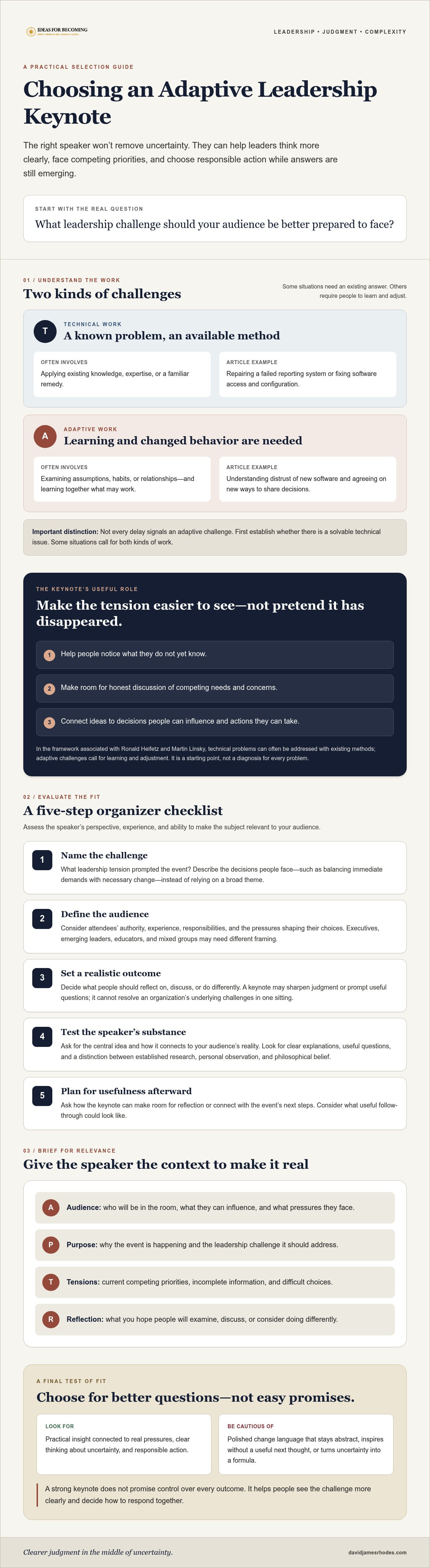
Adaptive leadership is the work of helping people face challenges that cannot be solved by expertise or authority alone. It involves learning, changing behavior, and responding together. It is a practice, not a job title. A leader can hold formal authority and still avoid adaptive work; someone without a senior title can help a group recognize what needs to change.
In the framework associated with Ronald Heifetz and Martin Linsky, technical problems can often be addressed with existing knowledge and methods, while adaptive challenges require people to learn and adjust. This distinction is a starting point, not a diagnosis for every organizational problem. Some situations call for both kinds of work.
How adaptive leadership differs from managing routine change
A familiar technical problem has a known remedy. If a reporting system fails, a qualified team may be able to repair it. An adaptive challenge is different: the answer may depend on changing assumptions, habits, or relationships, and the people affected need to take part in learning what will work.
Illustrative example: A company introduces new software, but teams continue to rely on old processes. Fixing access or correcting a configuration may be technical work. Understanding why people distrust the new system and agreeing on new ways to share decisions may require learning and changed behavior. Not every delay signals an adaptive challenge. First establish whether the cause is a solvable technical issue.
Adaptive leadership does not promise control over every outcome. It asks leaders to notice what they do not know, make room for honest discussion, and help people take responsible action while the answer is still emerging.
Why complexity changes what audiences need from a speaker
Complexity often involves incomplete information, competing needs, and consequences that are hard to predict. Leaders may need to protect near-term performance while making room for change. A speaker cannot remove that tension with a simple formula. A useful keynote helps an audience examine the tension clearly and decide what to do next.
This calls for more than polished change language. Audiences need ideas they can apply: how to listen for concerns, test assumptions, identify who is affected, and act without pretending uncertainty has disappeared. A Speaker on adaptive leadership in a complex world should connect those ideas to decisions the audience faces, rather than suggest that every problem has one elegant answer.
Complexity theory can offer a lens for understanding how actions and relationships interact. The related Complex Adaptive Leadership framework is one academic perspective on leadership as dynamic and distributed, not a universal explanation for every organizational challenge. A speaker’s task is to make the lens useful while leaving room for evidence, context, and human judgment.
How to evaluate a speaker on adaptive leadership
A strong choice begins before you compare biographies or presentation titles. First, define what your audience needs to think about differently. Then assess whether the speaker can address that need with clear ideas, relevant experience, and realistic expectations.
Judge fit by the quality of the questions a speaker helps your audience face, not by promises of easy answers.
A five-step checklist for organizers
- 1. Name the challenge. What leadership tension prompted the event? Describe the decisions people face, such as balancing immediate demands with a necessary change, rather than relying on a broad theme like “leading through change.”
- 2. Define the audience. Executives, emerging leaders, educators, and mixed groups bring different authority, experience, and responsibilities. Consider what attendees can influence and which pressures shape their choices.
- 3. Set a realistic outcome. Decide what you want people to reflect on, discuss, or do differently after the keynote. A talk can sharpen judgment or prompt useful questions. It cannot resolve an organization’s underlying challenges in one sitting.
- 4. Test the speaker’s substance. Ask for the talk’s central idea and how it connects to your audience’s reality. Can the speaker explain complex ideas plainly without turning uncertainty into a formula? Look for a clear distinction between established research, personal observation, and philosophical belief.
- 5. Plan for usefulness after the event. Ask how the keynote will make room for reflection or connect with the event’s next steps. Request examples tailored to the audience’s context, and clarify what attendees can take away without promising specific results.
Match the talk to the audience’s actual challenge
A proposed keynote should address the decisions and tensions people actually carry, not simply repeat the event theme. Share relevant context with the speaker and ask how the talk will speak to it. One presentation cannot solve an audience’s problems, but it can help people see their choices more clearly and consider responsible next steps.
When assessing a Speaker on adaptive leadership in a complex world, notice whether the conversation stays practical without pretending complexity has a neat answer. Does the speaker invite careful listening, honest reflection, and action within the audience’s real limits? Those qualities matter more than an impressive title alone.
For a perspective grounded in leadership, identity, and responsibility, explore David James Rhodes’s keynote speaking and consider whether its themes fit your audience’s needs.
What separates adaptive leadership insight from generic change messaging
Change language can sound persuasive while leaving the hardest questions untouched. Polished delivery and a compelling story may hold attention, but neither alone shows whether a speaker understands adaptive leadership. Look for substance beneath the performance: how the talk treats uncertainty, competing values, learning, and the responsibility people carry when there is no settled answer.
Generic change messaging: Treats change as a challenge to embrace, then offers a confident path forward.
Adaptive leadership substance: Examines who is affected, which values may conflict, what people need to learn, and how leaders can act while outcomes remain uncertain.
Generic change messaging: Presents a success story as a model others can repeat.
Adaptive leadership substance: Makes room for context, trade-offs, and the possibility that another group may need a different response.
This distinction does not mean inspiration has no value. A story can help people see a situation differently. But hindsight can make a difficult choice appear inevitable. A thoughtful speaker explains what was unclear at the time and what the story cannot prove.
Questions that reveal a speaker’s approach to complexity
Use the conversation before booking to understand how the speaker thinks, not just how they present. Ask: “How do you discuss uncertainty without turning hindsight into certainty?” “What should attendees examine or practice after the talk?” “How will you address trade-offs or perspectives that may not agree?” Listen for specific, considered answers. A speaker who acknowledges limits can help an audience think clearly, rather than selling a universal formula.
Evidence, experience, and claims: what to distinguish
Ask what supports the speaker’s claims. Peer-reviewed findings, emerging evidence, contested claims, and personal observation are not interchangeable. A credible speaker identifies the difference instead of presenting every insight with the same certainty.
Experience matters, but it has boundaries. A speaker’s work across countries, industries, or leadership roles can offer valuable context and human perspective. It does not establish that one conclusion applies everywhere. Ask how the speaker adapts examples to different settings and where their experience may not translate.
Be cautious of unsupported statistics, guaranteed outcomes, and claims that suggest a complex system can be changed through one simple intervention. A Speaker on adaptive leadership in a complex world should make ideas accessible without erasing their limits. The useful question is not whether the talk sounds certain. It is whether the speaker helps your audience make better judgments when certainty is unavailable.
How to brief and prepare your audience for an adaptive leadership keynote
A useful keynote begins before the speaker takes the stage. A thoughtful brief gives the speaker enough context to connect leadership ideas to the decisions people face, without scripting the conclusions they must reach. It also helps the audience understand why the conversation matters now.
Build an event brief around real leadership questions
Give the speaker a clear picture of the room and its context. Describe who will attend, what the event is meant to accomplish, and which decisions or tensions are shaping people’s work. “We’re discussing change” offers little direction. “Teams are balancing current commitments with a shift in priorities, and leaders need to hear concerns while making timely decisions” gives the talk a practical focus rooted in people’s experience.
A useful brief can cover:
- Audience: Who will attend, what responsibilities they carry, and how much influence they have over the challenges discussed.
- Purpose: Why the keynote belongs in this event and what reflection it should encourage.
- Relevant tensions: The competing needs, uncertainties, or sensitive boundaries the speaker should understand.
- Format and follow-up: Whether audience participation is expected and how the event will make space for learning afterward.
Be candid about topics that require care. Share context without asking the speaker to endorse a predetermined position or avoid every difficult question. Agree on tone and format in advance. A Speaker on adaptive leadership in a complex world should be prepared to meet the audience’s reality, not simply deliver a fixed message.
Turn the keynote into a conversation that continues
A keynote can prompt reflection. It cannot replace the decisions, conversations, and organizational action that follow. Set that expectation with attendees. The goal is not to leave the room with every problem solved, but to leave with a clearer question and greater readiness to act responsibly.
After the talk, pause for individual reflection, then invite a team conversation. Attendees might consider:
- What responsibility do I have in the situation we discussed?
- What assumption or perspective should I examine more carefully?
- What is one question or action I can bring back to my team?
- Who am I becoming through the way I lead under pressure?
Assess usefulness through relevant follow-up, not inspiration alone. Depending on the event’s purpose, organizers might review whether teams raised new questions, identified a next step, or returned to the topic in later discussions. These are prompts for learning, not proof that one keynote caused organizational change.
If this approach fits your event, learn more about David James Rhodes’s keynote speaking.
When David James Rhodes may be the right speaker for your audience
Choose a speaker for the questions your audience needs to face, not for a broad promise to make uncertainty disappear. David James Rhodes may fit an event examining leadership, identity, and responsibility under pressure, especially when the audience wants to consider not only what leaders do, but who they are becoming through their choices.
The perspective David brings to leadership under pressure
David’s perspective is shaped by more than four decades of experience across 156 countries, spanning international finance, leadership, entrepreneurship, and behavioral health. His work also explores recovery, adversity, and achievement. This experience offers lived context, not scientific proof, and does not mean every lesson applies equally across organizations and cultures.
His work returns to human becoming: how character, judgment, and responsibility shape the way people lead. This perspective may suit audiences considering purpose, leadership, and how to act when outcomes remain uncertain. It may be particularly relevant when an event aims to create thoughtful reflection alongside practical perspective.
Fit has limits. If your event needs technical instruction in a specialized field, a detailed review of a particular organizational intervention, or professional advice outside the keynote’s scope, another specialist may be more appropriate. Being clear about that distinction protects both the audience and the purpose of the event.
Decide whether the keynote fits your event
Before making an inquiry, consider the audience’s responsibilities, the event’s goals, and the questions you want explored. Then compare those needs with David’s perspective on leadership and identity. If your interest extends beyond a keynote to the relationship between personal direction and professional responsibility, his leadership advisory perspective on integrating life and work may offer useful context.
A conversation about fit should be specific. Share who will be in the room, what they are facing, and what you hope they will consider afterward. Ask whether the topic aligns with those needs, and be open to an honest answer if it does not. If the perspective appears relevant, contact David James Rhodes to discuss whether his keynote speaking may suit your event.
Choose a keynote that helps leaders think clearly
The right keynote will not make complexity disappear. It will help leaders examine uncertainty, competing responsibilities, and the choices in front of them. Look for substance beyond polished change messaging, brief the speaker on your audience’s real challenges, and make room for reflection after the event.
A Speaker on adaptive leadership in a complex world should bring perspective without promising easy answers. David James Rhodes’s perspective is shaped by more than four decades across 156 countries and experience spanning leadership, entrepreneurship, behavioral health, and recovery. His keynote work connects leadership with identity and human becoming, including the question of who leaders are becoming through the way they act.
Whether that perspective fits depends on your event’s purpose and your audience’s needs. Share the context, goals, and questions you want explored, then discuss the fit directly. Discuss whether David James Rhodes is the right speaker for your audience.
Uncertainty is part of leadership. A thoughtful conversation can help your people meet it with greater judgment, responsibility, and care.
Frequently Asked Questions
What does an adaptive leadership speaker talk about?
An adaptive leadership speaker helps an audience consider how leaders respond when familiar answers are not enough. A talk may explore uncertainty, learning, responsibility, and the human choices involved in change. The aim is to strengthen reflection and judgment, not to promise that one keynote can solve complex organizational challenges. Organizers can make the talk more relevant by sharing the decisions and tensions their audience faces before the event.
How do I choose a speaker on adaptive leadership?
Start with the audience’s real challenge and what the event can reasonably help people consider or do. Ask the speaker to explain their central idea, how it relates to your audience, and what informs their perspective. Look for practical relevance and careful distinctions between research, emerging evidence, personal observation, and belief. A Speaker on adaptive leadership in a complex world should make the subject accessible without reducing difficult choices to easy answers.
What should I ask an adaptive leadership speaker before hiring them?
Ask how they define adaptive leadership, which audience challenge their talk addresses, and what attendees might reflect on afterward. Explore how they handle uncertainty, competing perspectives, and the limits of their examples. Ask which claims draw on research and which come from personal experience or belief. Specific, thoughtful answers can help you judge whether the speaker’s approach fits your event better than a topic label or polished presentation description alone.
Can a keynote on adaptive leadership help an organization manage change?
A keynote can introduce useful language, prompt reflection, and help people examine how they respond to change. It cannot replace organizational decisions, sustained leadership, or the work required to put change into practice. Before hiring a speaker, clarify what the event can realistically accomplish. Consider how leaders will continue the conversation afterward, such as inviting teams to identify a relevant question, discuss a trade-off, or agree on a next step.
How is adaptive leadership different from change management?
Change management often focuses on planning and carrying out a defined organizational change. Adaptive leadership addresses challenges where the answer may not be known in advance and people may need to learn or change how they work. The ideas can overlap. Ask a prospective speaker how they distinguish the terms and what that distinction means for your audience. Their answer should connect the concepts to the decisions attendees actually face.
How much does it cost to hire an adaptive leadership speaker?
There is no one standard fee for every speaker or engagement. Cost may depend on the speaker and the event’s format, preparation needs, and other details. Rather than relying on a general topic category or marketplace listing, share your event goals, audience, timing, and format when you inquire. Confirm current availability and engagement information directly with the speaker or their representative before making plans.
What makes David James Rhodes relevant to adaptive leadership?
David James Rhodes brings a perspective shaped by more than four decades of experience across 156 countries, including international finance, leadership, entrepreneurship, and behavioral health. His work explores identity, character, leadership, and human becoming. That background offers lived perspective, not scientific proof or a claim that one approach fits every organization. Consider whether his focus aligns with your audience’s questions, the event’s purpose, and the reflection you hope to encourage.
Frequently Asked Questions
Related Articles

Guiding the Next Generation: How to Lead Without Defining Who They Become
Learn practical ways for guiding the next generation without control. Support youth agency, set clear boundaries, and honor who they are truly becoming.

The Way: A Guide to the Process of Human Becoming
David James Rhodes's human becoming book, The Way, reframes growth as a process, not a destination. Releasing September 15, 2026.

Emerging Leader Advisory: How to Choose Guidance That Builds Judgment
Discover how emerging leader advisory builds judgment, not just checklists. Learn to choose practical guidance that shapes who you are becoming as a leader.