
A young person’s future is not an adult’s project to complete. Yet guiding the next generation can feel like a choice between steering every decision and stepping back too soon. Young people may face pressure to choose a path and identity before they’ve had room to learn what fits.
Adults have a real role to play. Experience can help make risks visible, and clear boundaries can make exploration safer. But advice becomes control when it leaves no room to think, choose, or learn from consequences. Silence can leave a young person carrying uncertainty alone.
This article offers parents, educators, mentors, and leaders practical ways to support young people while respecting their agency. You’ll learn how to distinguish guidance from control or withdrawal, hold useful conversations, set boundaries, and help young people develop judgment without treating who they are today as their final answer. This connects with Human Becoming, the central idea in David James Rhodes’s work and his book The Way. The idea is that identity is not assigned by someone else; it continues to take shape through choice, responsibility, and time.
Key Takeaways
- Offer direction through presence, honest perspective, and clear boundaries, while leaving room for a young person to make considered choices.
- In guiding the next generation, treat agency as meaningful participation in decisions, not freedom from adult care or consequences.
- Notice when support becomes control, rescue, or withdrawal, and choose a response that preserves both responsibility and connection.
- For uncertain choices, use a practical sequence: listen, clarify the decision, share your perspective, and agree on a next action.
- Help young people grow without assigning them a finished identity. Human Becoming keeps the focus on who they are becoming.
What Does Guiding the Next Generation Mean When Their Future Is Unwritten?
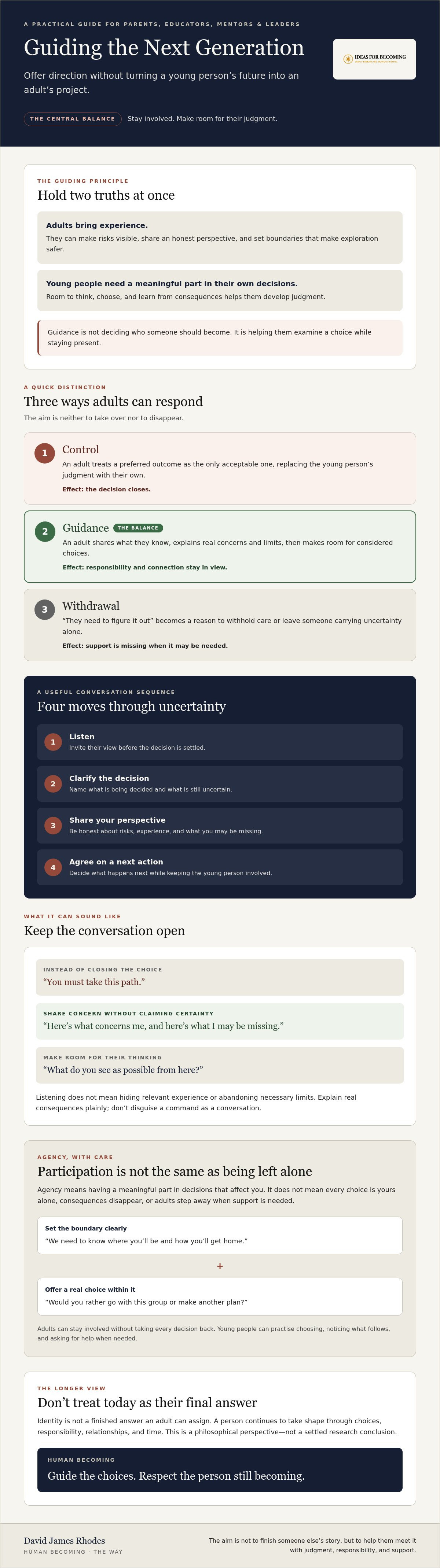
An adult may see a risk before a young person does. That experience matters, as does the young person’s right to make choices that belong to them. Guiding the next generation means holding both truths: offer direction without turning your hopes, fears, or past into a script for someone else’s life.
Guidance means being present, setting useful boundaries, sharing an honest perspective, and making room for considered choices. It is not control, where an adult treats a preferred outcome as the only acceptable one. It is not passive noninvolvement, where “they need to figure it out” becomes a reason to withhold care. And it is not pressure to meet inherited expectations simply because a family, school, or community has always valued a particular path.
Advice can clarify options without becoming a requirement. A parent might explain why a decision seems risky, then ask, “What do you see as possible from here?” Listening doesn’t mean hiding relevant experience or abandoning necessary limits. It means sharing what you know while leaving room for the young person to think. If a choice carries real consequences, explain them plainly. Don’t disguise a command as a conversation.
How is guidance different from deciding someone’s future?
Deciding someone’s future replaces their judgment with yours. Guidance helps them examine a choice and understand what may follow. The difference can be heard in the language: “You must take this path” closes a decision; “Here’s what concerns me, and here’s what I may be missing” keeps it open. The adult remains honest and involved without claiming certainty about who the young person should become.
Who has a role in guiding young people?
Parents may provide care and set boundaries. Educators can offer learning and perspective; mentors can share experience in a formal or informal relationship, as described in this overview of youth mentoring. Institutional leaders shape the conditions young people encounter. These roles differ, and no one adult can provide every kind of support. Authority carries responsibility: use expertise to clarify, not to make a young person’s choices on their behalf.
Identity is not a finished answer adults can assign. The view that a person continues to become through decisions and relationships is a philosophical perspective, not a settled research conclusion. David James Rhodes calls this idea Human Becoming. It invites adults to guide without treating a young person’s uncertainty as a defect or their future as already decided.
Why Agency, Belonging, and Responsibility Matter in Guiding the Next Generation
Young people need room to make choices, while adults remain responsible for the care and limits around them. These truths are not in conflict. Agency means a young person has a meaningful part in decisions that affect them. It doesn’t mean every choice is theirs alone, that consequences disappear, or that adults step away when support is needed.
In practice, an adult might set a clear boundary while offering choices within it: “We need to know where you’ll be and how you’ll get home. Would you rather go with this group or make another plan?” The limit is real, and so is the young person’s participation. The ASCD discussion of the practice of student agency offers an education-focused perspective on giving students a more active role in learning. It can inform how adults think about participation, but it shouldn’t be treated as proof that one approach guarantees a particular outcome.
What does young people’s agency look like in practice?
It starts with asking for a young person’s view before a decision is settled. A teacher might invite students to help shape how they demonstrate learning; a parent might discuss a change in routine and ask what feels workable. Adults should also name what isn’t negotiable and explain why. Agency isn’t a milestone reached once or a timetable every young person follows. It grows through opportunities to take part, with support suited to the decision and the person.
Responsibility belongs in that process. Young people can practise making choices, noticing what follows, and asking for help when needed. Adults don’t have to prevent every mistake to remain caring. Nor should they leave someone alone with consequences they aren’t ready to manage. The task is to stay involved without taking every decision back.
How can belonging coexist with difference?
Belonging means being treated as someone whose presence and perspective matter. It shouldn’t depend on matching an adult’s beliefs, preferences, or plans. A young person may disagree, change direction, or make a choice an adult wouldn’t make. The relationship can remain intact even when the decision is challenged.
Accepting a person doesn’t mean approving every action. An adult can say, “I care about you, and I don’t support this choice. Let’s talk about what happens next.” That distinction keeps connection from becoming a reward for compliance. It also makes room for honest disagreement without pretending the adult has no responsibility.
This is a practical tension in guiding the next generation: offer enough structure for safety and enough respect for young people to develop judgment. David James Rhodes’s perspective is shaped by experience, not presented as developmental research. A useful question for adults is specific: where can this young person have a real say, and where must I hold a clear boundary?
How Can Adults Guide Without Controlling a Young Person’s Choices?
Adults can care deeply and still take up too much space. Anxiety about a young person’s future may show up as repeated advice, decisions made on their behalf, or rescue from every difficult consequence. At the other extreme, an adult may withdraw and call it independence. Guiding the next generation calls for a steadier response: remain present, be honest about what concerns you, and leave choices open where it’s reasonable.
Adult behavior: Insisting on one acceptable choice.
Underlying message: “My judgment must replace yours.”
More respectful alternative: Explain your concern and ask how the young person sees the options.
Adult behavior: Taking over to prevent discomfort or failure.
Underlying message: “You can’t manage this without me.”
More respectful alternative: Ask what support is wanted, then help without removing appropriate responsibility.
Adult behavior: Offering no perspective or limits.
Underlying message: “You’re on your own.”
More respectful alternative: Stay available and make clear which boundaries still apply.
Adult behavior: Listening, sharing relevant experience, and holding necessary limits.
Underlying message: “You have a voice, and I remain responsible for my part.”
More respectful alternative: Agree on what the young person can decide and where adult involvement is needed.
When does helpful advice become pressure?
Advice can become pressure when it’s repeated after the young person has understood it, when affection or approval seems conditional on agreement, or when adult anxiety becomes the young person’s burden. Pause before adding another warning. When circumstances allow, ask, “Would it help to hear what I think?” If they say yes, speak plainly: “I’m concerned this option may close off others. I can’t know your whole future, but we can look at the next step together.”
Sometimes a question helps more than advice. Sometimes attentive silence gives a young person space to finish a thought they’re still forming. Neither requires adults to pretend they have no experience. The useful judgment is whether your words will clarify the choice or simply repeat your fear.
How can adults hold boundaries without taking over?
Separate limits needed for safety or care from preferences that can remain open. Explain the reason for a firm boundary, then name what’s negotiable. “I need to know how you’ll get home. You can choose the plan, and we’ll check that it’s safe.” That differs from treating every disagreement as a threat to adult authority.
If a situation exceeds your role or competence, don’t improvise certainty. Stay connected and help the young person reach an appropriate professional or trusted source of support. Being present doesn’t mean being the only person who can help.
A Practical Framework for Guiding the Next Generation Through Uncertainty
A young person considering an unfamiliar opportunity may need more than reassurance or a quick answer. They may need help understanding the choice without having it made for them. This four-step conversation gives adults a practical way to stay useful without taking over.
- Listen. Start with what the young person is thinking, not with your conclusion. Ask, “What matters most to you about this?” or “What feels uncertain?” Then give them time to answer.
- Clarify the choice. Name the decision in concrete terms. Is the young person deciding whether to apply, accept, try something for a limited period, or gather more information? Ask what they already know and what they still need to find out.
- Share perspective. Ask whether they want your thoughts. If they do, offer relevant experience and state your concerns without claiming to know exactly how their future will unfold.
- Agree on a next action. Choose a manageable step together, such as speaking with someone who knows the opportunity, checking a commitment, or setting a time to revisit the decision. Be clear about who will do what.
Suppose a student is weighing an unfamiliar program. Before listing every risk, ask what draws them to it, what they’re unsure about, and what information they still need. You might say, “I can help you think through the practical questions. Would you like my perspective now, or would you rather talk through what you know first?” This makes room for the student’s thinking without requiring you to hide yours.
What should an adult ask before offering direction?
Keep questions curious and specific, not so numerous that they feel like an examination. Try: “What matters most in this choice?” “What’s the part you’re least certain about?” “What information would help?” Then ask what kind of support they want. They may need advice, help finding information, or simply a listener. When guiding the next generation, a useful first response may be to wait and hear the whole concern.
Follow through on what you promised. Revisit the decision when agreed, even if the young person chooses differently than you hoped. If the choice goes badly, separate accountability from shame: name what happened, consider what can be repaired, and identify the next practical step. A setback doesn’t have to produce a lesson on demand. It may simply require attention, support, and time.
If wellbeing or safety concerns exceed ordinary mentoring, help connect the young person with appropriate professional support. Adults don’t need to manage every situation alone. Before giving direction, check yourself: whose fear is shaping this conversation? Whose values? What outcome am I trying to secure?
For more on David James Rhodes’s perspective on becoming through choice and responsibility, explore his work on Human Becoming.
From Guiding the Next Generation to Human Becoming
Adults can offer direction without deciding who a young person must become. That is the thread running through this approach. Guidance can help someone see choices more clearly, understand the responsibilities involved, and take a next step. It cannot provide a finished identity or guarantee a particular outcome.
What does Human Becoming add to adult guidance?
Human Becoming is David James Rhodes’s philosophical perspective: identity is not a fixed destination, but something that continues to take shape. This is a way of thinking about life, not a clinical method or a research conclusion. Applied to adult guidance, it shifts attention toward the quality of the relationship and the choices being made, rather than a label or final answer.
Adults can practise that perspective in ordinary moments. Pay attention before responding. Be honest about what you know and what you don’t. Take responsibility for the limits you set. Respect a young person’s agency, even when you would choose differently. These actions won’t determine who the young person becomes. They can make room for that person to think, act, and keep learning.
The question at the heart of David’s work is “Who are you becoming?” It applies to the adult, too. A parent, educator, mentor, or leader is not merely delivering advice. They are showing through their conduct how authority can be exercised. Do they make room for another person’s judgment? Can they remain connected through disagreement? Their example is part of the guidance.
Where can readers continue exploring this perspective?
David develops this philosophy in The Way, a book centered on the idea that the way is not something you find; it is someone you become. It was released on September 15, 2026. Readers interested in the connection between this philosophy and leadership may also explore his perspective on resilience in young leaders. David’s education and next-generation advisory is another relevant option for educational institutions and young leaders seeking support.
If this way of thinking speaks to you, explore The Way as a philosophical resource for reflecting on choice, responsibility, and becoming. Guiding the next generation does not mean naming their destination. It means offering care and perspective while allowing their lives to remain their own.
Offer Direction, Leave the Future Open
Guiding the next generation means staying present without treating a young person’s future as yours to decide. Listen before advising. Make boundaries clear, explain what remains open, and involve young people in choices that affect them. Agency is not abandonment; adults can remain responsible while young people practise judgment and responsibility.
When uncertainty surfaces, begin by listening. Clarify the decision, ask what support would help, share your perspective honestly, and agree on a next step. If things go badly, address what happened without turning a mistake into a verdict on who the young person is.
David James Rhodes is an author, global executive, entrepreneur, and advisor. His perspective is shaped by more than four decades of experience across 156 countries, and centers on Human Becoming: identity is not a fixed destination. The Way, released September 15, 2026, develops this philosophy. Explore The Way and David’s perspective on Human Becoming if you’d like to consider it further.
The future cannot be written in advance. But an adult can offer care, honesty, and room to choose. That is meaningful guidance, and a good place to begin.
Frequently Asked Questions
How do you guide the next generation without controlling them?
Begin by listening to what the young person understands and wants. Ask what kind of support would help, then offer relevant perspective without treating your preference as the only acceptable outcome. Keep necessary boundaries clear and explain their purpose. Leave room for choices where possible. Good guidance means remaining present while a young person develops judgment. It doesn’t mean withdrawing care or promising that a particular decision will lead to a particular result.
What is the difference between guiding and mentoring young people?
The terms overlap, but their meaning depends on context. Guiding can describe everyday support from parents, educators, or other adults. Mentoring usually refers to a more intentional relationship in which someone shares perspective and supports another person’s development. Neither role gives an adult ownership of a young person’s decisions. Be clear about what support you can offer, respect appropriate professional boundaries, and remember that no single approach suits every young person.
Can young people make their own decisions while still receiving adult guidance?
Yes. Adults can help young people understand options, consequences, and missing information while leaving appropriate decisions to them. Some limits may remain necessary, especially where safety, legal responsibilities, or institutional rules apply. Check the relevant requirements rather than assuming them. The distinction is between providing structure and taking over. Even when an adult must retain responsibility for a decision, the young person can still be heard and involved where appropriate.
How can parents and educators help young people find purpose?
Make room for reflection, introduce possibilities, and take a young person’s interests seriously without insisting on one permanent calling. Purpose can change with experience. Ask what feels meaningful now, what responsibilities matter to them, and what small step could provide useful experience. Treat these questions as invitations, not a formula. Uncertainty isn’t proof of failure, and one conversation can’t guarantee a lasting answer about who someone should become.
What should adults do when a young person rejects their advice?
Don’t assume disagreement is disrespect. Ask what they heard, what they’re weighing, and whether they want to explain their reasoning. State any genuine safety or role-based boundary plainly. If the decision is theirs to make, allow them to decide and remain available for later reflection. If serious wellbeing or safety concerns arise, don’t try to manage beyond your competence. Help involve an appropriately qualified professional.
Why is young people’s agency important when guiding the next generation?
Agency gives young people a meaningful part in choices that affect them. It doesn’t mean independence without support, and it doesn’t remove adult responsibility. In practice, adults can explain limits, share clear information, and involve young people in decisions where appropriate. These are practical principles, not a guarantee of specific developmental outcomes. Claims about such outcomes should be supported by suitable research and kept distinct from philosophical perspectives on growth and identity.
Frequently Asked Questions
Related Articles

Emerging Leader Advisory: How to Choose Guidance That Builds Judgment
Discover how emerging leader advisory builds judgment, not just checklists. Learn to choose practical guidance that shapes who you are becoming as a leader.

Speaker on the Journey of Personal Reinvention: A Guide to Choosing the Right Voice
Hire a speaker on the journey of personal reinvention who offers honest perspective over easy hype. Learn how to choose the right keynote for your event.
Educational Leadership Consulting: Choose Support That Develops Leaders
Educational leadership consulting should connect strategy with the people doing the work. Learn practical ways to assess advisors and choose support that fits.