
A promotion can give you authority before it gives you judgment. Emerging leader advisory should help close that gap, not simply add another list of skills to your calendar.
You may already know that leadership requires communication, delegation, and sound decisions. The harder question is how to develop those abilities in a way that fits you, especially when generic training doesn’t address the pressure or uncertainty behind a new role.
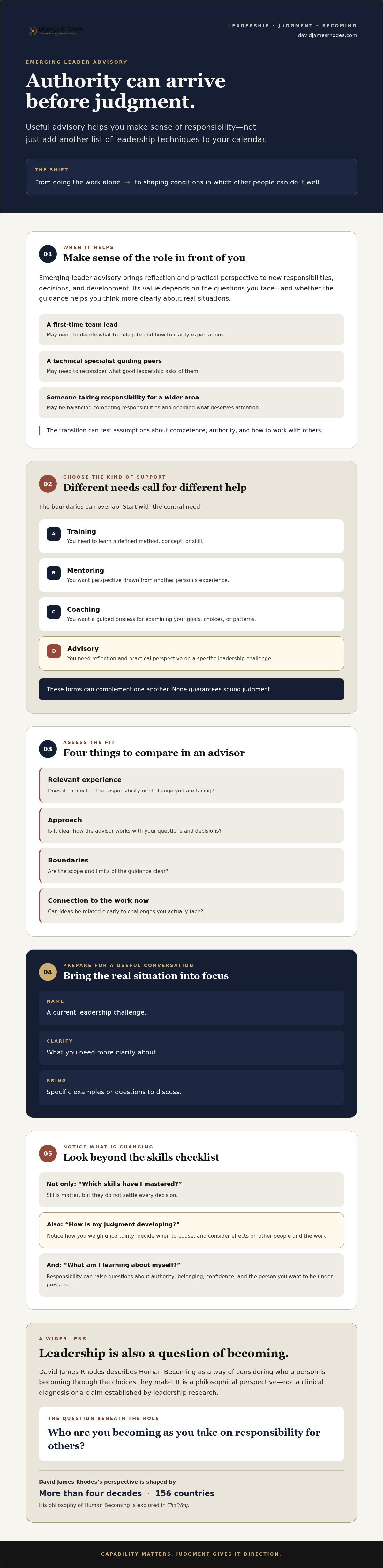
This article explains what useful advisory can and cannot offer, how it differs from coaching, mentoring, and training, and what to look for when assessing an advisor. You’ll find practical criteria for judging fit, plus signs of growth that go beyond a checklist of competencies.
Those practical questions point to a deeper one: who are you becoming as you take on responsibility for others? David James Rhodes’s work on Human Becoming is shaped by more than four decades of experience across 156 countries. His book The Way explores this philosophy. Here, the focus is narrower and immediate: choosing guidance that can strengthen your judgment while keeping identity and character in view.
Key Takeaways
- Useful emerging leader advisory helps you interpret responsibility and decisions, not just collect leadership techniques.
- Compare advisors by relevant experience, approach, boundaries, and how clearly they connect ideas to challenges you face now.
- Prepare by naming a current leadership challenge, the clarity you need, and specific examples or questions to discuss.
- Look for growth in the judgment and self-understanding behind your actions, not only in a list of skills mastered.
- David James Rhodes’s perspective draws on more than four decades of experience across 156 countries. His philosophy of Human Becoming is explored in The Way.
What Is Emerging Leader Advisory, and When Does It Help?
Emerging leader advisory is guidance that helps a person interpret new responsibilities, weigh decisions, and consider how to develop in a leadership role. It has no single universal format. Its value depends on the questions the leader faces and whether the guidance helps them think more clearly about real situations.
Leadership development broadly concerns building capacity for leadership roles. Leadership development offers a foundational overview of that wider idea. Advisory is one possible form of support, with an emphasis on reflection and practical perspective rather than a standard curriculum alone.
A promotion can change the work before confidence catches up. Decisions now affect colleagues, priorities, and shared outcomes. Someone valued for solving problems personally may need to delegate instead. Giving difficult feedback, deciding what deserves attention, and balancing competing responsibilities can all test assumptions about what good leadership requires.
The transition is different for everyone. A first-time team lead, a technical specialist guiding peers, and someone taking responsibility for a wider area may face distinct demands. Advisory can help when a person needs to make sense of those demands, examine a decision, or recognize where an old way of working no longer serves the role.
What changes when someone becomes an emerging leader?
The shift is from doing the work alone to shaping conditions in which other people can do it well. That can mean deciding what to delegate, clarifying expectations, responding when work falls short, or making room for a team priority alongside individual responsibilities. The challenge is practical, but it can also unsettle a person’s ideas about competence and authority.
How advisory differs from training, mentoring, and coaching
Training provides structured learning, such as concepts or methods for a defined area. It can support development, but may not address every live dilemma. Mentoring often draws on another person’s experience, though its focus and format vary. Coaching commonly supports a person in examining goals, choices, or patterns through a guided process. Approaches differ between practitioners.
Advisory, as used here, means bringing reflection and practical perspective to the responsibilities and decisions in front of a leader. The boundaries between these forms can overlap. A useful distinction is the central need: learning a method, hearing from someone with relevant experience, exploring your own thinking, or gaining perspective on a specific leadership challenge. These forms can complement one another, but none guarantees sound judgment.
The Work Beneath Leadership Skills: Judgment, Identity, and Responsibility
A change in role can alter more than a person’s calendar. It can unsettle assumptions about authority, belonging, and success. A leader may wonder whether setting a firm direction will cost the trust of former peers, or whether asking for help will be seen as weakness. These questions don’t arise for everyone, and they aren’t signs of failure. They are part of learning what responsibility now asks of you.
Leadership judgment is the practice of making decisions amid responsibility and uncertainty, while considering their effects on other people and the work. Skills matter, but judgment also involves deciding which skill to use, when to pause, and what consequences you’re prepared to own. An overview of essential skills for emerging leaders can help identify capabilities worth developing. It can’t settle the personal choices each leader must make in context.
Why identity can shift when responsibility grows
Holding a leadership role is not the same as becoming accountable for its effects. The title may arrive before a person has worked out how they want to use authority, what obligations they owe their team, or how to remain themselves under pressure. For some, this is a quiet adjustment. For others, it brings sharper questions about confidence and belonging.
David James Rhodes describes his larger philosophy as Human Becoming, a way of considering who a person is becoming through the choices they make. This is a philosophical perspective, not a clinical diagnosis or a claim established by leadership research. It brings attention to character alongside capability. What kind of person do your decisions ask you to become?
Turning reflection into decisions at work
Consider a difficult conversation with a colleague whose work has missed an important expectation. Before speaking, a leader might separate what they know from what they’re assuming, clarify the outcome the work requires, and consider what they need to hear from the colleague. Reflection is useful when it informs the next action.
That action might mean listening without avoiding the issue, setting a clear direction, or acknowledging where expectations were not made clear. It might also mean accepting responsibility for a decision after its consequences become visible. None of these steps guarantees a particular performance result. They make the leader’s choices more deliberate and open to examination.
David’s thinking draws on experience across leadership and other fields, but experience is not scientific proof. For a deeper account of the question beneath capability, explore David James Rhodes’s writing on Human Becoming.
How to Compare Emerging Leader Advisory Options
The right guidance is not necessarily the option with the most impressive language or the longest list of credentials. Start with the leadership need in front of you. Advisory is a fit when its purpose, experience, approach, and boundaries match a real decision or responsibility you need to work through.
Use these questions to compare options. The answers should help you understand what the relationship is meant to support, not promise what it will deliver.
- Purpose: What kind of leadership transition or challenge is the advisor equipped to discuss? Is it close to your current need?
- Relevant experience: What experience informs the advisor’s perspective? Ask how it relates to your role or context. A credential alone does not guarantee fit or results.
- Working approach: How will discussion connect to responsibilities and decisions you face now? Ask how broad ideas might apply when you need to set direction or address a difficult choice.
- Boundaries: What does the service include, and what does it not provide? Clarify whether it is advisory, training, mentoring, or another form of support. It isn’t a substitute for therapy or treatment when those are needed.
- Practical fit: Can you understand the format, expectations, availability, and terms before deciding? Confirm these details directly.
Questions to ask before choosing an advisor
Ask for a clear account of the leadership transitions the advisor can speak to. Then bring a current responsibility or decision into the conversation: “How would your approach help me think this through?” You’re not asking for a guaranteed answer. You’re checking whether the guidance can meet the reality of your work.
Also ask how you can raise concerns if the approach feels unhelpful, and what support falls outside its scope. Clear boundaries are a sign of care, not a lack of ambition.
Signs the approach may fit, or may not
A promising fit makes the purpose and expectations understandable. The advisor respects your agency, invites questions, and helps you examine choices rather than presenting ready-made answers for every situation. Credentials and personal connection both matter, but neither guarantees a particular outcome.
Be cautious if the scope remains vague, if you feel pressured to accept claims you can’t assess, or if abstract ideas never return to the decisions you face. Before committing, verify the format, availability, and terms directly. Useful emerging leader advisory should make your next step clearer while leaving the responsibility for choosing it with you.
A Practical Way to Prepare for Emerging Leader Advisory
You don’t need a polished account of your leadership or a perfect question before speaking with an advisor. A little preparation can make the conversation more specific, help protect what matters, and let you assess whether the guidance is useful. Try this sequence.
- 1. Choose one real challenge. Name a current decision or relationship issue with meaningful consequences. It might involve a priority you need to set, a responsibility you’re considering delegating, or a conversation you’ve been postponing.
- 2. Sort what you know. Write down the observable facts, the assumptions you may be making, and the questions that remain unanswered. This keeps the discussion grounded without pretending you already know the right answer.
- 3. Prepare a discreet example. Note what happened, what you did, and what you’re weighing now. Leave out names and identifying workplace or personal details unless you have permission to share them. You can explain the situation without exposing someone else’s confidence.
- 4. Define the clarity you want. Rather than seeking a guaranteed result, name what you hope to understand or decide. For example: “I want to see the trade-offs more clearly,” or “I need to decide how to set an expectation and listen to the other person’s perspective.”
- 5. Consider how you want to be challenged. Do you value direct questions, a different point of view, or time to reflect before deciding? Share what helps you think well, while staying open to an approach that may not simply confirm your first instinct.
Then make room for a quieter question: which responsibility do you want to carry differently? Perhaps you want to be clearer without becoming harsh, or more willing to share responsibility instead of taking every problem back into your own hands. This isn’t a promise of change. It’s a way to bring your intentions into view alongside the immediate decision.
For another perspective on how leadership connects with the wider shape of work and life, read leadership advisory and the integration of life and work.
Preparation won’t tell you whether every advisor is right for you. It can help you ask better questions and judge whether the discussion meets the challenge you brought. To learn more about David James Rhodes’s work, explore David’s leadership and life advisory.
David James Rhodes’s Emerging Leader Advisory and the Way of Becoming
Choosing an advisor means choosing a perspective, not handing over responsibility for your decisions. David James Rhodes is an author, global executive, entrepreneur, and speaker whose work spans leadership, international finance, entrepreneurship, and behavioral health. His experience extends across more than four decades and 156 countries. That history informs his perspective; it is not scientific proof and does not guarantee a particular result for any leader.
Advisory shaped by leadership, life, and the next generation
David’s advisory work focuses on leadership, life, and the next generation. For an emerging leader, those concerns can meet in ordinary but consequential choices: how to use authority, what responsibilities to accept, and how personal values shape decisions at work. His perspective is informed by varied experience, but the questions and choices remain your own. Useful guidance should help you think more clearly, not replace your judgment.
This is one way to understand emerging leader advisory in David’s work: attention to the demands of a role alongside the person growing into it. The practical question remains central. Does the conversation help you examine a real responsibility and choose how to meet it?
The Way as a philosophy for becoming
David’s broader philosophy is Human Becoming, a way of asking who a person is becoming through the choices they make. The Way gives that philosophy its clearest expression: the way is not something you find. It is someone you become. This is a philosophical lens, not a formula that removes uncertainty or decides for you.
The Way is the philosophy. 365 Days of Becoming is the daily practice. The distinction matters: one offers a way to think about becoming, while the other speaks to returning to that work in daily life. For a closer look at the book’s perspective, read The Way book and its perspective on finding a path.
Released on September 15, 2026, The Way is available for readers who want to explore the philosophy behind David’s work. If you’re weighing guidance now, begin with the leadership challenge you need to face and the kind of person you want to be while facing it. Then explore the book as a deeper inquiry into the question beneath every role: who are you becoming?
Choose Guidance That Helps You Lead Deliberately
Useful emerging leader advisory begins with a real responsibility, not a promise of instant confidence. The right guidance helps you examine decisions in context, clarify what you need, and strengthen judgment without taking away your agency. Credentials matter, but so do clear boundaries, relevant experience, and an approach that fits your needs.
Leadership also asks something beyond competence. It asks how you will use authority and what kind of person you are becoming through the choices you make. David James Rhodes brings a perspective shaped by more than four decades of experience across leadership and related fields, in 156 countries. That experience informs his work, but it doesn’t guarantee a particular outcome.
If you’re ready to explore whether his perspective speaks to your current questions, explore David James Rhodes’s leadership and life advisory. Bring the real decision, ask clear questions, and choose guidance that helps you meet responsibility thoughtfully. The role may be new. Your capacity to grow into it is still unfolding.
Frequently Asked Questions
What is emerging leader advisory?
Emerging leader advisory is guidance that helps a person interpret new leadership responsibilities, consider decisions, and reflect on development. Approaches vary by advisor, purpose, and working relationship. It may offer perspective, questions, or practical reflection around current challenges. It isn’t a universal program, nor does it guarantee confidence, improved performance, or a particular decision. Start by naming the responsibility or choice you want help thinking through.
How is emerging leader advisory different from executive coaching?
Emerging leader advisory and executive coaching can overlap, but their names alone don’t tell you exactly what happens. Advisory may emphasize practical perspective on responsibilities and decisions. Executive coaching may use a guided process to explore goals, choices, or patterns. Methods and boundaries vary by provider. Ask what the service involves, who it is intended for, and how it connects to your needs rather than assuming the label defines the work.
Who can benefit from emerging leader advisory?
People facing a change in responsibility may find advisory useful, whether they’re leading former peers, taking responsibility for shared work, or learning to make decisions that affect others. A formal title or seniority level doesn’t determine fit. Ask whether you have a leadership challenge you want to examine and whether an advisor’s experience and approach are relevant to that situation. Needs differ across roles and workplaces.
What should I ask an emerging leader advisor before working together?
Ask what the service covers, what it doesn’t, and what leadership transitions the advisor is equipped to discuss. Find out what experience informs their perspective and how conversations connect to decisions you face now. Clarify expectations, format, availability, and terms directly. Ask how you can raise concerns if the approach doesn’t feel useful. Clear answers help you assess fit. Credentials or personal rapport alone can’t guarantee an outcome.
How long does emerging leader advisory take?
There’s no single duration that applies to every advisory relationship. The time involved depends on what you hope to clarify, the questions that emerge, and the advisor’s format. Some needs may be focused, while others involve ongoing development. Don’t assume either without checking. Before deciding, ask what timeframe the advisor proposes, how it relates to your goals, and whether you can review expectations as your responsibilities or priorities change.
Can emerging leader advisory help with a difficult leadership decision?
It can offer space to examine a difficult decision, test assumptions, consider who may be affected, and clarify what information is still missing. For example, you might weigh how to set an expectation while remaining open to a colleague’s perspective. An advisor can bring questions or practical perspective, but can’t guarantee the right answer or a particular result. The decision and its consequences remain yours to consider.
What is the connection between Human Becoming and leadership?
Human Becoming is David James Rhodes’s philosophical perspective on growth, identity, and the person shaped by everyday choices. Applied to leadership, it invites attention not only to what a leader can do, but to how they use responsibility and authority. It isn’t a clinical framework or established scientific finding. In The Way, David develops the idea that the way is not something you find; it is someone you become.
Frequently Asked Questions
Related Articles

Speaker on the Journey of Personal Reinvention: A Guide to Choosing the Right Voice
Hire a speaker on the journey of personal reinvention who offers honest perspective over easy hype. Learn how to choose the right keynote for your event.

Educational Leadership Consulting: Choose Support That Develops Leaders
Educational leadership consulting should connect strategy with the people doing the work. Learn practical ways to assess advisors and choose support that fits.

Books on Leadership Principles and Core Values: Essential Reading for Genuine Character
Discover books on leadership principles and core values that bypass corporate jargon to build authentic character and shape who you are becoming as a leader.