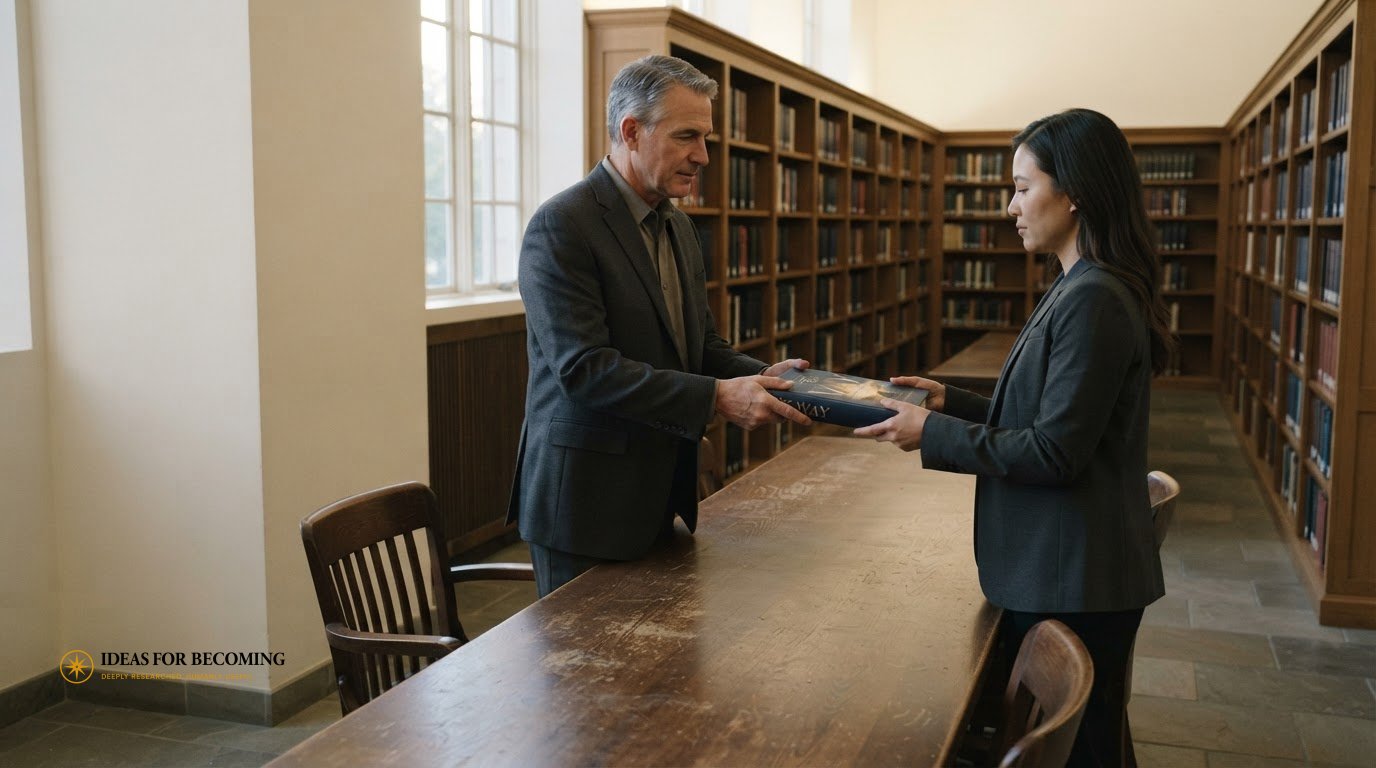
A title can be handed over. The example behind it cannot. Executive guidance on building a lasting legacy begins with the choices people see every day: how a leader takes responsibility, learns from mistakes, and makes room for others to lead.
It’s natural to think of legacy as something measured at the end of a career. But succession, trust, and the habits that shape an organization are built much earlier, through ordinary decisions repeated over time. This article sets out practical ways to make that work intentional: model accountability, prepare successors through shared responsibility and knowledge, clarify the purpose guiding your leadership, build trust through consistent actions, and help others grow beyond your tenure. The aim isn’t to control how the future remembers you. It’s to leave people better equipped to shape it.
Key Takeaways
- Model accountability by owning decisions, acknowledging mistakes, and showing how to learn from them.
- Prepare a successor through shared work and deliberate transfer of knowledge, responsibility, and trust.
- Clarify the purpose behind your leadership early, then use it to guide priorities and choices.
- Build a durable legacy through fair decisions, meaningful relationships, and attention to others’ growth.
- Measure your impact by what future leaders are equipped to continue, not only by what you achieve yourself.
1. Modeling accountability and learning from mistakes
Common risks include hiding mistakes, shifting blame, and asking teams to follow values that leaders ignore. These choices weaken trust and discourage honest discussion. A leader who takes credit for shared success but blames employees for setbacks teaches people to protect themselves rather than improve the work.
Start with a clear account of the decision. Name what happened, explain your part, and describe the next corrective step. For example, if a launch misses its target because you approved an incomplete plan, say so directly. Then invite the team to identify what the process missed. Accountability becomes credible when it changes the next decision.
Make learning visible in everyday leadership. After a difficult project, hold a short review: what worked, what failed, and what should change next time? Distinguish a reasonable experiment from repeated neglect of agreed responsibilities. This lets people learn from mistakes without treating every outcome as acceptable. Leaders who act on their own feedback demonstrate humility and integrity.
Values matter most when pressure makes them inconvenient. Define responsibilities and expectations for leadership roles, then use relevant performance indicators to clarify ownership. Give constructive feedback tied to specific actions, not judgments about character. A manager who misses a commitment needs a direct conversation about its impact and a clear plan to repair it. Consistency helps teams understand that standards apply to leaders, too.
Build reflection into a routine. Spend 15 minutes each day reviewing a decision, its effect on others, and what you would change. Revisit personal values yearly, then compare them with how your calendar and choices reflect them. Julia Dhar surveyed 70 former CEOs, C-suite executives, and board chairs about their biggest regrets. That kind of reflection can help leaders examine what their decisions may leave behind.
Peer learning can make that examination more candid. A small group of executives can bring one difficult decision to each meeting, describe its consequences, and ask peers what they may be overlooking. Alumni networks offer another place to exchange lessons across industries and career stages. Wharton’s alumni network includes more than 100,000 alumni, illustrating the scale such communities can reach. The value lies in thoughtful exchange, not access alone.
Learning together also develops talent across generations. Invite employees to challenge assumptions, contribute ideas, and test solutions within clear responsibilities. Recognize specific contributions, then explain what the team learned from the result. This gives people room to grow while keeping accountability visible. A leader’s example sets the terms: mistakes can become lessons, but only when someone owns the decision and acts on what it reveals.
2. Preparing a successor and transferring knowledge
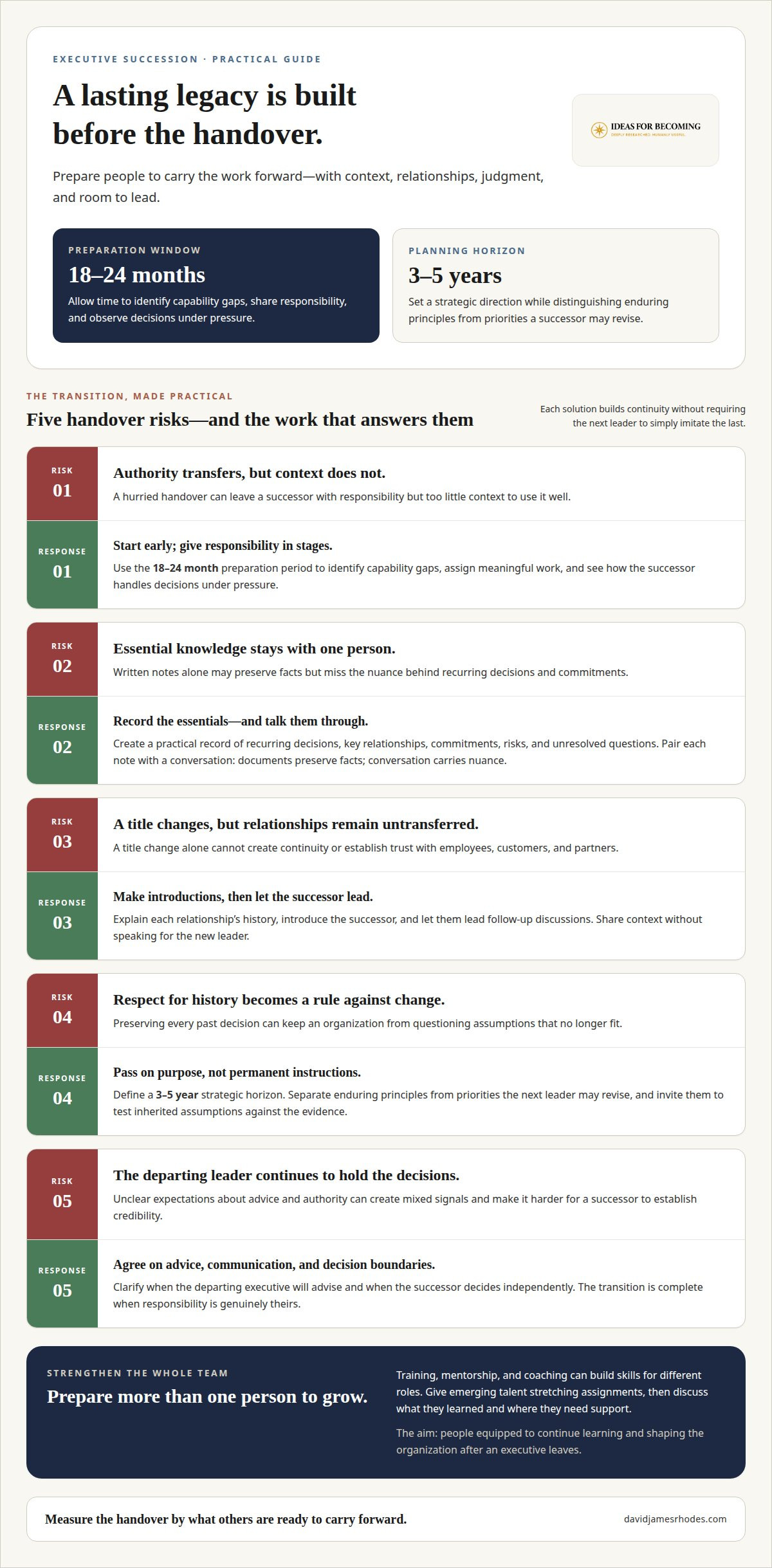
Executive guidance on building a lasting legacy starts before a departure is imminent. Allow 18 to 24 months to prepare a successor and plan the transition. That period creates room to identify capability gaps, assign meaningful responsibility, and observe how the successor handles decisions under pressure. A hurried handover may transfer authority without the context needed to use it well.
Work side by side. Invite the successor into planning conversations, stakeholder meetings, and difficult decisions. Explain the reasoning behind choices, including which information mattered and what trade-offs remained unresolved. Then give them responsibility for leading part of the work. The goal is not imitation. It is to help them understand the vision and develop sound judgment in their own way.
Make essential knowledge visible. Create a practical record of recurring decisions, key relationships, commitments, risks, and unresolved questions. For example, a successor taking over a regional team should understand why a partnership began, what each party expects, and which promises still need attention. Pair each written note with a conversation. Documents preserve facts; conversation carries nuance.
Transfer relationships deliberately. Introduce the successor to employees, customers, and partners, then let them lead follow-up discussions. Explain each relationship’s history without speaking for the new leader. This gives the successor room to build trust directly while making the shift in responsibility clear. A title change alone cannot create continuity.
Prepare more than one person to grow. Training, mentorship, and coaching can help employees build skills for different roles. Give emerging talent assignments that stretch their thinking, then discuss what they learned and where they need support. Learning should remain part of the organization’s life after an executive leaves. A meaningful succession process strengthens both the next leader and the wider team.
Connect the handover to the organization’s direction. Define a strategic plan for a three- to five-year horizon, then distinguish enduring principles from priorities the new leader may revise. This gives the successor a clear starting point without treating the past as a command. Success means continuity of purpose, not permanent dependence on one person’s decisions.
Executive guidance on building a lasting legacy also means preparing people to question and adapt what they inherit. Invite the successor to identify assumptions that may no longer fit, then discuss what evidence supports a change. This protects the organization from confusing respect for its history with an obligation to preserve every past decision.
Before the transition, agree on how the successor will communicate decisions and seek counsel during the handover. Set boundaries around when the departing executive will advise and when the new leader must decide independently. Clear expectations reduce mixed signals for employees and give the successor room to establish credibility. The transition is complete when responsibility is genuinely theirs.
3. Building a CEO legacy from the start of a tenure
A CEO’s legacy begins with choices made before results are visible. Dave Ulrich recommends clarifying personal purpose to define success, set priorities, and decide where time belongs. Write a short purpose statement, then test each major commitment against it. This turns an abstract ambition into a guide for daily actions, resource decisions, and leadership behavior.
That clarity matters because leadership tenure may be shorter than a full career. Stephen Howard of The Guardian has described a chief executive’s average length of service as seldom more than five or six years. A leader entering a new role should therefore establish direction early, while allowing time to understand the organization before changing it.
Begin with listening, not a signature initiative. Meet employees, customers, board members, and partners; ask what the organization must protect and what needs to change. Then identify a small set of strategic priorities. For each, name the intended outcome, the people responsible, and the evidence that would show progress. This sequence helps cultivate focus without mistaking visible activity for lasting value.
Legacy strategies differ by organization. A public company leader must consider shareholders, employees, customers, and the board; a private company leader may also weigh the priorities of founders or owners. A nonprofit CEO must keep the mission central while responding to communities, donors, and staff. In every setting, purpose and accountability must fit the people the organization serves.
Align ambition with company values by translating each value into a decision test. If innovation is a stated value, for example, explain which experiments deserve support and how the organization will learn from them. If stewardship matters, show how major investments serve the long-term strategy. A value earns credibility through repeated choices, especially when those choices carry a cost.
Julia Dhar’s survey of former executives found that more than half said their biggest regret was not acting swiftly enough when setting goals. That finding points to a practical balance: listen carefully, then decide. Set priorities early enough to create momentum, but review them as evidence changes. A CEO’s journey is not a fixed script; it is a series of commitments made visible through action.
Protect the organization from a legacy built around one person. Invite emerging leaders to shape initiatives, give them meaningful ownership, and make room for opportunities beyond the CEO’s direct control. If a new process works only when one executive intervenes, it is not yet durable. The stronger test is whether others can carry the purpose forward, adapt it, and create value beyond the leader’s tenure.
4. Building a legacy during your career
A career’s legacy is built through choices repeated across roles, not only through a final achievement. Dave Ulrich recommends aligning job, role, assignment, and task choices with personal purpose and identity. Apply that idea when considering a new responsibility: ask whether it serves your purpose, strengthens the organization, and creates value for the people affected by the work.
Choose three words you want people to associate with you, as Ulrich advises. Make them specific enough to guide behavior, such as “fair,” “curious,” and “reliable.” Then test them against actual decisions. If reliability matters, communicate early when a commitment may slip. If curiosity matters, invite a colleague to challenge your first interpretation before you decide.
Map the stakeholders you serve. Ulrich advises leaders to identify the people they interact with and consider how their purpose and identity can add value to them. For a department head, that could mean asking employees what blocks their work, then bringing a clear proposal to senior leaders. The point is to connect personal influence with other people’s needs.
Workplace relationships become more authentic when leaders understand each person’s contributions and aspirations. In a team meeting, recognize the analyst who clarified a difficult decision, not just the team’s overall result. In a one-to-one conversation, ask what kind of responsibility the employee hopes to develop. Specific attention helps people see how their work matters within the wider culture.
Fairness is experienced through decisions people can observe. Apply the same standards when assigning opportunities, reviewing performance, and responding to disagreement. If two team members make similar errors, explain the same expectations to both. Consistency can build trust and support loyalty because employees can understand how decisions are made, even when they dislike the outcome.
Turn values into shared practices. If respect is central, make room for quieter members to speak before a decision is final. If learning matters, discuss what a project revealed and what the next team should carry forward. These actions shape culture more directly than a statement on a wall. They also help people thrive without requiring the leader’s constant presence.
Review your influence as your career changes. At the close of a major assignment, note whose work became stronger, which relationships gained trust, and what practices should continue. Compare those observations with your three chosen words. If the evidence does not match, adjust your behavior rather than revising the words. A lasting contribution is not an image to protect; it is responsibility practiced with others.
Keep the three words in view as you make decisions. Fair and consistent leadership can help build trust and a supportive environment that encourages employee loyalty and commitment.
5. Creating a meaningful impact for future generations
For an executive, a lasting legacy means leaving an organization and its people better equipped to serve beyond one leader’s tenure. It is not only a reputation or a successful period; it is the capability, judgment, and shared purpose others can carry forward.
Measure long-term impact through evidence that remains after a chief executive leaves. Track whether successors can lead key work, whether employees gain meaningful responsibility, and whether important practices continue without constant intervention. Pair those indicators with feedback from employees and stakeholders. Results matter, as does the organization’s ability to keep learning and adapting.
David Packard’s leadership at Hewlett-Packard offers a reminder that enduring impact can outlast a title. HP delivered 40 consecutive years of profitable growth under Packard’s leadership, and his influence continued more than half a century after he stepped down as CEO. The lesson is not to copy a company’s history. It is to build principles and capabilities that others can use when circumstances change.
Make development part of the work itself. Give emerging leaders responsibility for decisions, then use coaching to help them examine trade-offs and consequences. For example, after a team member leads a difficult partnership, discuss what built trust, where communication failed, and what they would do differently. That conversation turns experience into learning another generation can use.
Sharing knowledge also makes impact less dependent on memory. Record why a major decision was made, which values shaped it, and what conditions could change the answer. Invite employees to add lessons from implementation. A living record preserves context while allowing future leaders to question old assumptions. The aim is continuity without rigidity.
Meaningful work gives people a reason to contribute beyond immediate tasks. Leaders can connect daily responsibilities to the people an organization serves, then recognize how individual contributions support that purpose. Anna Vital crunched numbers suggesting one person’s impact could touch almost two million lives. The estimate underscores how influence can travel through relationships and institutions, though no executive can control exactly how far it reaches.
Review the signs of durable impact during regular leadership discussions. Ask whether people are growing, whether decision-making is getting stronger across teams, and whether the organization remains faithful to its purpose. Consider both intended outcomes and consequences employees describe. These questions can reveal where to invest attention, coaching, and opportunity next.
To consider how leadership can support the next generation, explore guidance for future leaders.
Leaders can make work meaningful and engaging by helping others rise to meet their potential. That growth can preserve purpose and capability beyond one leader’s tenure, giving future leaders a stronger foundation from which to continue the work.
David James Rhodes
David James Rhodes helps executives connect leadership decisions with the people and principles they want to leave behind. When succession, organizational purpose, or the development of future leaders calls for deeper thought, Leadership & Life Advisory can help bring those questions into focus. Education & Next Generation Advisory offers a related perspective on preparing others to contribute and carry responsibility forward.
This work begins with a practical question: who are you becoming through the way you lead? The answer shapes more than a final handover. It influences how you use authority, develop people, and make meaning through daily decisions. The Way explores this larger idea of becoming through character, purpose, action, and legacy.
If you’re considering what your leadership should make possible for others, contact David James Rhodes to continue the conversation.
Choose what your leadership makes possible
A legacy is not a final statement about who you were. It is the space you create for others to act with purpose, even when you are no longer directing them. That work begins with the next decision in front of you: whose judgment will it strengthen, whose voice will it make room for, and what will it help them carry forward?
Executive guidance on building a lasting legacy matters most when it moves beyond intention and becomes a way of leading. You cannot decide exactly how people will remember you. You can decide whether your actions make the organization more capable, humane, and prepared for what comes next.
If you are considering how to turn those questions into your next steps, contact David James Rhodes. A thoughtful conversation can help bring your purpose and responsibilities into sharper focus. The next generation is already learning from how you lead today. Give them something worth carrying forward.
Frequently Asked Questions
What are the key steps executives can take to build a lasting legacy?
Choose a contribution that matters beyond your own performance, then make it part of how the organization works. For example, an executive who wants safer decisions can ask teams to surface risks before approving major commitments. Review whether that practice survives busy periods and leadership changes. A legacy grows through useful habits others can continue, not through a personal statement detached from daily work.
How can leaders develop successors and build leadership continuity?
Give a potential successor authority over a real decision, not just a place in the meeting. For example, let them lead a planning discussion and explain the reasoning behind their recommendation. Clarify which decisions they own and which still require approval. Afterward, discuss what information they used and what they would reconsider. Repeating this process in different situations reveals where their judgment is strong and where further preparation would help.
What role do mentorship and employee development play in an executive legacy?
Mentorship helps employees interpret experience; development gives them chances to apply what they learn. A senior leader might pair an emerging manager with a colleague outside their reporting line, then assign the manager a project requiring collaboration across teams. Discuss the results, including how they handled disagreement and changed course. Such opportunities build relationships and judgment, not just technical skills. Their benefits last when emerging leaders later support others.
How can executives contribute to community and social impact beyond their company?
Start by listening to people directly affected by an issue, rather than assuming what they need. An executive might share relevant expertise with a community organization, support a partnership aligned with the company’s capabilities, or make time for local education efforts. Agree on a useful contribution with those involved, then ask whether it helped. Community impact is more credible when it responds to real priorities and continues beyond a public announcement.
Frequently Asked Questions
Related Articles

Inspirational Books for Holistic Personal Growth and Steady Habits
Explore inspirational books for holistic personal growth, and learn how mindfulness and steady habits support change across daily life in everyday practice.

Books on discovering meaning through adversity: choose a path
Explore Books on discovering meaning through adversity, from purpose and resilience to grief and mortality, and choose a guide that fits what you need now.

Use 'Life After Anything' Exercises to Find Direction
Use Life After Anything practical exercises to explore ambitions, natural strengths, future vision, and life patterns, then take one small step toward direct...