
Life can change before you know what should come next. The ‘Life After Anything’ practical exercises offer a place to begin: examine ambitions you’ve set aside, notice abilities that come naturally, picture a meaningful future, and look for patterns in how you’ve responded to life’s turning points.
It’s reasonable to want a clear direction before taking action. But clarity often begins with attention, not certainty. These exercises won’t dictate a single answer. They can help you see what matters to you, what you bring, and which possibilities feel worth exploring.
You’ll work through practical reflections on ambition, natural abilities, future vision, and past experience. As you go, consider how your values appear in ordinary choices and what those choices reveal about the person you’re becoming.
Key Takeaways
- Name an ambition you have been postponing, then identify one small step that would let you explore it without making success the condition for beginning.
- Notice which activities come naturally and leave you feeling engaged; these can point toward strengths worth developing.
- Describe an ideal future through the details of an ordinary day, then look for the values and choices that make that picture meaningful.
- Review important turning points and trace the patterns they reveal about what matters to you and how you respond to change.
- Connect reflection to action by choosing one everyday choice that expresses your values and contributes to the life you want to build.
Exploring ambitions without fear of failure
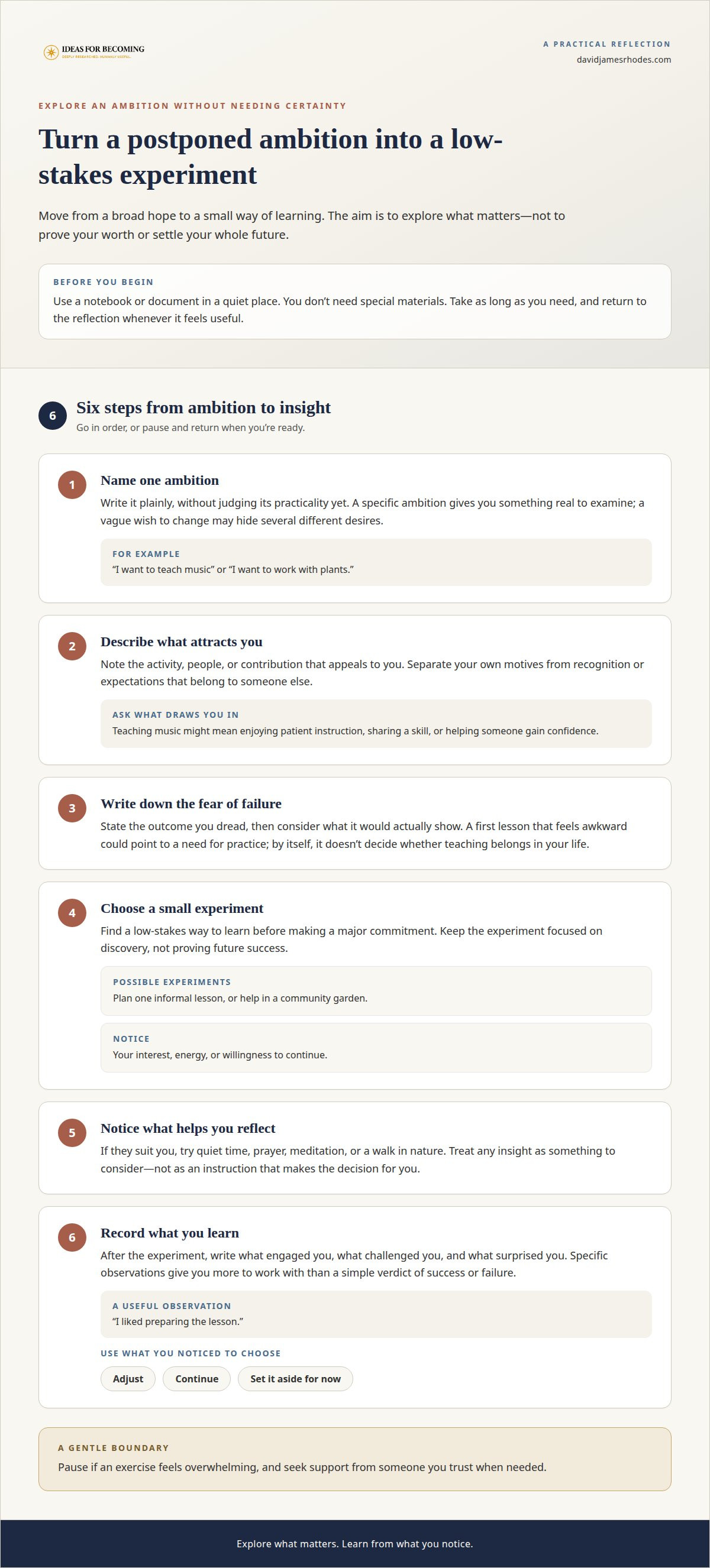
Choose an ambition you’ve postponed and examine what draws you to it. These ‘Life After Anything’ practical exercises help turn a broad hope into questions you can explore before making a major commitment.
Define Each Exercise’s Purpose
Write the purpose beside each reflection: clarifying a desire, understanding a fear, or identifying a possible experiment. Focus on exploring, not proving your worth. If you’re drawn to community gardening, for example, ask whether you value growing food, working outdoors, or bringing neighbors together. Your answer can point to a useful next step without requiring a fixed life plan.
Complete the Exercises Step by Step
Use a notebook or document in a quiet place; you don’t need special materials. Work through the steps at a pace that allows honest thought, and return to them whenever reflection feels useful. Take as long as you need. Pause if an exercise feels overwhelming, and seek support from someone you trust when needed.
- Name one ambition. Write it plainly, such as “I want to teach music” or “I want to work with plants.” Don’t judge its practicality yet. A specific ambition gives you something real to examine, while a vague wish to change can conceal several different desires.
- Describe what attracts you. Note the activity, people, or contribution that appeals to you. Wanting to teach music could reflect enjoyment of patient instruction, sharing a skill, or helping someone gain confidence. Distinguish these motives from recognition or expectations that belong to someone else.
- Write down the fear of failure. State the outcome you dread, then consider what it would actually show. A first lesson that feels awkward could point to a need for practice. It wouldn’t, by itself, decide whether teaching deserves a place in your life.
- Choose a small experiment. Find a low-stakes way to learn, such as planning one informal lesson or helping in a community garden. Decide what you’ll observe: your interest, energy, or willingness to continue. Keep the experiment focused on learning, not proving your future success.
- Notice what helps you reflect. Try quiet time, prayer, meditation, or a walk in nature if these practices suit you. Treat any insight as something to consider, not as an instruction that makes the decision for you.
- Record what you learn. After the experiment, note what engaged you, what challenged you, and what surprised you. “I liked preparing the lesson” gives you more to work with than “It went well.” Use that observation to choose whether to adjust, continue, or set the ambition aside for now.
Identifying natural gifts and talents
Natural ability often shows up in ordinary activities, not formal achievements. Notice what absorbs you, comes readily, or repeatedly helps someone else. Then compare that pattern with specific examples.
- List activities that hold your attention. Write down tasks you choose without being asked, such as repairing a chair, explaining a difficult idea, or organizing a shared meal. Include activities from work, home, and community life. Notice when you lose track of time, but don’t assume enjoyment alone proves talent. Interest is one clue among several.
- Recall what others ask you to do. Record requests you hear repeatedly from colleagues, friends, or family. Perhaps people ask you to settle disagreements, edit a letter, plan a trip, or make a confusing process clearer. Each request offers an example of how others experience your contribution. Look for recurring themes rather than treating one compliment as a final answer.
- Separate ease from effort. Choose an activity that feels natural, then describe what you actually do. Someone who makes newcomers feel welcome may notice who is standing alone, introduce them, and help them join a conversation. That skill still takes attention. “Easy for me” doesn’t mean effortless, and it doesn’t make the ability less valuable.
- Compare your strongest moments. Choose examples from different settings, such as helping a neighbor move, guiding a new colleague, or solving a household problem. Note the action you took and its effect. If you repeatedly clarify choices or bring people together, those patterns may point to strengths in communication or collaboration.
- Ask for specific observations. Invite someone who knows your work or everyday life to describe a moment when you were especially useful. Ask what they saw you do, not whether they think you’re talented. “You noticed the missing detail in the plan” gives you something concrete to examine. Compare their account with your own examples.
- Test one ability in a fresh setting. If explaining is a recurring strength, offer to help someone understand a process or prepare for a task. Notice whether you stay engaged and what the other person finds useful. One test can’t define your identity, but it can show which abilities you want to practice, share, or develop further.
Give particular weight to activities that come easily or make you feel most alive. To make that clue useful, describe the precise part that draws you in: noticing a need, shaping an idea, working with materials, or helping someone take a next step. The activity itself may be broad, while the ability becomes clearer when you identify what you contribute within it. Consider whether the satisfying part is beginning, improving, explaining, or bringing something to completion.
Keep these observations open to revision. An ability may show up differently across settings, and a familiar task may reveal a less obvious strength when you notice your choices. Look for the quality that remains meaningful rather than forcing every example into one label. Then choose a small opportunity to use that quality deliberately. Note what you did, how it felt, and whether it served the situation. These observations give you a practical basis for deciding which abilities you want to keep exploring.
Journaling about an ideal future
Write about a future that feels meaningful in ordinary detail, not as a perfect life without difficulty. A scene such as sharing breakfast with people you love can reveal more than a title or achievement alone.
- Choose a scene from an ordinary day. Picture a morning that reflects the life you want to live. Where do you wake? What do you do before work, and who is part of your day? For example, imagine walking to a familiar café, then starting work that leaves room for care and concentration. Describe what you can see, hear, and choose.
- Write in the present tense. Describe the scene as if you’re living it now: “I make time to cook dinner,” or “I use my ability to explain difficult ideas.” Present-tense details make assumptions easier to notice. If the scene depends on a prestigious title but says little about your daily actions, add the human details that matter.
- Name the values inside the picture. Beside each detail, identify what it represents. A shared meal might express connection; work with room for thought might represent independence. Use plain words such as service, curiosity, or belonging. If a detail reflects someone else’s expectations more than your own, mark it for closer examination.
- Include people and responsibilities. A meaningful future still includes relationships, obligations, and difficult days. Describe how you want to treat a colleague during a tense meeting, or how you might care for a family member while protecting time for meaningful work. These examples bring character into the picture, not just comfort or achievement.
- Notice what the vision asks you to release. Write down a habit or assumption that conflicts with the scene. If your imagined evening includes unhurried time with family, but your current routine leaves no space for it, name the trade-off honestly. Avoid turning the journal into a list of demands; focus on choices you can influence.
- Translate the scene into a present choice. Choose one action that fits your values now. If the future includes creative work, protect a little time to make something before seeking approval. If it centers on connection, give someone your full attention during a conversation. The action should express the vision, not imitate its finished appearance.
- Reread and revise with care. Return to the entry later and underline details that still feel important. Cross out images that no longer fit, such as a role pursued only for recognition. Keep the revision open-ended. A vision of the future is a working picture that helps you choose, not a contract requiring life to unfold exactly as written.
Reviewing life experiences and turning points
Use a written timeline to revisit important experiences and notice patterns in how you respond to change.
The Life After Anything Companion Guide & Workbook is a companion resource for reflection. You can also complete the prompts below in a notebook or digital document. No separate file is needed to begin.
These reflections can help you consider grief, trauma, or major life changes, but they are not treatment. If recalling an event feels overwhelming, pause and seek support from someone you trust or a qualified professional.
The steps below include sample prompts. For example, record what changed, what you did next, and what you learned about yourself.
- Mark significant events on a simple timeline. Write down transitions that changed your daily life, relationships, responsibilities, or sense of direction. Examples might include moving to a new place, losing a role, becoming a parent, or choosing a different path. Include quiet turning points too, such as deciding to ask for help. The purpose is to see the shape of your experience, not to create a complete record of your life.
- Choose one event to examine closely. Describe what happened using details you remember, then separate those details from conclusions you formed afterward. For example, “I left the meeting without speaking” describes an action; “I never have anything useful to say” is a judgment. This distinction can reveal which beliefs came from the event and which developed around it.
- Notice the choices you made at the time. Record what you did, what you couldn’t control, and what you were trying to protect. Someone leaving a familiar job might have been seeking safety, independence, or time with family. Naming the motive adds context without requiring you to label the decision entirely right or wrong.
- Look for patterns across different experiences. Compare the event you selected with other moments on your timeline. Did you repeatedly adapt by asking questions, caring for others, or starting again after disappointment? Treat repeated behavior as a clue about how you respond, not as a fixed identity or a rule for every future situation.
- Identify what the experience changed. Write down a belief, relationship, priority, or habit that shifted afterward. A move might have changed what “home” means; a difficult conversation might have clarified a boundary. Be precise about the change. “I became stronger” says less than “I now ask for clear expectations before accepting responsibility.”
- Decide what you want to carry forward. Finish with one lesson or value that can guide an everyday choice now. You might choose honesty in a conversation or patience while learning an unfamiliar task. Moving in a new direction doesn’t require erasing the past; it means deciding which parts of your experience deserve a place in what comes next.
What is the purpose of each exercise in Life After Anything?
Each exercise serves a different purpose: clarify what matters, notice what you bring, and connect reflection with action. Together, they turn broad questions about direction into observations you can use in everyday choices.
- Use ambition reflection to uncover desire. Naming an ambition helps distinguish personal interest from an expectation inherited from family, work, or culture. Ask what draws you to the possibility itself. Wanting to teach, for example, might reflect a desire to share knowledge, not a need for a particular job title. This exercise makes the motive easier to examine.
- Use talent reflection to notice contribution. Looking at activities that come easily or leave you feeling alive can reveal abilities you may overlook. Someone who naturally listens and helps a friend organize difficult thoughts may have a strength in careful communication. The purpose isn’t to assign a permanent label. It’s to identify capacities you might choose to develop or offer.
- Use future journaling to give values a shape. A description of an ideal day makes abstract hopes more visible. If your imagined day includes unhurried conversation, meaningful work, and time outdoors, those details may point toward connection, purpose, and nature. The exercise helps you examine what a satisfying life contains beyond status or a single achievement.
- Use turning-point reflection to find patterns. Reviewing significant experiences can show how you respond when circumstances shift. A change in work, a move, or a difficult decision may reveal recurring choices, such as seeking help or taking responsibility. The purpose is to understand those patterns, not reduce your life to one event or claim every hardship had a hidden benefit.
- Connect core values with the legacy you want to express. Choose a value, such as honesty or generosity, then describe how it could shape an ordinary interaction. A candid conversation or a patient response can express a legacy through daily conduct. This exercise brings purpose closer to the choices available now, rather than reserving it for one major accomplishment.
- Imagine the effect of one small positive action. Choose an act that could help another person, then consider what might follow. Offering a new colleague a thoughtful introduction could help them feel included and make it easier to contribute. You cannot control every consequence, but tracing possible effects helps you see how a modest choice may influence others over time.
Bring these reflections together by asking whether a choice aligns with the values you want to live by. Rather than treating legacy as something distant or grand, consider how your values could shape an ordinary moment. The aim isn’t to settle on a final definition of purpose, but to notice what those values invite you to express in situations already at hand.
When imagining a positive action, trace how it might affect others beyond the immediate exchange: how another person could respond, and how that response might influence later interactions. Treat this as a possibility, not a prediction or obligation. The exercise can help you consider the longer-term effects of an intentional choice, while recognizing that you can’t direct every outcome. Together, reflecting on values and imagining actions offer a way to explore purpose through the choices available to you and the effects you hope to encourage.
David James Rhodes
David James Rhodes connects reflection on life’s turning points with the larger question of who you are becoming. When these exercises clarify what matters but leave you unsure how to carry that insight into leadership, relationships, or everyday choices, his work offers a broader perspective on growth and direction.
The Way explores human becoming, while Leadership & Life Advisory offers space to examine questions about life and leadership. These are thoughtful next steps when you want to move beyond reflection and consider how your choices shape the person you’re becoming.
To continue the conversation, contact David James Rhodes.
Choose the next honest step
Direction rarely arrives as a complete plan. It takes shape through attention, decisions, and the person you become along the way. Let your reflections inform one choice you can make now. Not a promise about the whole future, but a deliberate act that gives your values a place in everyday life.
The ‘Life After Anything’ practical exercises are most useful when they lead beyond the page. Return to what you wrote when circumstances change or an old ambition begins to matter again. Your answers may shift. That isn’t failure; it’s part of paying attention to a life that continues to unfold.
David James Rhodes explores human becoming and the choices that shape a way forward. If you want to continue that conversation, contact David James Rhodes. Begin where you are, and take the next step with care.
Frequently Asked Questions
What practical exercises are included in Life After Anything?
The exercises include reflections for examining ambitions, recognizing strengths, imagining a meaningful future, and learning from important life experiences. They also invite you to connect personal values with everyday choices and consider how small actions affect others. To put the prompts to use, choose a current decision and notice which answers help clarify what matters in that situation.
Frequently Asked Questions
Related Articles

Inspirational Books for Holistic Personal Growth and Steady Habits
Explore inspirational books for holistic personal growth, and learn how mindfulness and steady habits support change across daily life in everyday practice.

Books on discovering meaning through adversity: choose a path
Explore Books on discovering meaning through adversity, from purpose and resilience to grief and mortality, and choose a guide that fits what you need now.

Books for Navigating Life’s Profound Changes with Resilience
Books for navigating life's profound changes offer perspective and ways to build resilience, test new directions, and consider who you are becoming now.