
What if a meaningful life after retirement isn’t something you discover all at once, but something you shape through the commitments you choose? When work has given your days a rhythm and your identity a clear role, its absence can leave more than free time. It can leave you wondering where your attention, experience, and sense of purpose belong now.
That uncertainty is understandable. Retirement changes the structure of ordinary life, and an open calendar can feel less like freedom when it brings isolation or a loss of direction. You don’t need to replace your career with another full-time role or find one grand purpose to justify this chapter.
You can begin with smaller, deliberate choices. This article offers practical ways to shape your days, strengthen relationships, contribute in ways that fit your circumstances, and follow interests that keep you curious. Together, these choices can help retirement become an evolving part of who you are, not an identity defined only by what you used to do.
Key Takeaways
- A meaningful life after retirement can grow from relationships, purposeful activities, and contribution, not simply a full calendar.
- Your former job title may change, but it does not define your worth or limit what you can offer.
- You don’t need a dramatic reinvention. Build on what matters, experiment with new interests, or make a larger change if it feels right.
- Try one small activity that reflects what you value, give it a place in your week, and notice how it affects you.
- Let the question “Who are you becoming?” guide your choices as retirement unfolds into a new chapter.
Why a Meaningful Life After Retirement Is More Than Filling Free Time
A calendar can be full and still feel empty. A meaningful life after retirement is shaped by relationships, activities, and contribution that matter to you, not simply by how many hours you occupy. Meaningful retirement is a way of living in which your time reflects what you value and your relationships and actions give you reasons to stay engaged. It is a personal description, not a clinical diagnosis or a standard everyone must meet.
Retirement can bring relief, uncertainty, grief for a former routine, or several feelings at once. None of these reactions means you have made the wrong choice. The idea of Retirement has changed over time, but the personal question remains immediate: what will give your days shape and significance now?
Financial readiness matters because it can shape which choices are available. But having the resources to retire does not automatically create fulfilling days. That is a separate kind of work: deciding what deserves your attention, then making room for it. Your former role may end or change. Your capacity to learn, care, create, and contribute does not disappear with a job title.
What can make retirement feel disorienting?
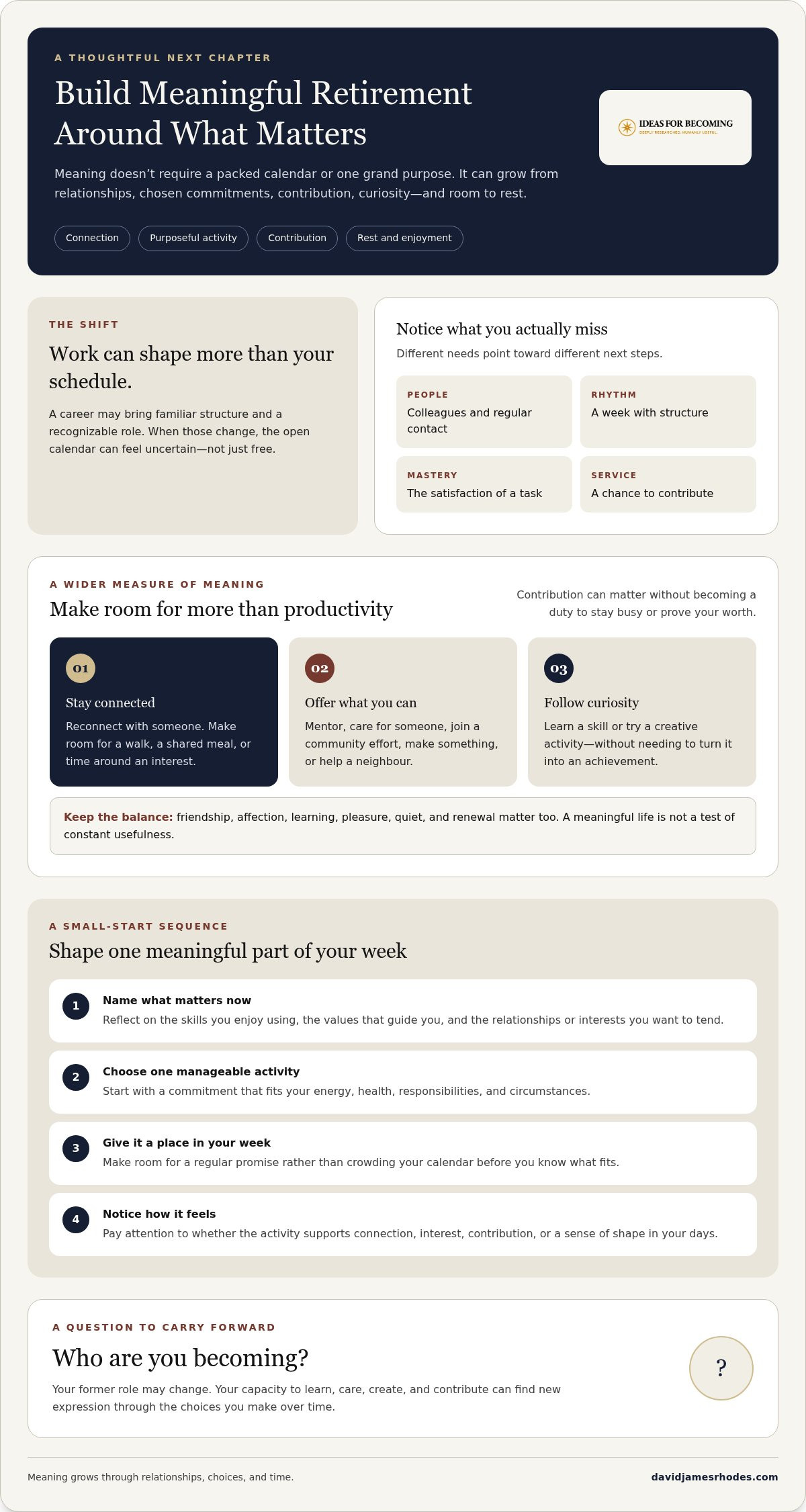
Work often provides more than income. It may bring routine, regular contact with colleagues, responsibility, and a recognizable role. When those elements change, some people feel unmoored; others welcome the space. Neither response is universal. Rather than rushing to fill every open hour, identify what you actually miss. Is it the people, the satisfaction of mastering a task, the chance to serve, or the structure that organized your week? Each answer points toward a different need, and a different kind of next step.
Does purpose after retirement have to be one big calling?
No. The pressure to find a single grand mission can make an ordinary beginning feel inadequate. Purpose may take the form of caring for someone, helping with a community effort, learning a skill, or keeping a regular promise to a friend. Small commitments can matter when they express something you value and become part of your days. So can rest and enjoyment. A meaningful life is not a test of constant usefulness. It makes room for pleasure, quiet, and renewal as well as contribution.
You don’t need to settle your identity all at once. Start by noticing what you want more of and what you’re ready to leave behind. The next chapter can hold continuity, change, and uncertainty together. Meaning grows through choices made over time, not through a perfect plan made on the first day of retirement.
How Identity, Relationships, and Contribution Shape Life After Retirement
A job title describes a role. It does not measure a person’s worth or contain all they can offer. Retirement may remove a familiar setting for using your skills, but qualities such as patience, judgment, curiosity, and care travel with you. The question is not whether you still have value. It is where that value might find expression now.
Meaningful activity can give identity room to grow without making productivity the measure of a person. Contribution matters, but you don’t have to earn your place in life by staying busy. Friendship, affection, learning, and time spent simply enjoying a day have their own worth.
Who are you beyond the role you held at work?
Consider what mattered to you before, during, and outside your career. Which skills did you enjoy using? What values shaped your choices? Which relationships and interests remained important even when work was demanding? Someone who valued teaching might mentor a younger person; someone who wants change might take up a craft with no ambition beyond learning. Both paths can be honest. Identity is not fixed by a former role. It keeps developing through what you choose, practice, and care about.
This is a practical reflection, not a claim that research prescribes one route to a satisfying retirement. David James Rhodes’s perspective on human becoming offers a related question: who are you becoming as your roles change? It invites exploration without treating any single retirement experience as universal.
Where can connection and contribution begin?
Start with a specific, manageable step. Reconnect with someone you’ve meant to call. Suggest a regular walk, a shared meal, or time together around an existing interest. To meet new people, look for settings built around something you genuinely enjoy, such as a community group, a creative activity, or learning alongside others. Choose a first commitment you can realistically return to rather than crowding your calendar before you know what fits.
Contribution can take many forms: mentoring, caregiving, community involvement, making something by hand, or helping a neighbour with a task. These are not duties to accept simply because you have retired. Think of contribution as participation, with give and take. You may offer experience and receive companionship, purpose, or a fresh perspective in return.
Choose commitments that respect your energy, health, responsibilities, and circumstances. A meaningful life after retirement does not require constant output. It can include a small promise kept, a relationship tended, and enough space to recover between activities. For further reflection on identity and change, explore David’s ideas on human becoming.
Why a Meaningful Retirement Does Not Require Reinventing Yourself
Retirement can invite change. It doesn’t demand a new identity. The pressure to discover a fresh calling, move somewhere unfamiliar, or remake your entire life can turn possibility into another obligation. A meaningful life after retirement may grow from continuity, from trying something new, or from a major change. No single path is right for everyone.
Purposeful commitments give your time direction; filling every available hour gives it volume. A quiet week can hold care, connection, and satisfaction. A packed one can still feel like an escape from asking what matters. Busyness is not proof of meaning, and constant positivity is not a requirement for a good life.
Your options are shaped by real circumstances. Finances may limit certain choices; health, caregiving, and relationships may call for flexibility or a slower pace. That isn’t failure to make the most of retirement. It is part of making choices that fit the life you have.
What is worth carrying forward from your working life?
Look beyond whether you enjoyed your career. You may want to keep a valued ability, a trusted friendship, a responsibility you chose, or a simple ritual that gave the week shape. A former manager might continue to offer guidance informally. Someone whose work felt draining may decide to use a hard-earned skill for personal projects, or leave that chapter behind entirely. Carry forward what feels worth keeping, not what others expect you to preserve.
When is a small experiment wiser than a complete reset?
When the next step is unclear, try one commitment before reorganizing your days around it. Attend a gathering, help with a community task, revisit an interest, or set aside time for a creative pursuit. Treat the choice as a way to learn, not a test you can pass or fail.
Afterward, pause and ask:
- Did this hold my interest?
- How did I feel before and after?
- Did it create a sense of connection?
- Did it feel personally significant, or mainly like something I thought I should do?
Your answers may suggest keeping the activity, changing it, or letting it go. Continuity can provide steadiness. Experimentation can reveal new possibilities. A larger change may be right when circumstances and considered desire point that way. You’re not required to choose once and stay fixed. Build a life through attention and adjustment, at a pace that respects your responsibilities and your own sense of what matters.
A Practical Way to Build Meaningful Days After Retirement
A week doesn’t need to resemble a work schedule to have shape. It needs a few chosen points of meaning and enough room to respond when life changes. To build a meaningful life after retirement, start small: notice what matters, try one activity, make space for it, then reflect. Adjust the plan to your health, finances, responsibilities, and preferences. A useful rhythm should serve your life, not become another standard to meet.
How can you discover what feels meaningful now?
Think back over recent days. When did you feel absorbed, connected, useful, or quietly satisfied? The moment need not be dramatic. Perhaps you enjoyed a conversation, tended a garden, helped someone solve a problem, or took time outdoors. Choose one small, realistic activity that draws on what you noticed. Afterward, jot down what gave you energy, what drained you, and whether you would like to do it again. Those details can help distinguish an activity that sounds worthwhile from one that actually suits you.
How can a flexible weekly rhythm support purpose?
Consider a few anchors rather than filling every day. These might include movement that suits your circumstances, social contact, learning, service, or time outdoors. Give each a realistic place in your week, then leave open space too. Rest and spontaneity belong in a rhythm that can adapt to appointments, caregiving, changing energy, or simply a day when you want to do less.
Use this sequence as a simple starting point:
- Notice: Recall a moment that felt absorbing, connecting, useful, or satisfying.
- Choose: Pick one small activity that reflects what mattered in that moment.
- Schedule: Give it a realistic place in the coming days, allowing for your current needs and responsibilities.
- Reflect: Consider what you felt before and after, then decide whether to repeat, adapt, or release it.
That last step matters. If an activity feels misaligned, changing it is information, not failure. Perhaps the setting was wrong, the commitment too demanding, or the interest less compelling than expected. Adjust one part and see what you learn. The aim is not to prove you can stick with a plan. It is to shape days that feel more like your own.
Review your week from time to time. Which commitments brought connection or satisfaction? Which were kept only from obligation? You can retain what serves you and let go of what doesn’t. For more reflection on purpose and the choices that shape a life, explore David’s ideas on human becoming.
How The Way Connects Retirement With the Work of Becoming
Retirement changes the shape of a life. It does not end the work of becoming. The question beneath decisions about routine, relationships, and contribution is still simple: Who are you becoming? The answer is not found in a title or a fixed plan. It takes shape over time through choices, habits, relationships, and the responsibilities you accept or set down.
This perspective does not frame retirement as either a crisis to overcome or a cure for everything that came before. It is a significant transition, and its meaning will differ from person to person. You might carry forward a value that guided your working life, such as service or curiosity, while finding a different way to express it. You might also discover that a former role no longer fits. Both continuity and change can belong to the same chapter.
What does becoming mean when a career chapter ends?
Becoming is not a demand to improve yourself every day. It is the recognition that identity continues to develop through how you live. A person who has spent years making decisions at work may bring that judgment to family life, a community commitment, or a personal pursuit. Someone who has carried heavy responsibilities may choose a quieter season. The point is not to recreate a career, but to remain open to what matters now.
David James Rhodes’s perspective draws on more than four decades of experience across 156 countries. That experience offers context, not proof that one path suits everyone. His philosophy, The Way, rests on a related idea: “The Way is not something you find. It is someone you become.” In retirement, that can mean taking the next step without needing to see the whole road.
How can a guide support reflection without prescribing a life plan?
A guide can offer language, ideas, and questions to consider. It cannot decide what your days should contain. The Way is a philosophy and a guide, not a guaranteed solution or a scientific intervention. It invites reflection on how choices become a way forward, while leaving the choices themselves with you.
The Way was released on September 15, 2026, and is available. If you want to explore how its ideas connect identity, purpose, and daily action, read The Way and human becoming. There is no need to make a sweeping decision first. Choose one next step that feels personally meaningful, and let what you learn guide the one after it.
Let Your Next Chapter Take Shape
A meaningful life after retirement doesn’t depend on filling every hour or finding one perfect purpose. It can grow through relationships you tend, contribution that fits your circumstances, and small experiments that help you discover what matters now. A steady rhythm can give your days shape while leaving room for rest and change.
Your career may have shaped part of your identity. It never contained all of you. Carry forward what remains important, release what no longer fits, and let your choices reveal who you are becoming. There is no single pattern for this chapter, and no need to have it all mapped out.
David James Rhodes brings more than four decades of experience across 156 countries to his reflections on human becoming. That experience informs his perspective; it does not prescribe one path. The Way is his flagship philosophy, connecting identity, character, action, and becoming. Explore it at your own pace through The Way and the work of becoming. Begin with one choice that feels true to you, then explore The Way for a deeper reflection on the work of becoming.
Frequently Asked Questions
Can retirement feel meaningful without a new career?
Yes. Meaning can come from relationships, learning, service, creativity, family responsibilities, or quieter routines that fit your circumstances. Paid work may suit some retirees, but it isn’t a requirement for a worthwhile next chapter. Begin by noticing what feels valuable, then try one modest commitment, such as a regular creative activity or time with someone you care about. Your life doesn’t need to resemble your former working life to matter.
How do I find purpose after retiring?
Start with moments when you’ve felt connected, useful, curious, or absorbed, rather than pressuring yourself to find one grand calling. Choose a small activity that reflects one of those experiences and try it in a realistic way. For example, if you enjoy sharing knowledge, offer informal help to someone learning a skill. Notice what you want to repeat or change. Purpose can take shape through consistent choices, not only a dramatic new direction.
What should I do every day after retirement?
There’s no single daily schedule that suits everyone. Consider a flexible rhythm with a few anchors, such as movement that fits your health, time with others, a valued responsibility, or space to rest. Leave room for spontaneity. If your days feel empty, add one activity that matters to you before redesigning your entire routine. Pay attention to what works, then adjust as your needs, interests, and circumstances change.
Is it normal to feel lost after retirement?
It can be. Work may have provided structure, regular contact, and a familiar role, so their absence can leave some people uncertain. Others welcome the change, and mixed feelings are also possible. There’s no required emotional response. Give yourself time to notice what has shifted and what you want to carry forward. If distress persists or interferes with daily life, consider speaking with an appropriate health professional.
How can retirees make new friends and stay connected?
Look for low-pressure ways to spend time with people around a shared interest, regular activity, learning, volunteering, or an existing community connection. Choose something you can realistically return to, since repeated contact can make conversation easier. Reconnecting with someone you already value can be a good first step, too. Focus on genuine exchange rather than accumulating activities, and shape social plans around your health, mobility, responsibilities, and preferences.
Does a meaningful retirement require volunteering or helping others?
No. Volunteering is one way to contribute, not a condition for a worthwhile life. Contribution might mean caring for family, sharing a skill, making something, mentoring, or being present in a relationship. Rest and enjoyment belong, too. Choose commitments that feel significant and sustainable for you. You don’t have to stay constantly productive just because you’ve retired; your worth isn’t measured by how much you accomplish.
How long does it take to adjust to retirement?
There’s no reliable timetable that applies to everyone. Adjustment may be shaped by health, finances, relationships, expectations, and whether retirement was chosen or prompted by circumstances. Rather than judging yourself against a deadline, notice what feels easier and what still needs attention. Small changes to routine or connection can help you learn what fits. Time alone doesn’t determine meaning; reflection and choices help shape what comes next.
Frequently Asked Questions
Related Articles

Redefining Success After 50: What Deserves Your Time Now
Redefining success after 50 is about deciding what deserves your time now. Clarify your values, evolve your identity, and shape an intentional next chapter.

Who Am I Becoming? A Clearer Way to Understand Your Life
Asking who am i becoming? Explore how daily habits and choices shape your character. Learn to understand your life patterns and take intentional next steps.

Executive Identity Crisis: When Success No Longer Feels Like You
Facing an executive identity crisis? When success no longer feels like you, discover who you are becoming beyond your title and clarify what matters next.