
What if redefining success after 50 has less to do with starting over than deciding what still deserves your time? The achievements that once gave your life direction may no longer feel like enough. A career change, family transition, or shift in responsibility can unsettle an identity built around them. That doesn’t make your past less valuable. It may mean your priorities are changing.
A new chapter can feel daunting when old measures of progress no longer fit and the next ones aren’t clear. You don’t have to dismiss what you’ve accomplished or reinvent yourself overnight. You can use what experience has taught you to choose your next steps with greater intention.
This article offers a practical framework: clarify what matters now, identify where your experience can contribute, and turn your priorities into grounded actions. We’ll look at how identity can evolve through transitions and how to shape a meaningful next chapter without pretending the past didn’t matter. The question isn’t only what you’ve achieved. It’s who you’re becoming.
Key Takeaways
- Redefining success after 50 starts with deciding which values, relationships, and responsibilities deserve your time now.
- Recognize how work and achievement have shaped your identity without letting a role or title define your whole life.
- Consider a change of direction as a deliberate choice, not a demand to discard everything you’ve built.
- Use a practical reflection exercise to review your commitments, name your values, and choose a meaningful next step.
- Explore how The Way connects a sense of direction with the person you are becoming.
What Does Success After 50 Mean When Old Measures No Longer Fit?
A birthday, a retirement decision, a change at work, or simply a quieter moment can prompt you to reconsider what success means. Not everyone reaches 50 feeling dissatisfied or ready for change, and there is no universal turning point. But when circumstances shift, it’s reasonable to ask whether the measures that once guided you still reflect the life you want to live.
Success is often counted through visible markers: income, title, recognition, or the size of a responsibility. These can matter. Financial security can create choices, and meaningful work can offer purpose. But external markers don’t tell the whole story. Integrity, connection, contribution, and the care you bring to chosen responsibilities are less visible, yet may matter just as much. Redefining success after 50 doesn’t require rejecting past achievements or making a dramatic change. It means deciding what those achievements mean to you now and what you want them to serve.
Why can success feel different in midlife and beyond?
Responsibilities and circumstances change. A role at work may end or become less central. Relationships may need different kinds of attention. Health, family needs, or a desire for greater autonomy can affect what feels worth pursuing. These shifts don’t happen to everyone in the same way, and turning 50 doesn’t dictate what should come next.
Consider someone who worked toward a promotion and earned it. The title still represents discipline and skill. Yet if the role leaves little time for family, mentoring, or creative work, the achievement may now feel incomplete. That feeling doesn’t erase the accomplishment. It offers information about what has become important and what the person may want to change.
Which measures of success still belong to you?
Some ambitions begin as our own. Others are inherited from family, workplace, or culture: earn more, advance, stay busy, be admired. Separate what you genuinely value from what you learned to pursue. Perhaps success still means financial security or mastery. Perhaps it means autonomy, service, connection, or time for creative work. More than one measure can matter, and priorities can change.
Erik Erikson’s framework for psychosocial development describes generativity, or contributing to others and the wider world, as one way to understand adult development. It’s a useful perspective, not a rule for how anyone must live. Contribution can take many forms, from caring for family to sharing hard-earned knowledge.
Success has no age-based formula. It is a life shaped by the values, relationships, contributions, and responsibilities you choose. Start by naming the measures that feel like yours. You don’t have to discard the life you’ve built to decide what deserves your time now.
How Identity, Character, and Time Shape a New Definition of Success
An achievement can tell you what you have done. By itself, it can’t tell you who you are. A title may reflect years of skill and responsibility, but it is only one part of a life. Its meaning also depends on how you carried the role, how you treated people, and what the work made possible.
Is success an achievement, an identity, or a way of living?
Two people can reach the same milestone and experience it differently. One may value the recognition; another may value the craft, independence, or service behind the work. Looking through your own values changes the question from “How impressive is this?” to “What does this represent in the life I want to lead?”
When a major role changes, identity can keep developing through new commitments, relationships, and choices.
Character is less visible than a résumé. It shows up in repeated actions: keeping a promise, taking responsibility when something goes wrong, making room for another person, or meeting difficulty without surrendering your principles. No single decision tells the whole story. Over time, these choices reveal what your achievements serve and what kind of person you are becoming.
What does limited time change about ambition?
Time matters because it is finite, not because there is a deadline for becoming someone new. That distinction matters. Fear says you must hurry before it’s too late. Deliberate attention asks what deserves your effort, given the life and responsibilities you have now.
Ambition doesn’t have to disappear or shrink with age. It can become more exact. You might still want to lead, create, build financial security, or master a demanding craft. Ask whether those aims still align with your values and what they require you to give up.
Try this reflection: What deserves more of my attention, and what no longer deserves my automatic attention? Look at your calendar and obligations, as well as the people who depend on you. Notice the difference between a commitment you choose and one you continue only because it has always been there. Redefining success after 50 can begin with that distinction, not a dramatic announcement.
This is a philosophical framework, not a claim that everyone’s identity follows the same course. In David James Rhodes’s wider thinking about human becoming and personal direction, the focus is not merely finding the next role. It is deciding who you want to be within it and what your daily conduct will make real.
Is It Too Late to Change Direction or Pursue a Different Kind of Success?
No. Age alone doesn’t decide whether a change is possible or worthwhile. But judge a new direction by more than its appeal. Consider whether it fits your responsibilities, health, energy, and financial needs. Experience can help you see risks more clearly, recognize patterns, and bring useful skills to work that matters to you.
Redefining success after 50 doesn’t mean treating the life you’ve built as a mistake. You may be ready to leave a role, or you may simply want to change how you contribute within it. Both can be meaningful. The aim isn’t reinvention for its own sake. It’s a considered choice about what to carry forward and what to change.
What is the difference between reinvention and redirection?
Reinvention can mean entering a new field, taking on a different identity, or rebuilding life around unfamiliar work. It’s one possible path, not a requirement. Redirection may be quieter: using established skills in a new setting, mentoring colleagues, reducing certain responsibilities, or making more room for work that feels useful.
For example, an experienced manager who no longer wants to lead a large team might share that knowledge through mentoring or a narrower advisory role. The contribution changes, but the experience still counts. A shift in professional priorities might also mean rethinking how you lead, what you want your work to make possible, and which responsibilities remain worth carrying.
How can you assess a change without romanticizing it?
Start with both sides of the decision. What do you hope to gain, and what might you have to relinquish? Consider uncertainty, income needs, family obligations, energy, relationships, and the satisfaction or strain of your current path. A new direction can bring meaning and possibility, but it can also involve adjustment, learning, and trade-offs. There are no guaranteed outcomes.
Where practical, test an idea before making an irreversible move. A small project, a conversation with someone doing similar work, or a limited shift in responsibilities can give you useful information without requiring an immediate life overhaul. Set a point to review what you learn: Does the work fit your values? Does the reality match your expectation? What would need to be true for a larger step to be responsible?
For readers reconsidering their role as leaders, David James Rhodes’s leadership advisory helps examine how responsibility, identity, and contribution may change together. The useful choice is not always the boldest one. It is the one that respects both what you hope to become and the life you are responsible for now.
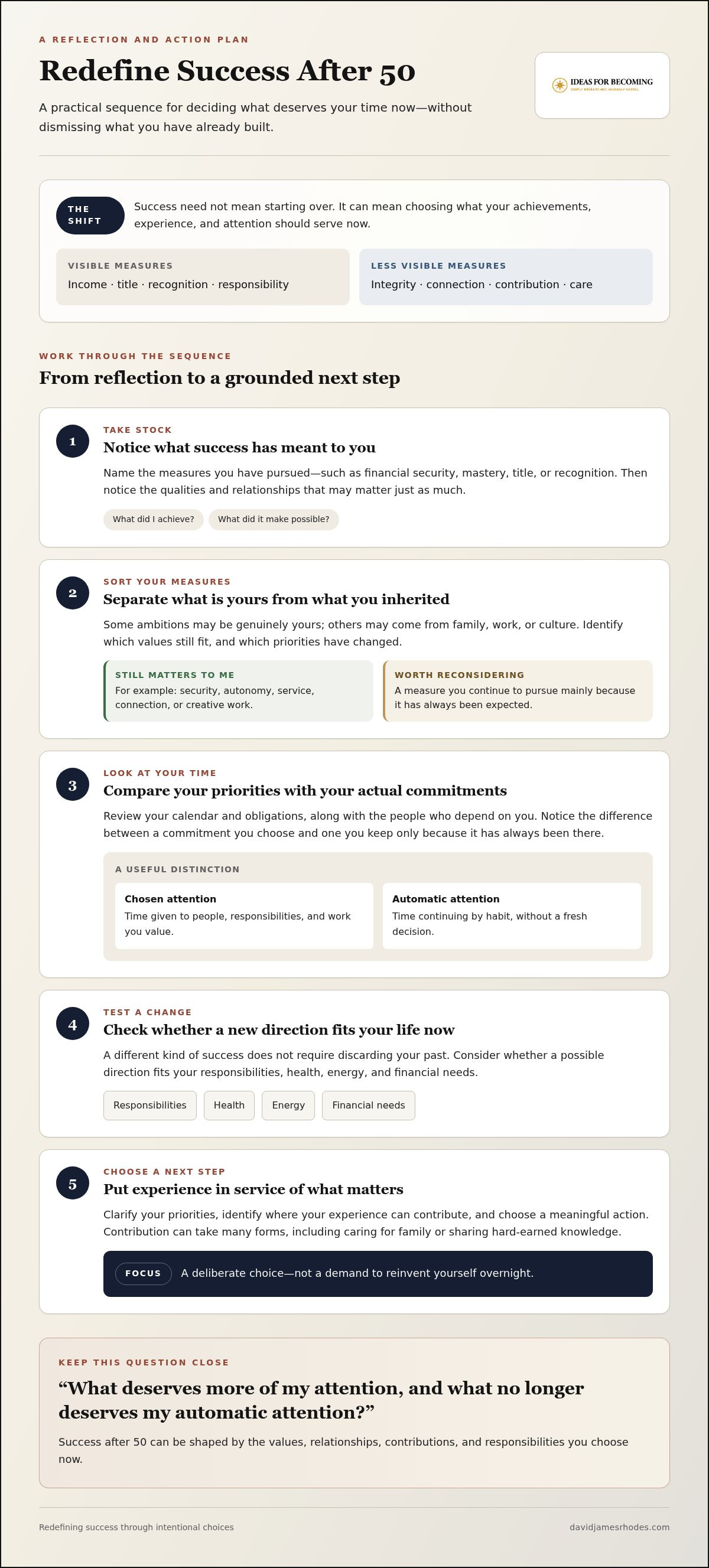
How to Redefine Success After 50: A Practical Reflection and Action Plan
Reflection is useful when it leads to a clearer choice, not when it becomes another demand to fix your life. This exercise helps you examine your commitments and sources of meaning, then choose a next step that fits your circumstances. It isn’t a guaranteed method or a clinical intervention. Treat it as a working note you can revisit and revise.
- Take an honest inventory. Write down your main responsibilities and how you spend your time. Which feel meaningful? Which do you maintain mostly from habit or expectation? Which need attention, support, or reconsideration? Include work, relationships, health, learning, contribution, and rest. There is no universal ranking. The point is to see your life more clearly.
- Describe a worthwhile ordinary week. Don’t picture a perfect holiday or an entirely different life. Write down what you want a normal week to include: time with someone you love, focused work, movement, service, quiet, learning, or creative effort. Be specific enough to recognize it in your calendar.
- Name the values underneath. Use plain language. “Be present with my family” is clearer than “balance.” “Do careful work I can stand behind” is clearer than “success.” You might choose connection, independence, service, mastery, creativity, or financial security. Choose words that describe how you want to act, not only what you hope to possess.
- Choose one near-term action. Give one value a practical form. If connection matters, set aside time for a conversation. If learning matters, identify a subject to explore and make room for it. Keep the action small enough to begin within your existing obligations.
- Plan one conversation and reconsider one commitment. Speak with someone affected by the change you’re considering. Then identify one commitment to review, not necessarily abandon. Ask whether it still serves a responsibility or value you want to honor.
- Set a point to review. Return to your notes at a time that makes sense for your circumstances. Notice what felt meaningful, what proved difficult, and what needs adjusting. A revised plan isn’t a failure. It’s a response to what you’ve learned.
Intention becomes meaningful when it shapes a real choice. Redefining success after 50 doesn’t require a complete life plan. It asks you to connect what matters with how you spend your attention, then keep learning from the choices you make.
For a broader perspective on becoming through deliberate choices, explore David James Rhodes’s thinking on human becoming.
The Way: A Philosophy for Becoming Who You Are After 50
You’ve considered what matters, examined your commitments, and identified choices that could bring your daily life closer to your values. The next question is not simply “What should I do?” It is also “Who am I becoming through what I do?”
The Way offers a philosophy for considering that question. Its central idea is simple: a way forward is shaped not only by the circumstances you face, but by the person you become as you meet them. That doesn’t promise certainty or remove difficulty. It directs attention to what remains within your influence: your actions, character, relationships, and responsibilities.
What does human becoming offer someone reconsidering success?
Human becoming treats identity as something that continues to develop. A former title or achievement can remain part of your story without defining all of it. The next chapter may involve new work, a different contribution, deeper attention to relationships, or a renewed commitment to something you value. The form will be personal. The question is consistent: Who are you becoming?
That question can keep redefining success after 50 grounded in more than appearances. It asks whether your choices express the values you named and whether the way you pursue an ambition reflects the character you want to practice. Sometimes the answer points toward change. Sometimes it helps you stay where you are, but with greater intention.
How can a philosophy support choices in ordinary life?
A philosophy earns its place in ordinary decisions. It might guide how you respond to a difficult conversation, use an afternoon, or decide whether to accept a responsibility that conflicts with a more important commitment. It won’t settle every question. It can offer a steady reference point when the options are imperfect and uncertainty remains.
David James Rhodes draws his perspective from more than four decades of experience across leadership and life transitions, including work across 156 countries. That experience offers a lived perspective, not scientific proof or a formula for other people’s lives. The Way is a philosophical guide for reflection, not treatment or a guarantee of a particular outcome.
You don’t need to define the rest of your life today. Begin with one choice that reflects who you want to become, then pay attention to what it asks of you. To explore the idea further, explore The Way and its philosophy of becoming.
Choose What Deserves Your Time Next
Redefining success after 50 isn’t a verdict on the life you’ve lived. It’s a chance to decide what your experience, values, relationships, and responsibilities should serve now. Achievements can remain meaningful without becoming the only measure of who you are.
Name one value you want your choices to express. Give it a practical form in your ordinary life, then review what you learn. A small, considered action can clarify more than waiting for certainty or demanding a complete reinvention.
David James Rhodes’s perspective draws on more than four decades of international leadership and entrepreneurship, and experience across 156 countries. That is lived experience, not research evidence. The Way develops a related idea: a way forward takes shape through who you become. Explore The Way and its philosophy of becoming.
Your next chapter doesn’t need to resemble anyone else’s. Choose what matters, take the next honest step, and let your choices give it shape.
Frequently Asked Questions
Is 50 too late to redefine success or change direction?
No. Age alone doesn’t determine whether a change is possible or worthwhile. The more useful question is whether a particular direction fits your circumstances, responsibilities, health, and values. Change doesn’t have to mean abandoning your life as it is. You might test a new interest, shift how you contribute at work, or redirect an existing skill before making a larger commitment.
What does success after 50 look like?
Success after 50 looks different for different people. It may include meaningful work, financial security, close relationships, service, learning, creative effort, or a more deliberate use of time. A title or income can still matter, but neither defines success on its own. Consider what you want an ordinary week to contain, then use those priorities to shape a definition that fits your life.
How do I find purpose after 50?
Purpose doesn’t have to arrive as one grand calling. Start by noticing what feels useful or meaningful in your existing life: a relationship you want to nurture, knowledge you could share, a responsibility you value, or a subject you want to learn. Ask what you want to contribute and what gives your attention a sense of direction. Then choose one manageable action that expresses it.
Can you start a new career after 50?
Yes, a career change can be possible after 50, though its practicality depends on your needs and circumstances. Identify skills that may transfer, then learn what the new field requires. Consider your financial responsibilities, energy, family commitments, and appetite for uncertainty. A small project, a course of study, or a conversation with someone in the field may help you assess the fit before making a major change.
What happens if my old definition of success no longer feels right?
It may be time to examine what has changed, not dismiss what you’ve achieved. Ask what your previous goals gave you, which parts remain valuable, and which expectations you may have inherited from family, work, or culture. Your definition can evolve without making your past a mistake. Begin by naming what matters now, then adjust one commitment or priority to reflect it.
How can I measure success in this stage of life?
Choose measures that reflect your values rather than relying only on outside recognition. You might consider whether you’re investing time in important relationships, doing work you respect, contributing in a way that matters to you, or protecting the financial security you need. Review your calendar and commitments: do they reflect those priorities? Your measures can change as your responsibilities and circumstances change.
Frequently Asked Questions
Related Articles

Who Am I Becoming? A Clearer Way to Understand Your Life
Asking who am i becoming? Explore how daily habits and choices shape your character. Learn to understand your life patterns and take intentional next steps.

Executive Identity Crisis: When Success No Longer Feels Like You
Facing an executive identity crisis? When success no longer feels like you, discover who you are becoming beyond your title and clarify what matters next.

Leadership for the Next Generation: Lead Through Character and Becoming
Explore leadership for the next generation through character, judgment, and responsibility. Learn how to guide emerging leaders without dictating their path.