
What if the answer to “who am i becoming” isn’t hidden inside you, waiting to be found, but taking shape through the choices you repeat? When life feels uncertain, it’s natural to look for a fixed label. Yet a job, a relationship, or a past decision can describe part of your story without defining all of it.
Your everyday patterns offer clues. So do the values you protect, the people you make room for, and the moments when your actions don’t match what you say matters. Looking at those patterns can be uncomfortable, but it can also offer something more useful than a label: a clearer view of where you’re headed and where you still have room to choose.
This article offers a grounded way to reflect on who you’re becoming. You’ll consider practical questions about your choices, values, and relationships, then use your answers to identify one manageable next step. You’ll also see why the past deserves honest attention without being treated as a verdict on your future. Becoming doesn’t promise that change will be easy. It gives you a chance to meet your next choice with greater intention.
Key Takeaways
- Understand “who am i becoming” by looking at the person your present patterns are shaping, rather than searching for a permanent label.
- Notice how repeated choices, relationships, and circumstances influence your direction while leaving room for agency.
- Compare the qualities you hope to embody with recent evidence from your life. Treat any gap as useful information, not a reason for shame.
- When you feel uncertain, use a simple reflection practice to name a value and choose one manageable action.
- Explore human becoming as an ongoing process of action, character, relationships, and response, rather than a final destination.
What Does “Who Am I Becoming?” Really Ask?
“Who am i becoming” asks what kind of person your current patterns, decisions, and relationships are helping shape. It isn’t a demand to settle your identity once and for all. It’s an invitation to notice how you respond, what gets your attention, and what you continue to make room for.
Human becoming is the ongoing shaping of a life through choices, relationships, and responses, not simply the act of choosing a new label for yourself. A job title, family role, or past decision may describe something real about you. None has to describe all of you or determine what you can become next. One difficult season does not erase years of care. One achievement does not settle what matters to you.
This way of thinking can make room for uncertainty. You may not know what comes next, and you may not need to know yet. Sometimes the honest first step is recognizing that an old description no longer fits, without rushing to replace it.
How is becoming different from finding your “true self”?
People understand the self in different ways. For some, a spiritual tradition offers a sense of identity that is discovered, received, or grounded in faith. This article offers another useful lens: identity can also develop through choices, commitments, and experience. An overview of Identity formation describes identity development as a process, not simply the discovery of a finished answer.
That doesn’t mean you need to reject your past or become someone unrecognizable. You might carry forward your loyalty, humor, or sense of responsibility while changing how you express them. Growth can mean keeping what remains true while reconsidering what no longer serves your values.
Why does this question arise during change?
Transitions make familiar patterns easier to see. A new responsibility may reveal what kind of leader you want to be. An achievement may leave you wondering whether the goal still matters. A disappointment may prompt you to reconsider what you value or how you respond when events don’t go as planned.
Uncertainty in these moments isn’t proof that you’ve failed to become someone. It can be a reason to pay attention. What feels unsettled? Which choices feel like yours, and which are shaped mostly by expectation or habit? You don’t have to answer everything immediately. Start by noticing the pattern. Give yourself time to understand it before deciding what should change.
How Do Choices, Habits, and Circumstances Shape Who You Are Becoming?
Identity takes shape in the space between what matters to you and how you actually live. Your stated values offer one clue. So do the ways you spend your time, the attention you give others, and the responsibilities you keep returning to. For example, you may value connection but find that work leaves little room to listen or be present. That gap isn’t proof of hypocrisy. It may point to pressure, habit, or a competing priority worth examining.
Repeated choices are evidence of the direction you’re travelling, not a final verdict on who you are. One missed commitment, impatient response, or difficult period doesn’t define your character. Patterns matter because they can show what has become easy to repeat. They can also change when you notice them and choose differently.
What can repeated choices reveal about your values?
Look at ordinary moments, not just major decisions. Do you make time to listen when someone needs your attention? Do you follow through on a promise when it becomes inconvenient? Under pressure, do you respond in a way you respect, or in a way you later want to reconsider? These questions help you compare the values you name with the evidence of daily life. The purpose isn’t to prosecute yourself. It’s to observe honestly.
How do other people and life circumstances affect identity?
None of us chooses every condition we live within. Family, culture, work, health, opportunity, and relationships shape what feels possible and what is asked of us. A caregiving responsibility or unstable work situation can limit your time and choices. That isn’t a personal failure. Agency remains real, but it isn’t unlimited. Sometimes the available choice isn’t to change the circumstance today, but to seek support, set a boundary, or decide how you’ll respond within it.
Psychological frameworks offer ways to understand identity development, though no framework can dictate what one person must become. Identity Development Theory surveys perspectives on how identity develops over time. The practical reflection here is simpler: notice what influences your choices, then distinguish what you can affect from what you cannot fully control. That distinction makes room for both responsibility and compassion.
From David James Rhodes’ perspective, shaped by experience across leadership and many human contexts, becoming is a continuing practice rather than a fixed destination. That is a philosophy, not scientific proof. To explore this perspective further, read David James Rhodes’ writing on human becoming.
How Can You Compare Who You Hope to Become With How You Live Now?
You can hold a sincere aspiration and still struggle to live it consistently. You may want to be patient, for instance, but find that pressure makes you impatient. That gap doesn’t cancel your aspiration or reveal your whole character. It gives you a place to look more closely.
Choose one quality you hope to embody, then compare it with recent evidence from your life. Keep the exercise specific. One reflection can’t explain your complete identity, but it can help you notice where intention and daily behavior meet, and where something gets in the way.
What do your daily actions say about the person you want to become?
Use the table as a prompt, not a test. Choose one quality, recall a recent moment that supports or complicates your view of yourself, and consider what may have influenced your response before deciding what to change.
| Hoped-for quality | Recent evidence | Relevant obstacle | Possible next action |
|---|---|---|---|
| Patience | I listened before responding in a tense conversation. | I was tired and rushing between responsibilities. | Pause for a breath before answering when I feel hurried. |
| Courage | I shared a concern at work, but delayed a difficult follow-up. | I feared damaging an important relationship. | Prepare one clear, respectful sentence and choose a suitable time. |
| Honesty | I admitted I’d missed a commitment and apologized. | I felt embarrassed and wanted to avoid the conversation. | Make the next commitment realistic, then follow through. |
Ask what the obstacle reveals. Was the action unrealistic? Were you under strain? Did someone else’s needs or expectations shape the moment? Curiosity helps you distinguish a meaningful pattern from a single hard day. The question “who am i becoming” can lead to responsibility without turning reflection into self-condemnation.
How can you notice growth without demanding perfection?
Look for movement, not a flawless record. Perhaps you still become impatient, but notice it sooner and repair the conversation. Perhaps you keep more commitments or ask for help before pressure becomes unmanageable. Small shifts matter. They can coexist with setbacks and questions that remain unanswered.
Return to the exercise from time to time. There’s no final score to earn. Let the evidence inform your next choice, then leave room for circumstances to change. Aspiration points toward a valued direction; everyday behavior shows how you’re living that direction now. Neither tells the whole story on its own.
What Can You Do When You Feel Unsure Who You Are Becoming?
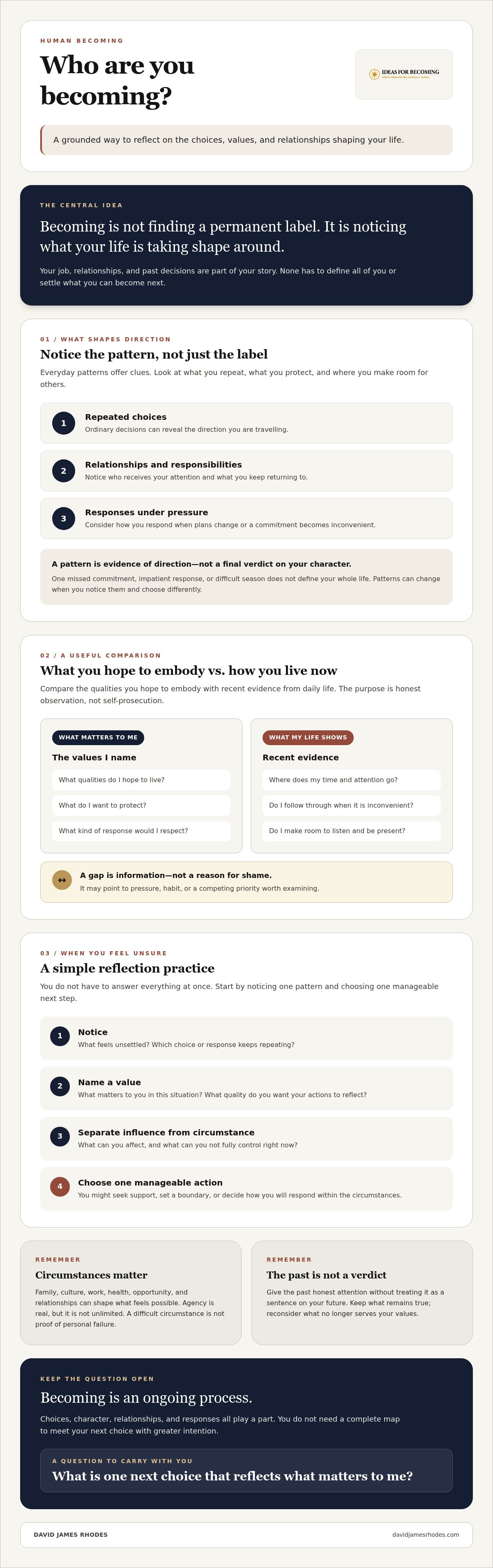
Uncertainty doesn’t always call for a grand decision. Sometimes it calls for a pause long enough to see what is happening, followed by one deliberate response that fits your life now. This practice won’t predict the future or settle your identity. It can help you meet the next choice with more care.
Pause, notice what’s happening, name a value, choose one small action, then review what you learned. Adapt each step to your circumstances. If you have little time or energy, keep the reflection brief.
Which questions help you reflect without judging yourself?
Begin with observable details. Before deciding what an event says about your worth or character, describe what happened as plainly as you can. Consider these questions:
- What recent action expressed care, courage, honesty, or responsibility?
- Where did circumstances limit my options or capacity?
- Is there another response available to me next time, even if I can’t change the situation itself?
- What value do I want to bring into this moment?
“I didn’t call because I felt overwhelmed” is an observation. “I’m a selfish person” is a sweeping judgment. The first leaves room to understand what was difficult and decide what to do next. The second turns one moment into a verdict.
How can you turn reflection into one deliberate next step?
Choose an action small enough to attempt in your actual daily life. If connection matters, you might give someone your attention during a conversation. If responsibility matters, you might clarify what you can realistically take on before agreeing. Link the action to a relationship, duty, or priority that already matters. It doesn’t need to prove anything about you.
Afterward, review what happened. Did the action fit the situation? What made it easier or harder? Is there something you would adjust next time? An honest review allows for an honest answer, including “I couldn’t do it today.” Adapt your next step rather than demanding instant transformation.
The question who am i becoming doesn’t require you to solve your whole life at once. Reflection can support a decision, but it can’t guarantee an outcome or replace professional care when that’s needed. To explore this broader perspective, read David James Rhodes’ writing on human becoming.
How Does Human Becoming Offer a Way Forward?
Becoming isn’t a destination where every question is finally settled. It continues through the actions you take, the character you practise, the relationships you tend, and the way you respond when life changes course. You can’t control every condition or guarantee an outcome. You can still consider what kind of response is possible now.
David James Rhodes writes about human becoming as a philosophy informed by experience across leadership, adversity, and other human contexts. That experience offers a perspective, not scientific proof or a universal formula. The idea doesn’t prescribe one identity for everyone. It asks you to take part in shaping the person your life is forming.
What does “The Way is not something you find” mean?
It means there may be no perfect path waiting to remove doubt. A way forward can emerge through how you act within the life in front of you. That doesn’t make every obstacle a choice or promise that effort will produce the result you want. It places responsibility where it belongs: not in controlling everything, but in deciding how to meet what you can influence.
In THE WAY, that idea becomes a central principle: The Way is not something you find. It is someone you become. David’s writing explores The Way as a philosophy for meeting life, not as a perfect path that eliminates uncertainty.
Where can you continue exploring human becoming?
The question who am i becoming brings together the reflections in this article. Look at your patterns without reducing yourself to a label. Consider the pressures you face alongside the choices still available to you. Then choose one action that expresses a value you want to live and learn from what happens.
David James Rhodes’ broader writing explores identity, character, purpose, and the ongoing work of becoming. If this way of thinking speaks to you, explore THE WAY and its central philosophy. Begin with the next honest choice in front of you. No grand declaration is required.
Carry the Question Into Your Next Choice
The question “who am i becoming” doesn’t ask you to define yourself forever. It asks you to notice the direction your choices, relationships, and responses are shaping. Your hopes offer a sense of direction; your daily actions offer evidence. Neither needs to become a verdict.
When you feel uncertain, pause and look honestly at what’s happening. Name a value that matters, choose one action you can take within your circumstances, then learn from the result. Change doesn’t require perfection. It asks for attention, responsibility, and a willingness to begin again when needed.
David James Rhodes’ perspective on human becoming draws on more than four decades of experience across 156 countries, informed by leadership, entrepreneurship, behavioral health, and human experience. This is perspective, not scientific proof. In The Way, he explores the idea that a way forward is shaped by who you become, not simply found in advance. Explore The Way and David’s perspective on human becoming.
You don’t need to settle every question today. Begin with one honest choice, and let the next one become clearer.
Frequently Asked Questions
Is it normal to question who I am becoming?
Yes, questioning who you are becoming can be a natural response to change, achievement, disappointment, or a shift in what matters to you. It doesn’t automatically mean something is wrong. You might be noticing that an old goal or role no longer fits, or that your daily choices deserve a closer look. You don’t need to settle the question immediately. Start by noticing what has changed and what still feels important.
How can I tell if I am becoming someone I do not want to be?
Look for recurring patterns that conflict with values you care about, such as avoiding honest conversations or repeatedly neglecting important relationships. Don’t treat one mistake or a demanding period as proof of who you are. Consider what circumstances may be contributing, then ask whether a different response is available. A trusted person’s perspective may help you see patterns you’ve missed, especially when you invite honest feedback without asking them to define you.
Can people change who they are?
People can change how they act, relate, and respond, though change doesn’t mean erasing the past or becoming a completely different person overnight. You might learn to pause before reacting, keep commitments more consistently, or repair harm when you make a mistake. Circumstances can limit what’s possible, and progress may be uneven. Focus on the next response you can influence, rather than demanding certainty about who you’ll be in the future.
What habits shape who I am becoming?
Habits that shape who you are becoming include how you listen, use your attention, keep commitments, and respond under pressure. Small repeated actions can express what you prioritize, but they don’t permanently define you. Notice which habits support the relationships and responsibilities you value. If a pattern isn’t serving you, choose one realistic adjustment, such as giving someone your full attention during a conversation or pausing before replying when you feel rushed.
How do I figure out who I want to become?
Start with qualities you respect, such as courage, patience, honesty, or care. Ask what each quality would look like in your actual life, then consider recent moments that support or challenge your sense of how you’re living. Notice obstacles before deciding what to change. Choose one small action that expresses the quality and review what happens. This reflection can clarify a direction without requiring you to settle on a permanent identity label.
What happens if my goals no longer fit me?
If a goal no longer fits, pause before treating that change as failure. Ask why you chose it, what it once represented, and whether those reasons still matter. Your values and circumstances can shift. You might adapt the goal, set it aside, or pursue the underlying value another way. For example, a career goal may have represented creativity or contribution. You can reconsider how to honour that value without forcing yourself to follow an outdated plan.
Does becoming yourself mean ignoring other people’s expectations?
No. Other people’s expectations can reflect care, shared responsibilities, or useful advice. The question is whether you can consider them without letting every expectation decide for you. Ask what commitments you genuinely accept, what boundaries you need, and which choices align with your values. Becoming more deliberate doesn’t mean disregarding the people affected by your decisions. It means taking their needs seriously while also taking responsibility for the life you are shaping.
Frequently Asked Questions
Related Articles

Executive Identity Crisis: When Success No Longer Feels Like You
Facing an executive identity crisis? When success no longer feels like you, discover who you are becoming beyond your title and clarify what matters next.

Leadership for the Next Generation: Lead Through Character and Becoming
Explore leadership for the next generation through character, judgment, and responsibility. Learn how to guide emerging leaders without dictating their path.

Speaker on Adaptive Leadership in a Complex World: A Buyer’s Guide
Find the right speaker on adaptive leadership in a complex world. Learn how to assess real depth, navigate uncertainty, and choose a talk that equips leaders.