
What if success has become the very thing making you question who you are? An executive identity crisis can begin when your career looks accomplished from the outside, but the role, recognition, and responsibility no longer feel like a complete reflection of you. Achievement once offered direction. Now the next milestone may feel distant, or you may wonder whether asking these questions puts your career or relationships at risk.
That uncertainty doesn’t mean you’re ungrateful, and it doesn’t automatically mean you need to walk away. It does deserve attention. Burnout, stress, and a deeper loss of connection to your professional identity can overlap, but they aren’t the same experience. Understanding the difference can help you respond thoughtfully instead of making a sudden decision under pressure.
This article explores why success can unsettle your sense of self, how an executive identity crisis differs from related struggles, and what you can do to examine who you are beyond your title. You’ll find practical questions for reconnecting with your values, relationships, and responsibilities, then consider a measured next step. The aim isn’t to reject what you’ve built. It’s to ask who you’re becoming within it.
Key Takeaways
- An executive identity crisis describes tension between your professional role and sense of self; it isn’t a clinical diagnosis.
- Examine identity beyond title and achievement by considering the values, relationships, choices, and commitments that matter to you.
- Burnout, identity questions, and broader life transitions can overlap, but a comparison alone can’t determine what you’re experiencing.
- Before making a major career decision, notice what feels unsettled, clarify your values, and consider a small change before reviewing what shifts.
- Explore identity as something shaped by who you become, not only by the role you hold.
What an Executive Identity Crisis Can Mean Beyond Career Doubt
An executive identity crisis is a period of questioning how your professional role, achievements, and personal sense of self fit together. The work may still matter. The uncertainty is about whether the person you have become through work reflects the person you want to be beyond it.
The phrase is descriptive, not a diagnosis. It doesn’t confirm a mental health condition, and no list of feelings can prove that you’re experiencing one. It names a tension: your career may look successful to others while your own sense of meaning or direction feels less certain. That mismatch deserves thoughtful attention, but it doesn’t mean every executive will experience it or that success itself is the cause.
When a leadership role starts to feel like the whole self
Leadership brings visible markers of identity: a title, authority, responsibility, and recognition. Over time, those markers can become closely tied to how you understand your value and place in the world. Professional identity is one part of that process; Professional Identification describes a sense of connection with one’s profession.
Consider an executive who has spent years being the person others rely on. In a quiet moment away from work, they may wonder what remains when no one needs a decision from them. That question doesn’t make their work meaningless. Commitment to a demanding role is different from believing that achievement is the only measure of personal worth.
Why success can bring identity questions into focus
A long-pursued goal can change the questions in front of you. After reaching a senior role, building a company, or delivering a defining result, the next target may not carry the same pull. That doesn’t erase the effort or make the achievement a mistake. It may reveal that accomplishment alone can’t answer what matters next.
Other moments can invite reflection, too. A changed role, an organizational shift, or a transition in personal life may alter familiar routines and expectations. These aren’t universal causes. They’re prompts to examine what has changed, what still feels meaningful, and whether your sense of self has room for more than your responsibilities at work.
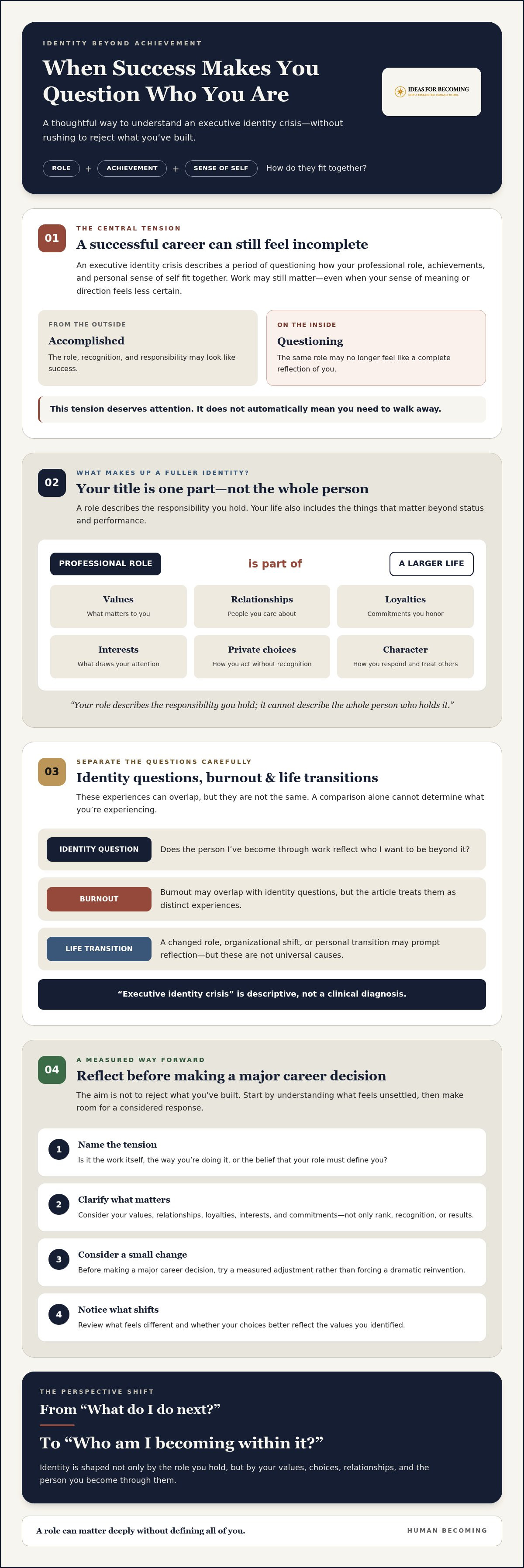
An executive identity crisis doesn’t demand an immediate resignation or dramatic reinvention. Start by naming the specific tension. Is it the work itself, the way you’re doing it, or the belief that your role must define you? That distinction creates space for a considered response.
How Executive Identity Forms Around Role, Achievement, and Responsibility
A professional role can shape how you see yourself, as can the decisions you make while carrying it. An executive’s identity may reflect not only a title, but also how they exercise authority, respond to pressure, treat colleagues, and honor commitments when the choice is difficult.
That identity is still only part of a larger life. Values, relationships, loyalties, interests, and private choices matter, too. A person may be a chief executive at work, a parent or partner at home, a friend to someone in need, and a learner in areas where no title offers authority.
The difference between executive role identity and personal identity
Role identity is the meaning you associate with a position and its responsibilities. It can be a source of purpose, belonging, and pride, without containing your whole sense of self. Try naming three parts of your life that don’t depend on your title, status, or performance. What do those parts ask of you? What do they make possible?
Your role describes the responsibility you hold; it cannot describe the whole person who holds it.
When achievement becomes the main measure of worth
Ambition isn’t inherently harmful, and there’s no need to dismiss achievement to examine its place in your life. The tension arises when external measures, such as rank, recognition, or results, become the only measures that count. A demanding role may reward visible outcomes. Character is often revealed in less visible choices.
Consider a few questions. Have your ambitions made room for the relationships you value? Under pressure, are you acting in ways you respect? Which commitments do you keep when there’s no recognition attached? These aren’t tests with correct answers. They’re ways to notice whether a life built around achievement still reflects your values.
David James Rhodes’s idea of human becoming is a philosophical lens, not a clinical method or a claim about what research has established. It turns attention toward the person taking shape through choices and actions: not simply what you have achieved, but who you are becoming as you achieve it. For more of that perspective, explore David’s writing on human becoming.
In an executive identity crisis, this distinction can help you examine your professional life without reducing yourself to it. Your position matters. So does the person you are beyond its demands.
Executive Identity Crisis or Burnout? Understand the Difference Carefully
Questions about who you are at work can arise alongside exhaustion, a major life change, or several pressures at once. The distinction matters, but a comparison can only help you describe what’s happening. It can’t diagnose the cause or tell you what decision to make.
| Experience | Questions it may bring forward |
|---|---|
| Identity questions | Does this role still reflect my values? Who am I beyond my work and achievements? |
| Work-related exhaustion | Am I depleted by the demands, pace, or strain of work? What might help me recover or change those conditions? |
| Broader life transition | Has a change in my personal life, responsibilities, or circumstances altered what matters to me? |
These experiences can overlap. Exhaustion may make reflection harder, while uncertainty about purpose may coexist with demanding work. A change in personal circumstances may also affect how a professional role feels. There isn’t a clean line visible from a short description. Use the table to notice context, not as a test.
What an identity question can sound like
For one person, it might be, “If I weren’t measured by results, what would I value?” For another: “Does the way I lead reflect the kind of person I want to be?” These are examples, not diagnostic signs. An executive identity crisis is one possible way to describe such questions, but uncertainty can have many causes. It deserves context before it receives a label.
Questioning a career isn’t proof of weakness, ingratitude, or inevitable failure. You can respect what you’ve built and still ask whether it fits your life now. Reflection isn’t a rejection of achievement. It’s a way to understand what achievement means to you.
When burnout or another concern may need professional attention
Sustained exhaustion and questions of identity aren’t interchangeable. One may center on feeling worn down by ongoing demands; the other may center on the relationship between work and self. Either can be complicated, and you may be facing both, or something else entirely.
If distress is persistent, severe, or disrupting daily functioning, consider speaking with a qualified health professional. Reflection can help you find words for your experience, but it doesn’t replace professional assessment or care. You don’t need to settle on a label before asking for support.
How to Navigate an Executive Identity Crisis Without Rushing a Career Decision
When your sense of self feels unsettled, resignation can appear to offer immediate relief. Sometimes change is right. But a decision made only to escape discomfort may leave the deeper question untouched. Reflection can guide action without requiring you to resign today.
Try a measured sequence: notice the tension, identify where it appears, clarify what matters, test a small change where feasible, then review what you learn. This isn’t a formula for finding one correct answer. It makes room for judgment while respecting real responsibilities.
Questions that help separate personal values from inherited expectations
Some ambitions remain deeply chosen. Others may continue through habit, family expectations, professional culture, or the desire to prove something. Consider asking:
- Which parts of my ambition still feel like mine?
- What do I want my relationships to receive from me, alongside my work?
- Which responsibilities reflect my values, and which have I accepted without examining them?
- Under pressure, what kind of leader and person do I want to be?
There is no single correct executive identity. These questions are useful not because they produce a quick verdict, but because they help you see the difference between what you value and what you’ve learned to pursue.
Small experiments before making a major change
Where your circumstances allow, test a modest adjustment before drawing a final conclusion. You might protect time for a relationship or commitment that has been crowded out, share a responsibility you habitually keep, or reconsider which work deserves your attention. Notice what changes in your energy, priorities, and sense of meaning. These experiments aren’t a substitute for a necessary career move. They can help you understand what you’re moving toward, not only what you want to leave.
Talk through your thinking with trusted people who understand both your character and the practical stakes. That may include someone close to you, a respected colleague, or a qualified professional if distress is persistent or interfering with daily life. If a major disruption is part of the picture, David’s books, including Life After Anything, explore life after adversity and major transitions.
The question behind an executive identity crisis may not be “Should I leave?” It may be “What needs to change, and what do I want that change to serve?” David James Rhodes’s leadership and life advisory work focuses on growth, adversity, and the search for meaning. To consider leadership alongside the person you’re becoming, explore David’s perspective on leadership and life.
From Executive Identity Crisis to Human Becoming: A Way Forward
An executive identity crisis can make a person feel they must choose between professional success and a more honest sense of self. That choice may be false. You can examine what your role means without dismissing your achievements or reducing your identity to a title. The task is to see whether the way you work, lead, and live still reflects what matters to you.
David James Rhodes uses human becoming as a philosophical lens for this question. It isn’t a clinical method or a research-backed intervention. It is an invitation to consider how identity takes shape through choices, conduct, relationships, and responsibility. A role can change. The person you are becoming is shaped by how you meet that change.
Who are you becoming beyond the executive title?
Look beyond the position and consider what you want your decisions to express. Patience? Courage? Fairness? Care for the people who rely on you? These qualities aren’t secured by finding the perfect role. They are practiced in how you act, especially when demands are real and the answer isn’t easy. For a deeper account of this philosophy, explore David’s perspective on The Way.
There may be no final answer to who you are, and no single identity you must perform. There are choices available now: how you listen to a colleague, what you protect time for, and whether you act in line with your values when pressure rises. These actions don’t erase ambition. They can help ambition belong to a larger life.
A next step that respects both ambition and the person behind it
Begin with one reflection, one conversation, and one proportionate action:
- Reflect: Write down what feels misaligned and what you want your work and life to express.
- Talk: Share the question with someone trustworthy who understands the personal and practical stakes.
- Act: Choose a modest, feasible change that lets you learn before making a larger decision.
Then review what the action clarified. It may point toward a change in how you lead, a change in your responsibilities, or a larger transition. Personal reflection can support careful choices, but it doesn’t replace professional support when distress is persistent, severe, or disrupting daily life.
The Way, David James Rhodes’s guide to becoming rather than searching for a perfect path, offers a way to explore these questions. If this question stays with you, consider the idea at its heart: who are you becoming?
Let Success Serve the Person You’re Becoming
An executive identity crisis doesn’t mean your achievements were false or that you must leave your role. It can be a reason to examine how work, responsibility, and the rest of your life fit together. Burnout and identity questions can overlap, but they aren’t interchangeable. A comparison can’t replace professional support when distress is persistent or disrupting daily life.
Start with what you can observe: name the tension, consider the values and relationships you want your choices to honor, and take one proportionate step before making a major decision. Your title matters. It still isn’t the whole measure of who you are.
David James Rhodes’s perspective on human becoming draws on more than four decades of personal and professional experience across 156 countries. That experience informs his thinking; it isn’t scientific proof. His work returns to a larger question: who are you becoming through the way you lead and live? Explore David’s perspective on The Way and consider how its philosophy speaks to that question.
You don’t need every answer today. You can begin by making your next choice with greater care for both your responsibilities and yourself.
Frequently Asked Questions
What is an executive identity crisis?
An executive identity crisis is a descriptive phrase for a period when a leader questions how work, achievement, and personal identity fit together. It isn’t, by itself, a clinical diagnosis, and the phrase can’t explain what’s causing the concern. Consider the wider context: responsibilities, values, relationships, and wellbeing. Naming the question may help you explore it, but it doesn’t replace a fuller understanding of your circumstances.
Can you have an identity crisis while being successful?
Yes. Professional achievement doesn’t automatically settle questions about meaning, personal values, or who you are beyond your role. Feeling uncertain doesn’t make your success false or mean you’re ungrateful. It may be a reason to look more closely at how achievement relates to your sense of self. There isn’t one cause or outcome, and this experience alone doesn’t establish a diagnosis.
How do I know if I am having an executive identity crisis or burnout?
You can’t reliably determine that from a short description or online checklist. Identity questions often focus on the meaning of your role, your values, or your understanding of yourself. Burnout concerns relate to work-related wellbeing. The experiences may overlap, and context matters. If distress is persistent, severe, or affecting daily life, speak with a qualified health professional rather than relying on a label alone.
Should I quit my job during an executive identity crisis?
Not necessarily. Uncertainty alone doesn’t prove that leaving is the right choice. First, identify what feels misaligned, what remains meaningful, and which personal or professional responsibilities need consideration. Where feasible, try a smaller change and discuss the situation with people you trust. If your wellbeing is seriously affected, seek appropriate professional support. A career decision shouldn’t have to carry the full burden of addressing distress.
How can executives rediscover their identity outside work?
Begin by noticing which parts of life receive attention beyond professional demands. Consider relationships, values, commitments, and activities that matter even when they bring no status or measurable result. Then choose one manageable action, such as protecting time for a relationship or returning to an interest you’ve set aside. The aim isn’t to reject ambition. It’s to make room for the larger person behind the role.
Can an executive identity crisis lead to a more meaningful career?
It can prompt useful questions about what meaning at work involves, but no particular outcome is guaranteed. You might change how you lead, reconsider what success means, or make a different career choice. Reflection is a way to understand your priorities, not a promise of transformation. Move at a considered pace, and seek professional support if exploring these questions brings persistent or significant distress.
When should an executive seek professional help for identity concerns?
Consider speaking with a qualified professional if distress persists, feels severe, or interferes with work, relationships, sleep, or everyday functioning. You don’t need to decide what to call the experience before asking for help. An article or personal reflection can’t assess your mental health. A professional can help you understand your circumstances and discuss appropriate support, including whether further assessment or care may be useful.
Frequently Asked Questions
Related Articles

Leadership for the Next Generation: Lead Through Character and Becoming
Explore leadership for the next generation through character, judgment, and responsibility. Learn how to guide emerging leaders without dictating their path.

Speaker on Adaptive Leadership in a Complex World: A Buyer’s Guide
Find the right speaker on adaptive leadership in a complex world. Learn how to assess real depth, navigate uncertainty, and choose a talk that equips leaders.

Guiding the Next Generation: How to Lead Without Defining Who They Become
Learn practical ways for guiding the next generation without control. Support youth agency, set clear boundaries, and honor who they are truly becoming.