
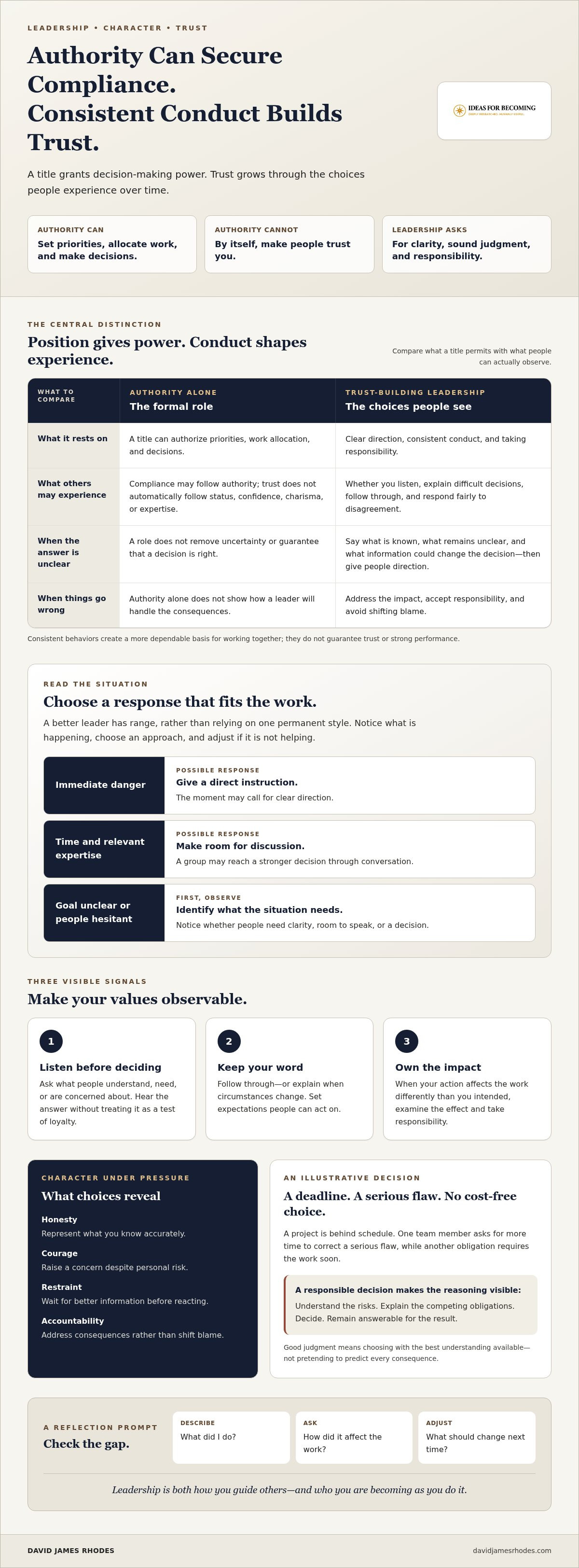
Authority can make people comply. It cannot, by itself, make them trust you. Becoming a better leader starts with choices people can see: whether you listen before deciding, keep your word when it costs you, and take responsibility when things go wrong. Expertise matters. So does the character behind it.
If you’ve ever wondered which leadership skills matter when pressure rises, you’re not alone. The answer isn’t a collection of slogans or a perfect leadership style. It’s acting consistently while staying willing to learn, even when the right course isn’t obvious.
This article will help you identify what better leadership asks of you, make clearer decisions, and build a practical routine you can adapt as circumstances change. We’ll look at trust, judgment, communication, and the daily practices that shape how others experience your leadership. The work is both outward and inward: how you lead people, and who you are becoming as you do it.
Key Takeaways
- Leadership is earned through clear direction, consistent conduct, and responsibility, not through authority alone.
- To build trust, bring your decisions and daily actions into closer alignment with the values you express.
- Choose a directive, participative, or coaching approach based on what the situation and people need.
- Make becoming a better leader a practical habit: observe, choose one focus, act, seek perspective, and reflect.
- Use leadership challenges to consider not only what you do, but who you are becoming.
Becoming a Better Leader Starts With More Than Learning New Techniques
A title gives someone authority to set priorities, allocate work, or make a decision. It doesn’t tell you whether people will trust that person when the situation becomes difficult. Trust develops through what a leader does over time: how clearly they explain the work, how fairly they respond to disagreement, and whether they accept the consequences of their choices.
Better leadership is the practice of helping people move toward shared work with clarity, sound judgment, and responsibility. It shows up in decisions and conduct, not automatically through status, confidence, charisma, or expertise.
Those qualities can help someone lead, but none substitutes for the work itself. A compelling speaker may leave a team uncertain about its next step. A quiet manager may help people focus by asking a clear question, listening carefully, and making a decision they can understand. Leadership isn’t a performance of certainty. It’s an accountable relationship with people and purpose.
What does it mean to become a better leader?
Leadership means taking responsibility for direction and for the effect your actions have on others. The right action depends on the moment. A team facing immediate danger may need a direct instruction. A group with time and relevant expertise may reach a stronger decision through discussion. Neither response has to define a person’s permanent style.
The wider field of Leadership Development includes both individual growth and collective approaches. In practice, becoming a better leader means learning to read the situation, understand what the work requires, and choose an approach that serves the people involved rather than your preferred image of yourself.
That calls for range, not a single ideal personality. Notice what is happening. Are people unclear about the goal, hesitant to speak, or waiting for a decision? Let what you observe shape your response. Then pay attention to the result and adjust if your approach isn’t helping.
Why good intentions are not enough
Intentions matter, but others can’t experience what you meant to do. They experience whether you followed through, explained a difficult decision, or made room for concerns. The gap between self-image and impact can be uncomfortable. It is also where useful learning begins.
Illustrative workplace scenario: Imagine a manager who believes they are giving a colleague room to work independently. They delegate a task, then change its direction without explaining why. The manager may see flexibility. The colleague may experience uncertainty and feel that their judgment doesn’t matter. This is an illustration, not a report of a specific case.
A leader can explore that gap without guessing: describe the action, ask how it affected the work, and listen without immediately defending the intention. If the impact differs from what you hoped, take responsibility for the difference. The goal isn’t to appear flawless. It’s to make the next choice with a clearer understanding of what others need.
The Inner Foundations of Better Leadership: Character, Judgment, and Trust
Trust is tested by the distance between what a leader says matters and what their choices show matters. A leader may speak about fairness, then make exceptions without explanation. They may praise candor, then punish the first person who raises a difficult concern. People notice these contradictions, even when no one names them aloud.
Character isn’t a claim about who you are. It becomes visible in what you choose, especially when the choice is uncomfortable. Honesty means representing what you know accurately. Courage can mean raising a concern despite personal risk. Restraint may mean waiting for better information before reacting. Accountability means addressing the consequences rather than shifting blame.
Character becomes visible in difficult decisions
Illustrative scenario: A project is behind schedule. One team member asks for more time to correct a serious flaw, while another obligation requires the work to be delivered soon. There may be no choice without cost. The leader’s task is to understand the risks, explain the competing obligations, decide, and remain answerable for the result.
Good judgment doesn’t require pretending to be certain. A leader can say what is known, what remains unclear, and what information could change the decision. That honesty must sit alongside action. Uncertainty isn’t a reason to leave others without direction.
Judgment means choosing with the best understanding available, then accepting responsibility for what that choice brings. This is a practical principle, not a claim that leaders can predict every consequence. David James Rhodes’s perspective, shaped by experience in leadership and other demanding settings is that character is revealed in these moments of responsibility. That perspective is not scientific proof.
Trust is built through relationships and consistency
Trust doesn’t come from one impressive conversation or a promise made at the right moment. It takes shape through repeated interactions: listening closely enough to understand a concern, setting expectations people can act on, and following through or explaining when circumstances change. These behaviors don’t guarantee trust or strong performance. They create a more dependable basis for working together.
Self-awareness matters because a leader’s intent and a colleague’s experience can differ. A leader may believe they are being decisive; others may experience their approach as dismissive. The useful response isn’t to insist on the intention, but to examine the effect. Ask what was clear, what created confusion, and what should change next time. Then listen without making the answer a test of loyalty.
For anyone becoming a better leader, this is a demanding measure: do your daily decisions match the values you ask others to respect? Start with one recent choice. Consider what you said, what you did, and how the people affected may have experienced it. David James Rhodes explores leadership and personal responsibility through his leadership and life advisory work, grounded in the belief that how we lead is part of who we become.
Leadership Styles and Skills: Choose What the Situation Requires
Leadership isn’t choosing a style and applying it everywhere. It’s noticing what the work and the people need, then responding without losing sight of your principles. A team facing an urgent safety issue may need a clear instruction. A team solving a complex problem may need time to surface different perspectives. The skill isn’t being directive or collaborative by nature. It’s knowing when each approach can serve the work.
Effective leadership adapts its response without surrendering its principles. The examples below are options to consider, not rules that can decide for you.
Situation: An urgent issue needs immediate coordination. Useful approach: Directive, with clear steps and ownership. Risk: People may feel shut out or miss important information. Adjustment: Explain the reason, invite essential facts, and review the decision when time allows.
Situation: A decision depends on knowledge held across the team. Useful approach: Participative, gathering views before deciding. Risk: Discussion may become unfocused, or people may mistake input for a promise of consensus. Adjustment: Set a clear question, invite relevant perspectives, then explain who decides and why.
Situation: Someone is learning a task or building judgment. Useful approach: Coaching, using questions, feedback, and room to try. Risk: Too little direction can feel like abandonment. Adjustment: Agree on the goal, boundaries, and when to check in.
When to provide direction and when to invite participation
Consider urgency, clarity, and experience together. If delay could create serious harm, give direct guidance and make responsibilities plain. If the problem is unclear and the team holds knowledge you don’t, invite perspectives before settling on a course. When colleagues are experienced, participation can reveal risks or options you might miss on your own. A new or uncertain team may need more structure first.
Participation doesn’t transfer accountability. You can hear competing views, weigh them, and still make the decision. Be clear about whether you’re asking for information, recommendations, or shared agreement. That distinction helps prevent people from believing they have authority they don’t actually hold.
How to recognize when your approach is not working
Repeated confusion, unmet expectations, silence, or unresolved disagreement can be reasons to pause. They aren’t proof that your approach has failed. People may be quiet for different reasons, and a demanding task can create confusion even with good leadership. Treat these signals as prompts to ask what is happening.
Is the goal unclear? Is the decision already made but being presented as open? Does the team need firmer boundaries, more room to contribute, or a chance to build capability? Becoming a better leader often means changing the method while holding steady to honesty, respect, and responsibility. David James Rhodes’s leadership and life advisory brings this practical attention to how people lead through changing circumstances.
A Practical Leadership Practice You Can Begin This Week
Leadership practice doesn’t require a new system or a spare hour each day. Start with one moment that matters: a decision you made, a conversation you avoided, or an expectation that wasn’t clear. Small actions are easier to test in ordinary work, where leadership is actually lived.
Observe what happened, choose one behavior to practice, act, seek another perspective, and reflect on what you’ll adjust next time. Repeat the cycle as a way to pay attention and learn from experience, not as a formula that guarantees change.
- Observe. Identify a recent leadership moment that still occupies your attention. Describe what happened as plainly as you can, without treating your first interpretation as fact.
- Choose a focus. Select one behavior within your influence, such as stating a deadline clearly or asking a colleague what information you may be missing.
- Act. Try that behavior in a real conversation or decision. Keep the step modest enough to carry out without waiting for ideal conditions.
- Seek perspective. Ask someone involved what they noticed. Listen for what you hadn’t considered, while remembering that one person’s account is useful information, not the whole truth.
- Reflect. Consider what helped, what didn’t, and what you’ll try next. Name one adjustment rather than judging your entire ability to lead.
Use one real leadership moment as your starting point
Choose a recent decision or conversation that you keep replaying. Separate three things: what happened, what you assumed it meant, and what you can influence now. Perhaps you can clarify an expectation, explain the reasoning behind a decision, or return to a concern you brushed aside. Pick one action you can recognize when you take it. “Improve communication” is too broad. “Ask the team to summarize the next step before we leave” is specific enough to practice.
Turn reflection into a repeatable routine
After a consequential meeting or decision, take a few quiet minutes to record what you saw. Whose perspective did you hear? Whose did you miss? What did people understand about the decision, and what remains uncertain? A trusted colleague may notice an effect you didn’t intend. Ask for a concrete observation, then weigh it against the wider context. Feedback deserves attention, not automatic obedience.
Reflection and repetition can support learning, but neither guarantees transformation. The point isn’t to become flawless. It’s to notice more, take responsibility for your next choice, and keep adjusting. That is a practical way to approach becoming a better leader without turning leadership into a slogan.
For support in applying these questions to the responsibilities you carry, explore David James Rhodes’s leadership and life advisory.
The Way: Leadership as an Ongoing Process of Becoming
Clearer decisions, thoughtful listening, and consistent follow-through are practical parts of leadership. They don’t form a final checklist. Each situation asks you to use judgment again: consider what the work requires, how your actions affect others, and whether you’re willing to learn from the result.
This is where the practical question of leadership meets a larger one of identity. The Way, David James Rhodes’s philosophy of human becoming, offers a perspective on that ongoing work. It doesn’t replace leadership skills, evidence, or attention to context. It asks what your choices are shaping in you.
Connect leadership choices to the person you are becoming
The values a leader expresses take form in ordinary decisions. You say you value openness, then someone brings you unwelcome information. You say you value responsibility, then a plan fails. In those moments, your response can reinforce your stated values or reveal a gap between what you intend and what you practice. Either way, there is something to learn.
Success doesn’t end the process. It can create new responsibilities and new questions. Uncertainty may call for patience, change may require you to revise a familiar approach, and setbacks may show where you need help or better information. None of these circumstances follows one fixed route or timeline. Becoming a better leader means continuing to pay attention and choosing your next action with care, not expecting yourself to have arrived.
The Way expresses this idea simply: “The Way is not something you find. It is someone you become.” In leadership, that means the path forward is shaped partly by how you meet the moment in front of you. What you protect under pressure matters. So does your willingness to acknowledge when your judgment needs to change.
Continue the work beyond a single article
David James Rhodes draws on more than four decades of experience across 156 countries, including work in leadership, entrepreneurship, and advisory roles. That experience informs his perspective; it isn’t proof that one approach will work for every leader or team. People, responsibilities, and circumstances differ. Useful principles still need to be considered in context.
Leadership also reaches beyond the workplace. The way we carry responsibility at work can affect our relationships, priorities, and sense of purpose elsewhere. Rhodes’s leadership and life advisory considers these connections, recognizing that personal growth is bound up with everyday decisions.
If you want to explore the wider philosophy behind this view, explore The Way, a guide to human becoming and the ongoing work of asking who you are becoming.
Carry Your Leadership Into the Next Moment
The next test of leadership may be an ordinary moment: a pause before answering, a decision that asks you to reconsider, or a conversation you could approach with more care. You don’t need to control every outcome to lead with intention. You can choose how you meet what comes next.
Becoming a better leader isn’t a finish line. It’s a continuing commitment to examine your choices and remain open to what they teach you. The question isn’t whether you’ll get every decision right. It’s whether you’re willing to keep learning, take responsibility, and act with greater care.
The Way offers a wider perspective on human becoming and the question of who you are becoming. If you want to explore that perspective further, explore The Way and the process of human becoming.
Keep going. The next thoughtful choice is a place to begin.
Frequently Asked Questions
Can anyone become a better leader?
Most people can strengthen behaviors that help them lead, though growth won’t look the same for everyone. Start with a responsibility you already have, such as organizing a shared task or helping resolve a disagreement. Notice what the situation asks of you, then practice one response. Progress depends on willingness to learn, the opportunities available, and how consistently you apply what you learn.
What is the first step to becoming a better leader?
Choose one recurring situation where your actions could help others work more effectively. Perhaps meetings end without clear owners for next steps. Before the next meeting, decide to close by naming who will do what and by when. Keep the action specific enough to observe. Afterward, check whether it helped the group move forward, then refine it instead of setting a vague goal to “lead better.”
How can leaders build trust with their teams?
Make it easier for people to raise a concern before it becomes a larger problem. For example, if a team member flags a risk, thank them for bringing it forward and discuss what happens next, even if you can’t resolve it immediately. Be clear about what you can address and when you’ll follow up. Trust takes shape over time; no single response can guarantee it.
Is leadership something you are born with or can learn?
Leadership isn’t reserved for people with a particular personality. Some may find speaking up or making decisions more natural than others, but skills such as clarifying a goal, handling disagreement, and sharing responsibility can be practiced. Learning often starts with noticing what you avoid. If difficult conversations feel uncomfortable, prepare one clear question and make space to hear the answer.
What should a leader do when they do not know the answer?
Say plainly what you don’t know, then make a plan to find out. For instance, if asked whether a deadline is realistic, explain which information is missing, identify who can help clarify it, and set a time to return with an update. Don’t guess to preserve an image of certainty. A clear next step helps people understand what they can rely on.
How can I improve my leadership skills without a formal title?
Look for places to make shared work easier without assuming authority you haven’t been given. You could help a group agree on a purpose, summarize a discussion for absent colleagues, or offer to coordinate a task everyone has overlooked. Ask before taking ownership, and keep commitments modest. These actions let you practice responsibility while respecting the roles and decisions of others.
How do you know whether your leadership approach is working?
Look beyond whether people agree with you. Check whether they can explain the goal, know what they’re responsible for, and raise practical concerns early enough to act on them. You might ask a colleague, “What would make this process easier to follow?” Compare the answer with what you observe over time. One reaction is a clue, not a complete measure of your impact.
Frequently Asked Questions
Related Articles

Best Leadership Guides for Executives: A Thoughtful 2026 Selection
Searching for the best leadership books for executives? Discover thoughtful leadership guides matched to real executive challenges, strategy, and character.
Executive Coach vs. Advisor: Which Kind of Support Does a Leader Need?
Choosing between an executive coach vs advisor? Learn how to match the right support to consequential leadership decisions and the leader you are becoming.

Executive Advisory on Purpose and Fulfillment: A More Human Way Forward
Seek executive advisory on purpose and fulfillment to align leadership choices with values and character. Discover who you are becoming beyond outward success.