
A title on the door won’t make a consequential decision clearer. The real question in the executive coach vs advisor choice is what the moment calls for: space to examine your own thinking, a seasoned perspective to help you see the decision in context, or both.
It’s easy to feel uncertain. Coaching, advising, mentoring, and consulting can sound interchangeable, even though they offer different kinds of support. Advice may feel too prescriptive when you need to reach your own conclusion. Coaching may feel too abstract when a difficult decision is waiting.
Neither is inherently better. This article explains what each relationship can offer, how to distinguish coaching from advising and related forms of support, and what to clarify before you begin. The aim is to match support to the work in front of you, so your decision serves not only the demands of leadership but also the person you’re becoming.
Key Takeaways
- Choose between an executive coach vs advisor by identifying whether you need space to examine your thinking, experienced perspective, or both.
- Look beyond titles. Compare the conversation style, contribution, and emphasis each kind of support brings.
- Match support to the situation, your preferred way of working, and how soon a decision needs to be made.
- Before an initial conversation, define the challenge and what a useful outcome would look like.
- Consider how leadership decisions connect to the person you are becoming, not only to the immediate result.
Executive Coach vs. Advisor: Why the Distinction Matters to Leaders
A leader can be capable and experienced yet still struggle to see the next move. A new role brings unfamiliar expectations. A consequential decision involves risks that are difficult to weigh alone. A leadership impasse can persist even when everyone understands the facts. Support may help, but the labels are often blurred.
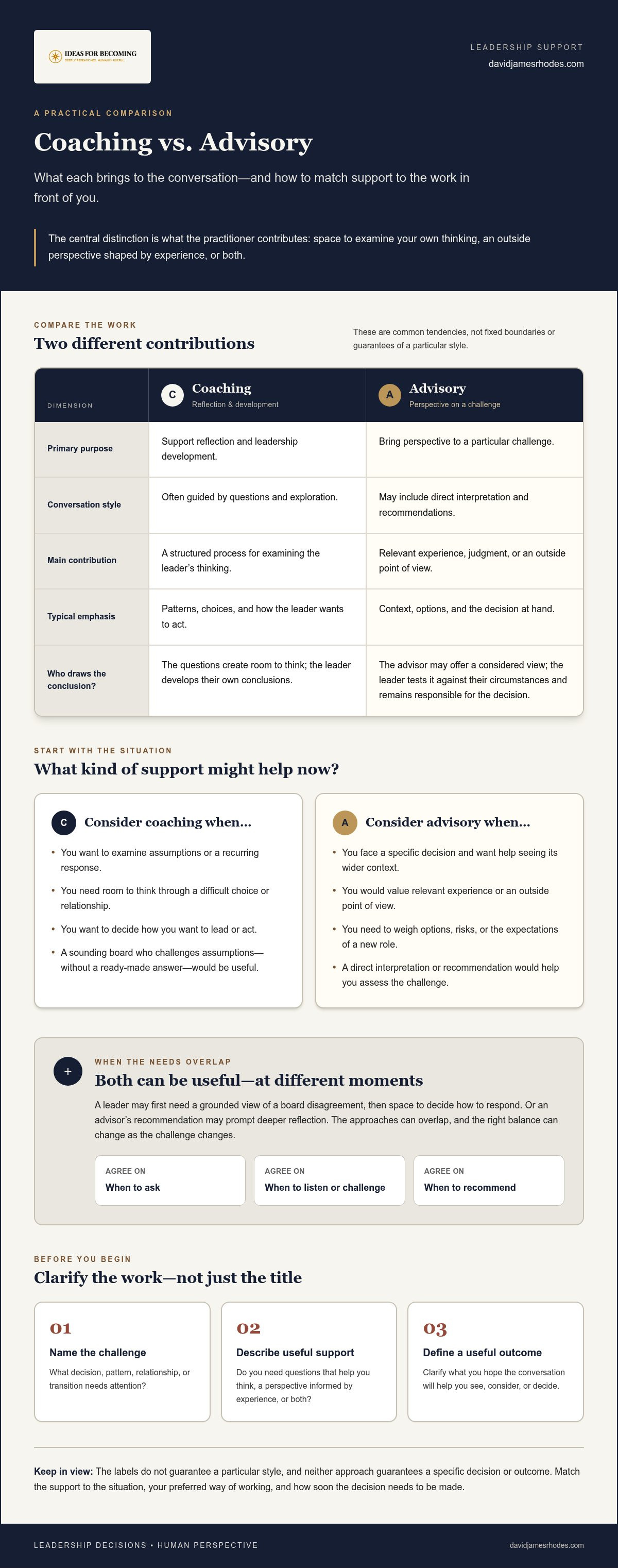
The central distinction is what each person contributes. Coaching commonly creates space for reflection, helping a leader examine assumptions and develop their own conclusions. Advising commonly brings an outside perspective and relevant experience to help clarify a specific challenge. The practical question is: do you need to think more clearly, benefit from someone else’s perspective, or combine both?
What executives usually mean when they seek a coach or advisor
The executive coach vs advisor decision often begins with an immediate pressure: “How should I handle this?” Beneath that may be another question: “What in my leadership is making this difficult?” A leader taking on a larger role may need perspective on the responsibilities ahead and room to decide how they want to lead. Someone facing a board disagreement may first need a grounded view of the situation and its stakes.
These needs aren’t interchangeable. One leader may want a sounding board who challenges assumptions without offering a ready-made answer. Another may value advice informed by experience with similar decisions. A third may need both, at different moments. The goal isn’t to choose the more impressive title. It’s to name the work the support needs to help you do.
A useful starting definition for each role
Coaching often centers on questions, reflection, and attention to the client’s own thinking. A coach may help a leader notice a recurring response, examine what matters in a difficult choice, or consider different ways to approach a conversation. The coach’s contribution is often the process of inquiry rather than a prescribed answer.
Advising may involve a more direct exchange. An advisor can contribute relevant experience, offer an interpretation of the circumstances, or recommend a course of action. During a transition, for example, a leader might ask how to weigh the expectations of a new position against the organization’s culture. An advisor may offer a perspective informed by comparable leadership situations while leaving the decision with the leader.
These are useful starting points, not fixed boundaries. The approach can vary by practitioner, engagement, and organizational context. Some coaches share observations or challenge clients directly. Some advisors ask careful questions before offering a view. The role labels also aren’t universal definitions that guarantee a particular style of conversation.
Before deciding, consider what would make support useful now. Do you need help seeing your own pattern, or insight into the decision’s wider context? The answer can guide your choice more reliably than status or title, and it may change as the challenge changes.
How Executive Coaching and Advisory Work Differ in Practice
The distinction becomes clearer when you consider what happens in the conversation. A coach may help an executive examine a difficult relationship with a colleague, notice how they respond under pressure, and decide what they want to change. An advisor may help interpret the situation, identify considerations the leader hasn’t weighed, or offer a recommendation based on relevant experience.
| Dimension | Coaching | Advisory |
|---|---|---|
| Primary purpose | Support reflection and leadership development | Bring perspective to a particular challenge |
| Conversation style | Often guided by questions and exploration | May include direct interpretation and recommendations |
| Contribution | A structured process for examining the leader’s thinking | Relevant experience, judgment, or an outside point of view |
| Typical emphasis | Patterns, choices, and how the leader wants to act | Context, options, and the decision at hand |
This table describes common tendencies, not a promise about what any engagement will deliver. A coach’s questions may help a leader see an overlooked option. An advisor’s recommendation may prompt deeper reflection. Neither approach guarantees a particular decision or outcome. The title alone is not evidence of impact; the value depends on the specific work and circumstances.
Who brings the questions, experience, and recommendations?
In coaching, the practitioner often shapes the inquiry while the executive remains responsible for drawing conclusions. For instance, a leader who avoids difficult conversations might be asked what they fear will happen, what the avoidance is costing, and what response would reflect their values. The questions create room to think. They don’t decide what the leader should do.
In advisory, the leader may bring a concrete problem and receive a considered point of view. An advisor with relevant operating experience might explain how a decision could affect a team, organization, or relationship. That perspective can be useful, but it still needs to be tested against the leader’s circumstances. The roles can overlap, so agree on when the advisor will ask, listen, challenge, or recommend.
What changes when the challenge is personal as well as professional?
Leadership decisions rarely stay confined to a job description. A change in role may affect family relationships, personal values, or a leader’s sense of responsibility. Before recommending a course of action, an advisor needs enough context to avoid treating a human decision as a narrow business calculation.
Advisory can make room for questions of character and meaning, but it isn’t therapy. Leadership reflection can help someone examine their choices, but it isn’t clinical care. The purpose is to support clearer judgment and deliberate action within the agreed scope of the relationship. For leaders weighing organizational stakes alongside the person they’re becoming, leadership and life advisory offers a perspective that considers the whole challenge.
Executive Coach vs. Advisor: Compare the Fit for Your Situation
Choose support by considering three things: what you need now, how you want to think together, and when the decision must be made. The executive coach vs advisor choice isn’t settled by urgency alone. A deadline may call for swift action, but a complex decision can still require time to understand the people, values, and consequences involved.
| Situation | Possible fit | Why it may help |
|---|---|---|
| You keep making similar decisions and want to understand the pattern. | Coaching | Reflection may help reveal assumptions, habits, and alternative responses. |
| You face a specific leadership choice and want an experienced perspective. | Advisory | An advisor may help interpret the circumstances and consider possible courses of action. |
| A major transition raises both immediate questions and recurring personal challenges. | Blended support | Perspective can address the decision while reflection helps you consider how you want to lead through it. |
| A decision is urgent, but the consequences are not yet clear. | Depends on context | First clarify what is known, what remains uncertain, and whether the immediate need is judgment, reflection, or both. |
Use the table as a starting point, not a verdict. Try completing two sentences: “I need help deciding…” and “I want to understand why I…” If the first is specific and the second points to a deeper pattern, the challenge may call for more than one kind of support. Sequence can matter too. You might seek perspective on the immediate choice, then explore the habits that shaped it.
When coaching may fit the work in front of you
Coaching may suit a leader who wants to develop self-awareness and strengthen independent problem-solving. Perhaps you delay decisions whenever disagreement is likely, or repeatedly choose short-term harmony over a difficult conversation. A reflective process can help you examine the pattern and consider a different response. Coaching isn’t always non-directive, and approaches vary, so clarify how the conversations are expected to work.
When executive advisory may fit the work in front of you
Advisory may fit when a leader wants an experienced view of a specific, consequential challenge. This might involve a change in leadership, a transition between roles, or a work decision with consequences for family life and personal commitments. Recommendations should be grounded in the situation, open to discussion, and weighed against the executive’s own judgment. Experience can widen the view, but it cannot remove the leader’s responsibility to choose.
Neither role is inherently more valuable. A coach may be the better fit when the work is understanding your own response; an advisor may be more useful when you need perspective on the decision itself. The right support fits the actual problem, and that can change as the problem becomes clearer.
How to Choose and Prepare for Executive Support
A useful first conversation begins before you enter the room. You don’t need a complete plan, but you do need a clearer sense of what you want help with. In the executive coach vs advisor decision, preparation helps you identify whether the challenge is a choice to make, a pattern to understand, or a mix of both.
Start with the issue in plain language. “I need to decide whether to accept a larger role” points to a decision. “I keep stepping back when disagreement arises” points to a pattern. The first may call for perspective on conditions and consequences. The second may benefit from reflection on your habits and responses. Naming both can help shape a conversation around the real need.
Three questions to clarify before the first conversation
Use these questions to focus your preparation. Your answers can be tentative. The aim is to make the work more specific, not to solve it in advance.
- What decision, transition, or leadership pattern do I want to examine? Describe the situation and what makes it difficult now.
- Do I want questions, an experienced point of view, or both? Consider whether you’re seeking space to think, context to weigh, or a combination.
- What would make the conversation useful? Name a realistic result, such as clarifying options or identifying a next step, without assuming a guaranteed outcome.
How to recognize a clear, responsible working relationship
Before the work begins, agree on its purpose and how the relationship will operate. Discuss confidentiality, each person’s responsibilities, boundaries, and how you’ll review progress. Clarify whether the practitioner will mainly ask questions, offer recommendations, or move between the two. A shared understanding helps prevent a mismatch between the support you expect and the support you receive.
The executive retains responsibility for decisions and implementation. A coach or advisor can help you consider choices, but they don’t carry the consequences on your behalf. You might review progress by discussing which questions you’re better able to address, what actions you’ve taken, or what has become clearer. Progress need not be reduced to a promise of success.
There are limits to executive support. If what you’re facing involves clinical needs, executive advisory alone isn’t a substitute for care from an appropriately qualified professional. Recognizing that boundary is part of responsible support, not a failure of leadership.
Some decisions are inseparable from the life around them: identity, relationships, values, and responsibilities beyond the role. Leadership advisory and the integration of life and work explores why context matters when choices reach beyond the office. To consider the whole challenge, explore leadership and life advisory with David James Rhodes.
David James Rhodes’s Leadership and Life Advisory: Perspective for the Whole Challenge
A consequential leadership decision rarely belongs to the role alone. A new opportunity may bring questions about ambition, responsibility, relationships, and what a leader is prepared to give up. A setback may call for practical judgment while also challenging a person’s sense of identity. David James Rhodes’s leadership and life advisory supports individuals and executives navigating growth, adversity, and meaning across both the professional and personal dimensions of their choices.
Rhodes’s perspective is shaped by more than four decades of experience across 156 countries, including international finance, entrepreneurship, leadership, and behavioral health. That experience informs how he considers a leader’s circumstances. It isn’t scientific proof, and it doesn’t guarantee a particular result. Its value is in offering a considered perspective that takes the whole situation seriously.
Bring the leadership decision into the larger human context
Suppose an executive is weighing whether to remain in a demanding role or accept a different opportunity. The practical questions matter: What does each role require? What consequences may follow for the organization and the people involved? Beneath them may be a more personal question: What kind of leader am I choosing to become through this decision?
That isn’t an invitation to replace analysis with inspiration. It’s a way to make analysis more honest. A decision can be commercially sound and still conflict with a leader’s values or responsibilities. A difficult choice can also require courage rather than waiting for certainty. The point is not to make every business decision a test of character. It is to recognize that character shows in how a decision is made, who is considered, and what the leader accepts responsibility for afterward.
This connects with The Way’s perspective on becoming: a person does not always find a perfect path in advance. They become someone through choices and actions. In advisory, that idea can bring the leadership question into focus without dictating the answer.
A considered next step for leaders weighing advisory
The executive coach vs advisor question comes down to the work you need the relationship to support. If your challenge calls for a perspective shaped by leadership and life experience, explore David James Rhodes’s leadership and life advisory. The right support should fit the question, not the status of the person providing it.
Before you decide, name the choice in front of you and the perspective you hope to gain. Then consider what the decision asks of you beyond its immediate outcome. Another person can help you examine the terrain. Responsibility for the path you take, and for who you become along it, remains yours.
Choose the Support That Helps You Move Forward
The decision ahead may not become simple just because you have another perspective. But clear support can help you meet it with greater honesty: seeing what the situation asks of you, what you’re responsible for, and what you want your next choice to reflect.
That is the deeper question beneath executive coach vs advisor. It’s not which title carries more weight, but which conversation will help you act with care and conviction. The answer may shift as the challenge changes. Your responsibility for the choice remains.
If a broader perspective would help you consider the leadership decision and the life around it, explore David James Rhodes’s leadership and life advisory. The next step doesn’t need to settle every question. It can begin with the one you’re ready to face, and the person you choose to become through answering it.
Frequently Asked Questions
Is an executive advisor the same as an executive coach?
No, not necessarily. Titles alone don’t tell you how a particular engagement will work. In the executive coach vs advisor choice, ask what a typical conversation looks like, what the practitioner will contribute, and what a useful result might be for your situation. You can also ask how you’ll review the work if your original challenge changes. Specific answers make it easier to judge fit than a title by itself.
Can an executive advisor also coach?
Yes. If a relationship shifts between different kinds of conversation, agree on a simple way to signal that shift. For instance, you might pause before moving from discussing your own assumptions to hearing the advisor’s recommendation. You can also review whether the arrangement is serving its purpose. This makes the process easier to adjust without assuming every meeting needs to follow the same pattern.
How much does an executive coach or advisor cost?
There’s no single fee that applies to every engagement. Cost can depend on the practitioner, scope of work, format, and duration. Before deciding, clarify what the proposed arrangement includes and how conversations or other work will be structured. Consider whether the support fits the challenge and your available resources. A title alone won’t tell you what the relationship covers or whether it suits your needs.
What happens if I need both coaching and advice?
You can discuss whether the work should happen in one conversation or in separate stages. For example, you might use an initial meeting to clarify the question, then a later conversation to consider a specific recommendation. Before each meeting, identify the decision or issue you want to address. This can keep the discussion focused and help you notice whether the support remains useful as circumstances develop.
Is an executive advisor the same as a consultant?
Not necessarily. A consultant may be asked to examine a defined organizational problem and provide specific analysis or work products. An advisor may focus more on helping a leader think through decisions over time. The boundaries vary by engagement. If you’re considering either, clarify the intended scope, expected outputs, who will carry out any recommendations, and who remains accountable for implementation.
How long should an executive advisory relationship last?
It should last as long as there’s a clear purpose for the work, rather than continuing by default. Support tied to a leadership transition may serve a different need from an ongoing sounding-board relationship. At the outset, agree on how you’ll revisit the arrangement as circumstances change. If the original challenge has shifted or the conversations no longer serve their purpose, discuss whether to adjust the focus or bring the relationship to a close.
Frequently Asked Questions
Related Articles

Executive Advisory on Purpose and Fulfillment: A More Human Way Forward
Seek executive advisory on purpose and fulfillment to align leadership choices with values and character. Discover who you are becoming beyond outward success.

Human Potential Speaker: From Inspiration to Meaningful Change
Looking for a human potential speaker? Discover how to move past easy slogans to examine character, identity, and the choices that shape meaningful change.

Leadership Speaker for Conferences: Choosing a Keynote That Stays With Your Audience
Choosing a leadership speaker for conferences? Discover how to find a keynote that moves beyond momentary hype to deliver lasting clarity and real purpose.