
What if the next leadership decision isn’t only about what it will achieve, but about who you’ll become by making it? Professional success can bring responsibility and recognition, yet still feel distant from personal meaning. Executive advisory on purpose and fulfillment begins with that tension, not with a formula for getting more done.
You may already know how to assess a decision by its likely results. The harder question is whether it fits your values, responsibilities, and the life you want to lead. Purpose-centered advisory gives you space to examine that question honestly, without pretending there is one perfect answer or a guaranteed outcome.
This article considers what purpose means amid the demands of leadership, how self-awareness can bring greater coherence to difficult choices, and how fulfillment connects to character, relationships, and daily action. David James Rhodes brings a perspective shaped by more than four decades of experience across 156 countries. At the center is a question that runs through THE WAY: Who are you becoming?
Key Takeaways
- Recognize when outward success no longer feels aligned with what matters to you.
- Use executive advisory on purpose and fulfillment to consider leadership decisions alongside personal meaning and responsibility.
- Bring purpose into practical choices without reducing fulfillment to a metric or expecting a guaranteed answer.
- Before consequential decisions, consider their effects on your values, relationships, and the leader you are becoming.
- Use a thoughtful advisory conversation to clarify a next step amid competing demands.
Why executive advisory on purpose and fulfillment matters when success feels incomplete
A promotion can recognize years of work. A company can grow. A long-pursued goal can finally be reached. And still, a leader may sense that achievement has not answered every important question. That feeling doesn’t mean success was a mistake or that something is wrong. It may be a reason to pause and consider what the work is serving.
Executive advisory on purpose and fulfillment creates room for that reflection alongside the realities of leadership. It is a thoughtful conversation about decisions, responsibilities, relationships, and meaning. Rather than offering a universal formula, it examines what matters in your circumstances and how your choices fit with the person you want to become.
When achievement no longer answers the deeper question
Transitions can bring this tension into view. A newly promoted executive may take on a wider remit and find that the role’s demands differ from the ambition that led to it. An organizational change may require decisions affecting teams, culture, and a leader’s sense of responsibility. Reaching a long-held goal can also create a quiet pause: now that this has been achieved, what deserves attention?
These moments don’t mean the same thing to everyone. Some leaders feel energized by the next challenge. Others notice that constant urgency has left little room to examine the values behind their decisions. Reflection can help distinguish a passing strain from a deeper question about direction, without treating either as a diagnosis. The point is not to assume achievement causes dissatisfaction, but to make room for the full experience of leading.
What purpose and fulfillment can mean in executive life
Purpose is not necessarily one grand mission waiting to be discovered. It can be a direction expressed through everyday choices: how you use authority, what you protect during change, how you treat people under pressure, and which responsibilities you accept or decline. Those choices connect intention with conduct and make purpose relevant to the work in front of you.
Leadership has always involved more than tasks and structure. The Functions of the Executive considers executive work through its organizational and social dimensions, a useful reminder that decisions affect human relationships as well as results.
Fulfillment, in this sense is not constant satisfaction or a life without difficulty. It is a developing sense of coherence between what you value and how you live and lead. Pressure, uncertainty, and choices with real costs remain part of leadership. A meaningful life does not require feeling certain every day.
Professional success and personal meaning are not the same measure. Success describes what you achieve; a meaningful life also asks what your achievements serve and who you become through them. You don’t need a dramatic answer today. Begin with the question at the heart of human becoming: Who are you becoming through the responsibilities you carry and the choices you make?
How executive advisory connects purpose, identity, and leadership decisions
A leadership decision is never only a choice between options. It also expresses what you consider important, what you are willing to carry, and how you understand your responsibility to others. Executive advisory on purpose and fulfillment brings these human questions into the same conversation as organizational demands, recognizing that the two are closely connected.
Advisory does not replace strategy, operational expertise, or evidence-based organizational practice. Those are essential when setting direction and deciding how to act. Advisory adds another line of inquiry: what is shaping the person who must make the decision? The answer can affect how a strategy is formed, communicated, and carried through.
The difference between an executive strategy and an advisory conversation
Strategy clarifies where an organization intends to go and what actions may move it there. An advisory conversation can also examine the judgment behind those actions. If you are considering a restructuring, for example, the business case matters. So do questions of responsibility: what does the change ask of employees, how will you explain it, and what principles should guide difficult trade-offs?
These perspectives can strengthen each other. Personal meaning doesn’t excuse a leader from performance or difficult decisions. Organizational goals need not erase a leader’s values. Purpose-centered advisory helps you examine the human meaning of a decision while remaining answerable to its practical demands. It offers perspective, not a universal formula or a guaranteed result.
Why identity belongs in serious leadership decisions
Under pressure, people often rely on familiar habits. One executive may respond to uncertainty by seeking control; another may move quickly to preserve momentum. Neither response alone defines a person. But repeated choices can reveal what a leader protects, avoids, or expects of others. Values and character are not abstract additions to leadership. They are present in how authority is used when consequences are real.
Identity is not a fixed label or a title. It is shaped through responsibility, relationships, and action. A leader considering a larger role might weigh not only what it offers, but what it will require of their time, attention, and commitments to others. A change in circumstances may also raise the question of whether an old way of leading still serves. Reflection helps make these tensions visible before habit makes the decision on its own.
David James Rhodes brings a perspective shaped by experience across leadership, international finance, entrepreneurship, and behavioral health. That experience can inform a thoughtful exchange, but it is not proof of a universal rule. The useful question depends on the leader and the choice before them: which responsibilities are truly yours, and which values should guide how you meet them?
For leaders weighing a consequential decision, David James Rhodes’s leadership and life advisory offers space to consider both the business realities and the person making the choice. The aim is not to remove uncertainty, but to meet it with greater clarity and intention.
Can purpose and fulfillment be practical rather than abstract?
Yes. Purpose can inform a decision without becoming a score. It won’t tell you exactly which option to choose, and it doesn’t replace financial analysis, operational evidence, or an honest account of risk. It can help you consider what those tools cannot decide on their own: which responsibilities you are prepared to accept and what you are unwilling to trade away.
Consider a choice between two viable priorities. A success-only lens may focus on which one promises the strongest near-term result. A purpose-and-responsibility lens still considers results, but also asks who will carry the consequences and whether the choice fits the commitments you have made.
| Success-only lens | Purpose-and-responsibility lens |
|---|---|
| Which option is most likely to meet the immediate target? | Which option meets the need while honoring important responsibilities? |
| What does the forecast suggest? | What does the forecast suggest, and what remains uncertain? |
| What will this choice deliver? | What will it deliver, require, and make harder to protect? |
Neither column is sufficient alone. A purpose-led choice that ignores evidence can become wishful thinking. A results-led choice that ignores its human cost can leave important obligations unexamined. Purpose helps frame the questions; evidence and sound judgment help test the answers.
A practical lens for weighing a consequential choice
Before deciding, write down the choice in one sentence. Name who is affected, the real constraints, and the plausible alternatives. Then ask which option best fits your stated values and what responsibility comes with choosing it. Record what you know, what you’re assuming, and what you can’t yet know. Clearly naming uncertainty is more useful than borrowing confidence.
This needn’t become a lengthy exercise. A few honest notes can reveal whether an apparent conflict is between values, between obligations, or between a preferred outcome and the facts. If evidence is incomplete, identify what information could change your view. If no option avoids harm or sacrifice, name the cost plainly. Purpose doesn’t remove trade-offs. It can help you choose with your eyes open.
Purpose is a direction, not a performance score
Fulfillment cannot be reduced to a title, a single achievement, or the expectation of feeling satisfied every day. Some commitments are observable: time given to a team, a difficult conversation handled with respect, or a promise kept. The meaning of those actions is more personal. Two leaders can act similarly and understand their significance differently.
The idea that purpose is better treated as a direction than a score reflects David’s philosophy, not a claim of scientific measurement. In this view, the practical question isn’t “How fulfilled am I?” It is whether today’s choice moves you toward a way of leading you can stand behind, while recognizing that circumstances and understanding may change. That is one application of executive advisory on purpose and fulfillment: not certainty, but a more deliberate relationship between what you value and what you do.
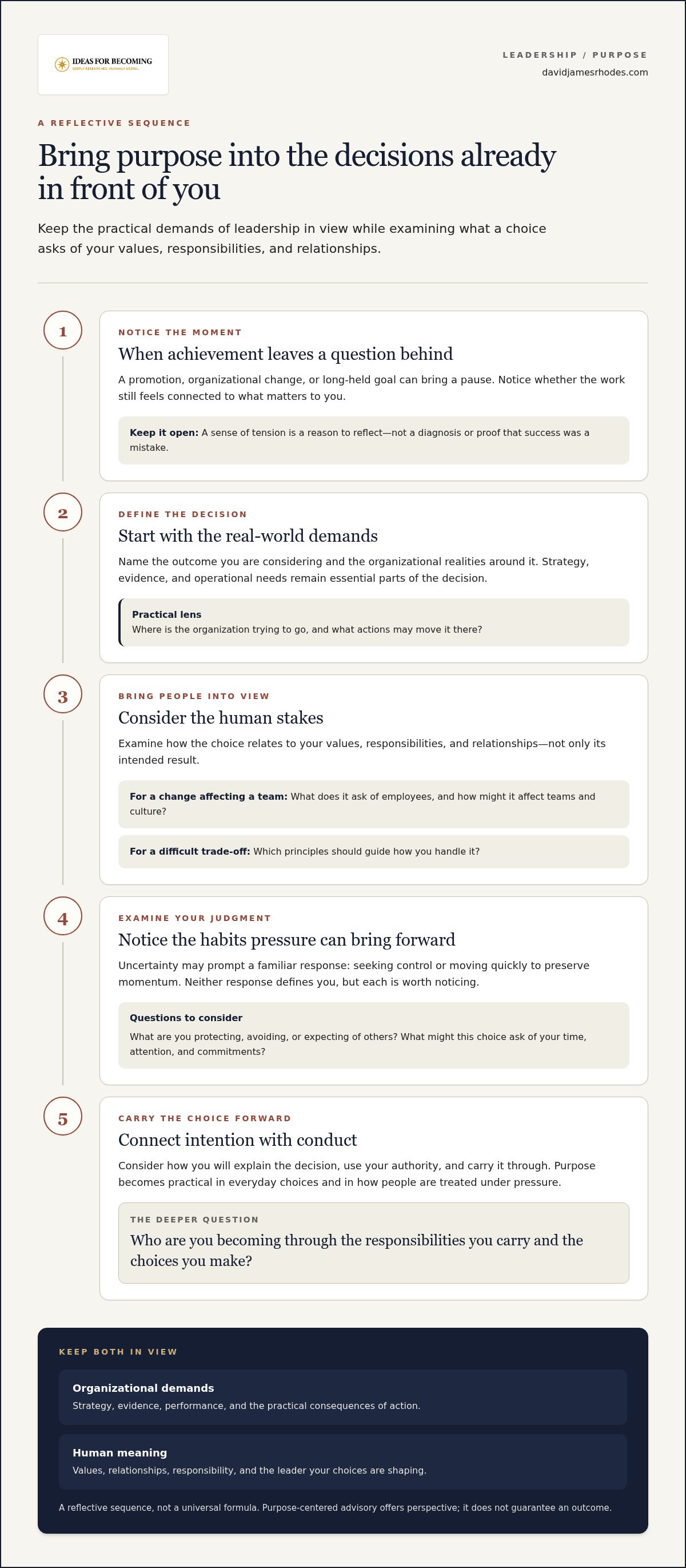
How executives can bring purpose into everyday leadership choices
Purpose becomes useful when it enters the decisions already on your desk. It need not become another elaborate process or a demand for certainty. Before a consequential choice, a brief pause can help you see what is changing, who will be affected, and what responsibility each option carries.
A four-step reflection before the next major decision
Use this sequence to create a little room between pressure and action. Write a few words if that helps. The point is not to delay a necessary decision, but to make your reasoning more visible.
- Name the change. State the decision clearly. What is changing, and what does this choice require of you as a leader?
- Identify what is at stake. For each option, consider the values, relationships, and responsibilities affected. Who may benefit? Who may carry a cost? What obligations remain yours?
- Separate evidence from uncertainty. Record what you know, what you are assuming, and what is still unclear. Include the information that could change your view. Don’t disguise an uncertain forecast as a settled fact.
- Choose a grounded next action. Decide what you will do next and what new information, consequence, or change in circumstances would prompt you to reassess. A considered decision can remain open to review.
For example, a leader weighing a major shift in team responsibilities might write down the business need, the people affected, the constraints, and the unanswered questions. They can then choose a next step, such as gathering a specific piece of information or explaining the decision to those involved. This doesn’t remove the difficulty. It makes the choice and its responsibilities harder to evade.
For a closer look at how leadership decisions intersect with personal life, the article on leadership advisory and the integration of life and work explores that connection.
Make room for reflection without abandoning responsibility
Reflection works best as a modest practice, not an emergency measure reserved for a crisis. Pause before a key conversation, revisit a decision after its effects become clearer, or set aside a moment to consider whether your actions match the commitments you have made. Keep the practice brief enough to fit into the life you actually lead.
Trusted colleagues can offer perspective. They may notice a consequence you have overlooked or question an assumption that feels obvious to you. Their views matter, but listening does not transfer responsibility. You remain accountable for the decision and how you carry it out.
This kind of reflection is not therapy or treatment, and it does not promise immediate personal change. Its value can be more ordinary: a clearer choice, a conversation handled with care, or a commitment followed through. Purpose is practiced in decisions, not declared once and left untouched. If you want to examine how purpose and leadership meet in your circumstances, explore leadership and life advisory, including the questions at the heart of executive advisory on purpose and fulfillment.
David James Rhodes's executive advisory: connecting leadership with human becoming
Leadership brings decisions that reach beyond the role itself. A period of growth may call for a different kind of responsibility. Adversity can test what a leader values. A change in direction can raise questions that strategy alone cannot settle. David James Rhodes provides leadership and life advisory for people considering these demands alongside wider questions of meaning and becoming.
His perspective draws on more than four decades of experience across 156 countries, spanning international finance, entrepreneurship, leadership, and behavioral health. This is lived professional experience, not scientific proof or a promise of results. It offers context for a thoughtful conversation about the choices in front of you and the person you are becoming through them.
The Way: a philosophy of becoming, not a perfect path
The Way is the broader philosophy behind this perspective. Its central idea is simple: “The Way is not something you find. It is someone you become.” A leader may hope for a perfect path, one that removes doubt before action. Human life rarely offers that certainty. What remains possible is to meet changing circumstances with character, courage, and purposeful action.
Becoming is not a private exercise in ambition. It also takes shape in relationships: in how a leader listens, keeps faith with responsibilities, repairs harm, or makes a difficult choice. These are not separate from purpose. They are among the ways purpose becomes visible. For a fuller account of this philosophy, explore The Way and the process of human becoming.
When purpose-centered advisory may be a useful next conversation
This kind of advisory may suit a leader facing growth, adversity, a transition in responsibility, or a persistent question about what their work means. It can also be useful when the decision is not simply which option looks strongest, but how to act with integrity amid competing demands. The conversation does not supply a guaranteed answer. It can offer another perspective, clarify the question, and support more deliberate consideration of what comes next.
That distinction matters. Advisory cannot remove the uncertainty inherent in leadership or decide on another person’s behalf. The choice remains yours. The value lies in considering its business realities, human consequences, and relationship to the life you are trying to lead.
If this is the kind of question you are carrying, explore David’s leadership and life advisory as a considered next step. Executive advisory on purpose and fulfillment is not about being handed a ready-made path. It is about examining the one before you and asking with greater care: who are you becoming?
Carry purpose into the decision in front of you
You don’t need to resolve every question about your future before acting with greater intention. Begin with the decision already asking for your attention. Consider what it requires, whose lives it touches, and what you want your response to reflect. Then choose a next step you can stand behind, even if some uncertainty remains.
That is one way to make executive advisory on purpose and fulfillment relevant beyond a conversation. The work continues in how you listen, what you take responsibility for, and whether your actions remain connected to what matters. There may be no final point at which a leader has become complete. There is the next choice, and the person shaped by making it.
If you’re ready to give that question considered attention, explore David James Rhodes’s leadership and life advisory. A more human way forward need not begin with certainty. It can begin with the willingness to look clearly at what comes next and meet it with care.
Frequently Asked Questions
What is executive advisory on purpose and fulfillment?
Executive advisory on purpose and fulfillment is a high-level conversation about how leadership responsibilities relate to personal meaning and the life a leader wants to lead. It can help someone examine a difficult choice, a change in role, or a growing sense of misalignment. It doesn’t prescribe a single definition of purpose. The leader brings their context and questions, and remains responsible for deciding what to do next.
How is purpose-centered executive advisory different from business consulting?
Business consulting often focuses on a defined organizational challenge, such as improving a process, assessing a market, or planning a change. Purpose-centered advisory also considers the executive’s judgment, values, and responsibilities as they address that challenge. The two can complement each other. A leader might use consulting expertise to assess options, then reflect on how to communicate and carry out the chosen direction responsibly.
Can executive advisory help me find more meaning in my leadership role?
It can help you examine where meaning may already be present and where your role feels out of step with your priorities. For instance, you might consider whether your time goes to work you believe matters or whether a responsibility you value is being neglected. Advisory can support that inquiry, but it can’t guarantee a particular feeling or determine what meaning should look like for you.
Is fulfillment a realistic goal for a busy executive?
Yes, if fulfillment means a sense that important parts of your work and life fit together, not constant happiness or the absence of pressure. A busy executive might find meaning in a demanding role while still needing clearer boundaries or stronger relationships outside work. Rather than waiting for a quieter season, notice one recurring choice that deserves more attention and consider what a more intentional response would require.
How do I bring purpose into a difficult business decision?
Keep purpose alongside the evidence, not in place of it. Before announcing a change that affects a client commitment, for example, examine the expected business effects and the trust at stake. Ask what must be communicated honestly, what obligations remain, and what you may need to repair if the decision causes harm. Then decide using the best information available and remain accountable for the consequences.
When should an executive consider leadership and life advisory?
Consider it when a transition or recurring decision raises questions that operational analysis alone cannot resolve. That may include taking on greater responsibility, reconsidering a long-held ambition, or reconciling work demands with commitments to family or community. David James Rhodes provides leadership and life advisory for people navigating growth, adversity, and the search for meaning. Advisory offers perspective, not guaranteed answers or outcomes.
Frequently Asked Questions
Related Articles

Best Leadership Guides for Executives: A Thoughtful 2026 Selection
Searching for the best leadership books for executives? Discover thoughtful leadership guides matched to real executive challenges, strategy, and character.

Executive Coach vs. Advisor: Which Kind of Support Does a Leader Need?
Choosing between an executive coach vs advisor? Learn how to match the right support to consequential leadership decisions and the leader you are becoming.

Human Potential Speaker: From Inspiration to Meaningful Change
Looking for a human potential speaker? Discover how to move past easy slogans to examine character, identity, and the choices that shape meaningful change.