
If you’re searching for the “best leadership books for executives,” start with the decision you need to make, not the title with the boldest promise. A useful guide may be the one that changes how you approach a choice you thought you’d already made.
Executives have no shortage of recommendations. The harder task is matching an idea to the responsibility in front of you. Advice that sounds compelling in the abstract can feel thin when you’re facing uncertainty, a difficult conversation, or a decision that affects people’s lives and livelihoods.
This selection of executive leadership guides is organized around challenges leaders actually face. For each, consider the question it helps you examine and the context in which its perspective may be useful. Some focus on strategy and change. Others invite you to look at trust, candour, or the judgment behind your choices.
No guide can make a decision for you. Its value lies in what it helps you notice and what you choose to do differently. Read with a specific responsibility in mind, and a short, considered list can become more than another set of recommendations. It can help you lead with greater intention.
- Choose executive leadership guides by matching their subject to the decision or challenge in front of you.
- For strategy and competing priorities, The Opposable Mind by Roger Martin offers a lens on integrative thinking.
- Compare guides by the questions they address, the context they provide, and whether they offer frameworks, stories, reflection, or practical prompts.
- Turn an insight into practice: choose one question, identify an idea, test it in context, then reflect on what changed.
- Consider The Way as a complementary perspective on how action and choice shape the person a leader becomes.
What Makes a Leadership Guide Worth an Executive’s Time?
A leadership guide earns its place not by giving you more terminology, but by helping you judge more clearly. A framework can name a problem. The harder test is whether it helps you identify what matters, weigh competing responsibilities, and choose a course of action when the answer is not obvious.
Executives have limited time, and real consequences attach to their decisions. A useful guide should connect with a live responsibility: leading a team through change, setting priorities when resources are constrained, or addressing a loss of trust. Look for an idea you can examine in your own setting, not a promise that a single method will work everywhere.
Some questions endure. What do you owe the people who depend on your decisions? How do you use authority without confusing it with certainty? Character and responsibility remain central across roles and eras. Techniques are different. A meeting format or feedback model may help in one organisation and fail in another. The concept of leadership includes varied theories and styles, as outlined in this overview of leadership. No single technique should be mistaken for a universal answer.
A useful leadership guide connects an idea to a decision or responsibility. It may not tell you what to do. It should help you understand the choice more fully, including who will be affected and which assumptions you are bringing to it.
Why executives need a shortlist, not another reading pile
An unread list can feel like progress. It suggests there is wisdom waiting just beyond the next title. But accumulation is not application. A long queue of recommendations may leave your habits untouched while creating the impression that you are doing the work of leadership development.
Begin with your actual responsibilities. What decision is approaching? What is your team struggling to say openly? Which part of your role demands better judgment? Choose a guide because it speaks to that particular pressure. A short, relevant shortlist gives you room to consider an idea carefully instead of rushing toward the next one.
A practical test for choosing a leadership guide
Before committing your time, write down the question you want to examine. Then consider whether the guide’s ideas can be tested in your setting, with your team, authority, and constraints. An approach designed for a founder making fast decisions may not transfer neatly to an executive leading a large, established organisation.
Notice what kind of support the author offers. A personal story can prompt reflection, but it is not, by itself, proof that a method works broadly. A research-based claim also deserves context: what was studied, and how closely does it resemble your situation? Keep those distinctions clear. The aim is not to dismiss experience or evidence, but to understand what each can and cannot establish. Choose the guide that sharpens the question before it offers an answer.
Leadership Guides for Executives, Matched to the Challenge
No single guide fits every executive. A leader weighing strategic trade-offs needs a different lens from one working across cultures or trying to listen better in a difficult conversation. If you searched for the “best leadership books for executives,” use the list as a way to compare perspectives, not as a universal ranking. The useful question is which guide speaks to the decision in front of you.
When the challenge is strategy, culture, or conversation
Start by naming the pressure you’re facing. These guides offer distinct points of entry, not guaranteed answers:
- The Opposable Mind by Roger Martin is suited to strategic choices where competing priorities seem to demand an either-or decision. Its focus on integrative thinking can help you examine whether a more considered option might hold elements of both.
- The Culture Map by Erin Meyer addresses cultural dimensions and collaboration. It can give executives working across cultures a way to consider how differing expectations may shape communication and cooperation.
- The Coaching Habit by Michael Bungay Stanier focuses on questioning rather than defaulting to advice. It may be relevant when a conversation with a colleague or direct report would benefit from more curiosity and less immediate problem-solving.
The distinction is practical: one helps you examine strategic tensions, another cultural differences, and another your role in a conversation. Each can prompt reflection. None can account for every relationship or organisational context.
When the challenge is teams, change, or organizational culture
Some leadership questions belong to the group, not only the individual. If coordination across teams is the concern, Team of Teams may be worth considering for its focus on teams and how they work together. If you’re thinking about the conditions and shared norms that shape a group, The Culture Code offers an organizational-culture lens. These descriptions point to subject areas, not promises of results.
For a different question, consider The Way by David James Rhodes. It complements management-focused guides by turning attention toward human becoming: how a leader’s choices and actions shape who they are becoming. It isn’t a substitute for a strategy or team framework. It speaks to the character and responsibility that inform how such frameworks are used.
Match the guide to the need: integrative thinking for competing priorities, cultural perspective for cross-cultural collaboration, better questions for coaching conversations, and a team or culture lens for shared work. That simple distinction can make a shortlist more useful than a ranking.
For a further perspective on leadership and human becoming, explore David James Rhodes’ leadership perspective.
How to Compare Executive Leadership Guides Beyond Their Titles
A familiar title can carry authority. That doesn’t make its advice right for every leader. Compare guides by the question they address, the context they assume, and the kind of help they offer. A strategy framework, a set of stories, and a practical prompt may all be useful, but they serve different purposes.
Which leadership question does the guide help you face?
Start with a responsibility you carry now. Are you setting direction, working across cultures, building trust within a team, or trying to change the quality of a difficult conversation? Then ask whether the guide’s examples resemble your own organisation. A perspective developed in one setting may still be useful elsewhere, but its assumptions deserve attention before you apply it.
The comparison below is a starting point, not a ranking. The practical application depends on your role and the decision at hand.
| Guide | Core question | Useful context | Leadership level | Practical application |
|---|---|---|---|---|
| The Opposable Mind | Can competing priorities be considered together? | Strategic choices and tensions | Executive and strategic | Use its integrative-thinking lens to examine an either-or decision. |
| The Culture Map | How might cultural differences shape collaboration? | Work across cultures | Individual, team, and organisational | Reflect on how cultural dimensions may affect communication. |
| The Coaching Habit | Can a question serve better than immediate advice? | Coaching conversations | Manager and team leader | Try a question that invites a colleague to think before offering a solution. |
| Team of Teams or The Culture Code | Is the central concern how teams work or organisational culture? | Teams, change, and shared norms | Team and organisational | Choose the guide whose subject most closely matches the group-level challenge. |
Does the guide offer evidence, experience, or a philosophy?
Look at the kind of support behind the central idea. Established research, emerging evidence, contested claims, personal observation, and philosophical reflection are not interchangeable. A guide should make its reasoning clear enough for you to judge what it can support. A compelling story may offer insight without proving that the same approach will work in another organisation.
The same care applies to the author’s experience. David James Rhodes’ perspective reflects leadership and life experience; it should be understood as lived perspective, not scientific proof. That distinction doesn’t make experience irrelevant. It helps you read it honestly, ask what transfers to your situation, and avoid treating a useful idea as a universal rule. The strongest choice is not necessarily the most popular title. It is the one whose question, context, and form of guidance fit the responsibility you need to meet.
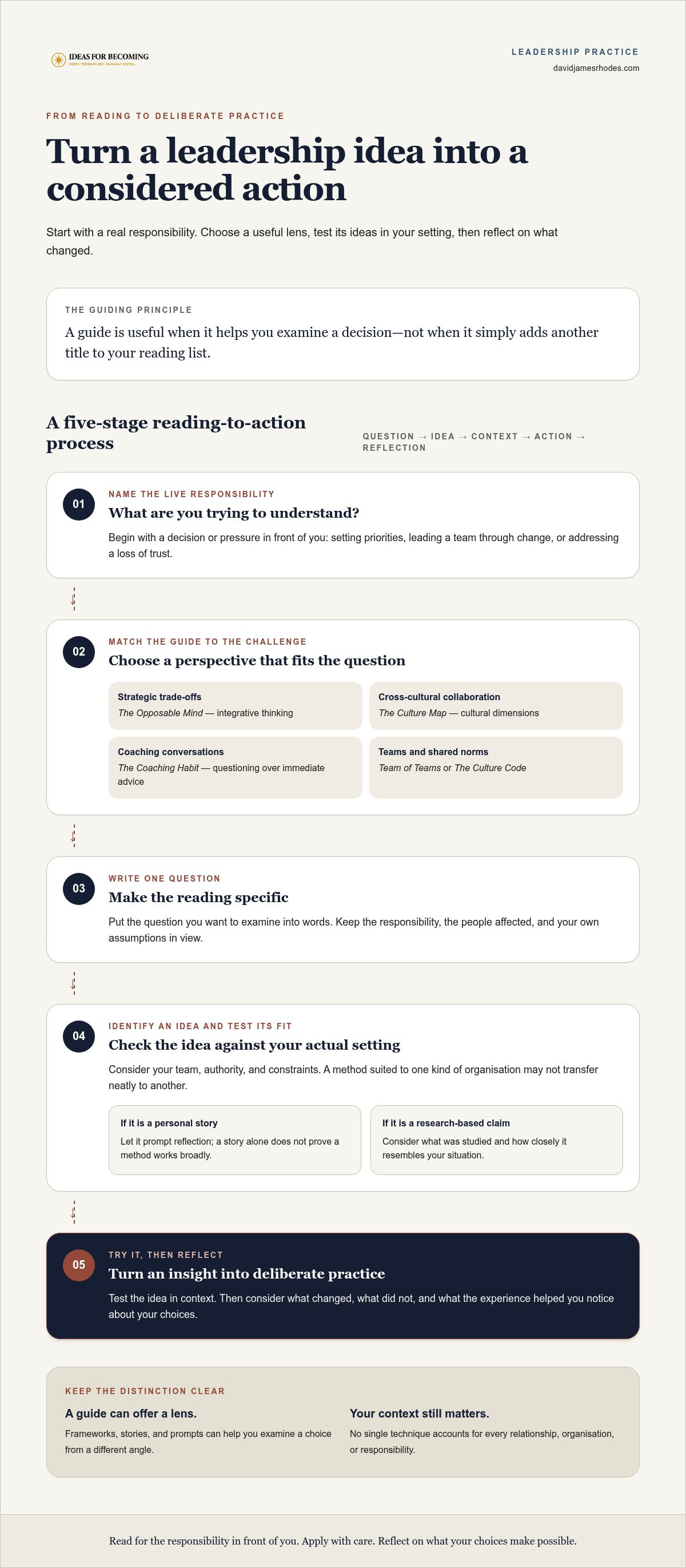
How Executives Turn Leadership Reading into Deliberate Practice
An idea matters when it enters the decisions a leader makes. Reading can widen perspective, but insight does not automatically become behaviour. The bridge is a modest, deliberate experiment: bring one idea into a real meeting, decision, or conversation, then pay attention to what follows.
Reading becomes practice when an idea changes what a leader notices or does. Keep the test proportionate to your role. A framework intended to guide a team discussion should not become a sweeping organisational rule after one reading. Use it as a lens, not a command.
Choose one idea to test in a real leadership moment
Begin with a recurring moment. Perhaps a meeting where quieter colleagues rarely speak, a decision where two priorities keep colliding, or a conversation in which you tend to offer solutions too quickly. Name the pattern before choosing an idea from a guide. That gives the reading a specific place to land.
Then make the idea observable. If you want to practise asking before advising, decide to ask one open question and listen to the full response in your next one-to-one. If you’re exploring competing priorities, write down what each option protects and what it puts at risk before making a recommendation. These are actions you can notice, not outcomes you can guarantee.
Consider the effect beyond your own performance. Did your action create space for another perspective? Did it clarify who holds responsibility for the decision? Could it place an unexpected burden on colleagues or slow work that needs a timely answer? Leadership practice includes the consequences others experience.
Reflect on what changed, and what did not
After the moment, make a brief record while the details are still clear. Note the situation, the action you chose, and what you observed afterward. Include what surprised you, what felt awkward, and whether anyone responded differently. A few precise observations are more useful than a vague verdict that the idea “worked.”
Reflection is not proof that a broad theory is universally true. One conversation can show that a question helped in that exchange. It cannot establish that the same approach will suit every person, team, or circumstance. Look for what the experience suggests, and keep the limits in view.
If the idea doesn’t fit, or creates an unintended effect, revise the experiment. Perhaps the question needs to be clearer. Perhaps the framework overlooks a constraint in your organisation. Or perhaps the right response is to set the idea aside. Changing course is not failure; it is part of sound judgment.
The best leadership guides for executives are most useful when their ideas are tested with care, then examined against real responsibilities. To explore a broader perspective on leadership, character, and human becoming in leadership, visit David James Rhodes.
Where The Way Fits in an Executive’s Leadership Reading
Once you’ve identified guides for strategy, culture, teams, or communication, there is another question beneath the methods: what kind of person is making these decisions? Executive work is not only a matter of frameworks. It also asks leaders to consider the character, courage, relationships, and purpose they bring to responsibility, and how they use the limited time they have.
The Way by David James Rhodes belongs alongside practical management guides, not in place of them. It explores human becoming and leadership. Its central idea is simple: the way is not something you find. It is someone you become. The choices a leader makes, especially under pressure, help shape both the path forward and the person walking it.
The Way as a philosophy of leadership and becoming
This is a philosophy, not a research claim, management formula, or promise of a particular outcome. It does not offer a substitute for a strategy framework or a team method. Instead, it invites reflection on the person using those tools. How do you exercise authority? What do you protect when priorities conflict? What do your daily decisions teach others about your values?
Those questions matter because leadership decisions reach beyond the immediate task. A choice may affect trust, opportunity, and the lives of people who have little say in it. A framework can help clarify options. Reflection on character can help a leader consider the responsibility attached to choosing among them. Neither removes uncertainty. Both can contribute to more deliberate judgment.
Rhodes’ perspective is shaped by more than four decades of experience across 156 countries. That is lived experience, not scientific proof. The value of the philosophy rests in the questions it asks and the reader’s willingness to examine how action and choice shape who they are becoming.
Continue the reflection beyond the reading list
For executives, this perspective can sit beside tactical learning. A guide on communication may help you consider how to speak with a team. The philosophy of The Way asks what your words and actions are helping you become, and what they make possible for others. The two forms of reading serve different purposes. One may offer a tool; the other invites reflection on the person who chooses how to use it.
That reflection can reach beyond the office. The demands of leadership touch relationships, purpose, and the way a person spends time. Exploring The Way can be a way to consider those dimensions together, rather than treating professional success as separate from the rest of life. For a related perspective on integrating life and work in leadership, consider how responsibility at work connects with the person you are beyond your role.
If the practical guides in this selection help you examine what to do, The Way offers a further question to carry into those decisions: who are you becoming? Explore it as a guide to human becoming and leadership.
Choose the Next Question You’ll Lead With
The next guide you choose can begin with a question, not a title. What decision deserves more care? What conversation would benefit from your full attention? Leadership guides for executives matter when they help you meet those moments with greater clarity, not when they simply add another idea to remember.
And the work doesn’t end with a better decision. Leadership is also shaped by the person making it: by what you value, how you treat people, and what you choose to protect when the pressure rises. David James Rhodes’ flagship work, The Way, connects leadership with human becoming. It offers a philosophical companion to practical guidance, inviting reflection on who you are becoming through your choices.
If that question feels relevant to the way you lead, explore The Way and its philosophy of human becoming. Carry one useful idea into your next decision. Let your actions give it meaning. The way forward can take shape in the leader you choose to become.
Frequently Asked Questions
What makes a leadership guide useful for an executive?
A useful guide helps an executive make sense of a real responsibility, not simply learn new terminology. For example, if a restructuring decision may affect team trust, a guide is valuable when it helps you consider both the operational need and the human consequences. That is a better measure than popularity alone. The best guide is one whose ideas can be weighed against the pressures and responsibilities of your actual role.
How should an executive choose a leadership guide for a specific challenge?
Choose by naming the challenge before selecting the title. If a team is unclear about priorities, look for a guide that addresses direction and decision-making. If your concern is collaboration across cultures, seek a different lens. Then consider whether the author’s examples resemble your organisation in scale, authority, and constraints. A useful mismatch can still prompt insight, but it calls for adaptation rather than direct imitation.
Can leadership guides help with real workplace decisions?
Yes, a leadership guide can help you examine a decision, though it cannot make the decision or remove its risks. Before a budget discussion, for instance, a guide might prompt you to clarify which commitments are essential and whose work will be affected by a change. Use the idea to improve your questions and reasoning. The choice remains yours, informed by the facts and people in your specific situation.
How many leadership guides should an executive read at once?
There is no fixed number that suits every executive. If you’re facing a demanding decision, keeping attention on one relevant guide may make it easier to assess its ideas and limits. Reading several at once can help when you’re deliberately comparing perspectives, but it can also blur their different assumptions. Let the purpose guide the number. Choose enough to gain perspective, not so many that reflection becomes another task left unfinished.
Is The Way a practical guide for executive leadership?
The Way is a guide to human becoming and leadership, with a practical emphasis on examining how choices shape character and direction. It is not a step-by-step management manual or a promise of results. An executive might use its questions to reflect on how a difficult choice aligns with their values, or what kind of example their conduct sets. It offers a philosophical companion to guides focused on specific management methods.
What is the difference between a leadership framework and a leadership philosophy?
A framework offers a structure for approaching a task, such as preparing for a decision or organising a conversation. A philosophy considers the deeper principles that shape how you lead, including what you value and what you believe you owe others. An executive can use both. A framework may help organise the immediate work; a philosophy can help examine whether the chosen approach fits the leader’s responsibilities and values.
How can executives apply an idea from a leadership guide without treating it as universal?
Try the idea in a limited, appropriate setting, then assess what happened. A question that helps one colleague speak openly may not suit a confidential performance conversation. Consider the people involved, the stakes, and any constraints before adapting the advice. Record what you observed, including unintended effects. Treat one useful experience as information about that context, not proof that the same approach will work for every team.
Frequently Asked Questions
Related Articles

Executive Coach vs. Advisor: Which Kind of Support Does a Leader Need?
Choosing between an executive coach vs advisor? Learn how to match the right support to consequential leadership decisions and the leader you are becoming.

Executive Advisory on Purpose and Fulfillment: A More Human Way Forward
Seek executive advisory on purpose and fulfillment to align leadership choices with values and character. Discover who you are becoming beyond outward success.

Human Potential Speaker: From Inspiration to Meaningful Change
Looking for a human potential speaker? Discover how to move past easy slogans to examine character, identity, and the choices that shape meaningful change.