
What if the person you're meant to be isn't someone you find, but someone you survive? We often treat identity as a trophy. We chase it. We expect it to arrive with the right title or the right milestone. Yet, the hollowness persists. You feel the weight of unfulfilled potential even when you win. It's a quiet, heavy burden. This search for books about becoming who you are meant to be often starts in these moments of profound transition. You're looking for a compass when the old map has failed you.
This article offers a curated exploration of literature that shifts identity from a destination to a lifelong process of growth. You'll gain a framework for personal evolution that accounts for both your peaks and your valleys. We'll examine how suffering and setbacks aren't interruptions to your path. They are the path itself. This guide provides a sense of purposeful direction for the year 2026 and beyond. We will look at literature that challenges you to stop seeking and start becoming. The process is slow. It's demanding. It's the only work that truly matters.
Key Takeaways
- Reframe identity as a process of navigation rather than a fixed destination. Stop searching for a finish line.
- Identify books about becoming who you are meant to be that prioritize existential honesty over simple motivation.
- Transition from passive reading to active reflection. Use structured tools to anchor philosophical insights into your daily character.
- View adversity as the primary catalyst for evolution. Your setbacks provide the raw material for your next chapter.
- Recognize when the page is no longer enough. Learn how advisory bridges the gap between theory and high-stakes reality in 2026.
The Existential Weight of the Unlived Life
The unlived life is a heavy ghost. It follows you into every boardroom. It haunts every quiet evening. You feel the gap between your current reality and your capable state. This isn't just a lack of ambition. It's existential weight. Many people reach for books about becoming who you are meant to be when this weight becomes unbearable. They aren't looking for simple motivation. They are looking for a way to carry the burden of their own potential. Why does it feel so heavy?
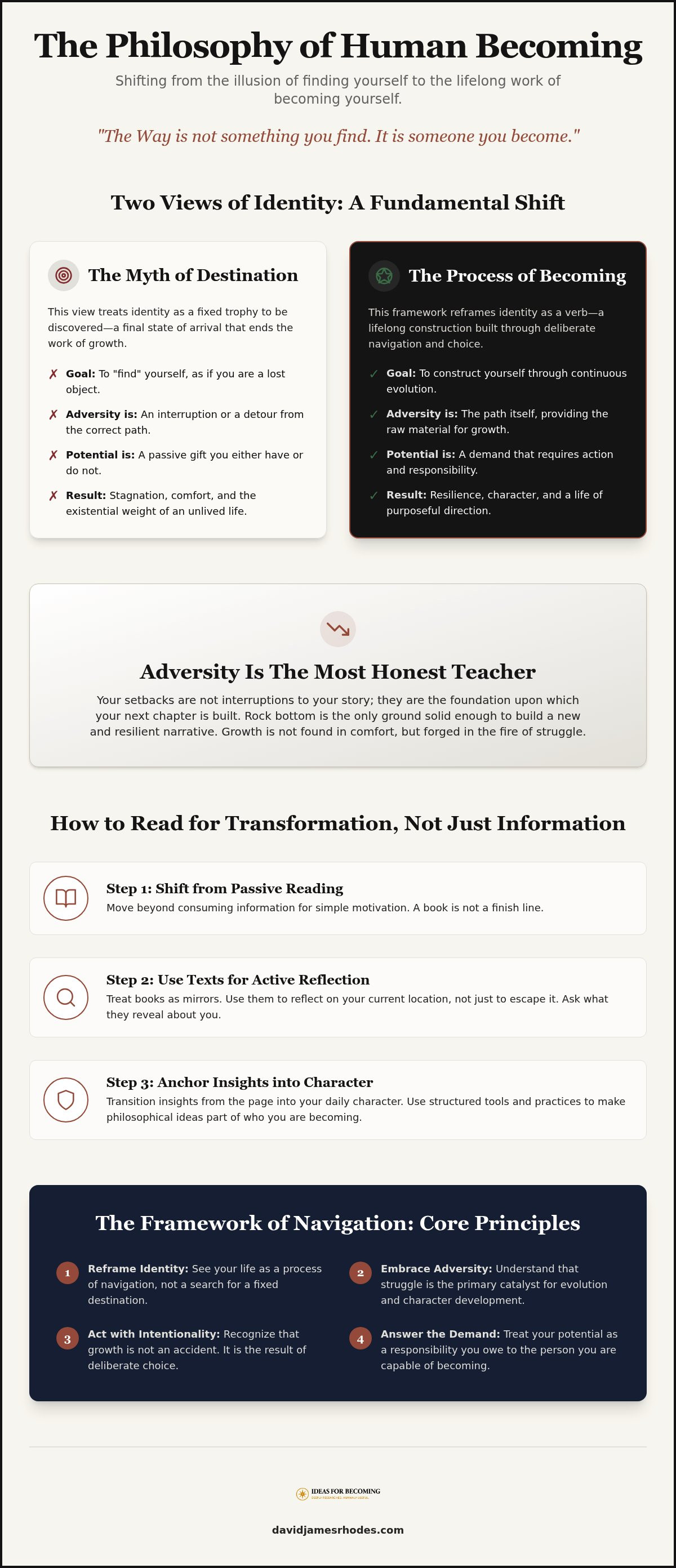
We often think of identity as something to be discovered. We talk about "finding" ourselves as if we were lost objects. This is a misleading metaphor. Identity is not a discovery. It's a construction. Remaining static in 2026 is an expensive choice. The world moves. Your potential demands movement. If you refuse to evolve, you don't just stay the same. You begin to rot. Identity is a responsibility. It's a debt you owe to the person you are capable of becoming. What happens when you refuse to pay?
The Gravity of Potential
Potential is not a gift. It's a demand. It creates a tension that pulls at the fabric of your daily life. When you face a major transition, you often feel a sense of profound loss. You feel like you're losing your core. In reality, you're shedding the version of yourself that no longer fits the reality you've built. This friction is necessary. Anxiety is not always a sign of failure. Often, it's the dizziness of growth. It's the feeling of standing on the edge of a new territory. Will you step forward or retreat into the familiar?
The Myth of the Destination
We've been sold a lie. The lie says there is a destination. We think we'll eventually "arrive" and the work will stop. This is a dangerous illusion. Identity is not a hidden treasure. It's a path you carve through a dense forest. Understanding the Process of Human Becoming requires you to view identity as a verb. It's a constant act of navigation. My experience across 156 countries has taught me one universal truth. Those who believe they have arrived usually stop growing. They trade their evolution for the hollow safety of comfort. Books about becoming who you are meant to be serve as mirrors. They reflect your current location and suggest the next step. They don't provide a map. They teach you how to read the terrain. Are you ready to navigate?
Understanding the Process of Human Becoming
Human becoming is not a passive event. It is a deliberate, lifelong navigation through the complexities of existence. We often mistake our current state for our final form. This error leads to stagnation. To become who you are meant to be, you must engage with the intersection of character, adversity, and meaning. It's a grueling process. It requires the shedding of old narratives that no longer serve the person you're evolving into. High-stakes environments demand this deeper identity work. If your internal foundation is weak, the external pressure of leadership will eventually crush you.
Many seekers turn to books about becoming who you are meant to be to find a structure for this evolution. They seek a language for the quiet shifts occurring within. This search is often the first step toward Essential Texts for the Journey of Becoming, where the focus moves from survival to actualization. It's about more than just success. It's about the weight of your own legacy. How will you answer the call of your own potential?
The Framework of Navigation
Transitions aren't interruptions. They're compass points. Whether it's a career shift, a loss, or a global upheaval in 2026, these moments force a re-evaluation of your internal map. You must move with intentionality. Growth doesn't happen by accident. It happens by choice. Human becoming is a rhythmic evolution of character that requires constant recalibration and presence. Every decision is a brushstroke on the canvas of your life. Every pause is an opportunity to check your heading. Are you moving toward meaning, or away from it?
The Role of Adversity
Adversity is the most honest teacher. Rock bottom isn't the end of the story. It's the only foundation solid enough to build a new narrative upon. Recovery is often the catalyst for this transformation. It forces a raw, unfiltered look at the self. This perspective isn't found in comfort. It's forged in the fire of struggle. My observations across 156 countries confirm this truth. The most resilient individuals are those who have navigated the extremes of human experience and returned with a singular, focused insight. They don't just survive. They evolve. For those ready to move beyond theory into practice, exploring leadership and life advisory can provide the steady presence needed for the journey. Reading is the prerequisite. Experience is the teacher. Character is the result.
Essential Texts for the Journey of Becoming
Literature is not an escape. It's a confrontation. When you seek books about becoming who you are meant to be, you're looking for more than information. You're looking for a mirror. A true text doesn't just describe the world. It reflects the parts of your soul you've been afraid to name. We select these works based on three criteria: depth, existential honesty, and practical application. If a book doesn't challenge your current narrative, it's not the right tool for your evolution. Modern research into the process of human becoming suggests it's a creative, open-ended endeavor. It requires a personal library of anchors to keep you grounded as the terrain shifts.
Building this library is an act of intentionality. It's about balancing the raw insights of modern experience with the quiet weight of timeless wisdom. You need voices that have survived the extremes of human success and failure. You need guides who don't offer easy answers. The goal is transformation, not just consumption. Every book you read should leave you slightly different than when you began. It should force a pause. It should demand a response. Are you prepared to let a book change you?
Core Works by David James Rhodes
These texts are forged from forty years of leadership across 156 countries. They are not theoretical. They are functional. The Way book serves as a primary guide for navigating the internal landscape of evolution. It shifts your perspective from the destination to the process. 365 Days of Becoming establishes the necessary daily practice of growth. It provides a rhythmic cadence for reflection. Life After Anything addresses the raw reality of rebuilding identity after major life transitions. These works are entry points. They prepare you for the high-stakes reality of 2026 by anchoring your character in truth. They are prerequisites for anyone seeking deeper leadership and life advisory.
Philosophical and Existential Classics
Timeless wisdom provides the foundation for any modern journey. Viktor Frankl's Man's Search for Meaning is essential. It teaches us that suffering is not an obstacle to becoming. It's the medium through which meaning is found. You don't find purpose in spite of your pain. You find it because of your pain. Marcus Aurelius offers Meditations, a masterclass in leading with character despite external chaos. It's a reminder that your internal state is your only true responsibility. Joseph Campbell's The Hero with a Thousand Faces provides the narrative structure for your journey. It reminds us that your personal struggle is part of a larger, ancient human story. These classics remind us that while the context changes, the work of becoming remains the same. It's a slow, deliberate movement toward the truth of who you are.
How to Read for Transformation, Not Just Information
Passive consumption is a form of avoidance. You read to feel progress without making any. When engaging with books about becoming who you are meant to be, the goal is not to finish the book. The goal is for the book to finish you. It should dismantle your comfort. It should disrupt your patterns. True transformation happens in the silence after the page is turned. It requires a space for quiet, intentional study. It demands that you stop collecting ideas and start testing them against the raw reality of your life. Are you reading to learn, or are you reading to change?
The Practice of Reflection
Reflection is the bridge between theory and character. It's where the abstract becomes concrete. Journaling is not a hobby. It's a survival tool for the internal landscape. Tools like the Life After Anything Companion Guide & Workbook are designed for this specific navigation. They force you to answer the provocative questions that the text poses. What are you hiding from yourself? What narrative are you clinging to that no longer serves the truth? These questions are the compass points for your evolution. Reflection turns a book from a lecture into a dialogue. It shifts the focus from the author's journey to your own. Without this dialogue, the wisdom remains external. It never takes root. It never changes the way you move through the world.
Integration into Leadership
Personal becoming is the prerequisite for professional authority. You cannot lead others through transitions you haven't navigated yourself. In 2026, the standard for reflective leadership is no longer about technical expertise. It's about existential depth. Your ability to guide a team through global complexity depends on the stability of your own identity. When you do the hard work of becoming, your advisory carries a quiet weight. It's grounded in high-stakes experience. It's informed by the shedding of your own old narratives. This internal clarity allows you to witness and strategize for others with a calm, steady presence. For those ready to bridge the gap between literature and legacy, exploring leadership and life advisory provides the necessary accountability. Reading starts the process. Advisory sustains it. Character completes it. Are you prepared to lead from the depth of your own evolution?
Beyond the Page: Navigating Your Way
Reading books about becoming who you are meant to be is a prerequisite. It's not the completion. The page provides the theory. The world provides the friction. There comes a point where the quiet reflection of study must meet the loud demands of reality. You can't think your way through a crisis of identity. You must navigate it. This requires a transition from consumer to practitioner. It's the moment when the narrative you've built on paper is tested by the fire of high-stakes responsibility. Are you ready for that test?
In 2026, the complexity of global leadership has reached a tipping point. The intersection of behavioral health, international finance, and personal evolution is where the most critical decisions are made. If you're leading a global organization or managing significant wealth, your personal becoming is no longer a private matter. It's a strategic imperative. Your ability to remain steady during a transition determines the stability of everything you touch. The wisdom found in books about becoming who you are meant to be provides the map. Advisory provides the compass. This is why seasoned guidance is essential. It offers a mirror that speaks back.
Advisory for the High-Stakes Journey
Executive advisory services are for those who find themselves in the middle of a major life transition. It's for the leader who has achieved everything and yet feels the weight of the unlived life. Guiding the next generation through identity challenges requires more than just advice. It requires a witness who has navigated the extremes. With forty years of experience across 156 countries, the perspective offered is both global and intimate. It's about building a legacy that's grounded in character, not just capital. Who is guiding you through the fog? For those navigating these complex waters, engaging with leadership and life advisory ensures your evolution remains purposeful and grounded.
The Voice of Experience
Moving from the internal to the external requires a shift in focus. Keynote speaking serves a singular purpose. It challenges the audience to stop asking "Who am I?" and start asking "Who am I becoming?". It's an invitation to step into the somber reality of growth. The exuberance of typical motivational speaking is replaced with a quiet authority. It's a call to responsibility. This shift in perspective is what separates those who survive a transition from those who are transformed by it. When you move beyond the page, the real work begins. It's a slow, deliberate navigation toward the person you were always meant to be. The journey is long. The stakes are high. Will you walk it alone?
Mastering the Art of Human Becoming
The search for identity is a lifelong navigation. It isn't a race to a finish line, but a rhythmic evolution of your character. You've seen that the unlived life carries a heavy weight. You've learned that adversity is the primary catalyst for growth. Engaging with books about becoming who you are meant to be provides the necessary language for this internal shift. However, the page is only the beginning. True transformation requires you to move beyond theory and apply these insights to the high-stakes reality of your leadership and legacy.
This work demands a steady presence. David James Rhodes offers a global perspective forged in 156 countries and 40 years of leadership experience. As the author of The Way and Life After Anything, he provides the strategic guidance needed to bridge the gap between literature and life. Begin your journey of becoming with David James Rhodes to anchor your evolution in truth. The path is demanding. It's also the only one worth walking. Your potential is waiting for your response.
Frequently Asked Questions
What does it mean to become who you are meant to be?
Becoming who you are meant to be is the deliberate alignment of your external actions with your internal truth. It's not a destination you reach. It's a state of constant, purposeful navigation. You must strip away the expectations of others to reveal the character beneath. This process requires honesty. It requires a willingness to face the unlived life. It's the work of a lifetime. Are you living for yourself or for a ghost?
How can books help in the process of human becoming?
Books serve as mirrors and compass points for the soul. They offer the language needed to describe internal shifts that otherwise feel chaotic. When you engage with books about becoming who you are meant to be, you're entering a dialogue with seasoned guides. They provide a framework for your evolution. They don't give you the answers. Instead, they ask the questions you've been avoiding. Literature anchors your journey in the universal human experience.
Is becoming a one-time event or a lifelong process?
Becoming is a rhythmic, lifelong process of evolution. There is no finish line where the work stops. Each transition in 2026 demands a new version of yourself. You shed old narratives to build new ones. This cycle repeats. You don't arrive at an identity. You navigate through it. Every day is a choice to move toward meaning or retreat into the familiar. The work is never finished. It only deepens.
What are the best books for finding purpose after a major setback?
The best works for navigating setbacks are those that acknowledge the somber reality of struggle. David James Rhodes's Life After Anything is a primary text for rebuilding identity. Viktor Frankl's Man's Search for Meaning offers a foundation for finding purpose within suffering. Books about becoming who you are meant to be don't offer easy comfort. They offer a way forward. They teach you that rock bottom is a solid foundation. Will you use your setback as a catalyst?
How does identity impact leadership and professional success?
Identity is the foundation of all authority. If your internal map is fractured, your leadership will eventually fail under pressure. High-stakes environments in 2026 require a leader who has navigated their own identity challenges. Professional success without personal becoming is hollow. It lacks weight. True influence comes from a place of quiet confidence. You must first lead yourself before you can hope to lead others through global complexity. What is your leadership built upon?
Can reading actually change your life after trauma or recovery?
Reading is the prerequisite for transformation. It provides the cognitive structure needed to reframe your history. After trauma or recovery, the old self is gone. You must construct a new one. Books offer the raw material for this construction. They witness your pain and suggest a direction. However, reading is only the beginning. You must integrate the insights through reflection and action. The page starts the change. You complete it. Are you ready to do the work?
What is the difference between self-help and existential growth?
Self-help often seeks to fix a problem with quick solutions and exuberance. Existential growth is a somber, intentional confrontation with the self. It doesn't promise happiness. It promises meaning. Self-help focuses on the "how" of success. Existential growth focuses on the "who" of being. It's a deeper, more demanding work that accepts suffering as a teacher. One is a patch. The other is a transformation of character. Which do you seek in your journey?
How do I start the journey of becoming today?
You start by acknowledging the quiet ache of your unlived potential. Stop searching for a destination. Begin navigating your current reality with intentionality. Pick up a text like The Way to establish a framework for your evolution. Dedicate time to quiet, active reflection. Ask yourself the provocative questions you've been suppressing. The journey begins with a single, honest look in the mirror. Are you ready to face what you see there?
Frequently Asked Questions
Related Articles

Best Leadership Guides for Executives: A Thoughtful 2026 Selection
Searching for the best leadership books for executives? Discover thoughtful leadership guides matched to real executive challenges, strategy, and character.

Executive Coach vs. Advisor: Which Kind of Support Does a Leader Need?
Choosing between an executive coach vs advisor? Learn how to match the right support to consequential leadership decisions and the leader you are becoming.

Executive Advisory on Purpose and Fulfillment: A More Human Way Forward
Seek executive advisory on purpose and fulfillment to align leadership choices with values and character. Discover who you are becoming beyond outward success.