
Guides for navigating life's profound changes can offer perspective when familiar roles, plans, or relationships shift. The most useful ones don’t promise easy answers. They help you understand what has changed, recognize what still matters, and consider a next step.
Guides on profound change take different approaches. Some share personal stories; others explore resilience, purpose, or practical decision-making. Choose one that speaks to the question you’re facing now, then notice which ideas help you think more clearly.
Reading can begin reflection, but applying an idea gives it weight. Carry one useful insight into a conversation or choice and see what it reveals. The deeper question is not only how to live through change, but who you are becoming as you do.
Key Takeaways
- Choose a guide that matches the change you’re facing, whether you need emotional steadiness, a renewed sense of meaning, or help considering a new direction.
- Look for ideas that help you understand adversity without reducing your experience to a simple lesson or a quick fix.
- Treat a possible new direction as something to explore through small, deliberate steps before making it the shape of your life.
- For changes in work, parenting, recovery, relationships, or aging, focus on guidance that speaks to the realities of that transition.
- Put one useful idea into practice in daily life; reflection matters, but change also asks for action.
1. Guides for emotional resilience and self-compassion
Guides for navigating life's profound changes can point you toward ideas about resilience, self-compassion, and identity. In Option B, Sheryl Sandberg and Adam Grant describe resilience as a muscle that can be built, rather than a fixed trait. This offers a useful starting point: seek guidance that treats change as something you can meet through reflection and practice, not as a test you must pass perfectly.
Self-compassion belongs in that practice. It does not mean excusing harmful choices or avoiding responsibility. It means replacing a harsh inner verdict with a more accurate account. After a failed interview, for example, write down what happened, what you learned, and what you would tell a friend in the same position. A guide focused on self-acceptance can help separate your worth from one outcome. A guide about independence can help you make decisions without waiting for everyone’s approval.
Some guides approach change through personal stories; others offer questions, exercises, or clear frameworks. Option B presents resilience as something that can develop through practice. A reflective guide may focus on grief or identity, while a practical one may help you identify a next step. Choose the tone that helps you face your circumstances honestly, rather than one promising the easiest answer.
Guides for navigating life's profound changes may also support self-understanding by helping you name the emotions beneath an immediate reaction. When irritation surfaces, pause and consider what lies underneath: fear of failure, disappointment, or a need for rest. Then record the situation and your response in a journal. This can reveal patterns in your thinking without treating one feeling as the whole truth. Clearer language can help you choose a response that reflects who you intend to become.
Personal growth also means examining self-limiting beliefs. Write down one belief, such as “I can’t begin again,” then list the experiences that support it and those that complicate it. This is not forced optimism. It tests whether an old conclusion still fits. A helpful guide invites honest examination rather than insisting that one thought can transform your life.
Creative practices offer another route to discovery. Draw two versions of a familiar place: one as it feels now, another as you hope it might feel. Or write a brief dialogue between the part of you that wants change and the part that fears it. Artistic skill is not required. These exercises make private conflicts visible and give your thoughts a shape you can examine. Reading can open a door; a small act of expression may help you see what lies beyond it.
2. What types of guides should I look for when going through a transition?
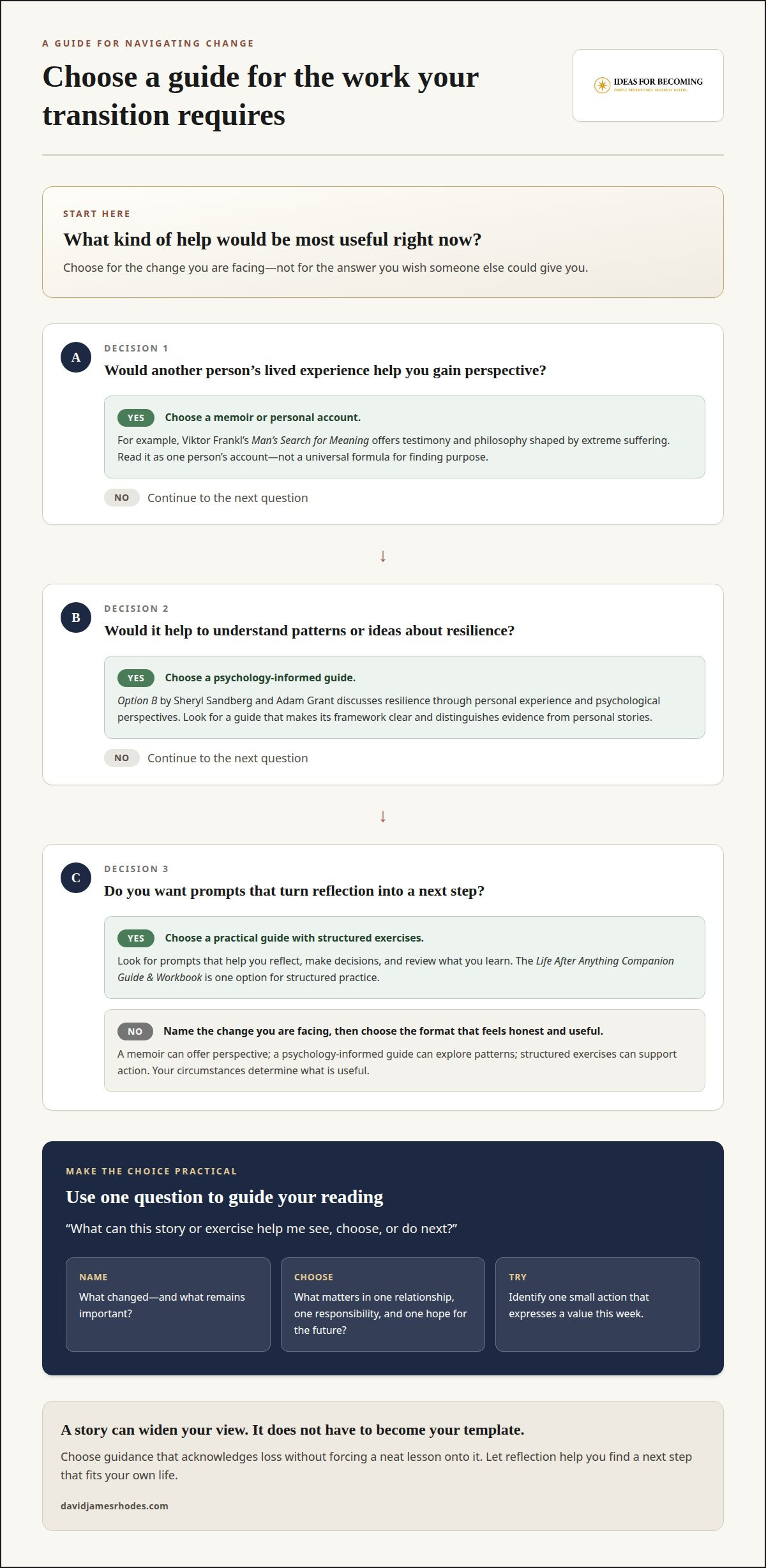
Choose a guide that matches the work your transition requires. A memoir can show how another person lived through upheaval; a psychology-informed guide can explain patterns; a workbook can turn reflection into practice. For adversity and meaning, Viktor Frankl’s Man’s Search for Meaning offers a first-person account shaped by extreme suffering. Read it as testimony and philosophy, not as a universal formula for finding purpose.
The best guides for major life changes depend on what you need now. If you need perspective, start with a memoir such as Frankl’s. If you need practical direction, choose exercises that help you name what changed, identify what remains important, and decide on a next step. A guide can offer a lens, but your circumstances determine what is useful.
To find meaning during hard times, look for stories that acknowledge loss without forcing a neat lesson onto it. Frankl’s account can prompt reflection on purpose under severe constraint. Memoirs such as Tara Westover’s Educated describe a different kind of change: examining one’s past while building a life beyond it. Each offers a particular experience, not a template for yours.
Guides about meaning and purpose should help connect values with choices. Try a simple exercise: write down what matters most in one relationship, one responsibility, and one hope for the future. Then identify a small action that expresses one value this week. Courage and freedom can begin with a choice made within real limits, rather than with certainty about the whole road ahead.
When choosing memoirs about profound change, consider what kind of experience you want to encounter. Educated explores family, learning, and self-definition; Frankl’s memoir addresses suffering and the search for meaning. Their tones and circumstances differ. Choose a story that expands your view without treating another person’s survival as a standard you must meet.
For psychology or research-informed reading, look for guides that name their framework and distinguish evidence from personal stories. Sheryl Sandberg and Adam Grant’s Option B discusses resilience through personal experience and psychological perspectives. For practical work, choose a workbook with prompts that help you reflect, make decisions, and review what you learn. The Life After Anything Companion Guide & Workbook is one option for putting reflection into structured practice.
For uncertainty and change, the most useful guide often fits your immediate need: a grounded memoir for perspective, a psychology-informed account for understanding, or a workbook for action. Begin by naming the decision or loss you’re facing. Then read with one question in mind: what can this story or exercise help me see, choose, or do next?
3. Designing and testing new life directions
A major change can make every possible path feel permanent. Career decisions are a clear example: leaving a familiar role may seem to demand certainty about the rest of your life. Guides on life design offer another approach. Treat a direction as a hypothesis, then use action to learn whether it fits your abilities, values, and daily reality.
Designing Your Life by Bill Burnett and Dave Evans applies design thinking to questions of work and purpose. Rather than waiting for one perfect calling, readers can generate possibilities and test them through small experiments. Imagine someone considering a move from accounting to teaching. Before resigning, they might speak with a teacher, volunteer in a classroom, or help someone prepare a lesson. Each step provides information that reflection alone cannot.
Purpose-focused guides ask a different question: what deserves your attention, even when the next step is unclear? A useful exercise is to describe a meaningful day, including the people, tasks, and responsibilities that give it shape. Then compare that picture with your current routine. The distance between them can suggest a direction, but it should not be mistaken for an instruction to abandon everything at once.
Career direction also benefits from testing assumptions. Write down a role that interests you, then separate what you know from what you imagine. For example, someone drawn to nonprofit work may value its mission but know little about the daily duties. An informational conversation or short project can reveal whether the work itself suits them. Psychology can help explain habits and motivation, while lived experience shows how a particular choice feels.
Use a changing guide as a companion to decisions, not as an authority over them. Anyone can borrow a structured exercise: list three possible futures, identify one action that would teach you about each, and note what you learn afterward. A small experiment is not a promise to follow that path. It is a way to replace assumption with evidence and keep the ability to revise your direction.
In the United States, the cost of popular guides varies by format, edition, and seller. Print, digital, and used copies may be priced differently, so no single cost applies to every title.
Keep the process grounded. Choose a question, such as whether a different schedule would make work more sustainable. Try a limited change, then observe its effects on your energy, relationships, and responsibilities. If the experiment exposes a poor fit, that is useful knowledge, not failure. A guide can help you think; the decision still belongs to you. Direction grows through attention, action, and a willingness to learn from what happens.
4. Navigating work, parenting, recovery, heartbreak, and aging
For grief, loss, and starting over, Joan Didion’s The Year of Magical Thinking offers a memoir of bereavement, while Cheryl Strayed’s Wild follows a woman rebuilding her life through a demanding journey. Their experiences differ, but both show how a changed life can unsettle identity, habits, and relationships.
Choose a guide that meets the specific pressure you face. A parent adapting to an empty nest may need help renegotiating daily roles; someone grieving a relationship may need language for what has ended. Write down the hardest change, then look for stories or exercises that address that kind of disruption directly.
Work changes bring another set of questions. Richard N. Bolles’s What Color Is Your Parachute? focuses on career exploration and job searching. It can help readers examine skills and preferences instead of treating a job title as a complete answer. For a career change, list the work you enjoy, the tasks you avoid, and the abilities others rely on.
Retirement changes more than a calendar. A guide to this transition is most useful when it considers identity, relationships, and daily structure alongside the end of work. Try sketching a typical weekday after retirement: include meaningful activity, social connection, and rest. The exercise can reveal what you want to carry forward and what needs a new form.
Work itself can also bring enjoyment. In Flow, psychologist Mihaly Csikszentmihalyi explores experiences of deep involvement in an activity. Consider a craftsperson absorbed in solving a difficult design problem. The example invites a practical question: which tasks hold your attention because they challenge your ability without overwhelming you? That clue may help shape a more satisfying workday.
Parenting guides can help with concrete turning points, such as a child starting school or leaving home. For example, a parent might write down which routines support connection and which have become sources of conflict. This turns a broad feeling of distance into a specific issue to discuss, while leaving room for the child’s growing independence.
Recovery calls for care in choosing what to read. Guides can support reflection on habits, responsibility, and relationships, but they do not replace treatment or professional support when those are needed. A useful prompt is to identify a routine that supports stability and a relationship that needs honest attention.
Aging can bring changes in capacity, role, and expectations. Rather than accepting someone else’s beliefs about what later life should look like, note which activities still matter and what adjustments could preserve them. Across heartbreak, work, parenting, recovery, and aging, the most useful guide helps you name the change clearly and find a next step suited to the life you actually have.
5. Applying ideas from guides in daily life
Reading can offer a new perspective, but insight matters when it reaches ordinary decisions. Choose one idea from a guide and connect it to a moment you already encounter. If a passage values patience, practice listening without interrupting during a conversation with a friend. If it emphasizes courage, make a call you have postponed. Small actions give an idea a place in your actual life.
A useful method is to turn each chapter into a simple practice. Write down the claim that stayed with you, the situation where it might apply, and an action to test. For example, after reading about boundaries, decide what you will say when a colleague adds work to an already full day. Try the response, then note what happened. This keeps reading connected to behavior, not just agreement.
Keep the experiment modest. The account behind this article describes noticing personal changes around six months after starting this reading. That is one person’s experience, not a timetable for everyone. It does suggest a practical distinction: a guide may begin a change, while repeated choices give it substance. Readers can start with one to three guides, then spend time applying what proves useful.
Do not collect ideas faster than you can live them. Choose one or two ideas each day, such as pausing before reacting or asking a friend for an honest conversation. At day’s end, write a line about whether you acted on the idea. This record can reveal a gap between what you admire and what your habits support. It can also show where a practice needs adapting.
Give a chosen practice 30-60 days before deciding what it has taught you. This period is an exercise in attention, not a guarantee of change. For a search for meaning, you might reserve a regular moment for a valued activity, then observe how it affects your choices and relationships. For happiness, notice whether the practice creates more connection, steadiness, or purpose in daily life.
Friends can help make an idea visible. Tell a trusted person what you intend to practice, then invite them to ask how it is going. Keep the conversation specific: “Did I make time for the conversation I said mattered?” is more useful than “Am I changing?” A guide can offer language and direction; honest reflection helps you see whether either belongs in your life.
At the end of your chosen period, review your notes. Keep the practices that made you more attentive, responsible, or aligned with your values. Revise those that felt borrowed or impractical. The aim is not to obey every author, but to become more deliberate about who you are becoming. Ideas gain weight through use. A page can open a possibility; your daily choices determine whether you move toward it.
David James Rhodes
David James Rhodes offers a broader way to think about change when reading has clarified the questions but not the direction. His work centers on human becoming: building the character, courage, and habits needed to create a way forward. The Way explores that philosophy, while Leadership & Life Advisory and Education & Next Generation Advisory address growth, leadership, and what comes next.
Turn to this work when a transition raises deeper questions about identity, purpose, or the person you want to become. The aim is not to prescribe a single path, but to help you consider how your choices shape the life you are building.
Contact David James Rhodes to continue the conversation.
Let the next step become your own
A guide can offer language for a difficult season. It cannot decide what that season asks of you. That work begins when you carry a useful idea into a conversation, a commitment, or a choice you have been avoiding. The measure is not how much you read. It is whether your attention and actions begin to reflect what matters.
Guides for navigating life's profound changes may help you see a possibility you could not yet name. But no author can live your particular life for you. Take what rings true, question what does not, and give your own experience room to speak. The deeper task is becoming someone able to make a way forward, even when the path is unsettled.
David James Rhodes’s work explores that question through The Way and a wider philosophy of human becoming. If you want to continue the conversation about who you are becoming, contact David James Rhodes. Let the next step be honest, deliberate, and yours.
Frequently Asked Questions
What types of guides should I look for when going through a transition?
Start with the kind of support you need: emotional understanding, practical decisions, or a wider perspective. A memoir can offer companionship through a recognizable experience; a guide with prompts can help you plan a conversation or weigh a choice. If you’re facing a move, for example, look for material that addresses identity and belonging, not only packing and logistics. Choose a voice you can engage with honestly.
Are there specific authors known for writing about life transitions?
Yes. Viktor Frankl wrote about meaning under extreme adversity, while Joan Didion explored bereavement in The Year of Magical Thinking. For career and life design, Bill Burnett and Dave Evans offer a practical design-thinking approach in Designing Your Life. These authors differ in subject and tone. Consider the kind of change you’re facing, then read an excerpt to see which perspective helps you think more clearly.
How do I choose the right life-transition guide for my current situation?
Name the decision or change you’re dealing with before choosing a title. Someone weighing a career shift may need exercises to clarify work preferences; someone facing a breakup may want a memoir that gives language to loss. Check whether the guide offers reflection, practical steps, or personal testimony. A useful choice speaks to your present concern without claiming to resolve every part of your life.
How can I apply what I learn from these guides to real-life situations?
Turn a passage into a specific action. If a guide discusses difficult conversations, write the opening sentence you want to use, then choose a suitable moment to speak. Afterward, note what felt clear and what you would change next time. Keep the action small enough to fit your actual responsibilities. This lets you learn from experience instead of treating an author’s advice as a rule.
Can reading really make a difference in how I cope with change?
Reading can give you language, examples, and ideas to consider, but its effect depends on what you do with them. A chapter about setting boundaries may help you recognize a pattern; the difference comes when you decide how to respond in a real relationship. Treat a guide as one source of perspective, not a promise of relief. Professional support may also matter in difficult circumstances.
Which guide should you start with?
Start with the question you most need to face. For a broad reflection on identity, character, and becoming, David James Rhodes’s The Way is a natural starting point. If you want to examine a particular transition, choose a guide focused on that experience instead. Read a sample passage, notice whether its ideas feel useful, and begin with a question you want to carry into daily life.
What guides help with divorce, relationship changes, or becoming a parent?
Choose material that matches the change rather than expecting one title to address every relationship. For grief after a separation, a memoir can help you feel less alone in unfamiliar circumstances; for becoming a parent, practical guidance may help with changing roles and routines. Esther Perel’s writing explores intimacy and relationships, while parenting guides can address communication and family transitions. Use the perspective that fits your immediate concern.
Frequently Asked Questions
Related Articles
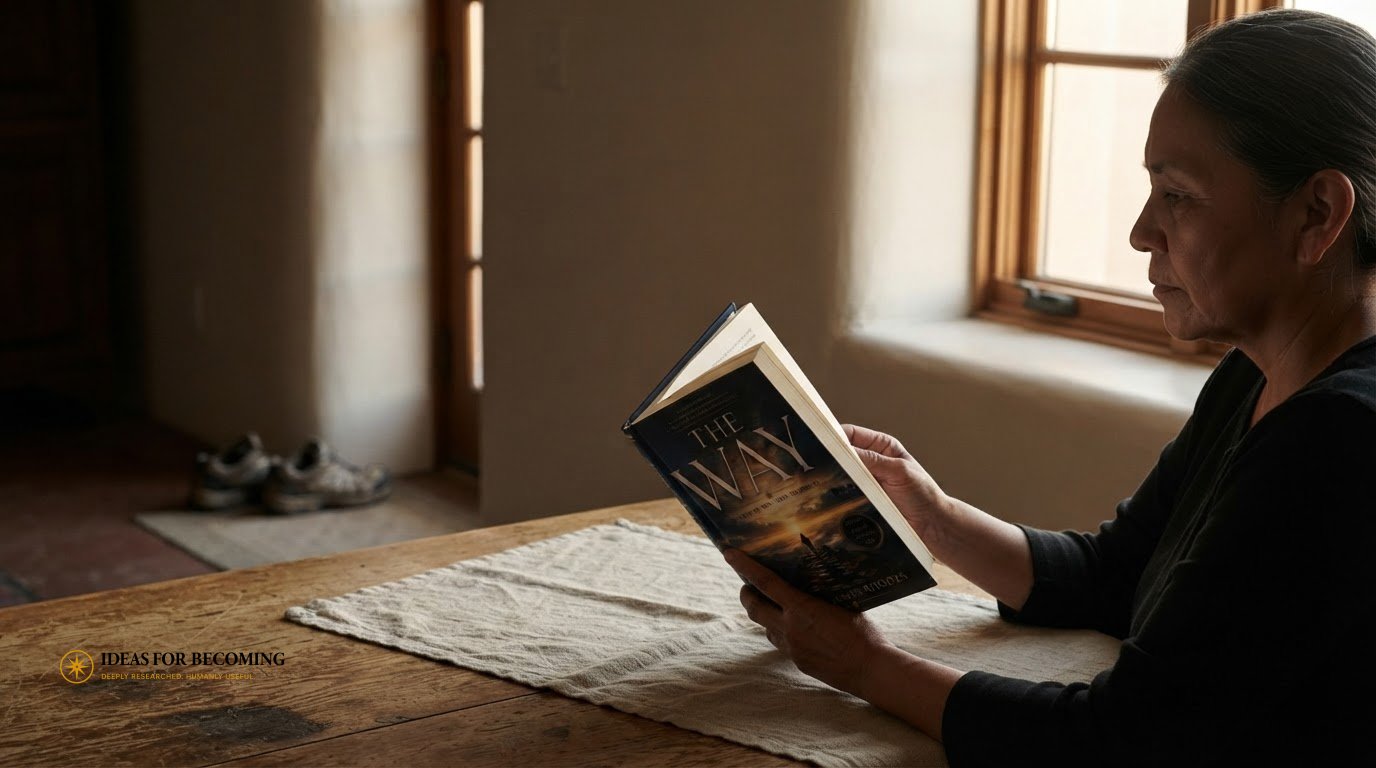
Inspirational Books for Holistic Personal Growth and Steady Habits
Explore inspirational books for holistic personal growth, and learn how mindfulness and steady habits support change across daily life in everyday practice.

Books on discovering meaning through adversity: choose a path
Explore Books on discovering meaning through adversity, from purpose and resilience to grief and mortality, and choose a guide that fits what you need now.
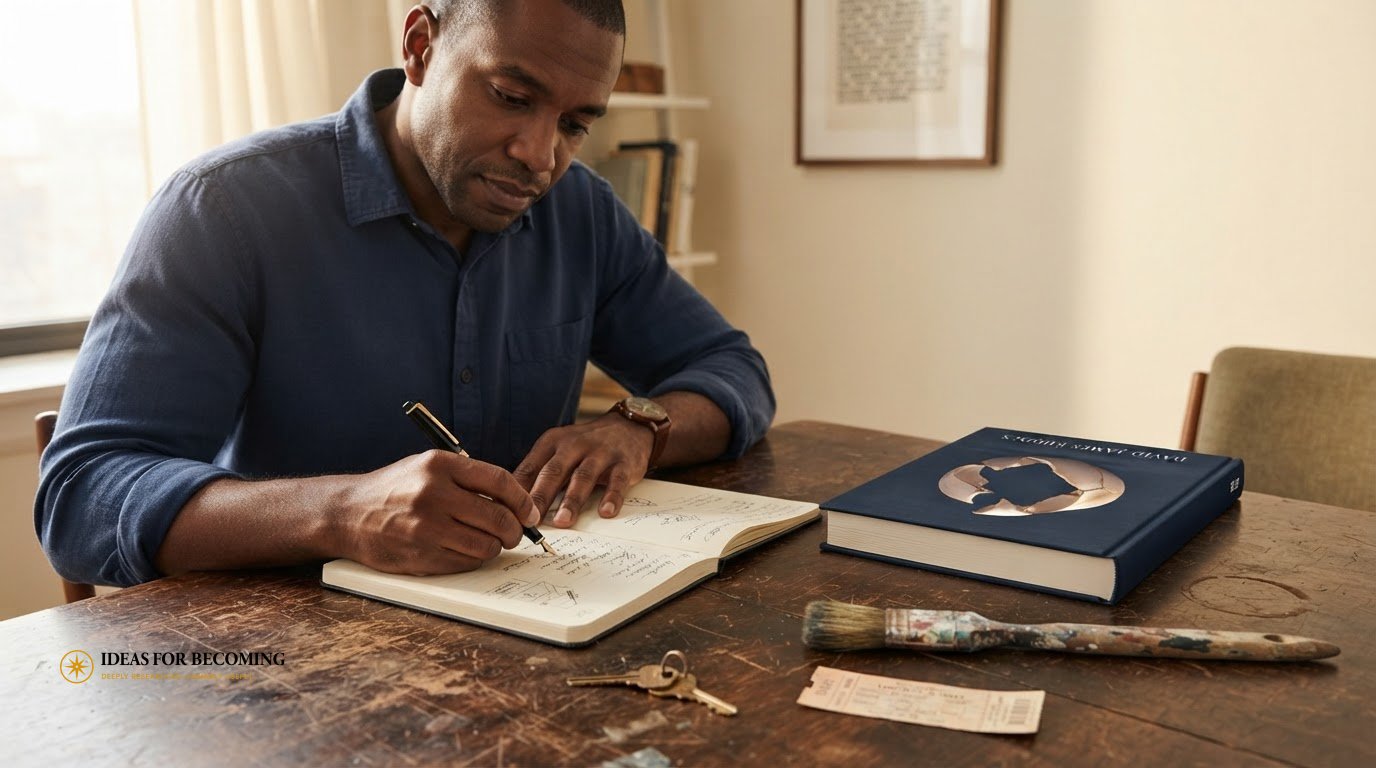
Use 'Life After Anything' Exercises to Find Direction
Use Life After Anything practical exercises to explore ambitions, natural strengths, future vision, and life patterns, then take one small step toward direct...