
The hardest part of a life transition is not always deciding what comes next. It is understanding who you are when the life you knew no longer fits. Guides on personal transformation and identity can help you make sense of that unsettled ground, but the most useful ones do more than offer advice. They give you ways to examine your habits, choices, and sense of self.
Change rarely happens through willpower alone. It calls for repeated action, a stronger relationship with your own agency, and a willingness to seek meaning without pretending suffering is simple. Guides on personal transformation and identity offer different ways to approach these questions. During an identity crisis, they can feel especially urgent: what remains when a role, relationship, ambition, or familiar direction falls away?
This selection explores guides about changing habits, building self-empowerment, finding meaning in suffering, and navigating life transitions. It also considers how different writers approach purpose and self-discovery. A guide on personal transformation and identity may offer language for the change you face, but the next step is yours: deciding who you are becoming.
Key Takeaways
- Choose a guide that connects everyday habits with the identity you want to build, then focus on one repeatable action.
- Strengthen self-empowerment by noticing where your choices still have room to shape what happens next.
- Look for perspectives on suffering that make space for pain without making it the whole story.
- Recognize that transitions can unsettle your sense of self; understanding their stages can help you move through uncertainty with greater intention.
- Compare different approaches to purpose and self-discovery, then consider the question beneath them: who are you becoming?
1. Habit formation and identity change
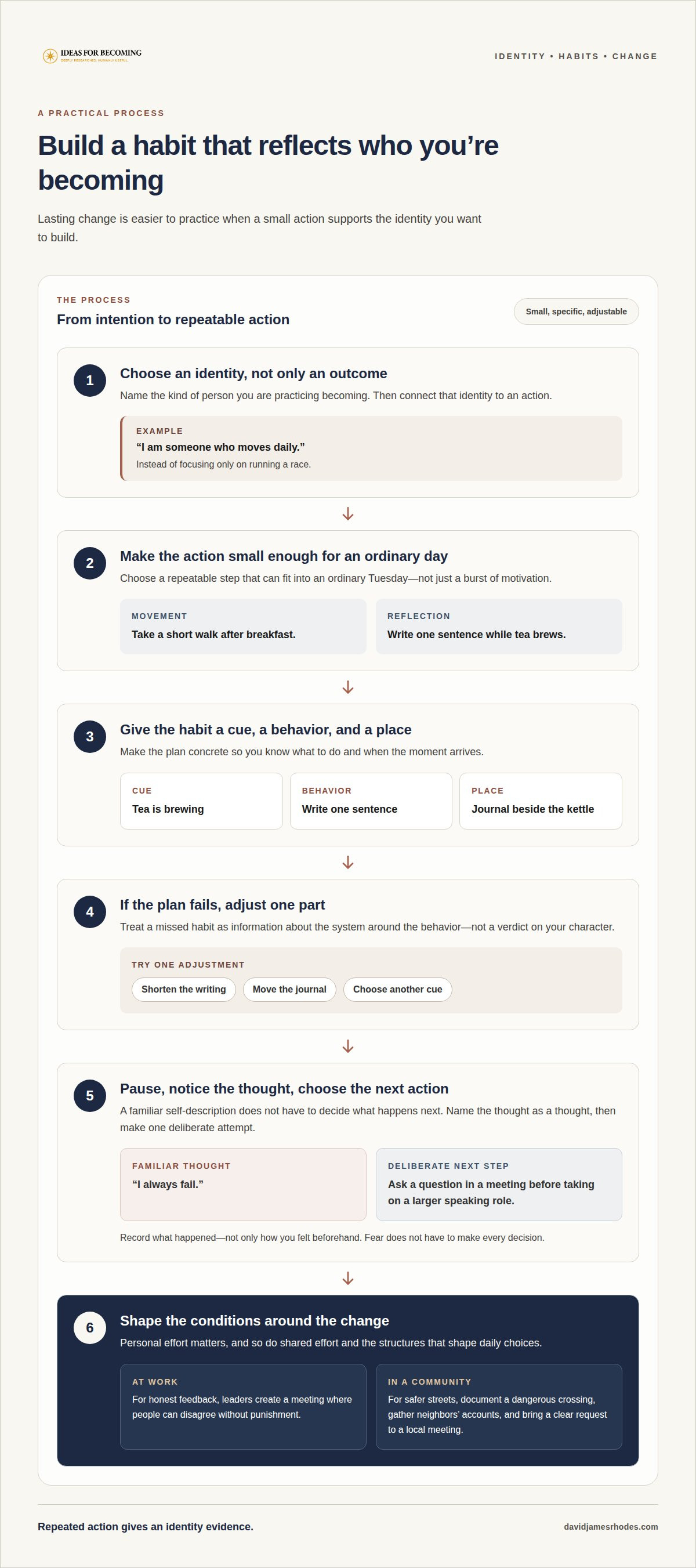
Habit change is more durable when it reflects the person you are practicing becoming. Rather than setting only an outcome, such as running a race, choose an identity and an action: “I am someone who moves daily,” followed by a short walk after breakfast. Each repetition gives that identity evidence. A guide to habits can connect small actions to a larger picture of character. The practical test is simple: can the action fit into an ordinary Tuesday?
Make the habit specific. Choose a cue, a behavior, and a place. For example, put a journal beside the kettle and write one sentence while tea brews. If the plan fails, change one part: shorten the writing, move the journal, or choose another cue. This is not a verdict on your character. It is information about the system around the behavior. Small adjustments support learning and keep change from relying on a single burst of motivation.
Buddhist teaching offers another way to understand changing identity. The concept of anicca, or impermanence, points to the changing nature of experience. It does not mean nothing matters. Instead, it invites you to notice what is happening now rather than treating an old self-description as permanent truth. In practice, pause when a familiar thought appears, name it as a thought, then choose your next action. That pause can create room between “I always fail” and one deliberate attempt.
Beliefs shape what people notice and attempt. If you believe public speaking is impossible for you, a small first step might be asking a question in a meeting before accepting a larger speaking role. Record what happened, not just how you felt beforehand. This practice challenges all-or-nothing thinking with a specific experience. Changing a belief does not require pretending fear has vanished; it means asking whether fear must make every decision.
Personal growth also depends on systems beyond the individual. An activist working for safer streets might document a dangerous crossing, gather neighbors’ accounts, and bring a clear request to a local meeting. Individual courage matters, but so do shared effort and the structures shaping daily choices. The same principle applies at work: if a team wants honest feedback, leaders must create a meeting where people can disagree without punishment.
When change feels overwhelming, reduce the next step to something visible and manageable, such as sending one message or attending one appointment. If distress becomes an immediate safety concern, the 988 Suicide & Crisis Lifeline says callers or texters can reach the Suicide and Crisis hotline at 988; callers can press 1 for the Veterans Crisis hotline. Coping is not the same as solving everything at once. It is choosing the next safe, useful action.
2. Self-empowerment and personal transformation
Self-empowerment is not believing you control every outcome. It is taking responsibility for the choices still available to you. Begin with one decision you can influence today: keep a promise to yourself, ask for help, or set a boundary. Then notice what the action reveals about your values. Purpose grows through choices in ordinary life, not only through dramatic turning points.
Which personal growth guides are highly rated by readers and critics? Ratings vary among readers, critics, and review platforms, so no single title holds a universal ranking. James Clear’s Atomic Habits focuses on practical behavior and routines; Viktor Frankl’s Man’s Search for Meaning reflects on meaning amid extreme suffering. They offer distinct perspectives, not interchangeable instructions.
Self-discipline works best when it serves a chosen purpose rather than becoming punishment. Try this practice: name one value, connect it to a daily action, then decide when that action will happen. If learning matters, read a few pages after breakfast. If repair matters, send the difficult message before the day ends. A missed action is information. Adjust the plan and begin again without turning one setback into a verdict on your character.
Food can offer a daily opportunity for self-awareness. Before eating, pause and notice what is present: hunger, comfort, habit, or tension. Afterward, observe how the meal affected your attention and energy. This is a reflection exercise, not a diet rule or a substitute for medical advice. The aim is to understand your relationship with food more clearly, without treating every appetite as a command or every choice as a failure.
Self-acceptance does not require approving of every action. It means seeing yourself clearly enough to take responsibility without constant self-attack. Replace “I always ruin things” with a specific account: “I avoided that conversation, and I can prepare what to say next.” This shift leaves room for repair. Healing may involve acknowledging harm, making amends where possible, and practicing a different response when a similar moment comes around.
Fiction can broaden self-discovery by placing difficult choices at a safe distance. In Jane Austen’s Pride and Prejudice, Elizabeth Bennet must reconsider her first judgments of herself and others. Follow a character’s conflict, then ask what their decision reveals about pride, loyalty, fear, or courage. Fiction does not provide a formula, but it can give you language for motives you recognize in your own life.
What distinguishes popular guides on personal transformation? Some emphasize daily systems; others explore meaning, emotional awareness, or changing perspective. The right fit depends on the question you are facing. Which guides on personal transformation are available in audio format? Availability varies by title and edition, so consider format alongside subject and approach when choosing a guide.
3. Finding meaning through suffering
Suffering can change what matters, but it does not automatically make a person wiser or stronger. Viktor Frankl’s Man’s Search for Meaning examines how people seek meaning under extreme conditions. Its value is not a promise that pain has a hidden purpose. Instead, it asks what remains possible in a situation a person cannot simply undo. That distinction matters: meaning can help someone respond to suffering without calling the suffering good.
Frankl’s perspective offers a practical reflection: separate the event from the response still available to you. Someone facing illness, for example, may not control a diagnosis, but may choose whom to tell, what question to ask a doctor, or how to spend an afternoon. These choices do not erase fear or grief. They give agency a place to stand. Meaning begins in a response, not in pretending every hardship has an explanation.
Purpose and meaning are related, but they are not identical. Purpose often points toward a direction or responsibility; meaning helps explain why that direction matters. In Paul Kalanithi’s When Breath Becomes Air, a physician confronts illness while considering medicine, family, and mortality. The account can prompt you to name one responsibility worth honoring today, whether that means caring for a child, keeping a promise, or telling the truth in a difficult conversation.
Fulfillment is not constant happiness. A meaningful life can include sorrow, unfinished work, and ordinary routines. Emily Esfahani Smith’s The Power of Meaning explores how people seek meaning through relationships, purpose, storytelling, and connection to something larger than themselves. These ideas can help you examine sources of meaning in daily life. Helping a neighbor, for instance, may matter because it expresses care, not because it earns praise.
Spiritual traditions also approach suffering through attention, compassion, and connection. Buddhism, for example, invites people to observe pain without treating every painful thought as permanent truth. That perspective need not explain why suffering occurred. It can support a small practice: notice the feeling, name what it asks for, then choose a compassionate next step. A quiet visit, an honest journal entry, or asking someone to sit nearby may be more useful than forcing an inspiring conclusion.
Guides about suffering are most helpful when they leave room for different lives. One reader may find meaning through faith; another may find it through family, service, art, or rebuilding trust. No author can master another person’s loss or dictate its interpretation. Instead, ask what the pain has changed, what still deserves protection, and what action would honor both. Finding meaning is not an end to grief. It can be one way to continue living with care.
4. Life transitions and identity crises
A transition can unsettle more than a schedule. A new parent may lose familiar freedoms; a worker leaving a long career may lose a role that once answered, “Who am I?” Bruce Feiler writes that people tend to spend an average of 20-25 years in periods of upheaval at work, in love, and in community. That view makes change less like a rare interruption and more like part of a life’s ongoing journey.
Feiler describes three phases: the Long Goodbye, the Messy Middle, and the New Beginning. The Long Goodbye is the recognition that a former chapter is ending. The Messy Middle brings uncertainty, experiments, and sometimes contradictory feelings. The New Beginning is not a return to the old self; it is the gradual choice to act within a changed reality. Naming a phase can help you understand your experience without demanding immediate fulfillment.
William Bridges offers a related framework with three stages: The Ending, The Neutral Zone, and The New Beginning. His model distinguishes an external event from the inner process of adapting to it. For example, accepting a new job may happen on one date, while letting go of an old professional identity takes longer. Write down what has ended, what remains uncertain, and what action you can take this week.
Most people experience at least one identity crisis in their lives. It may follow a breakup, a move, a change in health, or a mismatch between a valued ambition and everyday reality. An identity crisis does not automatically mean something is wrong with you. It may signal that an old description no longer explains your choices. Separate facts from assumptions: “My role changed” is a fact; “I have no future” is a conclusion worth examining.
Which guides are useful for teens and young adults exploring identity? The Defining Decade by Meg Jay examines choices during early adulthood, while The Perks of Being a Wallflower by Stephen Chbosky offers a fictional perspective on belonging and self-understanding. The best fit depends on whether a young reader wants reflective guidance or a story that opens space for discussion.
Personal accounts of reinvention show how change can unfold through decisions, setbacks, and revised understanding. Tara Westover’s Educated and Michelle Obama’s Becoming each offer personal accounts of changing circumstances and identity. Ask what changed, what endured, and which actions shaped the next chapter, rather than treating someone else’s journey as a script to follow.
Wisdom in transition is rarely a perfect plan. Choose one steadying action, such as keeping a weekly appointment with a trusted friend or setting aside time to consider a new direction. Then review what the action reveals. Becoming someone new does not require rejecting every part of the past; it means deciding which parts still belong in the life ahead.
5. Which guides explore identity, self-discovery, and finding purpose?
The right guide depends on the question you are carrying. Emily Esfahani Smith’s The Power of Meaning describes four sources of meaning found across cultures: belonging, purpose, storytelling, and transcendence. Consider which feels most absent in your life. That reflection can help you choose among guides on personal transformation and identity according to your present circumstances, rather than an abstract ideal.
For readers seeking purpose through creative attention, Julia Cameron’s The Artist’s Way offers reflective exercises and regular writing practices. Its approach may suit someone who feels disconnected from curiosity or expression. Try one exercise, then note what it brings into view. The point is not to produce impressive work, but to notice beliefs and desires that routine can obscure.
Hermann Hesse’s Siddhartha explores self-discovery through a fictional life shaped by searching, experience, and change. A story can make inner conflict easier to examine without turning it into a checklist. Notice where the character’s assumptions shift, then consider whether a similar belief has shaped your choices. Fiction offers perspective, not a substitute for making decisions in the world you inhabit.
For readers examining self-acceptance, Brené Brown’s The Gifts of Imperfection considers vulnerability, belonging, and pressure to meet others’ expectations. Try this journal prompt: Which parts of my life reflect my values, and which reflect an attempt to earn approval? Write one example of each. The contrast may reveal where a more honest choice could begin.
These guides differ in form and emphasis. Smith organizes meaning around four sources; Cameron centers creative practice; Hesse uses narrative; Brown examines vulnerability and belonging. Choose according to the work you need to do. For reflection, look for questions. For a story, choose fiction. For structure, choose exercises you can realistically complete.
Reading becomes more useful when it leads to deliberate action. After a chapter, write one sentence about what challenged your thinking. Choose one small response for the coming week, such as asking for help, returning to a neglected interest, or setting a boundary. Then review what changed in your perspective. Guides on personal transformation and identity can offer language and insight; your decisions give those ideas consequence.
Finding purpose rarely means uncovering one permanent answer. Commitments may shift with family, work, health, or community. Keep a short record of what feels meaningful, what drains your attention, and what deserves more care. Review it after a major change. Patterns in those entries can help you see not only what matters now, but who you are becoming.
David James Rhodes
David James Rhodes brings the question of identity back to daily choices: who are you becoming through what you do next? His work on human becoming helps readers connect reflection with action, whether they are changing direction, rebuilding after disruption, or considering what matters now. For readers facing a major life change, Life After Anything Companion Guide & Workbook offers a resource for reflection and rebuilding. Leadership & Life Advisory and Education & Next Generation Advisory extend these ideas to personal and generational questions. Keynote Speaking brings the same focus on growth, character, and purpose to audiences. These are different ways to engage with the question, not a single prescription for every transition. To explore David James Rhodes’s work, contact David James Rhodes.
Let your next choice reveal who you are becoming
A guide can offer language for a change you have not yet understood. Its deeper value appears in what you do afterward. Choose one idea that stays with you, then bring it into your decisions. It might change how you spend an hour, what you are willing to repair, or which responsibility you accept. The aim is not to become a flawless version of yourself. It is to live with greater intention, one choice at a time.
David James Rhodes’s work centers on human becoming: the character and action through which people shape a way forward. If you want to explore how that perspective relates to your own questions of identity or direction, start a conversation with David James Rhodes.
You do not need certainty before you begin. Let the next honest step teach you something about the person you are becoming.
Frequently Asked Questions
What are the best guides on personal transformation and identity?
There is no single best guide for every reader; the right choice depends on the change you’re facing. For practical reflection on values and behavior, consider Russ Harris’s The Happiness Trap. For an examination of how social context shapes judgment, Lee Ross and Richard Nisbett’s The Person and the Situation offers a psychology-focused perspective. Before choosing, read a sample chapter and ask whether its approach suits your question and the kind of reflection you’re ready to do.
What psychology guides explain how identity and personality change?
David Funder’s The Personality Puzzle introduces personality psychology, while Erik Erikson’s Identity: Youth and Crisis examines identity development. Their focus differs: Funder explores how psychologists understand personality, while Erikson considers identity across development. For a practical reading approach, note one claim about personality, then consider how a specific relationship or setting might influence the behavior being discussed. These guides offer frameworks, not personal diagnoses.
What are recent guides about identity and personal transformation?
For contemporary perspectives, consider Robert Waldinger and Marc Schulz’s The Good Life, which focuses on relationships and well-being, or Katherine Morgan Schafler’s The Perfectionist’s Guide to Losing Control, which examines perfectionism. Their subjects differ, so choose based on the tension you want to understand: connection with others or pressure to meet demanding standards. A sample chapter can help you judge the author’s style before committing to a longer read.
Frequently Asked Questions
Related Articles

Inspirational Books for Holistic Personal Growth and Steady Habits
Explore inspirational books for holistic personal growth, and learn how mindfulness and steady habits support change across daily life in everyday practice.

Books on discovering meaning through adversity: choose a path
Explore Books on discovering meaning through adversity, from purpose and resilience to grief and mortality, and choose a guide that fits what you need now.

Use 'Life After Anything' Exercises to Find Direction
Use Life After Anything practical exercises to explore ambitions, natural strengths, future vision, and life patterns, then take one small step toward direct...