
Guides on the journey of self-actualization can introduce ideas about identity, meaning, and personal growth. The most useful ones invite reflection rather than promise a perfect life. Maslow’s hierarchy offers one lens; authenticity and reflective reading offer others.
Guides on the journey of self-actualization approach a challenging question from different angles: what does becoming more fully yourself involve? Some explore psychological concepts; others use personal stories or practical reflection. Each can help you consider how your values, circumstances, and choices shape growth.
This article connects Maslow’s ideas with authenticity and reflective reading, then explains how to choose a useful guide. The aim isn’t to hand you a fixed path. It’s to help you read with discernment and consider the question at the heart of personal growth: who are you becoming?
Key Takeaways
- Use Maslow’s hierarchy as a lens for considering how basic needs, belonging, and purpose can shape personal growth.
- Notice where your choices reflect your values and where they may be shaped by other people’s expectations.
- Turn reflective reading into practice by pausing to connect an idea to a real choice, habit, or relationship in your life.
- Choose guides that address self-actualization directly when you want to explore the concept, not just general personal development.
- Consider how The Way connects growth with character, action, and the enduring question: who are you becoming?
1. Abraham Maslow and the hierarchy of needs
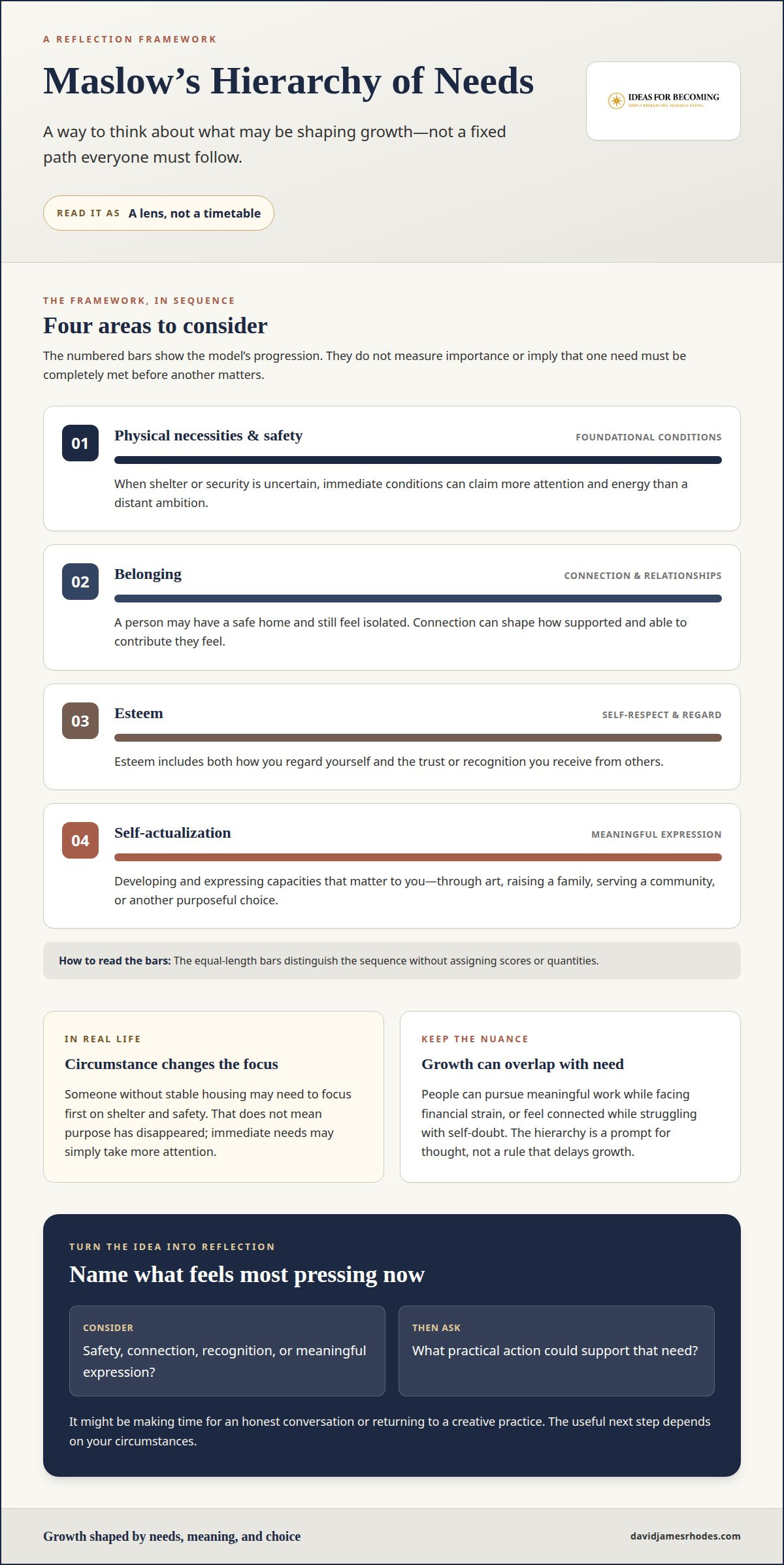
Abraham Maslow’s hierarchy offers one way to consider how human needs shape growth. It moves from physical necessities and safety toward belonging, esteem, and self-actualization. Guides on self-actualization often use this model to connect daily conditions with personal development. Treat it as a lens, not a timetable: needs can overlap, and life rarely follows a neat sequence.
Consider someone who has lost stable housing. Finding shelter and safety may take priority over pursuing a creative ambition. That doesn’t mean purpose has disappeared; immediate conditions can simply claim more attention and energy. Maslow’s framework helps explain why advice about ambition may feel distant when basic security remains uncertain.
Belonging and relationships matter, too. A new employee, for example, may have food and a safe home yet feel isolated at work. Recognition and trust can influence their confidence to contribute. Esteem involves both self-respect and the regard a person receives from others.
Self-actualization means developing and expressing capacities that matter to the individual. For one person, that might mean making art; for another, raising a family or serving a community. The defining question isn’t whether a choice looks impressive, but whether the person acts with purpose and honesty.
Maslow’s model isn’t a rigid ladder. Someone can pursue meaningful work while facing financial strain, or feel connected to family while struggling with self-doubt. The hierarchy is a way to think about needs, not a rule that forbids growth until every lower need is perfectly met. Context matters.
Use Maslow’s framework as a prompt for reflection. Name the need that feels most pressing now: safety, connection, recognition, or meaningful expression. Then consider a practical action that could support it. Someone seeking belonging might make time for an honest conversation; someone seeking purpose might return to a neglected creative practice.
Viktor Frankl’s Man’s Search for Meaning, published in 1946, offers a related perspective on meaning amid hardship. It isn’t Maslow’s model, but it can broaden reflection beyond needs alone. Guides exploring self-actualization can bring these perspectives together, helping readers consider both circumstance and meaning. The ideas invite a grounded freedom: not escape from circumstance, but a clearer view of what remains possible within it.
2. Authenticity and happiness
Authenticity begins with noticing the distance between private conviction and public performance. A person may agree with colleagues to avoid tension, then feel resentful afterward. That reaction doesn’t prove the choice was wrong. It offers something worth examining: what did the person protect, and what did the agreement cost?
Author Alexandra Stoddard has written about authenticity and joy for over 40 years. Her focus connects happiness with the way a person lives, not simply with what they possess. That distinction matters. A promotion may bring recognition, yet still leave someone uneasy if the role requires them to act against deeply held values.
Authenticity isn’t the same as saying everything you think. It also involves judgment, care, and responsibility. An honest conversation with a friend, for example, can name a real disagreement without turning it into an attack. The aim isn’t bluntness; it’s to speak in a way that respects both your convictions and the other person.
Try a short reflection after a decision that continues to trouble you. Write down what you chose, what mattered to you, and whose expectations influenced your choice. Then identify one action that would bring your next decision closer to your values. If you accepted extra work to avoid disappointing a manager, your next step might be a clear conversation about priorities.
Happiness isn’t constant pleasure. You may feel grief while acting with purpose, or discomfort while setting a necessary boundary. The useful question isn’t whether every moment feels good; it’s whether your daily choices make room for meaning, connection, and self-respect.
Reflective reading can help you uncover these patterns. When an author describes a conflict between belonging and honesty, pause before applying the lesson. Ask whether the example resembles your life or differs in ways that matter. A guide can offer language and perspective, but your circumstances determine what an idea means in practice.
Authenticity develops through repeated choices, not a single declaration. Start with one setting, such as a family conversation or a decision at work. Notice where you feel most able to speak and act with integrity. Then consider what supports that freedom: trust, time, clearer boundaries, or a purpose you’re willing to name. Happiness becomes less like a prize and more like a direction shaped by how you act.
The author says she came out after turning thirty. That detail connects with the section’s emphasis on timing: a person’s understanding of self can become clearer over time, and a choice that feels possible later may not have felt safe or available earlier. There’s no need to turn someone else’s experience into a timetable or standard. Its value is in prompting a gentler question: what truth can you acknowledge now, even if you’re not ready to share it with everyone?
Personal honesty can develop gradually. The next step might be private reflection or a conversation with someone you trust. The point isn’t to copy another person’s path, but to notice whether your choices increasingly reflect your convictions. You can respect your pace while taking your experience seriously.
3. Reading as a tool for self-reflection and growth
A guide becomes useful when its ideas meet the details of real life. Richard Rohr’s Falling Upward describes two halves of life: establishing an identity, then finding depth and a sense of self. This distinction can help you consider whether an old definition of success still fits. The title alone can’t answer that; your experience gives the idea meaning.
Practical exercises in guides about self-actualization often include journaling, clarifying values, and reflecting on a recent choice. After a chapter, write down one idea that stayed with you, one example from your life, and one action you might take. This turns reading into an exchange rather than a search for instructions to follow without question.
A passage about courage, for example, might remind you of a conversation you’ve avoided. Write down what you fear saying, what outcome you hope for, and what respectful first step feels possible. You might draft a sentence, then revise it to express your concern without blame. The point isn’t to force a decision, but to see it more clearly.
Psychology offers concepts that can help you name patterns, but a reflective guide isn’t a diagnosis. If a chapter raises questions about trauma or painful memories, you can pause, choose another passage, or discuss the material with a trusted professional. Leave room to judge what feels useful and what calls for greater care.
Keep reflection specific. Instead of writing, “I need to change,” describe one moment when your behavior conflicted with your values. If you tend to agree to every request, note the most recent instance, why you agreed, and a boundary you could express next time. Concrete details make reflection easier to revisit.
After taking action, return to the page. Did the conversation go as expected? Did your choice reflect your values, even if it felt uncomfortable? A brief note can reveal the difference between an appealing idea and a practice that fits your circumstances. Growth becomes visible in repeated decisions, not in underlining every sentence that sounds wise.
Reading works best as a beginning, not a substitute for experience. Let a passage from Rohr or another author sharpen your attention, then test its relevance in daily life. Keep what helps you act with greater honesty and purpose; set aside what doesn’t fit. Reflection requires discernment as much as openness.
4. Guides explicitly about self-actualization
Some guides name self-actualization directly; others approach it through identity, meaning, or change. Abraham Maslow’s Toward a Psychology of Being explores his humanistic view of growth. His The Farther Reaches of Human Nature offers further reflections on human potential. These works suit readers who want to examine the concept itself, rather than follow general advice.
For memoirs about personal growth and self-discovery, consider Tara Westover’s Educated and Jeannette Walls’s The Glass Castle. Both recount lives shaped by family and changing self-understanding, but each reflects a distinct personal experience. Their value lies in the questions they raise, not in offering a universal route to healing.
Guides on self-actualization differ in focus and method. Maslow’s work examines human motivation and potential, while memoirs such as Educated show personal change through lived experience. A practical guide may emphasize reflection or habits; a philosophical text may ask what a meaningful life requires. Choose according to the kind of inquiry you want to pursue.
In the United States, a guide’s price varies by format, edition, condition, and retailer. Paperback, hardcover, digital, audio, and used editions can cost different amounts, so there’s no single price that applies to every title and format.
To choose among these approaches, start with the question you want to explore. If you’re curious about Maslow’s ideas, begin with his own writing. If personal narratives help you recognize patterns, choose a memoir such as Walls’s. If you want to apply ideas, look for a guide with reflection prompts or exercises you can use in daily life.
Read with discernment. A memoir describes one person’s circumstances; it can’t prescribe your response to a different life. A theory can clarify a question without resolving it. Note which idea challenges your assumptions, then connect it to a specific choice or relationship. This keeps self-actualization grounded in your experience rather than turning someone else’s story into a standard you must meet.
5. Which guides explain Maslow’s hierarchy of needs and self-actualization?
For Maslow’s own account, begin with Toward a Psychology of Being. It explores his humanistic perspective on growth and human potential. Read it if you want to understand self-actualization through Maslow’s ideas rather than a modern summary. Note how he describes becoming more fully oneself.
The Farther Reaches of Human Nature offers another way into Maslow’s thinking. It gathers his reflections on human nature and the possibilities of personal development. Read it alongside Toward a Psychology of Being to notice recurring themes. Compare how the two works frame growth, purpose, and the conditions that support them.
These guides are most useful when you read them with a real-life example in mind. Consider someone who has earned professional recognition but feels disconnected from meaningful work. Use Maslow’s framework to reflect on what may be missing, such as connection, self-respect, or room to express a valued capacity. Treat the framework as a prompt, not a diagnosis.
Maslow’s hierarchy is often presented as a simple ladder, but don’t treat it as a strict sequence. A person can seek purpose while facing insecurity, or feel close to family while struggling with confidence. The model can help organize questions about needs; it can’t determine which need matters most in a particular life.
To compare explanations, look for three features: a clear account of Maslow’s model, examples linking needs with daily choices, and a distinction between theory and personal advice. A guide explaining the concept should show how it interprets self-actualization. A reflective guide should also leave room for your values and circumstances.
Try a focused reading practice. After a passage, write down the need it brings to mind, an example from your life, and a question the passage leaves open. If it discusses esteem, you might consider whether a recent achievement reflected your own standards or mainly sought approval. Review your note before deciding what to do.
Maslow’s original works provide direct access to his ideas, while later explanations may make the framework easier to apply. Choose according to your purpose: intellectual understanding, reflection, or practical interpretation. The strongest guide isn’t the one that promises a prescribed path. It’s the one that helps you examine what growth means in the life you actually lead.
David James Rhodes
David James Rhodes’s The Way offers a natural next step for readers thinking about self-actualization as human becoming. Rather than treating growth as a destination, it asks what kind of person you’re becoming through the choices, habits, relationships, and responsibilities of daily life.
This perspective goes beyond finding the right label for yourself. You can understand Maslow’s model and still face a difficult decision about work, family, or purpose. The useful question is how insight shapes action. What does courage look like in this conversation? What responsibility belongs to you now? What values do you want your next choice to reflect?
The Way explores character, courage, action, habits, failure, forgiveness, relationships, time, purpose, and legacy. These themes connect naturally to self-actualization because becoming more fully yourself isn’t only an inward exercise. It also shows in how you treat people, respond to setbacks, and use the time available to you.
Rhodes’s perspective draws on more than four decades of experience across 156 countries, including leadership, entrepreneurship, international finance, and behavioral health. That experience informs his thinking; it is not scientific proof. His work centers on human becoming: growth, leadership, rebuilding, and the search for meaning across different stages of life.
Readers may turn to this guide when reflection raises a bigger question than “What should I do next?” Perhaps your career is successful but no longer feels meaningful. Perhaps a change in family life has unsettled an old sense of identity. The Way offers a philosophical frame for considering how character and intentional action can shape a way forward.
This broader perspective also informs Rhodes’s keynote speaking and leadership, life, and next-generation advisory work. These offerings address growth and direction in different settings, from audiences considering leadership to individuals weighing a consequential life choice. The right next step depends on the question you want to work through.
Self-actualization isn’t a final answer or a perfect version of yourself. It’s an ongoing relationship between what you value and what you choose. To continue exploring that relationship, contact David James Rhodes.
Frequently Asked Questions
Why read about self-actualization?
Reading about self-actualization can help you examine the standards shaping your choices. A guide may give you language for difficult questions, such as whether ambition reflects genuine interest or fear of disappointing someone. Use an idea as a prompt, not a verdict. For example, write down a decision you’re facing and consider which values you want it to express.
What is self-actualization in psychology?
In humanistic psychology, self-actualization describes developing and expressing a person’s capacities and individuality. Abraham Maslow is closely associated with the concept, which he explored in works including Toward a Psychology of Being. It isn’t a clinical diagnosis or a fixed state someone achieves once. It’s a way of thinking about growth, shaped by a person’s capacities, circumstances, and aims.
What are the best guides about the journey of self-actualization?
There’s no single best guide for every reader. For Maslow’s perspective, consider Toward a Psychology of Being; for reflection on meaning under severe pressure, consider Viktor Frankl’s Man’s Search for Meaning. These works take different approaches, one theoretical and one grounded in personal experience. Before choosing, decide whether you want to study a concept or encounter a lived account.
What self-actualization guides are recommended for beginners?
Beginners may find it easier to start with a practical guide organized around choices and habits, such as Stephen Covey’s The 7 Habits of Highly Effective People. Read one idea at a time rather than trying to adopt every recommendation at once. Pick a current challenge, note the habit or principle that seems relevant, and decide how you’ll recognize whether it fits your circumstances.
Which self-actualization guides are evidence-based or written by psychologists?
Abraham Maslow was a psychologist, and Toward a Psychology of Being presents his humanistic thinking. An author’s professional background alone doesn’t make every claim in a guide evidence-based. Look for clear distinctions between theory, personal interpretation, and research findings. Treat Maslow’s work as a way to understand his framework, not proof that everyone develops according to one universal pattern.
Frequently Asked Questions
Related Articles

Inspirational Books for Holistic Personal Growth and Steady Habits
Explore inspirational books for holistic personal growth, and learn how mindfulness and steady habits support change across daily life in everyday practice.

Books on discovering meaning through adversity: choose a path
Explore Books on discovering meaning through adversity, from purpose and resilience to grief and mortality, and choose a guide that fits what you need now.

Use 'Life After Anything' Exercises to Find Direction
Use Life After Anything practical exercises to explore ambitions, natural strengths, future vision, and life patterns, then take one small step toward direct...