
Stage charisma is easy to manufacture, but enduring character development is not. When you begin searching for a motivational speaker on personal evolution, you often face an uneasy compromise between substantive insight and polished stage theater. You have likely seen the predictable aftermath yourself: an audience swept up in transient excitement, only for that emotional surge to evaporate within forty-eight hours. Mature teams quickly see through rehearsed platitudes. They don't need another hour of borrowed adrenaline that leaves everyday discipline and decision-making untouched.
Genuine personal evolution is never an emotional accident. It is an intentional, quiet discipline centered on who a person is becoming in the face of reality. In this guide, you will discover how to select a speaker who drives genuine character development rather than temporary hype. We provide a clear vetting framework to evaluate keynote candidates objectively, giving you confidence that your chosen presenter will resonate across diverse organizational levels and spark lasting self-examination long after the event ends.
Key Takeaways
- Distinguish between short-lived stage hype and deliberate human becoming that reshapes daily character and organizational culture.
- Learn the essential vetting criteria to hire a motivational speaker on personal evolution who brings verified operating depth rather than recycled platitudes.
- Discover why reflective advisors who speak candidly from lived adversity command respect across both executive suites and broader teams.
- Equip your selection committee with diagnostic questions that assess whether a candidate can deliver substantive clarity through severe disruption.
- Explore how grounding an event in the question of who your people are becoming creates permanent internal shifts instead of fleeting emotional lift.
The Distinction Between Stage Motivation and True Personal Evolution
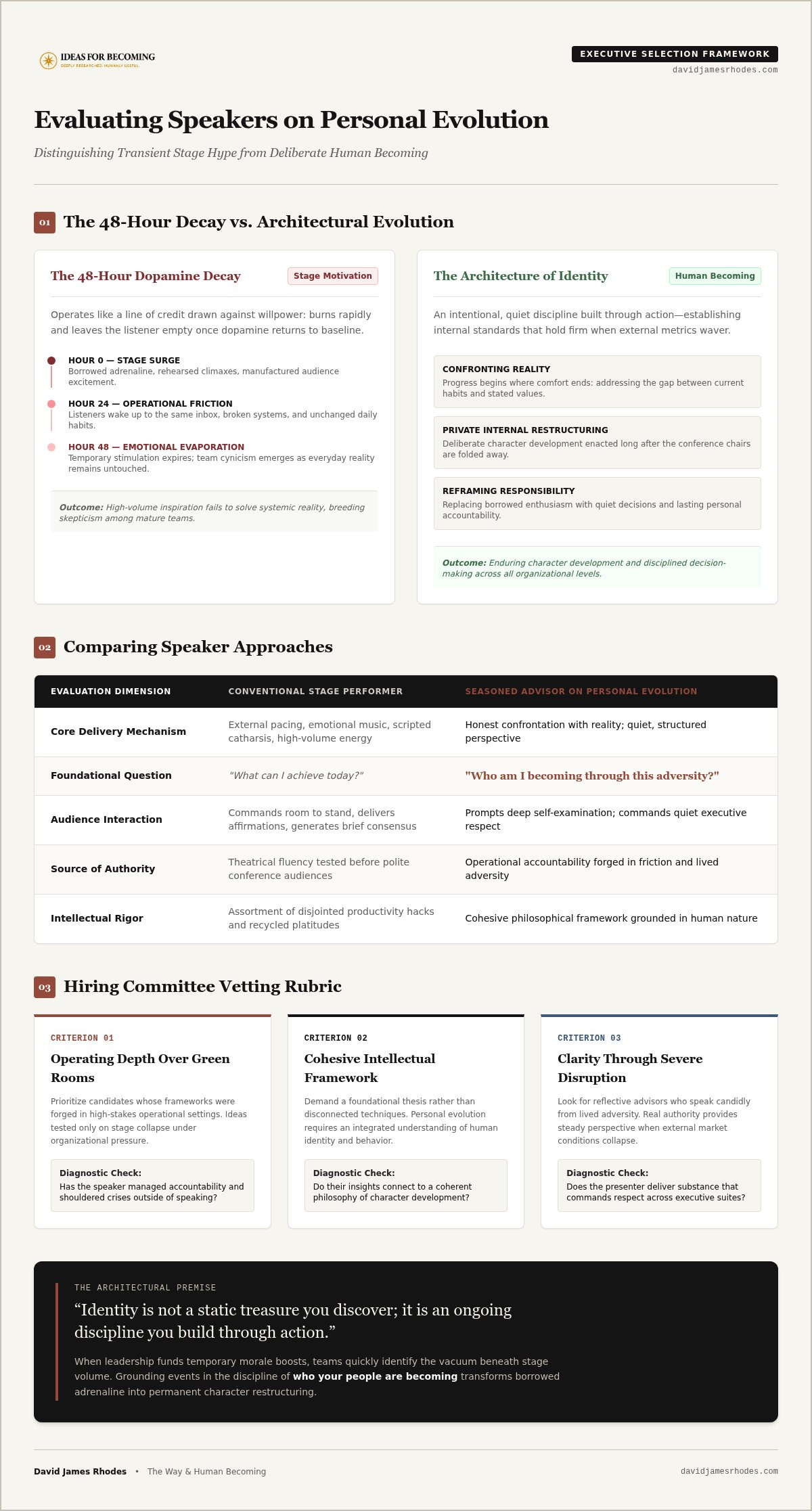
Most corporate gatherings settle for emotional stimulation. A presenter strides across the platform, delivers rehearsed climaxes, and commands the room to stand. The room responds. Energy surges. Yet beneath the noise, nothing structural has shifted. Personal evolution is not an adrenaline spike. It is a deliberate, continuous process of human becoming; an internal restructuring of character that happens in private long after the conference chairs are folded away.
A true motivational speaker on personal evolution does not deal in temporary stimulation. Emotional arousal feels good, but it operates like a line of credit drawn against willpower: it burns fast and leaves the borrower empty. Real growth demands disciplined self-examination rather than borrowed enthusiasm. When an organization seeks genuine change, it must look past stage volume and examine what happens when the applause dies down.
The Forty-Eight-Hour Decay of Emotional Hype
The neurochemical high of an energetic keynote fades rapidly. As dopamine returns to baseline, listeners wake up to the same inbox, the same broken processes, and the same ingrained behavioral patterns. Listening passively to heroic narratives rarely alters daily habits. When leadership continually funds these brief morale boosts, cynicism takes root across teams who recognize that high-volume inspiration rarely solves systemic reality.
Personal Evolution as an Architecture of Identity
Identity is not a static treasure you discover; it is an ongoing discipline you build through action. When you select a motivational speaker on personal evolution, you are hiring an architect of perspective. True evolution requires your people to establish internal standards that hold firm when external metrics waver. To make this distinction clear, consider the opposing mechanisms at play:
- Conventional Stage Motivation: Relying on external pacing, emotional music, and scripted catharsis to push listeners into brief enthusiasm.
- Architectural Evolution: Forcing an honest confrontation with uncomfortable realities, leading to quiet decisions about personal responsibility.
- Transient Stimulation: Borrowing the speaker's confidence for an hour, which leaves no footprint once difficult decisions arise.
- Internalized Character: Reframing the foundational question from "What can I achieve today?" to "Who am I becoming through this adversity?"
Progress begins the moment comfort ends. An audience does not grow by feeling affirmed; it grows by confronting the gap between its current habits and its stated values. That confrontation requires a steady, grounded voice, not a cheerleader with a microphone.
Essential Criteria for Evaluating a Speaker on Personal Evolution
Hiring committees often default to showmanship. They watch a two-minute highlight reel, see an expressive presenter pacing an auditorium, and mistake theatrical fluency for depth. But an audience facing structural restructuring, market collapse, or profound personal reckoning does not need a performance. They need evidence that the person at the lectern has lived through equivalent trials and emerged with practical clarity.
When selecting a motivational speaker on personal evolution, your evaluation rubric must separate seasoned advisory from polished stagecraft. Lived authority cannot be mimicked. If a speaker's ideas have only been tested before polite conference crowds, their advice will collapse under the weight of real organizational pressure.
Depth of Real-World Experience Across Diverse Environments
Prioritize candidates whose frameworks were forged in high-stakes operational settings rather than green rooms. You want someone who has shouldered accountability, managed through crises, and observed human behavior across different cultures and regulatory regimes. An accomplished keynote speaker on leadership and identity understands that character reveals itself through friction. Career presenters recite theory; experienced operators share lessons bought with their own sweat and capital.
A Cohesive Intellectual and Practical Framework
Demand a foundational thesis rather than an assortment of disjointed productivity hacks. Genuine personal evolution requires a coherent view of human nature. Before issuing a contract, run prospective candidates through this baseline evaluation checklist:
- Operational Track Record: Has the speaker run organizations, led international initiatives, or weathered genuine failure outside the lecture circuit?
- Cross-Cultural Durability: Do their insights hold true across varied geographies, or do they rely on narrow corporate slang?
- Substantive Literature: Does the candidate anchor their address in published, long-form work that outlines an overarching philosophy?
- Daily Practical Architecture: Can the speaker translate broad philosophical principles into concrete, daily disciplines that employees can apply independently?
- Quiet Gravitas: Does the presenter possess the calm weight necessary to challenge senior executives while offering genuine hope to emerging staff?
If you want to move beyond superficial stimulation, explore the body of work shared by David James Rhodes, whose philosophy grounds executive decision-making in the steady, daily practice of character architecture. When an address is anchored in a comprehensive framework, your event ceases to be an isolated diversion and becomes the foundation for lasting self-examination.
Comparing Speaker Approaches: Charismatic Performers Versus Seasoned Advisors
Stage energy can fill a hall, but it rarely commands respect in the boardroom. Event organizers often hire dynamic performers expecting genuine culture change, only to discover that the impact ends at the exit doors. Selecting a motivational speaker on personal evolution requires choosing between two fundamentally different archetypes: the stage entertainer who manufactures emotional peaks, and the seasoned advisor who cultivates internal discipline.
Entertainers rely on momentum. Advisors rely on substance. While a performer seeks applause, an advisor seeks alignment, challenging the audience to examine their choices under pressure.
The Limits of Entertainment in Professional Settings
Formulaic overcome-all-odds narratives often feel hollow to experienced professionals. When leaders have managed difficult restructuring or navigated severe operational disruption, theatrical optimism feels disconnected from reality. Humor has its place, but when it sidesteps difficult realities, it insults the intelligence of the room. Mature teams don't need a cheerleader telling them to smile through adversity. They need clear principles that withstand pressure.
The Power of Advisory-Led Keynotes
A seasoned advisor steps onto the platform with quiet gravity. Rather than projecting manufactured certainty, they speak as someone who has carried accountability in complex environments. Presenters who offer ongoing leadership advisory bring strategic weight that bridges the gap between senior executive decisions and frontline execution.
Advisors treat listeners as capable adults. Instead of demanding synchronized cheers, they invite thoughtful silence. Consider how these two distinct approaches shape organizational response:
- Theatrical Performers: Rely on high volume, emotional catharsis, and dramatic pacing designed to win immediate social approval.
- Strategic Advisors: Rely on measured clarity, lived accountability, and principles designed for quiet implementation during organizational stress.
- Performer Outcome: Fleeting enthusiasm that fades when normal workplace friction resumes on Monday morning.
- Advisor Outcome: A sober, enduring commitment to personal standards and deliberate character development.
A credible motivational speaker on personal evolution does not offer easy answers. They provide an intellectual mirror, challenging leaders and staff alike to examine who they are becoming when the spotlight is gone.
The Vetting Process: Questions Event Organizers Must Ask
A promotional video rarely reveals the truth. Anyone can stitch together ninety seconds of applause, dramatic lighting, and standing ovations. When you evaluate a motivational speaker on personal evolution, you must look past the presentation packaging. You need diagnostic questions that test whether a candidate possesses real substance or merely rehearsed stage habits.
True vetting requires moving beyond speaker one-sheets. It demands examining how a thinker responds when stripped of theatrical cues.
Interrogating the Speaker’s Core Message
Begin by asking what central question the presenter forces the room to confront. If their material promises rapid breakthroughs or effortless success, it belongs in the category of stage entertainment. Personal evolution acknowledges the reality of suffering, prolonged rebuilding, and the slow discipline of human becoming. Ensure the speaker recognizes the boundary between philosophical reflection and clinical therapy; a credible speaker never acts as an unqualified therapist from the stage.
Ensuring Cultural and Intellectual Resonance
Request unedited recordings of long-form interviews or panel discussions rather than curated highlight reels. This reveals how the speaker articulates complex ideas under pressure. Listen closely for intellectual consistency between their written publications and spoken words, confirming they avoid trite corporate buzzwords.
Before making a final commitment, bring these specific inquiries directly to the candidate or their bureau representative:
- The Core Inquiry: What central question do you leave the audience to answer in private once the event concludes?
- Handling Disruption: How do you adapt your message for an organization navigating genuine loss, crisis, or structural upheaval?
- Literary Consistency: How do your books and written essays support the philosophical claims you make during your keynote?
- Tone and Posture: How do you ensure your delivery invites mature reflection rather than demanding superficial audience compliance?
Selecting the right voice requires rigorous discernment. To bring an authentic, philosophically grounded perspective to your next executive summit or conference, book David James Rhodes for keynote speaking and initiate an event centered on lasting character development.
David James Rhodes: A Grounded Voice on the Path of Human Becoming
When leadership teams seek a motivational speaker on personal evolution, they often struggle to find a voice that balances commercial reality with quiet philosophical depth. David James Rhodes occupies that rare space. As an author, global executive, entrepreneur, and advisor, his work departs completely from conventional stage exuberance. He does not offer theatrical formulas for complex human struggles. Instead, his keynotes center on the foundational question that governs all personal and organizational growth: Who are you becoming?
A Perspective Shaped Across 156 Countries
Lived authority cannot be manufactured through speaking technique. Shaped by more than four decades of executive experience across 156 countries, David's insight draws from international enterprise, high-stakes negotiations, and direct observation of human struggle under extreme pressure. He understands that while market conditions fluctuate, the core disciplines of character remain constant. Leaders facing acute organizational disruption don't respond to superficial cheerleading; they respond to a seasoned guide who speaks with quiet gravity and practical clarity.
Extending the Stage Beyond the Event
A keynote address should mark the beginning of internal work, not its conclusion. David's speaking engagements connect directly to his forthcoming book, The Way, releasing September 15, 2026. The core idea is simple yet demanding: The Way is not something you find. It is someone you become. This philosophical foundation translates into tangible daily practice through his companion volume, 365 Days of Becoming, giving teams a structured framework for continuous self-examination.
By shifting the focus from momentary stage excitement to sustained character architecture, David provides organizations with a lasting standard. When you evaluate candidates for an executive summit or global gathering, consider the depth of impact:
- Lived Depth: Over forty years of global operating experience across 156 countries.
- Singular Focus: Grounded in the intentional discipline of human becoming rather than recycled platitudes.
- Actionable Continuity: Supported by written literature designed for daily personal practice long after the keynote concludes.
Engaging a motivational speaker on personal evolution should never be an exercise in buying temporary morale. It is an opportunity to challenge your people to look inward, take ownership of their choices, and build the internal strength required to navigate an unpredictable world.
Moving Beyond the Stage to Build Enduring Character
Selecting the right presenter is ultimately a decision about organizational culture. When you bypass temporary theatrical lift, you give your people space for authentic self-examination. A credible motivational speaker on personal evolution doesn't offer borrowed adrenaline or scripted enthusiasm. They deliver structured, actionable principles that guide teams through uncertainty and anchor them in everyday discipline.
David James Rhodes brings a quiet, reflective keynote style shaped by more than four decades of executive leadership across 156 countries. As the author of the forthcoming philosophical work The Way, releasing September 15, 2026, David invites audiences into a serious dialogue centered on the enduring inquiry of human becoming. Bring a grounded perspective to your next event and help your leaders confront who they are becoming under pressure. Inquire about keynote engagements with David James Rhodes and set a standard that outlasts the stage.
Frequently Asked Questions
How does a speaker on personal evolution differ from a traditional motivational speaker?
A traditional presenter focuses on emotional stimulation, relying on performative delivery to generate brief enthusiasm. In contrast, a motivational speaker on personal evolution acts as an architectural guide. Rather than offering borrowed excitement, they lead audiences through rigorous self-examination. The objective isn't temporary stage energy, but an intentional restructuring of personal standards and daily habits that sustain character long after the gathering concludes.
Why is emotional hype ineffective for long-term organizational development?
High-energy stage performances trigger a temporary neurochemical lift that inevitably fades within days. When employees return to entrenched workplace patterns and real operational pressure, ungrounded enthusiasm offers zero structural guidance. True organizational resilience requires cognitive clarity and daily discipline. Without an underlying philosophy that addresses who people are becoming through difficulty, emotional hype creates cynicism across experienced teams who recognize its lack of operational depth.
What industries benefit most from a keynote focused on human becoming?
Organizations undergoing significant transition, regulatory pressure, or technological disruption gain the greatest value. High-stakes environments like international finance, healthcare, technology, and global enterprise require leaders who remain steady when external metrics fluctuate. Teams in these sectors don't need simplistic cheerleading. They need a grounded framework that helps them maintain ethical composure, navigate failure, and anchor their identity in consistent principles rather than shifting market conditions.
How does an author-led keynote create longer-lasting impact than standard presentations?
An author brings a tested, codified body of thought rather than a collection of disconnected anecdotes. When a keynote connects to literature like The Way or daily practice guides like 365 Days of Becoming, the address acts as an entryway rather than a standalone event. Audiences gain reference material they can study, debate, and apply across quarters, converting a single stage presentation into continuous character development.
Can a philosophical keynote address concrete corporate and business challenges?
Business challenges are ultimately human challenges. Issues like executive burnout, team misalignment, and ethical drift stem from unexamined habits and weak internal standards. A philosophical keynote strips away corporate jargon to address the root motives behind strategic decision-making. By asking critical questions about personal accountability, an experienced advisor equips professionals to handle severe commercial pressure with practical wisdom and disciplined resolve.
What preparation should an event committee undertake before engaging an evolution speaker?
Committees should look past short promotional reels and evaluate uncut long-form interviews to judge intellectual depth. Define the specific internal tensions your organization faces instead of asking for generic inspiration. Prepare questions about how the candidate tailors their philosophy for complex environments. Engaging a motivational speaker on personal evolution requires alignment on tone, ensuring the speaker treats your people as mature adults capable of disciplined reflection.
How does David James Rhodes approach audiences navigating acute organizational disruption?
David speaks from more than four decades of global operating experience across 156 countries. He doesn't dismiss the reality of crisis or offer superficial platitudes. Instead, he brings quiet authority to the room, helping leaders and teams reframe disruption as an arena for character architecture. His approach centers on the essential inquiry, "Who are you becoming?", grounding audience focus in deliberate action and internal stability.
Frequently Asked Questions
Related Articles
Rebuilding Character After Failure: The Process of Human Becoming
Learn how rebuilding character after failure becomes the quiet work of human becoming. Move past shame, restore trust, and discover who you are becoming.

Professional Recovery Speaker: Moving Beyond Sobriety to Human Becoming
A professional recovery speaker who goes beyond sobriety to identity. Discover the Human Becoming philosophy and what real leadership recovery looks like.

The Way: A Guide to the Process of Human Becoming
David James Rhodes's human becoming book, The Way, reframes growth as a process, not a destination. Releasing September 15, 2026.