
A successful career can still leave you wondering what it serves. Purpose-driven leadership connects your values and sense of meaning with your work, the people you lead, and your organization’s goals. Purpose-driven life advisory for professionals offers space to examine those connections without confusing achievement with fulfillment.
It is natural to want work that matters, not just work that advances a title or target. But purpose is not a slogan placed over an organization’s existing priorities. It asks leaders to consider how decisions affect people, whether daily responsibilities reflect their values, and what gives their work meaning. For some, faith is part of that reflection. For others, purpose takes shape through service, responsibility, or contribution.
This article explores how purpose-driven leadership works in practice, how individual work can support organizational goals, and how purpose relates to fulfillment. It considers how professionals can bring values, ambition, and faith into closer alignment, while recognizing that purpose can deepen and change over time. The question is not only what you want to accomplish, but who you are becoming as you do the work.
Key Takeaways
- Name the values that guide your decisions, then use them to assess whether your daily work reflects what matters to you.
- Connect individual responsibilities to the people and goals they serve to make organizational purpose tangible.
- Understand purpose-driven leadership as a way to bring meaning, responsibility, and direction into how you lead.
- Recognize that fulfillment can grow as you put your strengths to work in service of others, and that your sense of purpose may evolve.
- Consider how faith can shape your choices and actions while keeping reflection grounded in the responsibilities of your work and life.
1. What Is Purpose-Driven Leadership?
Purpose-driven leadership brings your values into decisions, relationships, and work. It helps you consider not only what must be done, but why it matters. A manager who values integrity, for example, communicates difficult changes honestly rather than hiding behind polished language. Purpose becomes useful when it shapes conduct, not when it remains a phrase in a presentation.
Identify your values through specific moments. Recall a decision you felt proud of, a situation that troubled you, and someone whose conduct you respect. Name what mattered in each example: perhaps fairness, courage, family, service, or learning. Then choose a few values and define each in observable terms. “Respect” might mean listening without interrupting during a tense meeting. This turns abstract values into a practical guide.
A brief reflection can help connect your values to your current work. Consider which tasks reflect your principles, which feel disconnected, and what meaningful contribution they support. Purpose can clarify priorities by revealing what deserves attention and what merely fills time. This is a way to make choices, not a demand that every task feel inspiring. A budget review, for instance, may serve a value of stewardship even when the task itself feels routine.
Organizations also need to connect their mission, vision, and values to everyday communication. A mission explains the work an organization exists to do; a vision describes the future it seeks; values guide how people pursue it. Leaders can make these ideas concrete by linking a team decision to a stated value. If a company names customer trust as a value, its communications should explain decisions clearly and address their effects on customers and employees.
Discuss personal values with employees through specific work examples, rather than assumptions about what motivates them. A manager might ask which responsibilities feel meaningful and where an employee’s strengths support the team’s goals. The answers can inform assignments, feedback, and development conversations. Personal values differ, so a shared organizational purpose should make room for different sources of motivation.
People often ask whether they need a life coach, career coach, or therapist. A life coach generally focuses on personal goals and direction; a career coach focuses on work decisions and professional development; a therapist addresses emotional or mental health concerns. Choose based on the need at hand and the kind of support you require.
The cost of purpose-driven life coaching in the United States depends on the provider, format, length, and scope of the work. Compare what an arrangement includes, such as session frequency and the focus of the advisory, rather than relying on an assumed rate.
When considering a purpose-driven life advisor, look for relevant experience, clear training, defined boundaries, and an approach that explains how values inform decisions. Ask how the advisor handles concerns beyond their scope. Advisory has limits: another person can offer perspective, but cannot choose your values or guarantee fulfillment. It does not replace therapy when emotional or mental health care is needed.
2. Connecting individual work to organizational goals
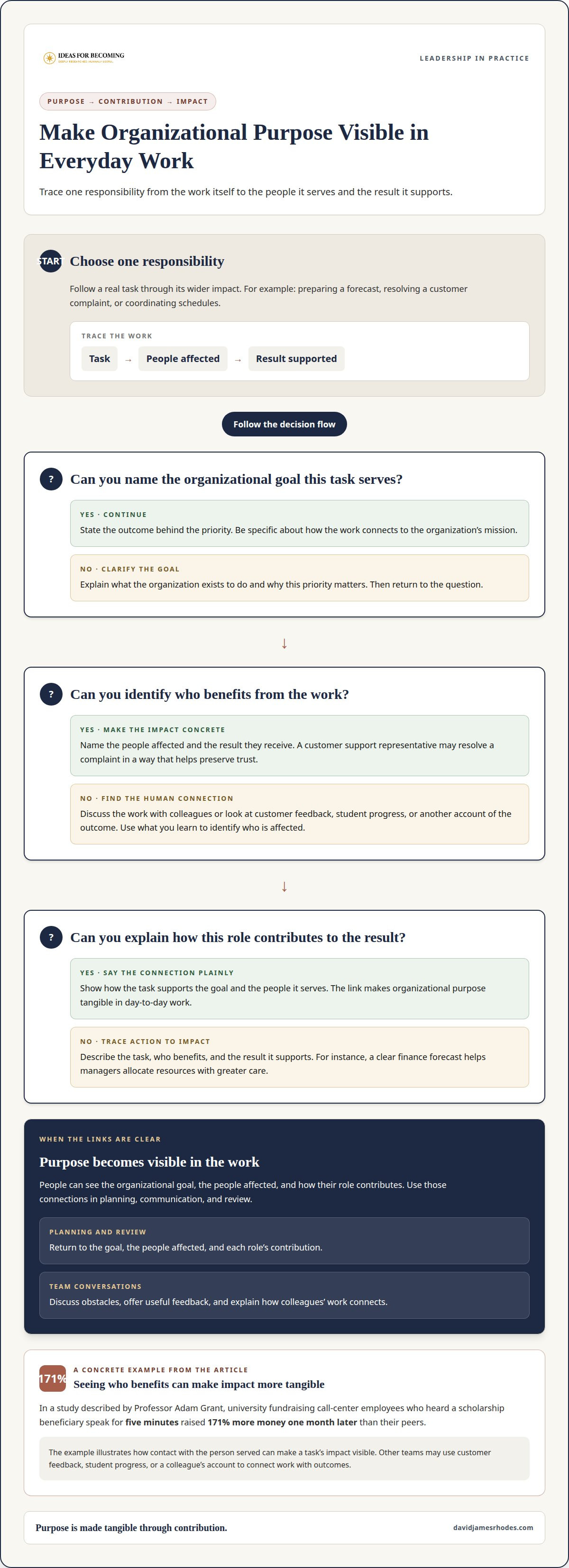
Organizational purpose becomes credible when people can see how their work contributes to a shared result. A customer support representative, for example, may resolve a complaint in a way that helps preserve trust. The task is part of the organization’s mission, and one point where that mission becomes visible. Leaders can clarify the connection by naming the outcome behind a priority and showing how each role contributes.
Trace one responsibility from action to impact. Identify the task, name who benefits, and describe the result it supports. A finance analyst preparing a clear forecast helps managers allocate resources with greater care. A school administrator coordinating schedules helps teachers spend more time with students. These links give routine work a wider purpose without pretending every task feels meaningful on its own.
Communication must make the same connection. If an organization’s mission is to improve access to education, managers should explain how a budget decision, service change, or hiring priority relates to that aim. Specific examples matter more than repeating a slogan. At a team meeting, a leader can describe what changed, who it affects, and how the decision serves the mission. That explanation helps staff understand both the goal and its consequences.
Purpose also depends on relationships. Employees can better understand their contribution when they discuss obstacles, receive useful feedback, and see how colleagues’ work connects. A project lead might pair a new analyst with an experienced teammate who can explain how a report informs a client decision. Regular conversations reveal where work feels disconnected, where support is needed, and how teams depend on one another.
A study described by Professor Adam Grant offers a concrete example. Employees at a university fundraising call center who heard a scholarship beneficiary speak for five minutes raised 171% more money one month later than their peers. The example shows how contact with the person served can make a task’s impact visible. Not every team needs a personal story. Customer feedback, student progress, or a colleague’s account can also make outcomes easier to understand.
Keep the connection active by returning to three points during planning and review: the organizational goal, the people affected, and each role’s contribution. If a target changes, explain why and clarify what remains important. If an employee’s work no longer supports the intended outcome, discuss the barrier and adjust priorities where possible. This keeps the link between purpose and action open to revision.
Review the connection through concrete evidence: whether teams understand why priorities changed, whether handoffs support the shared goal, and whether employees can describe the impact of their work. Use these as prompts for discussion, not substitutes for judgment. When leaders make room for questions and explain trade-offs plainly, organizational purpose becomes part of how work is coordinated, not merely a statement made at launch.
3. Meaning and definition of purpose-driven leadership
Purpose-driven leadership guides people toward meaningful work while connecting daily choices to a reason beyond personal status. It gives employees context for effort, responsibility, and change. A hospital team, for example, may connect accurate record keeping to safer care. The paperwork remains necessary, but its human consequence becomes clearer. Purpose does not remove difficult tasks; it helps people understand what they serve.
Helping employees find meaning begins with listening to their experience of work. A manager can ask which responsibilities feel useful, what skills an employee wants to contribute, and where work feels disconnected. Then the manager can explore practical adjustments, such as involving a skilled writer in a customer communication project. Not every preference can shape every role, but this approach creates room to align strengths, responsibilities, and organizational needs.
Meaning in professional work can come from service, craft, learning, or responsibility. A building engineer may find purpose in maintaining a safe workplace. A junior colleague may find it in developing expertise and contributing to a team. The title matters less than the connection between effort and consequence. Leaders can make that connection visible by naming who benefits from a task and what changes when it is done well.
Viktor Frankl emphasized the importance of meaning amid difficult circumstances. That perspective does not make hardship desirable or erase its weight. It suggests people can still orient themselves toward a value, relationship, or responsibility during adversity. In a workplace, a team facing a failed launch might review what happened, support affected colleagues, and apply the lesson to the next decision. Meaning can help turn failure into a reasoned response rather than a verdict on personal worth.
Mindfulness can help you notice meaningful moments that routine work might obscure. A brief breathing practice gives your attention a place to return. Distraction is ordinary; noticing it and gently redirecting your attention is the practice. A leader might pause before a difficult conversation, then listen closely instead of rehearsing a response. Small moments of attention can change how you meet the work in front of you.
Purpose-driven life advisory can offer reflection on values, work decisions, leadership, and personal goals. The format and scope differ, so ask whether the service addresses the decision or transition you face. When assessing an advisor, review their stated experience, approach, boundaries, and relevant qualifications. A clear first conversation should define the concern, explain the advisory process, and establish whether the work fits your needs.
A sense of meaning is associated with greater resilience during life’s challenges and greater satisfaction. That does not make purpose a cure for every difficulty. It offers a direction for action: identify what still matters, choose a responsible next step, and seek support from a trusted colleague or community when needed.
4. Purpose, fulfillment, and contentment
Purpose can bring direction to professional life, but it does not require constant enthusiasm. A project manager may find meaning in helping a team deliver reliable work, even during a demanding week. Fulfillment grows when your talents, expertise, and interests serve other people or the wider world. Contentment differs from achievement: it can mean recognizing that a meaningful life includes ordinary responsibilities, not only visible milestones.
Begin with a practical reflection: name a strength, a source of curiosity, and a person or community that could benefit from them. A finance professional might use analytical skill to help a nonprofit plan responsibly. A teacher might turn subject knowledge into patient support for a struggling student. These examples connect ability with contribution and make purpose more concrete than a broad ambition such as “make a difference.”
Purpose can change as circumstances and understanding change. A professional who once valued rapid advancement may later place greater weight on mentorship or family. That shift does not mean earlier choices were false. It may reflect new responsibilities, experience, or a clearer sense of what matters. Review the direction of your work when a major transition arrives, such as a new role, a change in caregiving, or a desire to contribute differently.
Meaningful living also involves deliberate attention. Meditation, prayer, or time in nature may help you feel more connected to your purpose. With a crowded schedule, you could set aside a quiet moment before your first meeting and consider how to act with patience or integrity that day. Volunteering offers another practical expression: mentoring, community service, or environmental work can connect professional skills with a cause beyond the workplace.
A vision board can make long-term intentions visible through images, words, and ideas that represent the life you hope to build. It becomes useful when paired with action. If an image represents mentoring, identify an opportunity to support a colleague. If it represents health or family, choose a boundary that protects time for those priorities. Reflection gives direction; repeated choices bring that direction into daily life.
Evidence supports a relationship between meaningful living and outcomes such as resilience and satisfaction. That does not prove purpose-driven coaching itself causes those outcomes. Treat coaching as a process for clarifying goals and translating reflection into action, then assess progress through concrete changes in decisions, relationships, or work.
Purpose does not eliminate disappointment or guarantee contentment. A meaningful goal may still involve setbacks, and service can require sacrifice. Ask whether the pursuit reflects what matters and remains sustainable. If your commitment to helping others leaves no room for rest or close relationships, the approach may need revision. Fulfillment depends not only on contribution, but also on how you live while contributing.
5. Aligning actions with God's purposes
For a person of faith, purpose can mean living in response to God, not simply pursuing personal ambition. That belief gives professional choices a larger frame. A manager deciding how to address a mistake might consider honesty, accountability, and care for those affected. Faith does not remove the pressure of the decision, but can shape how the leader meets it.
Exodus 9:16 is cited as a biblical passage about being raised up for a purpose. Readers may understand that passage through their own faith tradition and interpretation. Its practical invitation is to consider how influence is used. A leader with authority over hiring, budgets, or team culture can ask whether those choices serve others or only protect personal status.
Discernment often requires more than a strong feeling. Bring a decision into prayer, examine its likely effects, and seek thoughtful counsel from someone trusted in your faith community. For example, a professional weighing a promotion might consider its responsibilities, its effect on family commitments, and the values the role would require them to practice. Reflection should lead toward responsible action.
Faith can also shape ordinary work. An employee who values service might prepare carefully for a client meeting, respond truthfully to a difficult question, or make space for a colleague who needs support. These actions rarely look dramatic. Their importance lies in the character they express and the people they affect. Purpose becomes visible through conduct repeated across everyday decisions.
Aligning work with God’s purposes does not mean treating every career setback as a divine message or assuming every opportunity is a command. A rejected application may call for patience, a new plan, or simply time to grieve the disappointment. Separate what happened from the meaning you assign to it, then choose a next step consistent with faith and responsibility.
Leaders can make room for faith without imposing it on employees. In a team conversation, invite people to describe what gives their work meaning, while respecting that colleagues may draw purpose from different beliefs. This distinction matters. Shared work can be guided by fairness, service, and care, even when individuals understand those values through different spiritual or personal traditions.
Review your actions through a simple practice: name the decision, identify who it affects, and consider whether your response reflects your faith in practical terms. Then decide on one responsible action. The answer may be a candid conversation, a fairer process, or the humility to reconsider a choice. Such decisions make belief visible in the responsibilities of daily work.
David James Rhodes
David James Rhodes offers Leadership & Life Advisory for professionals considering how purpose, values, and responsibility shape their work and leadership. Turn to this advisory when a career decision, leadership challenge, or question of meaning calls for reflection beyond immediate performance. For organizations and families thinking about the next generation, Education & Next Generation Advisory focuses on the values and choices shaping future leaders. Speaking offers another way to bring these questions into a shared conversation. The work connects practical decisions with the larger question of human becoming: who are you becoming through the way you lead and live? If these questions are present in your work or life, contact David James Rhodes to begin a conversation.
Let Purpose Shape What Comes Next
Purpose is not a final answer. It is a way to choose what deserves your attention and how you will meet the responsibilities already before you. Purpose-driven life advisory for professionals can help bring that question into clearer focus when achievement no longer feels like a sufficient measure of direction.
The next step need not be dramatic. Begin with a deliberate choice about how you want to lead, what deserves your attention, and which responsibilities call for your care. The answer may change as life changes. What matters is meeting that change with honesty and intention.
Your work is one part of who you are becoming. Let your next decision reflect the person you hope to become, not only the result you hope to reach.
Frequently Asked Questions
What Is Purpose-Driven Leadership?
Purpose-driven leadership uses a clear reason for the work to guide priorities, conduct, and accountability. It shows up in how a leader handles trade-offs, not only in what they say. When choosing between a quick result and a durable one, for example, a purpose-led leader explains the decision and considers who bears its consequences. The team can then judge whether actions match the organization’s stated direction.
What steps help professionals clarify their values and life purpose?
Notice which choices feel difficult to compromise on, especially under pressure or without recognition. Write down the principles behind those choices, then describe how your abilities could serve people or work you consider worthwhile. Turn that reflection into a provisional purpose statement. Test it against a real decision, such as accepting a role or changing priorities. Refine the statement when experience reveals a mismatch between your words and actions.
Frequently Asked Questions
Related Articles

Executive Guidance on Ethical Leadership Principles for Building Trust
Executive guidance on ethical leadership principles shows how honesty, fairness and accountability build trust, credibility and guide everyday decisions.

Mentorship for Aspiring Global Leaders: Track Outcomes and Impact
Mentorship for aspiring global leaders builds practical skills and sound judgment. Learn to set goals, make cross-cultural matches, and assess impact.

Confidential Sounding Board for Fortune 500 Executives
A confidential sounding board for Fortune 500 executives helps leaders test decisions and assess peer trust, confidentiality, and conflicts before sharing.