
Mentorship for aspiring global leaders is a purposeful relationship in which an experienced person helps another strengthen leadership skills, think through decisions, and learn from challenges. Its value depends on more than the match itself. Trust, clear goals, and an understanding of cultural and regional context shape whether guidance can be put to use.
Leadership across borders asks for judgment as well as knowledge. A mentor can help a participant examine assumptions, communicate across difference, and choose a considered response when the path is unclear. This article explains how mentoring works, how to approach cross-cultural matching, and how to assess progress through goals, feedback, and meaningful participant outcomes. The measure is not simply whether conversations took place, but whether they helped someone lead with greater clarity and responsibility.
Key Takeaways
- Set clear development goals so mentoring conversations build practical leadership skills, not just familiarity.
- Connect organizational goals with participant needs to make mentoring relevant at different levels of leadership.
- Make cross-cultural matches with attention to context, communication, and the guidance each participant needs.
- Measure progress through more than meeting attendance: consider feedback, development, and meaningful outcomes.
- Use a mentor’s perspective to examine complex decisions, test assumptions, and choose a considered next step.
1. Leadership development and skills transfer
Mentoring gives leadership development a human structure. It helps a developing leader make sense of experience, practice sound judgment, and apply learning to decisions at work. Unlike formal training, mentoring is grounded in an ongoing relationship where perspective and questions can be tailored to the leader’s real responsibilities.
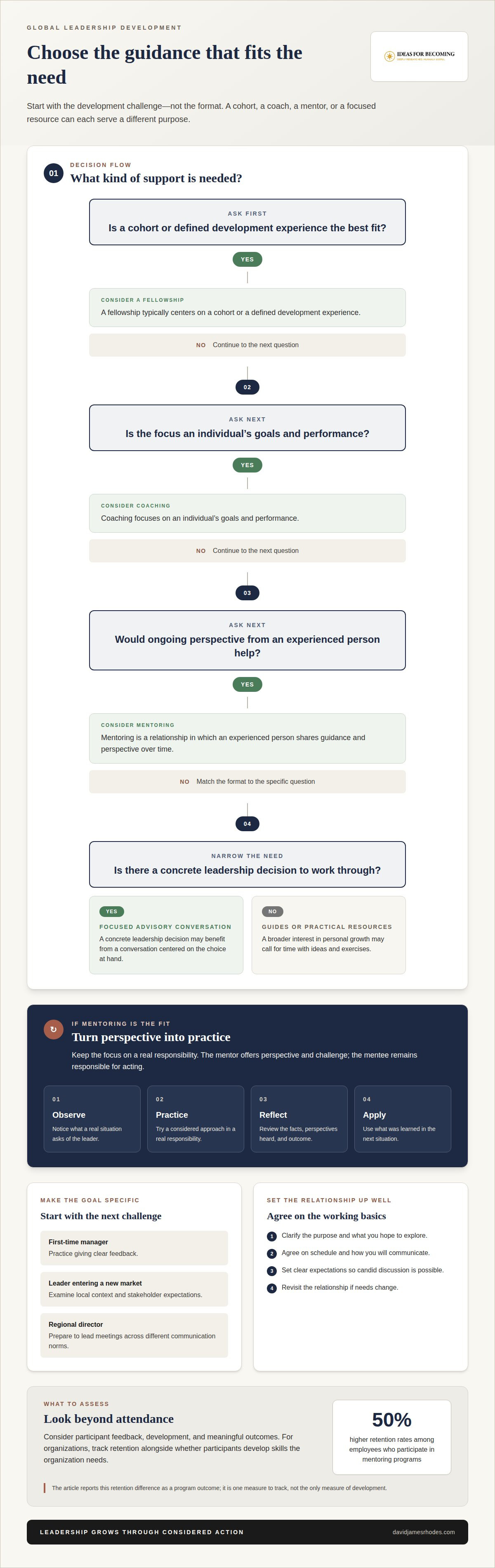
A useful relationship begins with a specific development goal. A new regional director, for example, might want to lead meetings across different communication norms. The mentor can help them prepare, reflect on what happened, and consider a different approach for the next meeting. The mentee remains responsible for acting; the mentor offers perspective and challenge.
Skills transfer is most useful when it shows up in real responsibilities. A mentor might discuss how to frame a difficult decision, then encourage the mentee to lead the next discussion. Afterward, they can review which facts shaped the choice, whose perspective was heard, and what the outcome revealed. This cycle of observing, practicing, reflecting, and applying turns advice into behavior.
Leadership growth also depends on access to guidance during consequential transitions. In Russell Reynolds Associates’ Global Leadership Monitor Q1 2023, 71% of CEOs felt mentoring could have been better incorporated during their transition into the role. The finding points to a practical need: mentoring should not begin only after a leader struggles. A planned relationship can help an incoming executive examine expectations, relationships, and decision-making before habits harden.
Talent mobility is another outcome to design for. When employees can discuss their strengths and development needs with experienced leaders, they gain a clearer view of possible responsibilities inside the organization. A mentor can help someone prepare for a cross-functional assignment by identifying skills to build, relationships to develop, and evidence of readiness. The organization, in turn, can connect learning with internal opportunities rather than treating development and movement as separate processes.
Make the focus specific to the person’s next challenge. A first-time manager may want to practice giving clear feedback. A leader entering a new market may need to examine local context and stakeholder expectations. Naming the challenge gives both people a useful focus and makes it easier to discuss progress without reducing leadership to a checklist.
Strong mentorship for aspiring global leaders develops more than technique. It helps people test assumptions, receive candid feedback, and act with greater awareness across roles and cultures. The measure is not the number of conversations, but whether a leader can put what they learn to use when responsibility becomes real.
2. Benefits of mentoring for global organizations
A structured mentoring program can connect individual learning with organizational priorities. Employees who participate in mentoring programs have retention rates that are 50% higher. That figure makes retention worth tracking, alongside whether participants develop skills the organization needs. For example, a company expanding across regions can use mentoring to help emerging leaders understand new responsibilities and build relationships across teams.
Mentoring differs from a leadership fellowship or executive coaching. A fellowship typically centers on a cohort or defined development experience, while coaching focuses on an individual’s goals and performance. Mentoring is a relationship in which an experienced person shares guidance and perspective over time. Each approach can serve a different purpose, so organizations should match the format to the development need.
The right guidance depends on the person’s purpose and circumstances. Students, emerging leaders, and experienced executives may face very different questions, from navigating education to taking on greater responsibility. Start by naming the decision or challenge you want to work through, then consider what perspective would help you move forward.
Mentoring can take different forms, including a sustained relationship, a focused advisory conversation, or guidance through guides and practical resources. Choose the format that fits the question in front of you. For example, a concrete leadership decision may benefit from a conversation, while a broader interest in personal growth may call for time with ideas and exercises.
In the United States, global leadership mentoring opportunities may come through employers, universities, professional associations, or international initiatives. The Global Mentorship Initiative is one example: its community includes students in more than 150 countries and eight refugee camps. Its international reach makes it relevant to readers seeking cross-border perspectives.
For aspiring global leaders, useful guidance may come from an experienced mentor, an advisory conversation, or a body of work that helps clarify how to lead. David James Rhodes offers Speaking and Advisory, alongside guides including The Way and Life After Anything. The right starting point depends on the question you are trying to answer.
To apply, take three practical steps: identify a leadership goal, find programs serving your career stage, then prepare an application connecting your experience to that goal. For example, an applicant pursuing international work could describe a specific skill they want to develop and the challenge they hope to address. Clear aims help program organizers assess fit.
Before beginning a mentoring relationship, consider whether the purpose, schedule, and expectations suit your needs. Unclear boundaries can make candid discussion difficult, while a vague focus can leave conversations going nowhere. Agree on what you hope to explore, how you will communicate, and how you will revisit the relationship if your needs change.
3. Matching mentors and mentees across cultures and regions
Cross-cultural matching begins with the mentee’s purpose, not a shared job title. A leader entering a new region may need insight into local expectations, while another may need help leading a dispersed team. A mentor matrix can connect those needs with relevant experience. The Global Mentor Network recommends matching mentors to the specific issues where guidance is needed.
For aspiring global leaders, the best online mentorship platform depends on the program’s audience and the support it provides. The Global Mentorship Initiative is one relevant example; mentoring platforms can match participants, support communication, track relationships, and measure impact. Organizations evaluating platforms should also prioritize multiple languages, time zones, and data privacy standards.
Cross-cultural mentoring calls for attention to how people communicate, make decisions, and understand authority. A mentor with experience across regions can help a mentee question assumptions that may feel universal but are culturally specific. Someone preparing to lead a multinational meeting, for example, might discuss how to invite disagreement and clarify decisions across different communication styles.
Geography alone is not enough to make a useful match. Consider the mentee’s goals, the mentor’s relevant experience, language needs, and practical communication arrangements. If the immediate challenge is entering a new market, local context may matter most. If it is managing a distributed team, experience working across time zones may be more relevant.
Programs also need ways to address mismatches. A clear purpose at the start gives both people a reference point: the mentee can describe the challenge, and the mentor can explain where their experience applies. If conversations remain disconnected from that purpose, program coordinators can revisit the match or adjust its focus. A structured process protects the relationship from becoming a series of pleasant but unproductive exchanges.
Programs focused on women and underrepresented groups can address barriers that general matching may overlook. The Women’s Impact Initiative was launched in 2018 to address challenges women face in fundraising. That example shows how a defined focus can connect participants with guidance relevant to a particular professional context, rather than assuming every leader faces the same obstacles.
Cross-border relationships can help knowledge move between contexts, but that transfer is not automatic. A mentor’s approach needs to be considered in light of the mentee’s local relationships and responsibilities. Advice about stakeholder engagement, for instance, may need to change when decision-making structures differ. A strong match leaves room for both people to question assumptions and learn from their differing experiences.
4. Mentorship metrics and participant outcomes
A useful way to assess mentoring is to connect activity with changes participants can describe and demonstrate. Consider whether the mentee has clarified a goal, applied an insight, or approached a consequential decision differently. Attendance shows that people met; it does not show whether the guidance made a difference. Focus on evidence of learning in practice rather than activity alone.
At the start of a mentoring relationship, write down the participant’s goal, current responsibilities, and the skills they want to develop. Later, ask for a concrete example of a change in practice, such as leading a difficult conversation or taking on a broader assignment. Comparing the example with the original goal makes progress more meaningful than a general rating alone.
Employment outcomes offer another measure for programs serving students. Among students who complete a Global Mentorship Initiative mentorship, 74% secure a job within six months of graduation, and 88% secure one within one year. These figures describe participant outcomes. They do not, by themselves, isolate mentoring as the cause of each career result.
Program reach can show whom an initiative connects. More than 35,000 students and mentors have joined the Global Mentorship Initiative since it launched in 2019. Reach is useful context, but organizations should pair it with completion, satisfaction, and participant progress. A large enrollment figure cannot reveal whether each match had a clear purpose.
Organizations can also measure the contribution of mentors. Expedia Group’s Month of Caring partnership with Global Mentorship Initiative contributed 640 volunteer hours. That total captures time given, not the quality of each conversation. Pair it with participant feedback and examples of learning applied, so recognition reflects both effort and value.
For an employer program, examine retention and advancement alongside participant feedback. A major U.S. academic hospital reported an 89% retention rate for mentoring participants, compared with 74% for non-participants. Its program also helped avoid 440 employee turnovers. These figures can inform evaluation, while differences between participants and non-participants remain important context.
When an organization has a mentoring program, it can review whether participants with different roles and backgrounds have similar access and experiences. A major U.S. academic hospital reported that mentoring participants from underrepresented groups advanced at twice the rate. Looking at outcomes across relevant groups can help leaders identify where program design or support needs attention.
Finally, schedule reviews at defined points: launch, midpoint, and close. At each stage, compare goals with participation, feedback, and observed changes. Track turnover or advancement over time where those measures fit the program’s purpose. This discipline turns metrics from a report into a decision tool, guiding adjustments while keeping the human purpose of mentorship in view.
5. Strategic guidance and decision-making
Mentoring can help a leader pause before acting. Consider a manager deciding whether to enter a new market. A trusted mentor can help examine the business case, local relationships, and possible effects on the team. The mentor does not make the decision; the value lies in noticing how pressure or assumptions may be narrowing the leader’s view.
A useful discussion can follow three steps. First, define the decision and its deadline. Next, separate known facts from assumptions, such as confirmed customer interest from a belief about local demand. Finally, identify who will be affected and what evidence could change the decision. This gives feedback a clear purpose instead of turning the conversation into general discussion.
For a global leader, context matters. A communication style that works with one team may create confusion in another. A mentee preparing to address colleagues across regions can consider how directness, hierarchy, and disagreement may be interpreted. The mentor can offer another perspective, while the mentee remains responsible for understanding local people and conditions.
Relationships also shape strategic choices. A leader considering a reorganization should think not only about reporting lines, but also about trust, informal influence, and the people whose work may change. A mentor can ask whose perspective is missing and what conversations should happen before a decision becomes public. Questions like these make consequences easier to see.
Good mentoring requires honest boundaries. A mentor may share how they handled a difficult transition, but that experience is not a universal answer. The mentee can ask what shaped the mentor’s choice and what is different in their own situation. This distinction protects judgment from becoming imitation and leaves room to challenge an appealing but incomplete solution.
Make each session practical by ending with a decision or action to examine. The mentee might prepare for a stakeholder conversation, test an assumption with a local colleague, or compare possible approaches. At the next meeting, discuss what happened, what changed, and what the leader learned. This creates continuity without making the mentor responsible for carrying out the work.
When a decision has serious consequences, mentoring can complement specialist advice, not replace it. A leader facing a legal, financial, or operational question still needs relevant expertise. The mentor can help clarify the leadership judgment around that advice: what matters, who is affected, and how to act with care. Strategic maturity is not certainty; it is deciding with attention to evidence, people, and consequences.
The Global Mentor Network recommends creating a mentor matrix that matches mentors to the issues on which a person needs guidance. This can help direct conversations.
David James Rhodes: Leadership & Life Advisory
Leadership & Life Advisory offers space to examine the decisions, responsibilities, and personal questions that shape how you lead. Consider it when a career transition, a new leadership challenge, or a difficult choice calls for a wider perspective rather than a ready-made answer. The work connects practical judgment with a deeper question: who are you becoming through the way you lead?
David James Rhodes brings experience in international leadership and entrepreneurship to conversations about growth and direction. His perspective is grounded in human becoming: leadership is not only a role to hold, but a way of acting and relating to others. Start with a considered conversation about what you are facing and what kind of guidance would be useful.
To explore an advisory conversation with David James Rhodes, get in touch.
Choose the kind of leader you are becoming
Mentorship for aspiring global leaders matters most when it changes how someone meets responsibility. The next step is not to wait for certainty, but to bring a real decision, an honest account of what is at stake, and a willingness to learn. That is where guidance becomes practice. A conversation can open a door, but character is shaped by what you do after it closes.
Leadership is never finished. Each choice affects the people who depend on you and the standards you set for yourself. Keep asking what your decisions serve, whose perspectives they include, and what kind of person they are helping you become. The answers may change as your responsibilities grow.
If you are considering your next step in leadership, contact David James Rhodes to begin a thoughtful conversation. You do not need every answer before you start. Begin with the question that matters, then move forward with care.
Frequently Asked Questions
What Is Mentoring?
Mentoring is a purposeful relationship where an experienced person helps another think through professional growth and challenges. Unlike a single piece of advice, it develops through conversation, reflection, and action over time. For example, a newly appointed leader could use a mentor to prepare for a difficult conversation, then reflect on what happened and what to do differently. The mentee remains responsible for decisions and applying what they learn.
Why Build a Global Mentoring Program?
A global program connects people across regions and disciplines, helping knowledge move beyond one office or market. It can give emerging leaders access to perspectives they might not encounter in their immediate team. For instance, a participant preparing to manage a cross-border project could learn how another leader approaches collaboration across different working norms. A well-designed program also gives an organization a deliberate way to support development across locations.
How can I find and choose a mentor with international leadership experience?
Start with the leadership challenge you need help navigating, such as entering a new market or building trust across cultures. Then look for a mentor whose experience relates directly to that challenge, rather than relying on title or reputation alone. In an initial conversation, describe the situation and ask how their experience might apply. A strong fit makes room for candid questions and different perspectives.
What outcomes and career benefits do global leadership mentees report?
Outcomes commonly tracked include clearer leadership goals, stronger communication, expanded professional relationships, and readiness for new responsibilities. A mentee might, for example, use guidance to prepare for a regional assignment, then reflect on the skills and relationships that role required. These are useful indicators to discuss with a mentor or program. Career progress also depends on the participant’s actions and the opportunities available in their organization.
How can I build an effective mentor relationship across countries and time zones?
Agree on communication preferences early. Choose a recurring meeting time that respects both people’s working hours, and use a shared agenda when spontaneous conversations are difficult. Before each session, send a brief update identifying one decision or challenge to discuss. At the close, summarize the next action and who owns it. These habits support trust and continuity, even when the mentor and mentee work far apart.
Frequently Asked Questions
Related Articles

Executive Guidance on Ethical Leadership Principles for Building Trust
Executive guidance on ethical leadership principles shows how honesty, fairness and accountability build trust, credibility and guide everyday decisions.

Purpose-Driven Life Advisory for Professionals: Work With Purpose
Purpose-driven life advisory for professionals connects your values to leadership and daily work, helping you pursue meaningful goals and lasting fulfillment.

Confidential Sounding Board for Fortune 500 Executives
A confidential sounding board for Fortune 500 executives helps leaders test decisions and assess peer trust, confidentiality, and conflicts before sharing.