
What does a leader’s conduct teach people to trust? Executive guidance on ethical leadership principles begins with a clear answer: ethical leadership means making decisions with honesty, fairness, and accountability, then living by those standards even under pressure. Trust grows when a leader’s actions match their words.
Most leaders know integrity matters. The harder task is holding to it when a decision carries personal cost, competing demands, or uncertainty. In those moments, principles are not abstract ideals. They shape who gets heard, how responsibility is shared, and whether people trust the organization to mean what it says.
This article explains ethical leadership, why it matters, and how its principles can strengthen trust, credibility, and organizational performance. It also explores the responsibilities leaders carry in everyday decisions, from communicating honestly to treating people with dignity. The goal is practical clarity: recognizing ethical leadership not by what leaders declare, but by what their choices make possible for others.
Key Takeaways
- Ethical leadership means weighing decisions fairly, accepting accountability, and staying honest when pressure makes shortcuts tempting.
- Trust is built through consistent conduct: people notice whether leaders’ actions match their stated values.
- Leadership responsibilities include listening to affected people, honoring commitments, and considering the wider consequences of decisions.
- Use the 4V model to connect personal values with organizational vision, communicate those values, and remain accountable to them.
- Turn principles into daily practice by making fairness, respect, transparency, and responsibility visible in how decisions are made.
What is Ethical Leadership and Why Is It Important?
In the United States, ethical leadership operates within the laws, rules, and regulations that apply to an organization’s activities. Executives should honor both their letter and spirit. Organizations can make ethics part of decision-making by involving ethics officials, inviting perspectives from affected people, and documenting the reasons behind choices.
Ethical Decisions Under Pressure
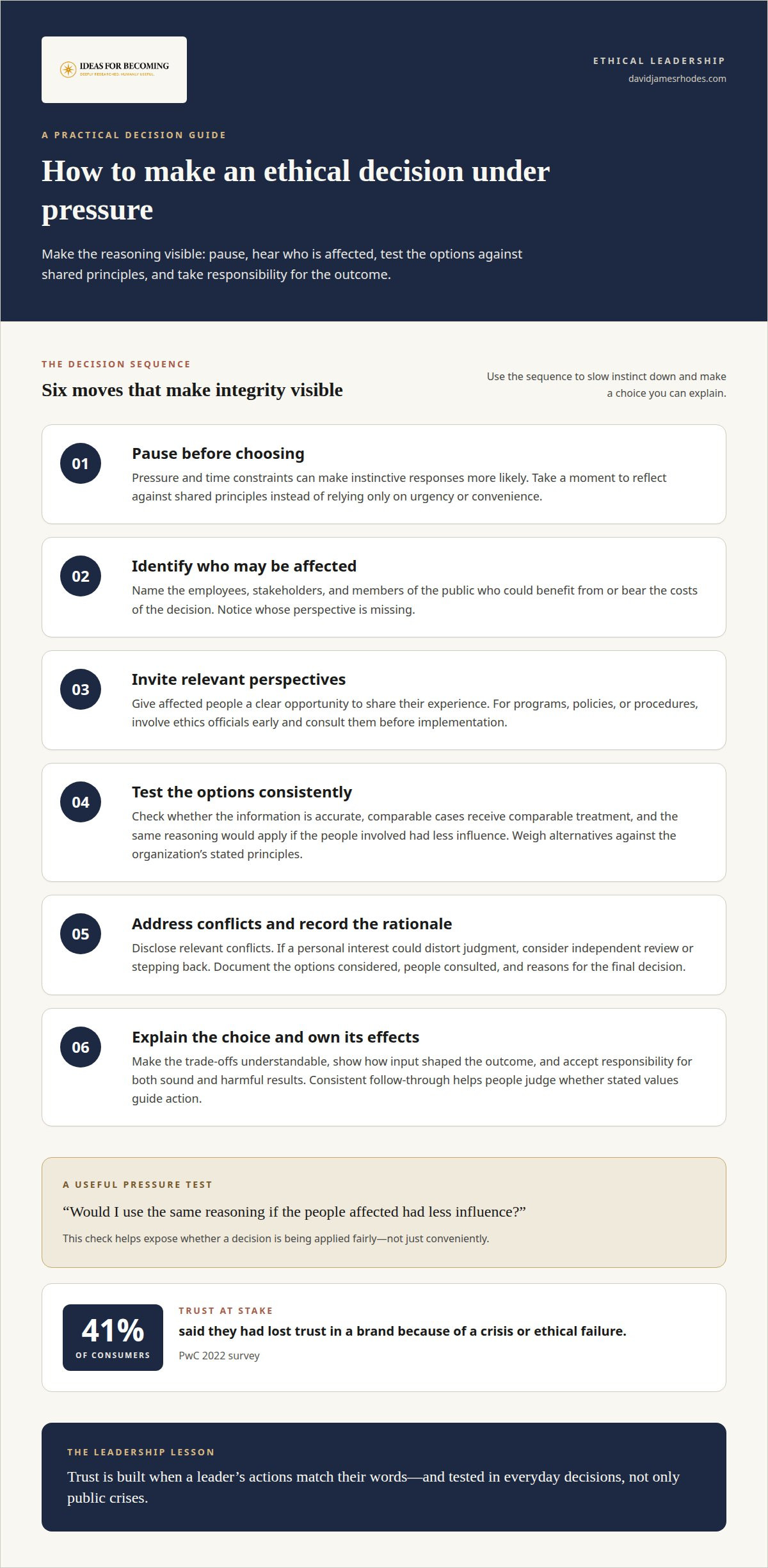
Ethical decision-making under pressure starts with pausing to test a choice against shared principles rather than relying only on instinct. Urgency can narrow attention and make a convenient response seem sufficient. Research cited by Harvard Kennedy School reports that stress and time pressure can impair ethical decision-making by increasing reliance on instinctive rather than reflective responses. Leaders can demonstrate integrity by identifying who may be affected, weighing alternatives, and recording their rationale.
Ethical principles give decisions a standard beyond immediate results. Fairness asks whether comparable cases receive comparable treatment. Accountability means owning both sound and harmful outcomes. A practical review can ask whether the decision relies on accurate information, whose perspective is missing, and whether the same reasoning would apply if those involved had less influence. These questions make integrity visible in the decision itself.
Values-Driven Business Choices
Values-driven business choices consider stated principles alongside commercial aims. Patagonia offers an example: it built a billion-dollar business while prioritizing environmental responsibility over maximum profitability. The lesson is not that every organization should make the same choice. Leaders can define what they will not trade away, then make difficult decisions consistent with that commitment. Consistency helps employees and the public judge whether values actually guide action.
Embedding Ethics in Organizational Decisions
Embedding ethics means building ethical considerations into routine approvals, rather than reserving them for crises. Organizations can involve ethics officials in senior staff meetings, consult them before introducing programs or policies, and include ethical conduct in leadership performance standards. These steps can surface conflicts early and clarify responsibility. They also give decision-makers a structured way to consider consequences for employees, stakeholders, and the public.
The U.S. Office of Government Ethics says ethics officials can take concrete steps to help build an ethical culture and support leaders in sustaining it. Agency leaders can include those officials in senior discussions and consult them before implementing new programs, policies, or procedures. Clear records should capture the options considered, the people consulted, and the reasons for the final decision. Documentation supports accountability when questions arise later.
Inclusive decision-making takes more than inviting comments. Leaders can give people affected by a proposal a clear opportunity to share relevant experience, then record how their input shaped the outcome. Teams can build ethical decision-making skills by reviewing realistic scenarios, identifying competing duties, and explaining their reasoning before a high-pressure moment. Repeated practice makes reflection part of how an organization works, rather than a principle stated only in policy.
Trust, credibility, and organizational performance
Trust grows when leaders make their reasoning visible and accept responsibility for its effects. It is tested in everyday decisions, not only public crises.
Ethical Loyalty and Workplace Culture
Ethical loyalty means supporting colleagues and an organization without excusing unlawful or morally wrong conduct. Silence can allow harmful practices to become part of workplace culture. The U.S. Office of Government Ethics describes organizational culture as shared behaviors, norms, values, beliefs, rituals, and stories. These patterns influence what people feel safe reporting and what leaders choose to reward.
Executives can reconcile loyalty with accountability by welcoming concerns, responding consistently, and making room for respectful disagreement. Slogans alone do not create a strong ethical culture. A manager who rewards results achieved through deception teaches one lesson; a manager who examines both outcomes and methods teaches another. Transparency helps employees see whether stated values shape real decisions.
Conflicting Stakeholder Duties
Conflicting stakeholder duties arise when a choice benefits one group while imposing costs on another. Executives should identify affected parties, disclose relevant conflicts, compare options against consistent principles, and document their reasoning. When a leader’s personal interest could distort judgment, independent review or stepping back from the decision can help preserve credibility.
Consider a proposed policy that improves short-term results but burdens employees or the surrounding community. Leaders can hear those perspectives, explain the trade-offs, and show how the decision reflects the organization’s stated purpose. This approach will not eliminate disagreement, but it gives people a clearer basis for understanding how competing duties were weighed.
Risks of Unethical Executive Leadership
Unethical executive leadership can damage employee confidence, stakeholder relationships, and an organization’s standing with the public. In a PwC 2022 survey, 41% of consumers said they had lost trust in a brand because of a crisis or ethical failure. That finding shows how decisions inside an organization can shape relationships beyond it.
Leaders can assess trust and culture using practical signals, including reporting frequency, decision-escalation patterns, and employee performance in post-training scenarios. Review these measures alongside employee feedback and recurring concerns, then track whether responses change. A rise in reports alone does not prove that culture has worsened; it may indicate that employees feel safer speaking up. Interpretation requires context and follow-through.
Ethical performance also extends beyond the workplace. Leaders can consider community and environmental effects when setting goals, selecting vendors, or assessing a policy. Patagonia’s emphasis on environmental responsibility is one example of values shaping business choices. A clear framework helps executives explain how purpose, stakeholder needs, and organizational performance fit together, especially when those interests do not align neatly.
Commitment to leadership responsibilities
Leadership responsibility is tested when commitments become inconvenient. Employees, customers, communities, and the environment all experience the consequences of executive choices.
Make Commitments Visible in Daily Decisions
A leadership commitment matters when people can see it shaping priorities, conduct, and follow-through. Executives should make promises carefully, honor their letter and spirit, and explain changes when circumstances require a different course. This strengthens credibility because employees can distinguish a considered adjustment from a convenient retreat.
Consider a leader who says the organization values work-life balance but routinely expects employees to work an 80-hour workweek. The practice contradicts the stated commitment. Leaders can close that gap by examining workload expectations, recognizing the behavior they reward, and addressing conduct that undermines the standard. Responsibility includes noticing what the organization teaches through its routines, not only what its policies declare.
Account for Environmental and Social Effects
Ethical leadership includes considering how business decisions affect the environment and society. That responsibility can shape vendor selection, product choices, and long-term priorities. Patagonia offers a prominent example: founder Yvon Chouinard transferred ownership of his $3 billion company to a climate-focused trust in 2022. The decision connected the company’s ownership structure with its environmental purpose.
Executives need not copy Patagonia’s approach to take environmental responsibility seriously. They can assess a decision’s likely effects, identify who bears its costs, and explain how those effects influenced the choice. A commitment becomes more credible when leaders account for consequences beyond immediate financial results.
Respond When Service Breaks Down
Responsibility becomes especially visible when operations fail. In 2008, JetBlue passengers were left on the tarmac at John F. Kennedy International Airport for more than five hours during a snowstorm. JetBlue canceled more than 1,000 flights over the following five days. The disruption illustrates how operational decisions can affect passengers well beyond a single delay.
When something goes wrong, leaders should treat it as an obligation to respond, not merely an inconvenience to explain away. They can communicate what is happening, prioritize the people directly affected, and review the decisions that contributed to the failure. Follow-through matters. A public explanation without learning and operational change leaves the underlying problem untouched.
Take Employee Concerns Seriously
Employees who raise ethical concerns are sharing information leaders need to address potential harm. Organizations can explain reporting channels, provide regular status updates, and set investigation timelines typically spanning 30-60 days. Clear communication helps employees understand that concerns are handled as part of organizational responsibility.
Leaders can strengthen the response by recording the concern, assigning an appropriate reviewer, protecting a fair inquiry, and sharing an update without disclosing private details. If an investigation reveals a weakness, the organization can correct the process and communicate what changed. Commitment is not proven by inviting employees to speak. It is demonstrated by what leaders do with what they hear.
Definition and characteristics of ethical leadership
Ethical leadership connects personal character to an organization’s choices. Its standards become real through conduct others can observe.
Meaning of Ethical Leadership
Ethical leadership means guiding people through fairness, honesty, respect, responsibility, and commitment to ethical behavior. These standards help employees judge decisions, not just the intentions behind them. Leaders show respect by hearing affected people, fairness by applying consistent criteria, and responsibility by owning the effects of their choices.
Integrity matters most when pressure makes departing from principle seem useful. A leader who reports an error accurately, for example, sets a different standard from one who conceals it to protect appearances. That example shapes what employees believe is acceptable. Ethical leadership is both individual conduct and a pattern that can influence an organization.
Dr. Bill Grace developed the 4V model to describe ethical leadership. It connects values, vision, voice, and virtue: values are internal principles; vision links those values to organizational goals; voice communicates values across the organization; and virtue holds leaders accountable to their commitments. The model offers a way to examine how a leader’s stated beliefs reach everyday decisions.
Setting Ethical Non-Negotiables
Ethical non-negotiables are standards leaders agree not to set aside for convenience, competition, or crisis. Leadership teams can define three to five before a crisis. Timing matters: under pressure, clear standards give people a reference point before urgency narrows their choices.
A team might define truthful reporting, respectful treatment, and disclosure of conflicts as non-negotiables. Each standard should describe recognizable conduct. “Tell the truth” becomes clearer when leaders specify that material information must not be knowingly distorted or withheld. Concrete language helps employees understand what a commitment requires in practice.
Teams can test each standard against realistic situations. Ask what happens when a deadline conflicts with accurate reporting, or when a powerful colleague requests an exception. Identify who makes the decision, what information must be considered, and how the reasoning will be recorded. This turns a principle into a usable decision framework.
Leaders must hold themselves to the same standards they expect employees to follow. If an executive says respectful disagreement matters but dismisses a critical view, that weakens the commitment. Reviewing decisions against agreed non-negotiables can reveal gaps between stated values and actual conduct. The aim is not flawless performance, but visible accountability and a willingness to correct course.
Core ethical leadership principles
Ethical principles turn values into standards for decisions and conduct. Their force becomes clear when a leader must choose between convenience and fairness.
Compliance-focused leadership asks whether conduct meets applicable rules. Ethical leadership includes that responsibility, then asks whether a decision is honest, fair, respectful, and responsible in its effects. A choice can meet a formal requirement yet still undermine trust if leaders conceal important information or treat people inconsistently. Rules set a floor; ethical judgment guides decisions when the right course requires more than minimum compliance.
Honesty and transparency mean communicating accurately about decisions, risks, and results. Leaders can explain what they know, what remains uncertain, and why they chose a course of action. Accurate financial reporting and clear stakeholder communications, for example, help others understand the basis for a decision. Selective omissions can distort the truth, even when each sentence is technically accurate.
Fairness requires consistent standards and genuine attention to different perspectives. In a workplace conflict, a leader should hear from the people affected, assess the evidence, and apply the same criteria regardless of seniority or influence. Respect means treating employees and stakeholders with dignity, including when their views challenge a favored proposal. These habits reduce the chance that status or bias quietly determines whose interests count.
Responsibility means considering how conduct affects others, not just the immediate business result. Before approving a new policy, an executive can examine its financial, operational, and human effects. The decision record should capture the alternatives considered and the reason for the final choice. This makes accountability more concrete if the outcome harms employees, customers, or the broader community.
Courage is needed when a principled choice carries a personal or organizational cost. Leaders demonstrate it by refusing to excuse unlawful or morally wrong conduct as loyalty and by making room for colleagues to dissent. A manager who invites criticism before a major decision can uncover overlooked risks. Openness also means listening without retaliation or dismissing disagreement as disloyalty.
Executive guidance on ethical leadership principles can help leaders turn values into habits. Teams can work through a realistic scenario, identify affected parties, name competing values, compare options, and explain their reasoning. Afterward, leaders can consider whose perspective was missing and whether the decision matched stated standards. Repeating this process helps make principles part of everyday behavior, not merely policy language.
For executives facing difficult trade-offs, executive guidance on ethical leadership principles can also clarify how to test choices against the organization’s commitments. The central test is consistency: whether a leader’s actions reflect the standards they expect others to follow. Integrity becomes credible through repeated choices, especially when pressure makes an easier answer attractive.
David James Rhodes: Leadership & Life Advisory
Ethical leadership can mean facing difficult decisions, competing duties, or questions of personal responsibility. Leadership & Life Advisory offers space to examine how your values show up in leadership, where commitments conflict, and what kind of conduct you want others to experience.
The work is not about applying a formula to every dilemma. It is about bringing greater clarity to the choices before you and the person you are becoming as you make them.
For leaders seeking support with these questions, David James Rhodes offers advisory services.
Let Your Next Decision Reflect Who You Are Becoming
Ethical leadership is not a final state to achieve. It is a practice renewed whenever a choice tests what you value. Carry that awareness into the decisions ahead, especially those where certainty is limited and the consequences reach beyond you.
Thoughtful executive guidance on ethical leadership principles can help leaders examine the space between intention and action. Reflection can clarify what deserves protection, where accountability belongs, and how to lead without losing sight of the people affected. The work is not about appearing flawless. It is about choosing carefully, learning from the result, and continuing to become someone others can trust.
If you are considering how to bring greater integrity to your leadership, contact David James Rhodes. Begin with the question that makes every principle personal: who are you becoming? Let the answer shape what you do next.
Frequently Asked Questions
How can you deal with ethical issues in the workplace?
Address a workplace ethics concern by separating what happened from assumptions about why it happened. Record relevant details, preserve appropriate messages or documents, and use the organization’s established reporting channel. If the concern involves your manager, consider another designated route. Avoid spreading allegations among colleagues. A careful, factual account helps the organization assess the issue fairly and decide whether further review or action is needed.
What are the core principles of ethical leadership?
Ethical leadership rests on honesty, fairness, respect, responsibility, and integrity. In practice, these principles work together. For example, a leader choosing a team for a high-stakes assignment can explain the selection criteria, consider candidates consistently, and give people respectful feedback. That approach makes the decision easier to understand, even for employees who were not selected. Principles become useful when they guide specific conduct.
What executive frameworks or guidelines define ethical leadership?
No single framework defines ethical leadership for every organization. The 4V model, developed by Dr. Bill Grace, offers one lens for connecting personal values with organizational vision, communication, and accountability. Organizations may also use codes of conduct, internal ethics policies, and decision-review processes. These tools serve different purposes: a code sets expectations, while a framework helps leaders reflect on how values shape choices.
How can executives model ethical behavior and set the tone at the top?
Executives set the tone through small, repeated choices employees can observe. They can explain the reasoning behind difficult decisions, acknowledge when new information changes their view, and invite disagreement before a plan is final. A leader who publicly credits a colleague for identifying a risk, for instance, shows that raising concerns is valued. Follow-through matters: employees watch what leaders reward, correct, and tolerate.
How can executives respond to misconduct, whistleblowing, and ethical dilemmas?
Executives should take reports seriously, protect the integrity of the review, and avoid prejudging the people involved. Preserve relevant records, assign an impartial reviewer, and provide the reporting employee with appropriate progress updates. In an ethical dilemma, identify who may be affected, consider competing duties, and document the decision rationale. Apply the same standards to senior leaders and other employees, without treating rank as an exemption.
Frequently Asked Questions
Related Articles

Purpose-Driven Life Advisory for Professionals: Work With Purpose
Purpose-driven life advisory for professionals connects your values to leadership and daily work, helping you pursue meaningful goals and lasting fulfillment.

Mentorship for Aspiring Global Leaders: Track Outcomes and Impact
Mentorship for aspiring global leaders builds practical skills and sound judgment. Learn to set goals, make cross-cultural matches, and assess impact.

Confidential Sounding Board for Fortune 500 Executives
A confidential sounding board for Fortune 500 executives helps leaders test decisions and assess peer trust, confidentiality, and conflicts before sharing.