
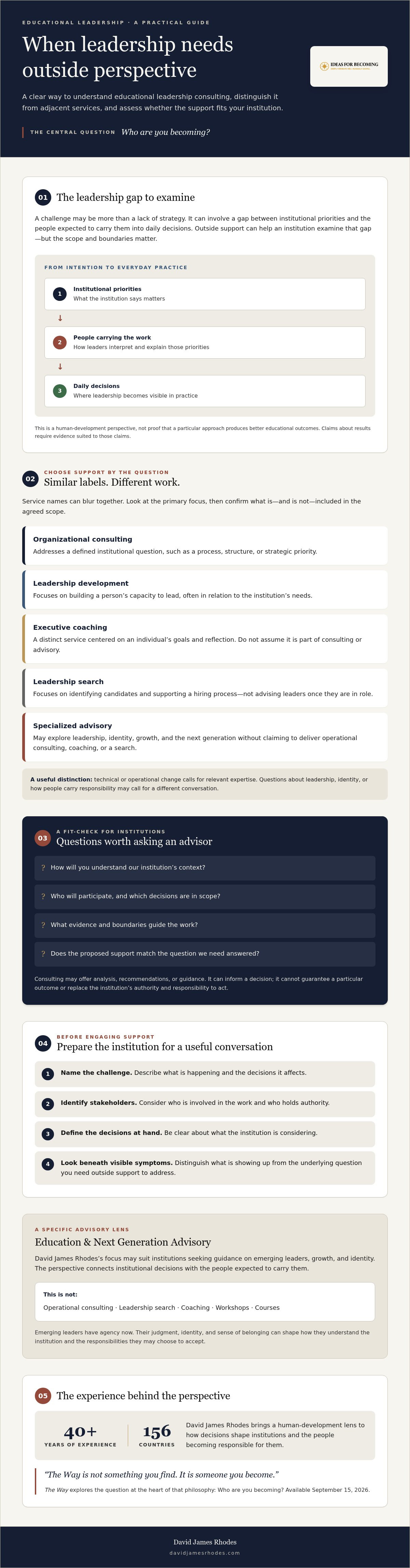
What if a leadership challenge is not simply a lack of strategy, but a gap between institutional priorities and the people expected to carry them out? Educational leadership consulting can help institutions examine that gap. But broad promises do not explain what the work involves or whether an advisor understands your institution’s needs. Leaders need clarity about the question, the support being offered, and how it relates to the people doing the work.
This article explains how consulting differs from leadership development, coaching, and advisory support. It also offers practical questions for assessing an advisor’s approach, experience, and fit, plus ways to consider both institutional responsibility and individual growth.
David James Rhodes’s work in educational leadership and next-generation advisory starts with that connection. Informed by more than four decades of experience across 156 countries, his perspective considers how decisions shape institutions and the people becoming responsible for them. His book The Way explores the question at the center of this philosophy: Who are you becoming?
Key Takeaways
- Educational leadership consulting can address institutional and leadership challenges, but the scope varies. Clarify whether you need organizational advice, leadership development, coaching, a search, or specialized advisory.
- Assess whether an advisor connects institutional priorities with the people responsible for carrying them into daily decisions.
- Before choosing support, ask how the advisor will understand your institution’s context, who will participate, which decisions are in scope, and what evidence and boundaries guide the work.
- Prepare by naming the challenge, identifying stakeholders, defining the decisions at hand, and distinguishing visible symptoms from the question you need outside support to address.
- David James Rhodes’s Education & Next Generation Advisory may suit institutions seeking guidance on emerging leaders, growth, and identity. It is not operational consulting, leadership search, coaching, workshops, or courses.
What Educational Leadership Consulting Can and Cannot Address
Educational leadership consulting is outside support that helps an institution clarify and address a leadership or organizational question. Depending on the need and agreement, the work may include analysis, recommendations, or guidance. It can inform a decision, but it cannot guarantee a particular outcome or replace the institution’s authority and responsibility to act.
Educational leadership involves more than administering a school or institution. It concerns how people guide learning and shape the conditions in which educational work takes place. The right outside support depends on the question, who has authority to address it, and what change the institution is considering.
Which educational leadership challenges may call for outside support?
A leadership transition may raise questions about continuity and direction. An institution may want to support emerging leaders or clarify a broader organizational challenge. These needs are not interchangeable. An operational problem may call for technical expertise. A concern about leadership, identity, or how people carry responsibility may call for a different conversation. Start by describing the challenge and the decisions it affects, then identify the kind of expertise needed.
Consulting, coaching, and advisory: where the boundaries differ
Service names can blur together. Ask what the work actually addresses. One useful way to distinguish these services is to look at their primary focus:
- Organizational consulting addresses a defined institutional question, such as a process, structure, or strategic priority.
- Leadership development focuses on building a person’s capacity to lead, often in relation to the institution’s needs.
- Executive coaching is a distinct service centered on an individual’s goals and reflection. Do not assume it is part of consulting or advisory.
- Leadership search focuses on identifying candidates and supporting a hiring process. It is different from advising leaders once they are in role.
- Specialized advisory may explore leadership, identity, growth, and the next generation without claiming to deliver operational consulting, coaching, or a search.
The distinction matters because a well-defined service makes its boundaries clear. If the main question is how to implement a technical or operational change, confirm that the provider has the relevant expertise and that the work is included in the agreed scope. If the question concerns emerging leaders and the people they are becoming, specialized advisory may be more relevant.
David James Rhodes’s focus is educational leadership and next-generation advisory. Informed by more than four decades of experience across 156 countries, his perspective connects institutional decisions with the people expected to carry them. This is a human-development lens, not a promise of institutional results. The practical test is whether the proposed support fits the question you need answered.
Why Educational Leadership Depends on the People Carrying the Work
A strategy does not act on its own. People interpret it, explain it, and make decisions in its name. A new priority may look clear in a document but feel different to someone deciding how to respond to a student, colleague, or competing demand. The distance between a plan and daily practice is where leadership becomes visible.
This is a practical observation, not proof that a particular approach produces better educational outcomes. Research-backed claims require evidence suited to the claim. A human-development perspective asks a different question: what judgment, capacities, and sense of responsibility do people need to carry the work? Educational leadership consulting can help institutions examine the stated priority alongside the realities faced by the people responsible for it.
Developing emerging leaders without reducing them to a pipeline
Preparing people for greater responsibility is not simply a matter of filling future roles. Emerging leaders have agency now. Their judgment, identity, and sense of belonging influence how they understand the institution and the responsibilities they may choose to accept. Development should make room for honest reflection, rather than treating a person as a replacement waiting in line.
Harvard Graduate School of Education’s next-generation educational leadership program offers one reference point for system-level leadership preparation. For a more personal perspective on how young leaders meet difficulty, readers can also explore David’s article on developing resilience in young leaders. These are related questions, but neither establishes that one development model suits every institution.
Leadership responsibility deepens as people develop the judgment and character required to carry it.
Connecting leadership decisions with institutional purpose
Purpose is tested in ordinary choices. When an institution names a priority, leaders need to translate it into decisions about time, communication, and competing needs. That translation cannot be understood from the strategy document alone. Listen to the people expected to put it into practice. What does the priority mean to them? Where does it meet friction? What decisions are they being asked to make without enough clarity or authority?
David James Rhodes brings more than four decades of experience across 156 countries to his perspective on leadership. That experience informs his thinking, but it is not scientific proof or evidence of institutional results. His focus on human becoming adds a question alongside institutional purpose: who are people becoming as they carry it? Readers considering the connection between leadership responsibilities and life beyond a role may also find David’s article on leadership advisory and life-work integration relevant.
For institutions seeking a human-centered perspective on emerging leaders, David’s education and next-generation advisory is one form of specialized support to consider. Its fit depends on the institution’s question and the agreed scope, not on a promise that every challenge has the same answer.
How to Evaluate an Educational Leadership Consultant
A polished proposal can still answer the wrong question. Before comparing providers, describe the challenge in plain language. It might involve a leadership transition, uncertainty about institutional direction, or a need to develop emerging leaders. Then ask how the advisor would understand the institution’s context before recommending an approach. The quality of that first conversation matters.
A clear scope is more useful than a broad promise. Use the questions below to compare proposals. Ask each advisor to explain what the work would involve in your institution, not just what their general model includes.
- Challenge fit: Which specific institutional or leadership question does the proposed work address? How does it connect to the challenge we identified?
- Scope: What activities or guidance are included? What is explicitly outside the engagement?
- Participants: Who needs to be involved, and how will their perspectives be understood? Which decisions remain with institutional leaders?
- Approach: What would you need to learn about our context before recommending a course of action? Which assumptions might need to be tested?
- Evidence: What supports the claims being made? Is the evidence relevant to this approach and this kind of institution, or does it show only that the advisor has experience?
- Boundaries: How will progress be discussed? What can the advisor reasonably influence, and what depends on institutional choices or conditions beyond their control?
Questions to ask before choosing a consultant
Ask, “What would you need to understand before defining the work?” Then clarify who will participate, who holds decision-making authority, and how the scope will be documented. Ask how you will review progress and adjust the work without treating a desired result as guaranteed. A thoughtful advisor should be able to explain both what they can contribute and what they cannot control.
Signs the proposed approach may not fit
Be cautious if a provider promises results but cannot explain the work, the evidence, or the limits of the claim. A familiar framework may be useful, but familiarity alone does not establish fit. Credentials and testimonials may offer context, but they do not prove an approach will suit your institution. If the proposed service does not address your stated challenge, pause before proceeding.
Good educational leadership consulting should make the institution’s question clearer, not obscure it beneath a service menu. The right fit is not necessarily the broadest offer or the most confident promise. Look for support with a defined purpose, a credible approach, and boundaries your leaders understand.
How to Prepare Your Institution for Educational Leadership Support
A useful first conversation begins before anyone recommends a solution. Institutions often notice symptoms first: a decision keeps returning to the agenda, communication is strained, or emerging leaders seem unsure of their authority. These observations matter, but they are not yet the central question. Preparation helps you describe what is happening without deciding in advance what the answer must be.
Define the leadership question before contacting an advisor
Write down the situation in concrete terms. Clarify who is affected, who has authority to make decisions, and whose perspective may be missing. Separate immediate operational needs from longer-term questions about leadership development. A time-sensitive operational issue may require different expertise from a question about how emerging leaders are growing into responsibility.
Before seeking educational leadership consulting, use this sequence to establish a workable starting point:
- Name the challenge: Describe what you have observed without assigning blame or prescribing a fix.
- Identify stakeholders: Note who is affected, who should be heard, and who can authorize change.
- Define the decisions: Be clear about which decisions are open for consideration and which remain with institutional leaders.
- Clarify boundaries: Identify the expertise you need, the limits of outside support, and the areas that are not part of the work.
This distinction can change the conversation. “Staff aren’t aligned” describes a perception. A more useful question might be whether people understand the priority, have a chance to raise concerns, and know which decisions they can make. An advisor should help examine the question, not simply confirm the institution’s first interpretation.
Make the first conversation useful
Bring your priorities, known constraints, and the questions you want answered. Ask what the advisor needs to understand before suggesting an approach, what they do not provide, and how they distinguish observation from recommendation. Before work begins, agree on who communicates with whom, what confidentiality expectations apply, and when the institution will review progress. These details support clarity, but they do not guarantee a particular result.
For broader context, David James Rhodes writes about leadership advisory and the relationship between leadership responsibilities and life beyond work. His Education & Next Generation Advisory focuses more specifically on educational institutions and emerging leaders. If that focus matches the question you have defined, read about David’s education and next-generation advisory.
When Next-Generation Educational Leadership Advisory May Be the Right Fit
Institutions do not always need another strategy. Sometimes they need space to consider who will carry that strategy, how emerging leaders are growing into responsibility, and what kind of leadership the institution is asking them to develop. This is where specialized next-generation educational leadership advisory may be relevant.
What David James Rhodes brings to an educational leadership conversation
David James Rhodes is an author, global executive, entrepreneur, and advisor. His perspective is shaped by more than four decades of experience across 156 countries in international finance, leadership, entrepreneurship, and behavioral health. That experience informs his thinking, but it is not evidence that a particular engagement will produce a specific institutional result.
His advisory offer focuses on educational leadership and the next generation. It may fit institutions considering how emerging leaders understand responsibility, how growth and identity relate to leadership, or how institutional priorities are carried by the people expected to put them into practice. These are practical questions about judgment, communication, and the meaning people make of their roles.
The Way gives this work a philosophical lens: becoming is not a destination someone hands you. It is shaped by the choices and responsibilities you take up. In an institution, that idea can prompt a grounded discussion about who is being prepared to lead, what support they need, and whether expectations are clear.
This advisory is not a substitute for every form of educational leadership consulting. An organization primarily seeking leadership search, technical implementation, workshops, or therapy should look for support suited to that need. Fit begins with an honest match between the question and the work offered.
A clear next step for institutions exploring advisory
Before reaching out, write down the leadership question you are trying to answer. Note who is affected, what decisions are at stake, and what kind of guidance may help. Use the first discussion to assess mutual fit, including what the advisory can address and what falls outside its scope. Clarity about the work matters more than a promise of an outcome.
If the central question concerns emerging leaders, growth, and identity, learn more about David James Rhodes’ work and consider whether his educational leadership and next-generation advisory aligns with your institution’s needs.
Choose Support That Strengthens the People Behind the Work
The right educational leadership consulting begins with a clear institutional question, a defined scope, and an honest understanding of who will carry decisions into daily practice. An advisor’s experience matters, but so does the fit between their approach and the challenge your institution actually faces.
Keep the human dimension in view. Emerging leaders are not simply future role-holders. They are people developing judgment, identity, and a sense of responsibility. Supporting that growth can help institutions consider not only what must change, but who is being asked to lead the change.
David James Rhodes’s perspective is shaped by more than four decades of experience across 156 countries. His advisory focus is educational leadership and the next generation. This experience informs his perspective, but it does not guarantee a particular outcome. If your institution is considering questions of leadership, growth, and identity, his work may be relevant.
Outside support does not remove the institution’s responsibility. It can help leaders see that responsibility more clearly and meet it with greater care. The work begins with a question that matters: who are your leaders becoming?
Frequently Asked Questions
What does an educational leadership consultant do?
An educational leadership consultant provides outside support for a defined leadership or institutional question. Depending on the provider and scope, the work may involve understanding a challenge, offering recommendations, or advising leaders as they consider next steps. The term does not describe one standard service. Before agreeing to an engagement, clarify what the consultant will do, what expertise they bring, and which decisions remain with your institution.
What is the difference between educational leadership consulting and coaching?
Educational leadership consulting generally focuses on an institutional question or organizational need. Coaching is a distinct service, usually centered on an individual’s goals, reflection, and development. The terms are not interchangeable, and one may not be included in the other. Ask the provider what the work involves, who it serves, and what falls outside the scope. David James Rhodes’s advisory focuses on educational leadership and the next generation, not life coaching.
How do we choose an educational leadership consultant?
Choose based on fit, not the breadth of the provider’s service menu. Describe your institution’s challenge, then ask how the consultant would learn its context before recommending an approach. Clarify who will participate, which decisions remain with institutional leaders, how progress will be reviewed, and what evidence supports any claims. Relevant experience can inform an approach, but it does not guarantee that the same approach will suit your institution.
Can educational leadership consulting support emerging leaders?
Yes, some forms of educational leadership consulting or advisory can address emerging leaders’ development. Useful questions include how they understand responsibility, exercise judgment, and find belonging within an institution. This work should recognize emerging leaders as people with agency, not simply as future replacements for current role-holders. David James Rhodes’s specialized advisory focuses on educational leadership and the next generation, including questions of growth and identity.
When should a school or education institution seek outside leadership support?
Consider outside support when a leadership transition, a question of institutional direction, or a challenge involving emerging leaders could benefit from an external perspective. First distinguish the observed symptom from the question that needs attention. A technical or urgent operational problem may require specialized operational expertise, while a question about leadership growth may call for different support. External advice can inform decisions, but institutional leaders remain responsible for them.
What should we prepare before speaking with an educational leadership advisor?
Prepare a clear description of what is happening, who is affected, who holds decision authority, and whose perspective may be missing. Note your institution’s priorities, constraints, and the decisions you hope to consider. Ask what the advisor needs to understand before defining the work and what they do not provide. Before work begins, clarify the scope, communication expectations, confidentiality, and how you will review progress.
If your institution is considering support for emerging leaders, growth, and identity, contact David James Rhodes to discuss whether his Education & Next Generation Advisory fits your needs.
Frequently Asked Questions
Related Articles

Books on Leadership Principles and Core Values: Essential Reading for Genuine Character
Discover books on leadership principles and core values that bypass corporate jargon to build authentic character and shape who you are becoming as a leader.

Inspirational Life Purpose Speaker: Event Planner's Guide
Book an inspirational speaker for finding life's purpose who delivers lasting depth, not stage hype. Here is how event planners evaluate real perspective.

Choosing a Corporate Keynote Speaker on Future-Proof Leadership in 2026
Find a corporate keynote speaker on future-proof leadership who trades stage hype for seasoned executive gravity, character under pressure, and real impact.