
What if a human potential keynote isn’t about convincing people they can do anything, but asking what they’re willing to become? The phrase can sound broad, and speaker descriptions can blur together when they promise little more than inspiration. Event planners need to know what an audience will take away and whether the message belongs in the room.
A human potential speaker can help people examine how identity, character, and action shape what becomes possible. The right perspective can speak to personal growth and leadership without reducing either to easy slogans. This article explores what human potential can mean in a speaking context and how to assess whether a speaker’s message fits your event and audience.
David James Rhodes brings a global perspective shaped by more than four decades of experience across 156 countries, alongside close attention to the choices people make in difficult and consequential moments. His thinking connects potential with becoming: not simply imagining a different future, but developing the character to meet it. We’ll look at how that idea informs his keynote speaking and how The Way offers a broader philosophy of human becoming.
Key Takeaways
- Understand human potential as capacity put into action, not a guarantee of achievement or a measure of personal worth.
- Assess a human potential speaker by the depth of the ideas, their relevance to your audience, and their connection to the event’s purpose.
- Give a keynote stronger direction by naming your audience’s real circumstances and the central tension they face.
- Consider how identity, relationships, choices, and action shape human becoming, while distinguishing philosophy from established research.
- Explore how David James Rhodes connects leadership and change with the question of who people are becoming.
What a Human Potential Speaker Can Help an Audience See
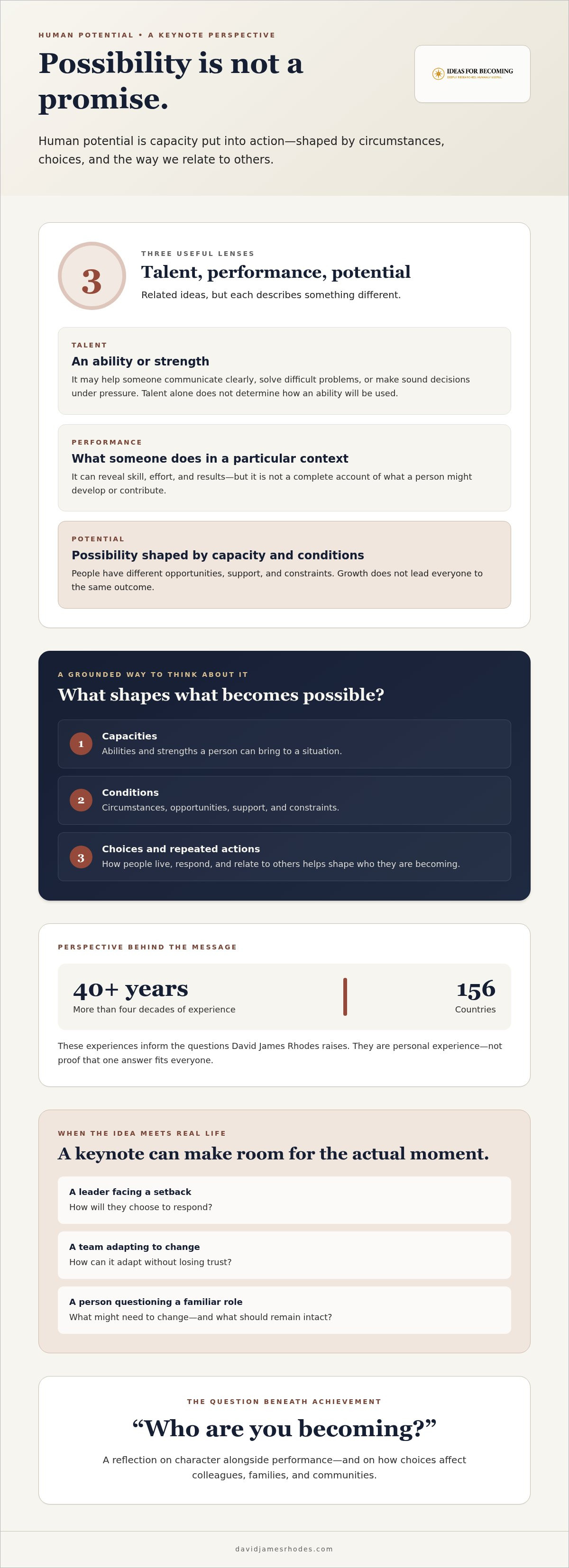
A human potential speaker helps an audience consider how human capacity can become lived action. The subject is not a promise that everyone will achieve the same things. Nor is potential a measure of someone’s worth. It asks what may become possible when people meet their abilities, circumstances, responsibilities, and choices with greater awareness.
Potential concerns possibility, not guaranteed outcomes. That distinction matters in a room where people face change, pressure, or uncertainty. A leader may be deciding how to respond to a setback. A team may need to adapt without losing trust. An individual may be questioning whether a familiar role still fits. A thoughtful keynote can make room for these realities without pretending one message will resolve them all.
How human potential differs from talent or performance
Talent is an ability or strength. It may help someone communicate clearly, solve difficult problems, or make sound decisions under pressure. But talent is not the whole person, and it doesn’t determine how that ability will be used.
Performance describes what someone does in a particular context. It can reveal skill, effort, and results, but it’s not a complete account of what a person might develop or contribute. Circumstances matter. People don’t have identical opportunities, support, or constraints, and growth doesn’t lead everyone to the same outcome. Potential is better understood as possibility shaped by a person’s capacities and the conditions in which they act.
Why the topic belongs in a keynote
A shared question can draw an audience beyond titles and immediate targets. What kind of colleague does this moment ask me to be? What responsibility comes with influence? These questions connect personal becoming to the people affected by our choices: colleagues, families, and communities.
The idea also has a wider history. The Human Potential Movement offers context for the long-standing interest in human development and growth. A keynote can bring that broad subject into the audience’s present concerns without presenting one interpretation as settled science or a universal formula.
For planners, the value lies in how the speaker handles the distance between possibility and daily life. Can the audience consider what responsibility, courage, or a change in habit might look like in their own setting? A useful keynote doesn’t need to prescribe a single path. It can help people see their choices more clearly and leave them with a question worth carrying back into work and relationships.
Human Becoming: The Deeper Idea Behind Human Potential
Human becoming describes identity as something that develops through living. Choices matter, as do relationships, repeated actions, and the demands of time. A person isn’t simply defined by a role they hold or a result they once achieved. What they practice, how they treat others, and how they respond when circumstances change all shape who they are becoming.
This is a philosophical perspective, not a scientific formula or a claim that every person follows the same path. Research can examine particular aspects of human development, but it doesn’t make David’s interpretation a universal law. His observations come from experience across leadership, behavioral health, recovery, adversity, and achievement. Those experiences inform the questions he raises; they aren’t proof that one answer fits everyone.
Success can invite reflection: what responsibilities come with this influence? Failure can prompt another kind of reckoning: what needs to change, and what should remain intact? A transition may unsettle an identity built around a familiar role. Responsibility can make the stakes visible. These moments don’t automatically make people wiser. They create occasions to examine a choice, learn from its consequences, and decide how to act next.
Potential isn’t a fixed destination; it’s a possibility shaped by how we live, choose, and relate to others.
The question beneath achievement
People often focus on the next role, milestone, or result. Those aims can matter. But beneath each one sits a quieter question: what kind of person will I need to become to pursue this well? Ambition may call for discipline, but also integrity when a shortcut is available. Leadership may bring authority, but also responsibility for how decisions affect others.
David’s question, “Who are you becoming?”, isn’t a test with a prescribed answer. It invites honest reflection. Is success strengthening your relationships or narrowing your attention? Are you pursuing a meaningful goal in a way you can respect? For a human potential speaker, the question can give an audience space to consider character alongside performance, without reducing a life to metrics.
Why experience can deepen the message
Experience across different professional and personal settings can widen the questions a speaker brings to a room. David’s work connects leadership with the human realities of change, recovery, and adversity. That perspective can help audiences consider how becoming unfolds beyond the workplace, while remaining clear that individual stories don’t establish universal conclusions.
This view sits naturally alongside The Way’s philosophy of becoming: a way forward is shaped by who a person becomes, not found as a perfect path waiting in advance. Event planners can explore David James Rhodes’s keynote perspective when seeking a message that connects achievement with identity, responsibility, and the choices people make along the way.
How to Assess a Human Potential Keynote Beyond Motivation
A keynote can move a room in the moment. The harder question is whether its ideas fit the audience’s real circumstances and offer something worth considering after the applause. Assess a human potential speaker not by energy alone, but by the relevance and substance of the message.
| Approach | Audience relevance | Depth of ideas | Practical connection | Best fit |
|---|---|---|---|---|
| Generic uplift | Broad and accessible, but may not address the audience’s particular situation. | Often centers on encouragement. | May leave people inspired without clarifying what to do differently. | Events seeking a shared moment of energy. |
| Subject expertise | Strong when the audience needs knowledge in a specific field. | Develops concepts and insight within that subject. | Can connect expertise to decisions, tools, or professional practice. | Events focused on a defined discipline or challenge. |
| Reflective human-potential perspective | Connects the theme to the audience’s roles, pressures, and choices. | Explores identity, character, and responsibility alongside possibility. | Links ideas to decisions people face at work and beyond it. | Events inviting reflection on leadership, change, or direction. |
These approaches can overlap. A speaker may bring expertise and offer encouragement. The distinction is what organizes the talk and whether its ideas meet the event’s purpose. No keynote can guarantee lasting change, and energy in the room isn’t evidence of it. A philosophical talk can still be practical when it helps people examine a real decision, such as how to lead through uncertainty or respond when a familiar approach no longer serves the team.
Questions that reveal whether the message has substance
Ask what central human question organizes the talk and why it matters to this audience. Look for a clear connection between the idea and situations people actually face, such as giving difficult feedback or taking responsibility after a mistake. Notice whether the speaker distinguishes personal observation from research-backed claims. That distinction builds trust and helps planners understand what kind of insight the audience will hear.
Match the keynote to the event’s purpose
For leadership gatherings, consider whether the talk connects potential to character, responsibility, and the consequences of how people lead. For broader audiences, identity, purpose, resilience, and different directions of becoming may be more fitting. The subject can remain reflective while speaking directly to the room. David James Rhodes’s keynote perspective on leadership and identity brings these themes into conversation.
Before selecting a keynote, write down the audience’s central tension in one sentence. Then ask whether the speaker’s ideas help illuminate it, rather than simply placing a familiar theme over the event. To explore a perspective built around leadership and human becoming, consider David James Rhodes’s keynote speaking.
Plan a Human Potential Keynote Around the Audience's Real Questions
A strong keynote brief begins with people, not a slogan. “Inspire our team” names a hope, but not the circumstances the speaker needs to understand. A more useful brief describes what attendees are carrying, what the event is meant to make possible, and what kind of reflection could serve them. A human potential speaker can then shape the message around the room rather than deliver a general appeal.
Begin with the audience, not the event slogan
Attendees may be taking on greater responsibility, facing uncertainty, rebuilding after disruption, growing into new roles, or reconsidering their direction. Name the tension without defining people by it. For example, a team can be adapting to change while still bringing experience, commitment, and different views of what should happen next.
David’s speaking themes include leadership, recovery, and human potential. Choose the emphasis according to the audience’s actual context: leadership may suit a group considering how it exercises responsibility, while broader human-potential themes may better serve people reflecting on identity, purpose, or change.
Shape a useful outcome for the room
A keynote can frame a question, introduce a perspective, or open a conversation attendees carry forward. It can’t guarantee that each person will change or that the organization will achieve a particular result. Keep the aim proportionate. “Leave with a clearer question about how we lead through change” is more grounded than promising transformation.
Use this sequence to turn your event’s intention into a workable brief:
- Clarify the audience. Describe who will attend, their roles, and the circumstances they share. Note meaningful differences in experience or responsibility, too.
- Name the central tension. State what people are trying to reconcile, such as meeting new expectations while preserving trust or making decisions with incomplete information.
- Define the event’s purpose. Explain why the gathering is happening now and what a useful reflection or conversation would contribute.
- Shape the keynote. Identify relevant leadership or life themes, the planned timing, and the tone that will fit the occasion. Invite the speaker to connect ideas to the audience’s lived decisions.
A short sample brief might read: “Audience: department leaders and emerging managers. Context: responsibilities are changing, and teams are working through uncertainty. Purpose: help attendees reflect on how they lead when answers aren’t clear. Desired reflection: what does responsibility ask of us now? Relevant themes: character, leadership, and becoming through change. Timing: opening keynote before the day’s leadership sessions.”
This gives the speaker something more substantial than a request for generic inspiration. It also leaves room for a keynote to meet the audience without claiming to solve every challenge. To shape a keynote around your event’s audience and purpose, explore David James Rhodes’s keynote speaking.
David James Rhodes on Human Potential and the Work of Becoming
David James Rhodes speaks about human potential through a question that reaches beyond achievement: who are people becoming through leadership, adversity, and change? His perspective joins experience as a global executive and entrepreneur with attention to the human realities behind decisions. Results matter. So do the character, courage, and care people bring to the effort.
This is not a claim that one keynote can resolve a difficult transition or provide a universal answer. It is an invitation to examine how people respond to the lives and responsibilities they have. In a leadership setting, that might mean looking beyond authority to the trust a leader builds. In a time of change, it might mean considering what values can guide a decision when the old direction no longer holds.
A keynote grounded in human experience
Rhodes’s work spans international leadership and business, as well as behavioral health, recovery, and adversity. These are contexts for his perspective, not scientific proof of universal claims. They bring different questions into view: how people carry responsibility, how identity can be tested by disruption, and what it means to keep acting with purpose when circumstances shift. His keynote themes include leadership, recovery, and human potential.
That breadth can help a human potential speaker connect public responsibilities with private choices without treating them as separate lives. A decision at work can affect a team’s sense of safety and direction. A personal change can alter how someone understands their contribution. The practical work is to notice those connections, then ask what an honest next action requires. No promise of instant reinvention is needed.
The Way as a natural extension of the conversation
The Way is the philosophy behind this question of becoming, not a solution meant for every audience. Its central idea is simple: The Way is not something you find; it is someone you become. That perspective brings character, courage, action, relationships, purpose, and the limits of time into the same conversation. It asks not only what a person hopes to achieve, but how they want to live while pursuing it.
For an event centered on disruption, that reflection can include how people rebuild direction without pretending adversity is easily overcome. Rhodes’s writing on human becoming after adversity explores that wider process. For other audiences, the same philosophy may speak through leadership, relationships, or purpose rather than hardship.
A keynote can open a question. What follows belongs to the people who carry it back into their choices and relationships. To explore how David James Rhodes’s keynote speaking can serve your event, explore David James Rhodes and his work.
Choose the Question Your Audience Should Carry Forward
The right keynote doesn’t need to give every attendee the same answer. It can give them a better question to take into the decisions waiting beyond the event. For planners, that begins with a clear choice: what do you want people to notice about how they lead, work, or respond to change?
A human potential speaker is most relevant when the ideas meet that question with care and substance. Consider the reflection you want the room to carry forward, then build your event brief around the audience’s actual circumstances. The goal isn’t to promise change from a single speech. It’s to make space for a perspective people can test against their own choices.
David James Rhodes’s work brings leadership and human becoming into that conversation. Explore David’s keynote speaking as you shape an event that leaves room for thought as well as action. A meaningful next step can begin with one honest question, and the courage to keep answering it through how you live and lead.
Frequently Asked Questions
What does a human potential speaker talk about?
A human potential speaker may explore growth, purpose, leadership, resilience, identity, or how people respond to change. The topic is broad; each speaker gives it a distinct shape through experience, ideas, and examples. One may focus on developing talent at work, while another asks how responsibility and relationships influence who people become. For planners, the useful question is which perspective speaks to the audience’s present concerns.
Can a human potential keynote be relevant to both personal growth and leadership?
Yes. Leadership is practiced by people whose habits, values, and relationships extend beyond their job titles. A keynote might consider how self-awareness influences a difficult conversation, or how a leader’s response to uncertainty affects a team. Those themes can resonate personally while remaining relevant to organizational life. The talk can offer a shared lens for reflection, but it can’t guarantee that individuals or teams will act differently afterward.
How is a human potential speaker different from a motivational speaker?
The distinction often lies in the talk’s central purpose. A motivational address may prioritize encouragement and momentum. A human-potential perspective may instead examine the beliefs, choices, and responsibilities shaping how people live and lead. The approaches can overlap, but planners can listen for whether the speaker connects inspiration to the audience’s specific realities. Ask what ideas attendees can consider after the event, not only how they may feel during it.
What should event planners include in a keynote speaker brief?
Describe who will attend, what they’re experiencing, and why the event is being held. Include relevant context, such as a leadership transition, a period of uncertainty, or a new organizational direction. Name themes that matter to the audience and what kind of reflection would make the session worthwhile. Share practical details such as the keynote’s place in the event schedule. This helps the speaker shape a focused contribution.
Can a human potential keynote address adversity without making it the whole message?
Yes. Adversity can be one setting in which people reconsider their priorities, identity, or relationships, but it doesn’t need to define the entire talk. A speaker can place it alongside success, ordinary responsibility, or a change in direction. For example, an audience might reflect on what a setback reveals about its assumptions, then consider how the same question applies when things are going well.
How can an organization continue the conversation after a human potential keynote?
Make room for reflection in the work people already do. A team could begin its next meeting with a prompt from the talk, such as “What choice would reflect the kind of colleague we want to be?” Individuals might write down one idea they want to carry into a current decision. Keep discussion voluntary and connected to real work. The aim is to create space for thought, not require a particular response.
What is the central question behind David James Rhodes's work?
The central question is, “Who are you becoming?” It invites people to look beyond what they want to achieve and consider how their everyday choices shape the person pursuing it. For a leader, that might mean noticing how they use authority; for anyone facing change, it may mean deciding which values to carry forward. The question doesn’t prescribe an answer. It asks for attention to the life being formed through action.
Frequently Asked Questions
Related Articles

Best Leadership Guides for Executives: A Thoughtful 2026 Selection
Searching for the best leadership books for executives? Discover thoughtful leadership guides matched to real executive challenges, strategy, and character.

Executive Coach vs. Advisor: Which Kind of Support Does a Leader Need?
Choosing between an executive coach vs advisor? Learn how to match the right support to consequential leadership decisions and the leader you are becoming.

Executive Advisory on Purpose and Fulfillment: A More Human Way Forward
Seek executive advisory on purpose and fulfillment to align leadership choices with values and character. Discover who you are becoming beyond outward success.