
What if the keynote your audience remembers isn’t the one that inspires them for an hour, but the one that changes the question they carry into work? Choosing a leadership speaker for conferences means looking beyond a familiar topic. A directory can show who speaks about leadership. It can’t tell you whose ideas fit the decisions your audience is facing.
A broad message may sound compelling on stage and still leave attendees unsure what to do with it. A relevant keynote connects a central idea to the pressures, responsibilities, and choices people bring into the room.
This article offers a practical way to assess that fit: define the question your audience needs to consider, examine whether the speaker’s message gives them something useful to carry forward, and look for a perspective that reaches beyond momentary inspiration. David James Rhodes approaches leadership through identity, character, responsibility, and human becoming. His work returns to a simple question: Who are you becoming? It is a question an audience can keep considering after the conference ends.
Key Takeaways
- Define the conference’s purpose, audience, and central question before comparing speakers.
- Use a four-step framework to assess whether a leadership speaker for conferences fits the people in the room and the choices they face.
- Compare a keynote and a motivational talk by their purpose, core idea, audience connection, and tone. Inspiration and practical reflection can work together.
- Prepare the speaker with a clear audience profile, conference theme, and relevant context so the keynote speaks to the event at hand.
- Explore how David James Rhodes connects leadership with identity, character, and the ongoing work of human becoming.
Why a Leadership Speaker for a Conference Needs More Than a Leadership Theme
Conference organizers face a deceptively difficult task: finding a speaker whose ideas fit the people in the room. A directory can help identify someone who speaks about leadership. It can’t tell you whether that speaker understands the moment your audience is facing or has a central idea that belongs at your event.
A leadership keynote connects leadership ideas to an audience’s context. The subject might be trust, decision-making, or responsibility. But the same subject means different things to a team entering a period of growth, an organization responding to disruption, or leaders trying to rebuild confidence after a difficult change. The theme is only the starting point.
A leadership topic names the territory; a leadership question identifies what the audience needs to face within it. “Leadership” is a broad label. “How do we make sound decisions when the old assumptions no longer hold?” is a question with a setting, a tension, and a reason to listen. For organizers choosing a leadership speaker for conferences, that distinction makes the search more purposeful.
Start by asking what the event is meant to do. Is it bringing different teams together, helping people make sense of change, or creating space to reconsider what responsible leadership requires? The answer shapes the kind of message that will feel relevant. It also gives you a way to assess a proposed keynote: does the speaker’s idea meet this audience at the right point, or does it repeat a familiar theme?
What should a leadership keynote contribute to a conference?
A keynote can give attendees a shared question to consider, language for an issue they have struggled to name, or a different way to examine a leadership choice. That is intellectual value, not a promise that people will change their behavior or deliver specific business results. Those outcomes depend on more than one address. Let the event’s purpose guide what you hope the keynote clarifies, challenges, or puts into conversation.
Inspiration and reflection can sit together. A speaker may draw on approaches associated with a motivational speaker while offering a distinct leadership perspective. The important question is whether the message serves this event, not which label best describes it.
Which audience details matter before choosing a speaker?
Consider who will attend, what decisions they influence, and what pressures shape their work. Senior leaders may be weighing direction and responsibility; emerging managers may be learning how to lead people through uncertainty. Note whether the audience is facing growth, change, adversity, or transition. Then consider which language and examples they will recognize. Relevance rarely requires jargon. It requires a clear connection to the realities people bring into the room.
These details help you move from a speaker category to a meaningful fit. The clearer you are about the audience’s circumstances, the easier it becomes to judge whether a keynote’s central question belongs at your conference.
Match a Leadership Keynote to Your Conference Audience
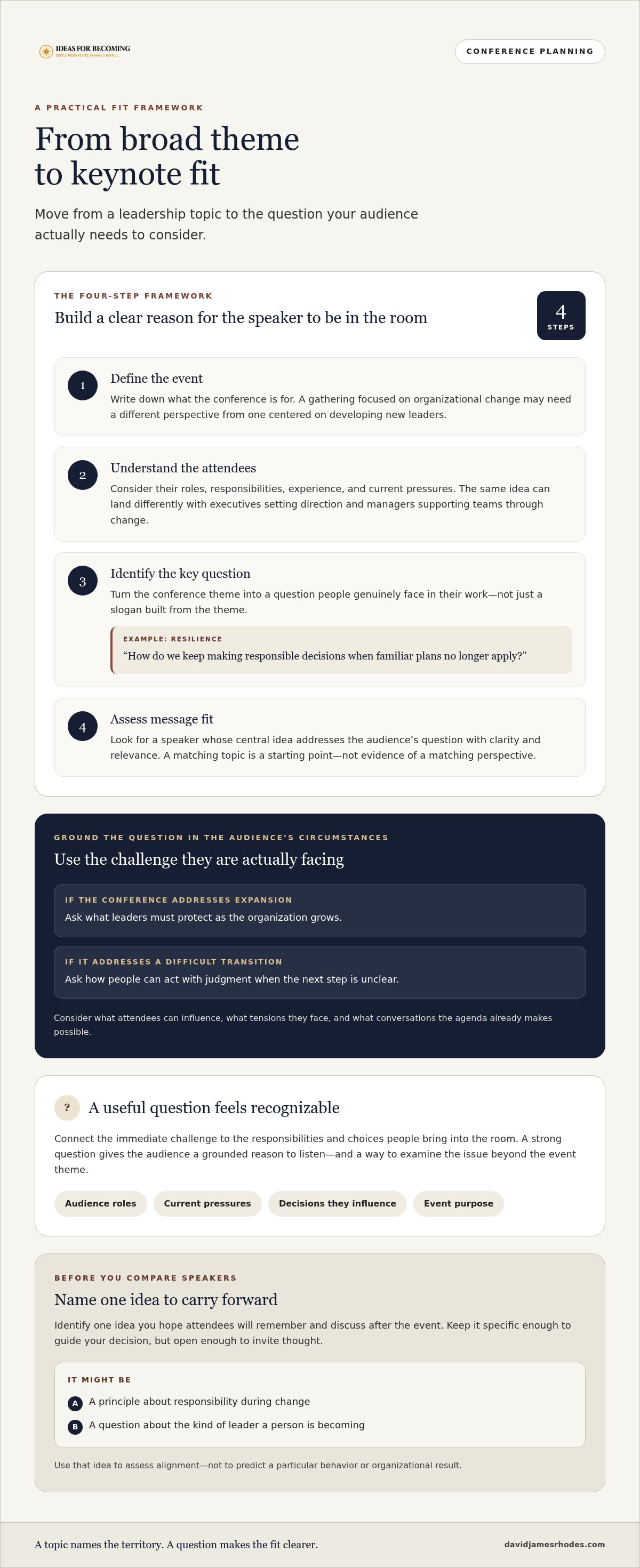
A strong match begins before you compare speaker profiles. It begins with the event itself. Use this four-step framework to move from a broad theme to a keynote with a clear reason to be in the room.
- Define the event. Write down what the conference is for. A gathering focused on organizational change may need a different perspective from one centered on developing new leaders.
- Understand the attendees. Consider their roles, responsibilities, experience, and current pressures. The same idea can land differently with executives setting direction and managers supporting teams through change.
- Identify the key question. Turn the theme into a question people genuinely face in their work. For example, “resilience” might become, “How do we keep making responsible decisions when familiar plans no longer apply?”
- Assess message fit. Look for a speaker whose central idea addresses that question with clarity and relevance. A matching topic is a starting point, not evidence of a matching perspective.
Then name one idea you hope attendees will remember and discuss after the event. Keep it specific enough to guide your decision, but open enough to invite thought. It might be a principle about responsibility during change or a question about the kind of leader a person is becoming. Use it to assess alignment, not to predict a particular behavior or organizational result.
How do you define the audience’s real leadership question?
Begin with the agenda and the circumstances around it. If the conference addresses expansion, ask what leaders must protect as the organization grows. If it addresses a difficult transition, ask how people can act with judgment when the next step is unclear. These questions connect an immediate challenge to broader concerns about identity and responsibility while keeping the work attendees must do in view.
A useful question should sound recognizable to the audience, not like a slogan built from the event theme. Consider what attendees can influence, what tensions they face, and what conversations the agenda already makes possible. That context keeps the question grounded.
How can a speaker’s perspective fit the event?
Look for a throughline between the speaker’s experience, the conference theme, and the audience’s question. David James Rhodes approaches leadership through identity, character, growth, and human becoming. His perspective connects leadership to more than techniques or corporate terminology. The question becomes not only what a leader must do, but who they are becoming through the choices they make.
For organizers considering a leadership speaker for conferences, listen for language that makes the central idea understandable without flattening its complexity. Explore David James Rhodes’s keynote perspective as you consider what kind of message fits your event. A clear fit gives the audience a thoughtful idea to examine in the context of its own responsibilities, without promising a particular outcome.
Leadership Keynote or Motivational Talk: What Should Organizers Compare?
The labels can overlap. A leadership keynote may inspire, and a motivational talk may offer useful reflection. The more revealing distinction is what holds the address together: its purpose, central idea, connection to the audience, and tone. Compare those elements with the work your conference needs the keynote to do.
| Criterion | What to look for | Why it matters |
|---|---|---|
| Purpose | A leadership keynote examines leadership choices, responsibilities, or challenges. A motivational talk often aims to renew energy or encourage action. | Clarifies the role the address should play in the event. |
| Central idea | A clear point that connects the talk’s themes rather than a collection of familiar advice. | Gives attendees something coherent to consider and discuss. |
| Audience connection | Examples and questions that relate to attendees’ work and circumstances. | Makes the message relevant without relying on industry jargon. |
| Tone | Consider whether the event calls for challenge, encouragement, reflection, or a thoughtful mix. | Helps the talk fit the room and the conference’s purpose. |
These are useful distinctions, not rigid categories. A keynote can leave people encouraged while asking them to think more carefully about how they lead. A motivational talk can also prompt serious reflection. Don’t assume that energy is shallow or that a measured tone is automatically meaningful. Look at the substance beneath the delivery.
What makes a leadership keynote feel relevant rather than generic?
Relevance comes from a distinct central idea and a clear connection between that idea and the audience’s concerns. A talk about character, for example, can explore what responsibility looks like when a decision is unpopular or circumstances change. Personal stories may give an idea texture, but stories alone don’t establish a fit. The speaker still needs to connect experience to the question the audience is there to consider.
How can a reflective keynote remain grounded in professional reality?
Pair questions of identity with decisions people recognize: how to respond when a plan fails, how to treat a team under pressure, or what responsibility means during change. Human becoming offers a perspective on leadership, not a proven organizational intervention. Reflection becomes useful when it meets the choices people actually face.
Reflection has a subject; abstraction has no place to land. That distinction can help organizers assess whether a philosophical keynote stays connected to professional life. David James Rhodes’s perspective brings leadership into conversation with identity, character, and the question, “Who are you becoming?” Explore David James Rhodes’s leadership perspective as one example of a keynote grounded in that question.
How to Prepare Your Conference for a Leadership Keynote
A well-matched keynote still needs context. Preparation helps the speaker understand who will be listening, why they have gathered, and how the address fits into the wider program. It doesn’t mean scripting the speech. It means giving the speaker enough information to address the real event, rather than an imagined audience.
Before the conference, prepare a concise briefing that covers:
- Audience profile: attendee roles, leadership responsibilities, and relevant differences in experience or perspective.
- Conference purpose: the event’s central question and the ideas organizers hope participants will consider.
- Current context: changes, pressures, or circumstances that shape the audience’s work.
- Program overview: the keynote’s place in the agenda and the themes other sessions will address.
- Tone and sensitivities: the kind of conversation the event calls for, plus any context that deserves care.
Keep the brief candid and useful. An audience profile should explain more than job titles. It might note that attendees are responsible for guiding teams through a period of change, or that the conference brings together people with different levels of authority. These details help a leadership speaker for conferences make thoughtful choices about language and examples without relying on jargon.
What should organizers communicate before the event?
Share the attendee roles, the event’s central question, and the wider program. Describe the tone the keynote should understand, whether the room calls for a direct challenge, a reflective address, or a balance of both. Include relevant boundaries or sensitivities so the speaker has context. The aim is to inform, not prescribe conclusions. A good brief leaves room for the speaker’s judgment and perspective.
It also helps to state what the address is not expected to do. A keynote can frame a question or offer a perspective. It shouldn’t be presented as a substitute for every conversation the organization needs to have, or as a guarantee of individual or business outcomes.
How can the keynote connect with the rest of the program?
Think about its relationship to the sessions around it. An opening keynote might introduce a question that later discussions examine from different angles. A closing address might help attendees reflect on ideas raised during the conference. Either way, share the agenda and themes of related sessions so the keynote has a meaningful place in the whole event.
For organizers exploring how leadership connects with life beyond a formal role, David James Rhodes’s leadership and life advisory work offers a related point of view. His approach considers leadership through identity, character, and responsibility. To explore how that perspective might serve your conference, inquire about David’s keynote speaking.
David James Rhodes: A Leadership Speaker for Conferences Exploring Human Becoming
David James Rhodes brings a perspective shaped by more than four decades of professional experience across 156 countries. He is an author, global executive, entrepreneur, founder, advisor, and keynote speaker. His experience includes leadership, international finance, entrepreneurship, behavioral health, and recovery. These experiences inform the questions he brings to leadership. They are personal and professional experience, not scientific proof or a guarantee of what an audience will take away.
For organizers considering a leadership speaker for conferences, the value of a speaker’s perspective lies not only in where they have worked, but in the idea they can bring into the room. David’s centers on human becoming: how identity, character, responsibility, and growth shape the way people lead.
What leadership themes can David bring to a conference?
Leadership can be discussed as more than a set of techniques. It is also expressed in how people use their influence, respond to pressure, and take responsibility for their choices. David’s perspective brings these questions together with human potential and personal growth. The emphasis is reflective and grounded, not generic motivational rhetoric.
The conference context matters. An audience working through change may be considering how to lead when familiar assumptions no longer hold. A gathering focused on leadership development may be ready to examine how character is formed through daily decisions. The subject can be shaped around the event’s concerns without relying on a fixed talk title or assuming every audience needs the same message.
How does The Way connect leadership with human becoming?
The Way is David’s philosophy of becoming. Its central idea is simple: the task is not always to find a perfect path, but to become someone capable of making a way forward. That idea speaks to people leading others, succeeding, changing direction, or questioning what comes next. Leadership is part of that larger work because each choice reflects and shapes the person making it.
The question “Who are you becoming?” can bring a broad conference theme down to a human scale. It invites attendees to consider not only what their roles demand, but how they want to meet those demands. Explore The Way’s perspective on becoming to understand the philosophy behind this approach.
A keynote can open a thoughtful conversation; it cannot promise what each person or organization will do afterward. If this perspective fits the question your conference is asking, start a conversation with David about a conference keynote.
Choose the Question Your Audience Will Carry Forward
The decision doesn’t end when the program is set. Consider what question you want attendees to carry into their next difficult conversation, decision, or moment of responsibility. A keynote can’t choose for them. It can create space to notice what their choices ask of them, and what kind of leader they want to become.
That is a more human measure of fit than a theme alone. A leadership speaker for conferences should bring an idea that belongs to your audience’s present, while leaving room for people to interpret it through their own roles and experiences. Make that purpose clear, then consider how the keynote can meet it.
Explore David James Rhodes’s keynote speaking and start a conversation about bringing his perspective on identity and becoming to your conference. Give the audience a question worth carrying forward, and trust them to meet it in their own way.
Frequently Asked Questions
How do I choose a leadership speaker for a conference?
Begin with the conference’s purpose, then consider what attendees are responsible for and what they’re facing. A leadership speaker for conferences should bring a perspective relevant to that setting, not simply a profile that matches a topic label. Compare how clearly each speaker expresses a central idea and whether their experience helps illuminate it. For example, a conference on succession may need a different lens from one addressing trust across teams.
What makes a good leadership keynote speaker?
A good leadership keynote speaker has a clear point of view and can make it understandable to the people in the room. Look for a message that connects leadership to real choices, such as how to share responsibility or respond when a decision is unpopular. A speaker’s experience can inform that perspective, but it isn’t scientific proof. Ask whether the keynote offers the audience a question worth considering beyond general encouragement.
Can a leadership speaker address both business performance and personal growth?
Yes. A keynote can connect professional responsibilities with the character and judgment people bring to their work. For example, a discussion of performance might also consider how leaders respond to setbacks or treat colleagues under pressure. The personal dimension should serve the conference’s purpose, not be added as a separate lesson. David James Rhodes’s perspective on human becoming invites people to consider who they are becoming as they lead and respond to change.
How far in advance should you secure a conference keynote speaker?
There’s no universal lead time. Timing depends on the event date, planning process, and speaker’s schedule. Start once you can describe the conference’s purpose and the kind of contribution you need. For instance, if the keynote must connect with a program under development, beginning early gives organizers more opportunity to align themes and share context. Avoid treating another event’s timeline as a reliable standard for your own.
What should conference organizers tell a leadership keynote speaker?
Give the speaker a concise picture of the event: who is attending, what the conference is for, and where the keynote sits in the program. Mention relevant pressures or sensitivities, such as a recent leadership transition or major organizational change, when they affect the audience’s perspective. If the event includes several departments, explain their different roles. Context helps a speaker address the room without prescribing what conclusions attendees should reach.
How is a leadership keynote different from a motivational talk?
The distinction depends on the actual address, since the labels can overlap. A leadership keynote usually focuses on leadership responsibilities or ideas, while a motivational talk may emphasize encouragement. Either can be thoughtful and relevant. Consider what the audience will hear, not just how the event listing categorizes the speaker. A talk intended to energize a team, for example, may still offer a serious perspective on responsibility and decision-making.
Can a conference keynote guarantee lasting changes in leadership behavior?
No. A keynote can present an idea or prompt reflection, but it can’t guarantee what people will do afterward. A leader may leave with a useful question, then return to a workplace with competing demands, established habits, and decisions that require ongoing attention. Treat promises of lasting change or measurable impact cautiously unless they’re supported by appropriate evidence. Assess the talk for its relevance and value, not as a guaranteed intervention.
Frequently Asked Questions
Related Articles

Best Leadership Guides for Executives: A Thoughtful 2026 Selection
Searching for the best leadership books for executives? Discover thoughtful leadership guides matched to real executive challenges, strategy, and character.

Executive Coach vs. Advisor: Which Kind of Support Does a Leader Need?
Choosing between an executive coach vs advisor? Learn how to match the right support to consequential leadership decisions and the leader you are becoming.

Executive Advisory on Purpose and Fulfillment: A More Human Way Forward
Seek executive advisory on purpose and fulfillment to align leadership choices with values and character. Discover who you are becoming beyond outward success.