
What if purpose in recovery isn’t something you discover all at once, but something you build through the choices you make today? Finding purpose in recovery can feel difficult when familiar routines have changed and the future seems too large to plan. You may feel pressure to find a passion, choose a new identity, or prove that your past no longer defines you. That pressure can make an ordinary next step seem insignificant.
But a meaningful life rarely arrives as one perfect calling. Purpose can take shape through keeping a commitment, repairing a relationship, contributing at home, or returning to an activity that matters. Small actions don’t erase hardship. They can help you build a life larger than a recovery label.
This article offers practical ways to explore what matters, take on manageable responsibility, and make room for meaningful activity without demanding certainty from yourself. It also considers how purpose can change over time and coexist with professional care. Recovery is not only about leaving something behind. It is also about asking, through the choices of each day, who you are becoming.
Key Takeaways
- Purpose in recovery can grow through direction, meaning, and contribution, without one perfect calling.
- Use values to guide small choices, then notice how repeated actions shape habits and identity.
- For finding purpose in recovery, try one meaningful next step rather than waiting for a passion or complete plan.
- Name a value, choose a manageable action, notice its effect, and adjust while keeping your treatment plan and trusted support in mind.
- Consider how the question “Who are you becoming?” can help you build meaning as your life and priorities change.
Finding Purpose in Recovery Starts Beyond the Immediate Crisis
When life has been organized around getting through the next hour, day, or difficult decision, questions about the future may arise only after some stability returns. That shift can feel unsettling. A crisis often gives life an urgent structure: appointments to keep, risks to manage, immediate needs to meet. When the pressure eases, there may be room to ask what comes next, but no clear answer waiting.
Recovery purpose is a developing sense of direction, meaning, and contribution, built through how you live, not a single career, passion, or achievement. It can include work, but it can also take shape in relationships, care for others, learning, responsibility, or the way you meet ordinary obligations. Finding purpose in recovery doesn’t require a perfect plan. It begins by making room for a life that matters to you.
Treatment and professional support can help create safety and stability. Reflection on purpose addresses a different question: how might you build meaning as life continues to change? These concerns can exist alongside one another. The recovery approach describes meaning and purpose as part of a broader view of recovery, rather than reducing recovery to the immediate management of symptoms.
Why direction can feel unclear after a major change
Some familiar roles or routines may no longer fit. A person who once measured the day by work, family responsibilities, or social habits may find that those structures have shifted. Another person may still have the same responsibilities but experience them differently. There is no single pattern.
Uncertainty isn’t proof that recovery is failing. It doesn’t mean you lack ambition or should already know what your future holds. It may simply mean that the old map no longer describes the life in front of you. Purpose can help orient choices, but it won’t automatically remove grief, resolve practical difficulties, or make hard feelings disappear. Those realities deserve attention in their own right.
Purpose is not a substitute for treatment or support
Reflection on meaning does not replace appropriate clinical care, recovery support, medication, therapy, or help in a crisis. Each has a different role. Medical and therapeutic care can address health needs; recovery support can offer connection and structure; reflection on purpose can help you consider what you want your days and relationships to stand for.
If you’re in immediate danger or need urgent help, seek current guidance from official emergency or crisis-support services. This article cannot assess an individual crisis or provide clinical advice. If you’re receiving care, treat questions about purpose as a conversation that can complement your plan, not a reason to set it aside.
You don’t have to solve your whole life before taking part in it. For now, the question may be smaller: what deserves care today, and what kind of person do you want your next choice to express?
How Purpose in Recovery Takes Shape Through Identity and Action
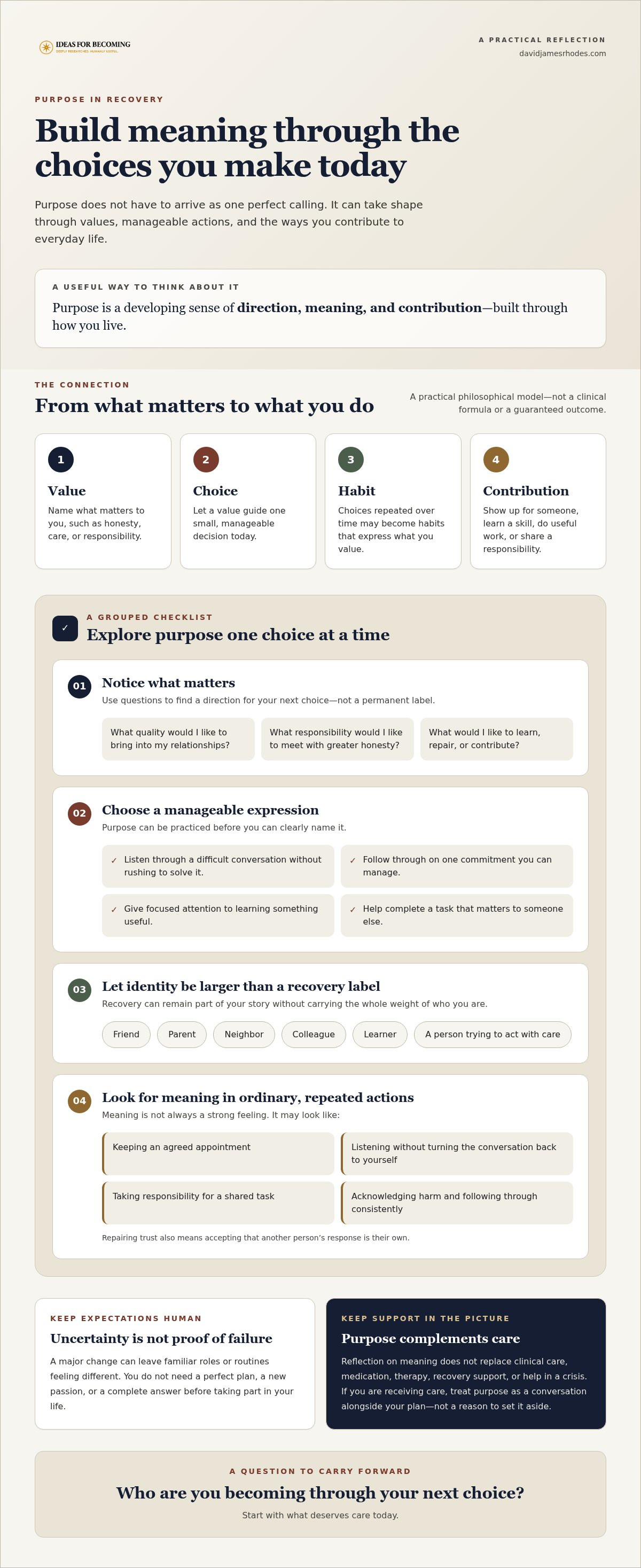
Purpose can become clearer through the connection between values and action. A value, such as honesty, care, or responsibility, can guide a choice. Choices repeated over time may become habits. Those actions can express contribution: showing up for a family member, learning a skill, doing useful work, or taking responsibility for a shared task.
This is a practical philosophical model, not a clinical formula. It cannot guarantee a particular outcome, and it doesn’t replace professional guidance. It offers a way to notice what matters and give it expression in daily life. SAMHSA’s perspective on recovery also recognizes that recovery can involve building a meaningful life alongside health and support.
Purpose can be practiced before it is clearly named. You may not yet know what you want your life to stand for in broad terms. You can still act with patience in one conversation, follow through on one commitment, or give focused attention to learning something useful. The action can come before the larger description.
Identity can grow beyond a recovery label
Recovery may remain an important part of your story. It can hold truths about what you’ve faced and the work you continue to do. But it need not carry the whole weight of your identity. You are also a friend, parent, neighbor, colleague, learner, or simply a person trying to act with care. The past is not erased, but the future is not limited to it.
Instead of searching for a new label to adopt, consider questions that point toward practice:
- What quality would I like to bring into my relationships?
- What responsibility would I like to meet with greater honesty?
- What would I like to learn, repair, or contribute?
Your answers don’t need to define you permanently. They can give direction to your next choice. For example, if you choose patience, you might listen through a difficult conversation without rushing to solve it. If you choose responsibility, you might follow through on one manageable commitment.
Meaning can be ordinary, relational, and repeated
Meaning is not always a strong feeling. Sometimes it looks like keeping an agreed appointment, listening without turning the conversation back to yourself, or helping complete a task that matters to someone else. Repairing trust may involve acknowledging harm and following through consistently, while accepting that another person’s response is their own.
These actions can feel plain. That doesn’t make them empty. Work, study, care, service, and shared responsibilities can all express what you value, whether or not they feel inspiring that day. Repetition gives you more chances to take responsibility, but repetition alone doesn’t guarantee change. Circumstances, support, and choices matter too.
For finding purpose in recovery, the useful question may not be, “What is my one calling?” It may be, “What value can I put into action here?” That question leaves room for growth. Who are you becoming through the way you meet the life in front of you?
Finding Purpose in Recovery Without Waiting for a Passion or Perfect Plan
The idea of purpose can become another demand: choose the right career, discover a consuming passion, or produce an impressive account of how your life changed. That fixed-destination model asks you to know the answer before taking a step. A more flexible view leaves room to learn through choices, relationships, and changing circumstances.
| Must know my calling | Can test one meaningful next step |
|---|---|
| I need a complete plan before I begin. | I can try one action that reflects what matters to me. |
| Purpose must become my career or achievement. | Purpose can also live in care, learning, responsibility, or connection. |
| If my interests change, I have failed. | New experience may change what feels important. |
A new career or public achievement may matter to some people. Neither is a requirement. Meaning can be present in private commitments and relationships that no one applauds. Interests and direction can also change. There is no universal timetable for knowing what comes next, and uncertainty itself is not a verdict on your capacity to build a meaningful life.
When passion is absent, start with what matters
You don’t need to feel passionate to begin exploring. Ask what you would like to protect, which responsibilities deserve your attention, or whose presence matters in your life. Recall a small moment that felt worthwhile, even if it wasn’t exciting. Notice what draws your curiosity or what you might be willing to try, without requiring a hobby to become a vocation.
Perhaps you’re curious about preparing a meal, learning a practical skill, spending time outdoors, or reconnecting with someone. Let these be experiments, not tests of your worth. Grief, fatigue, and uncertainty may also be present. You don’t need to diagnose them or force them into a lesson before considering what matters to you.
Purpose does not mean recovery is complete
Meaning and ongoing recovery support can coexist. Caring about a relationship or making plans doesn’t prove sobriety, readiness, or clinical progress. Nor does difficulty identifying a purpose mean recovery is failing. These are not measures that can determine someone’s health or future.
David James Rhodes’s perspective, shaped by experience in leadership, behavioral health, recovery, and rebuilding is that a person can keep becoming through life’s changes. That is a philosophical view, not a clinical finding or a promise of an outcome. The practical point is modest: you can explore what matters while continuing the care and support that serve you. Purpose isn’t a certificate of completion. It can be one thread in a life still being rebuilt.
Steps for Exploring Purpose in Recovery One Day at a Time
Purpose can feel too large to solve as a life question. Make it smaller. Treat the next choice as an experiment, not a verdict on who you are or where you’ll end up. This four-step practice can help you explore what matters without requiring a career change, a public declaration, or a perfect routine.
- Name a value. Choose a quality you want to express today, such as honesty, care, learning, patience, or responsibility. Keep it simple. You’re choosing a direction for one day, not defining yourself forever.
- Choose one small action. Let the value suggest something practical. Learning might mean reading a few pages or asking a question. Care might mean checking in with someone. Responsibility could mean writing down an appointment or completing one manageable task.
- Notice its effect. Afterward, pause. What felt meaningful? What was difficult? Did the action connect you with someone, clarify a priority, or feel worth repeating? You don’t need to feel inspired for the action to teach you something.
- Adjust. Keep what seems useful, change what doesn’t fit, or choose a smaller step. If an action creates strain or conflicts with your care plan, pause and consider another approach with support.
A small action can test a direction without asking you to settle your whole life. It gives you information, not a final answer. Keep a short note on paper or in your phone: the value you chose, what you tried, and what you noticed. Over time, these observations can help you recognize what feels meaningful and what may need to change.
Turn a value into one manageable action
Make the action specific enough to do, but flexible enough to suit your circumstances. If honesty matters, you might prepare for one truthful conversation or simply write down what you need to acknowledge. If care matters, you could make a meal for yourself or offer practical help to someone else. If learning matters, choose one question to explore. There is no single routine that fits everyone.
Some days, your note may say, “This mattered.” Other days, it may say, “That was difficult,” or, “I would try something different.” Each response is useful. Don’t turn the exercise into a scorecard. The purpose is to notice, not to judge yourself.
Use relationships and support without handing over agency
You can adapt this practice to your treatment plan and existing recovery support. A trusted person or support professional may help you think through whether an action is realistic, or notice a pattern you’ve missed. Their perspective can inform your choice without making the choice for you.
If you’re unsure whether a goal fits your health or care needs, discuss it with the professional supporting you. Finding purpose in recovery can include asking for guidance while remaining an active participant in your own decisions.
For a broader perspective on values, action, and becoming, explore David James Rhodes’s ideas on becoming.
The Way: Connecting Recovery Purpose to the Person You Are Becoming
The practical steps in this article can help you explore what matters through ordinary choices. David James Rhodes’s philosophy, The Way, offers a broader lens for that work. Its central idea is simple: “The Way is not something you find. It is someone you become.” From this perspective, purpose is less a final destination than a way of meeting the life in front of you.
Rhodes’s perspective is shaped by more than four decades of experience across 156 countries, including leadership, behavioral health, recovery, adversity, and rebuilding. That experience informs his philosophy. It isn’t scientific evidence or clinical advice, and The Way doesn’t replace treatment or support. It asks a different question: as you make choices and build relationships, what kind of person are you becoming?
Recovery is one application of human becoming
Recovery belongs to a larger human story. People grow, take responsibility, repair relationships, change direction, and search for meaning at many points in life. Recovery can bring those questions into sharper focus, but it doesn’t contain them all. The Way is not exclusively about recovery, grief, or treatment. It is a philosophy of becoming for people beginning, rebuilding, succeeding, struggling, or wondering what comes next.
This wider view can matter when a recovery identity feels too small to hold the whole of who you are. Recovery may remain an important part of your story without becoming its only subject. There is room for the person learning to be dependable, the friend trying to listen well, the parent finding a steadier presence, or the learner returning to a subject that once held their interest.
None of these roles needs to become a grand declaration. They can begin with a private choice, then deepen through attention, responsibility, and connection. The point is not to prove that you have changed or reached a final state. It is to remain involved in your own becoming, with appropriate care and support alongside you.
A useful question for the next chapter
There may be days when the future feels indistinct. You don’t have to force an answer from that uncertainty. Let the question stay open while you take the next manageable step. Rhodes explores related questions of identity and rebuilding in Navigating Life After Adversity: The Process of Human Becoming, connecting adversity with the larger work of deciding how to live afterward.
For readers who want to explore this philosophy further, explore The Way, David James Rhodes’s guide to human becoming. The Way was released on September 15, 2026, and is available. It offers a broader reflection on character, courage, action, relationships, purpose, and the person each of us is becoming.
So take the question with you, without demanding an immediate answer: Who are you becoming?
Let the Next Choice Open a Way Forward
Purpose doesn’t have to arrive as certainty. You may still be learning what matters, what has changed, and what you want to carry forward. That unfinishedness is not a reason to put your life on hold. A direction can emerge gradually as you meet each day with attention and leave room to revise your understanding.
Finding purpose in recovery is not a demand to turn hardship into a grand story. It is a chance to shape what comes next without denying what came before. Some choices may feel clear; others may teach you what does not fit. Both can help you move with greater honesty and care.
The Way offers a wider perspective on this ongoing work of becoming. If you want to explore how character, action, relationships, and meaning can inform the way forward, explore The Way.
You don’t need the whole map today. Let the next step be real, manageable, and yours. A meaningful life can take shape one choice at a time.
Frequently Asked Questions
Is it normal to feel unsure of your purpose in recovery?
Yes, uncertainty about purpose can be part of adjusting to changed routines, relationships, or expectations. It doesn’t tell you whether recovery is succeeding, and you don’t need to compare your pace with someone else’s. Set aside the demand for a complete answer for now. Notice what you want to protect, which responsibility feels manageable, or what kind of support would help you consider your next step.
How do you find purpose when you have lost interest in everything?
Start by lowering the pressure to feel inspired. Choose a basic, manageable action connected to care or connection, such as sitting with someone you trust or tending to one ordinary need. If losing interest persists, worsens, or affects daily life, tell a healthcare professional or support person; they can help assess what may be contributing. Finding purpose in recovery shouldn’t mean forcing yourself to feel better or going without care.
Can your sense of purpose change during recovery?
Yes. Relationships, health, responsibilities, and interests can shift, so what feels meaningful may shift too. A direction that once centered on work might later include family, learning, or service. You don’t have to treat that change as inconsistency. Review your priorities from time to time, and revise a goal if circumstances or your needs have changed. A past purpose can still have mattered, even if it no longer fits.
Does finding purpose in recovery mean choosing a new career?
No. A career change is one possibility, not a requirement or a measure of purpose. Meaning might come from being a dependable colleague, caring for family, learning something for its own sake, or contributing to a shared task. If work is an important goal, explore it gradually. You might identify one skill to strengthen or speak with someone in the field before making a major decision.
What can family members do to support someone finding purpose in recovery?
Ask what kind of support would feel useful, then listen without turning the conversation into a plan you control. Offer practical choices, such as joining an activity or helping with a task, while respecting a “no.” Recognize effort without demanding visible progress. Families can also seek guidance for their own boundaries and wellbeing. Support is most respectful when it leaves room for the person to decide what matters to them.
Does having a purpose replace treatment or recovery support?
No. A sense of purpose does not replace medical care, therapy, medication, or recovery support when those are needed. It also cannot establish whether someone is safe or clinically ready for a change. Meaningful goals can be discussed alongside an existing care plan. If a goal affects treatment, health, or safety, raise it with the professional involved so reflection and appropriate care can work in parallel.
Frequently Asked Questions
Related Articles

Best Leadership Guides for Executives: A Thoughtful 2026 Selection
Searching for the best leadership books for executives? Discover thoughtful leadership guides matched to real executive challenges, strategy, and character.

Executive Coach vs. Advisor: Which Kind of Support Does a Leader Need?
Choosing between an executive coach vs advisor? Learn how to match the right support to consequential leadership decisions and the leader you are becoming.

Executive Advisory on Purpose and Fulfillment: A More Human Way Forward
Seek executive advisory on purpose and fulfillment to align leadership choices with values and character. Discover who you are becoming beyond outward success.