
The boardroom often demands a finished product. It asks for the expert who has already arrived. This expectation is a fiction. It leads to isolation and eventual stagnation. True leadership requires a different posture. It requires a growth mindset for executives that is rooted in the reality of human becoming. You've likely felt the pressure to appear perfect. You've sat in the silence of high-stakes decisions, wondering if your achievements have outpaced your internal evolution. It's a heavy, common weight.
We'll move beyond corporate jargon to discover a way of leading grounded in who you're actually becoming. This article provides a framework that integrates your personal growth with professional excellence. You'll learn to view setbacks not as failures but as essential data points in your development. We'll explore how this philosophy, which I discuss further in my book, The Way, can help you lead with a quiet, steady authority. It's time to stop performing and start evolving.
Key Takeaways
- Reframe growth as a continuous process of human becoming rather than a corporate tactic for scaling results.
- Confront the executive paradox where your past successes can become a cage that limits your future capacity for change.
- Cultivate a growth mindset for executives that draws on global insights to transform setbacks into essential data for your evolution.
- Discover how the daily practice of reflection moves you toward a leadership style defined by quiet authority and human integration.
Redefining Growth Mindset: From Corporate Tool to Human Becoming
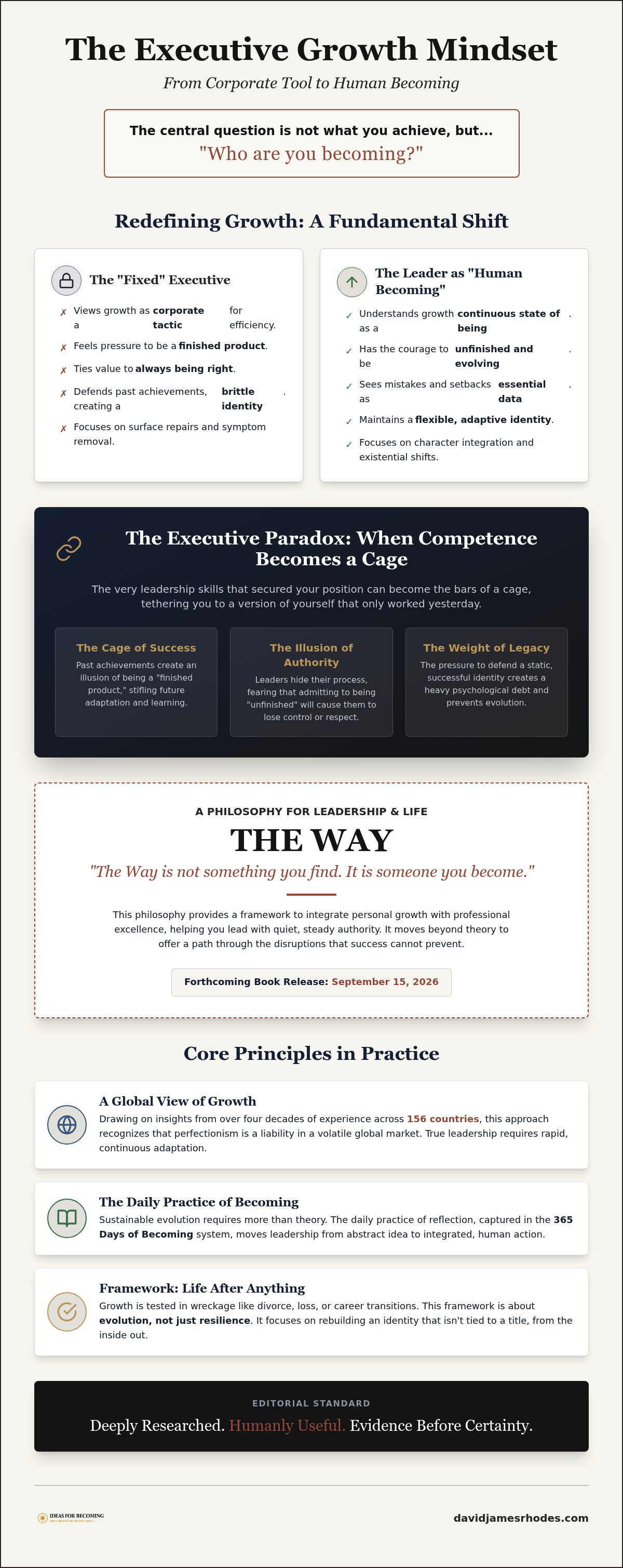
Growth is often sold as a lever for efficiency. In the corporate theater, it's a metric for scaling talent or optimizing output. But for those at the helm, a growth mindset is not a tactic. It is a state of being. It's the quiet admission that you're not yet a finished product. This is difficult for the executive who's spent decades being rewarded for having the right answer. The boardroom demands certainty. It rewards the expert. Yet, this very expertise can become a cage. When you stop becoming, you start decaying.
High-stakes leadership often punishes the vulnerability required for evolution. It favors the mask of the all-knowing leader. But the world is too volatile for masks. A growth mindset for executives requires the courage to be unfinished. It shifts the focus from what you're doing to who you're becoming. This is the heartbeat of my philosophy, "The Way,",. It asks a singular, heavy question: Who are you becoming through your leadership?
The Limits of the 'Fixed' Executive
The pressure to be an expert creates a brittle identity. When your value is tied to being right, any mistake feels like an existential threat. You become static. You defend your past achievements rather than navigating your future potential. This is the trap of the fixed ego. It leads to a leadership style that's defensive and isolated. In a global market, perfectionism is a liability. It prevents the rapid adaptation required to survive. Leading from a place of "having arrived" is a hallucination. There is no arrival. There is only the next step in the process of becoming.
Mindset as an Existential Choice
True growth begins with a somber recognition of your own limitations. This isn't a lack of confidence; it's a presence of reality. Many leaders focus on symptom removal. They fix their time management or their communication style. These are surface repairs. Sustainable evolution requires more than a temporary shift in behavior. This existential shift is the foundation of a growth mindset for executives who seek more than just quarterly gains. Human Becoming is a continuous process of character integration.
The Executive Paradox: Why Competence Can Be a Cage
Success is a seductive teacher. It convinces you that you've finished the work of becoming. If you've reached the C-suite, why change? This is the executive paradox. The very leadership skills that secured your current position can become the bars of your cage. They tether you to a version of yourself that worked yesterday. But yesterday is gone. Global markets don't care about your past credentials; they care about your current capacity to adapt.
A growth mindset for executives isn't about acquiring new tools. It's about shedding old certainties. It's about the weight of legacy. We fear that if we admit to being unfinished, we'll lose our authority. We believe we must be the finished product. In reality, the most effective leaders are those who remain in a state of "Human Becoming." They don't go around disruption; they go through it. This is the core of "The Way," my forthcoming philosophy,. It provides a path through the professional and personal disruptions that success cannot prevent. If you find yourself questioning the weight of your own success, my leadership advisory services offer a space for these deeper conversations.
The Illusion of the Finished Leader
Executives often hide their process. They project a finished persona to maintain control. This creates a heavy psychological debt. You're forced to defend a static identity while the world around you evolves. It's exhausting. It's also dangerous. If you can't be seen as "becoming," you can't be seen as learning. This brittle identity eventually cracks under the pressure of high-stakes reality. Navigating this integration of life and work is the focus of my Leadership Advisory work, where we move beyond the mask of the finished leader.
Navigating Life After Anything
True growth is tested in the wreckage. Divorce. Loss. The sudden end of a long career. These aren't just professional setbacks; they're existential disruptions. A growth mindset for executives allows you to rebuild an identity that isn't tied to a title. It's not about "resilience," which often implies bouncing back to who you were. It's about recovery and evolution. It's about who you become after the storm. Character isn't found in the title you hold, but in how you navigate the transition when the title is gone. My framework for Life After Anything centers on this raw reality. It's a somber, intentional process of rebuilding from the inside out.
Lessons from 156 Countries: A Global View of Growth
Four decades of global leadership across 156 countries teach a specific kind of humility. I've sat in boardrooms within major financial hubs and marketplaces in developing nations. The geography changes. The human struggle remains constant. Whether navigating international finance or the complexities of behavioral health, the core challenge is identity. A growth mindset for executives isn't a western corporate luxury. It's a survival mechanism for a world that refuses to stay still. It requires the quiet authority of someone who is still becoming.
Different cultures view the process of becoming through varied lenses. Some prize the collective evolution of the group. Others focus on the solitary refinement of the individual character. Yet, the common thread is adversity. Growth is rarely the result of comfort. It's the product of navigating the unknown without the baggage of ego. To lead globally, you must be willing to be wrong. You must be willing to learn from the very environments you seek to influence. In my experience, the most resilient leaders aren't those with the most data. They're those with the most integrated character. The struggle is universal.
Adversity as a Global Teacher
Leadership is often found in the most unexpected places. I've seen quiet authority in those who have lost everything and were forced to rebuild. They didn't just "know the way" through a map or a manual. They were "on the way." They lived the process. This is a distinction of presence. It's the difference between a theorist and a practitioner. Stories of leadership aren't limited to the Fortune 500. They're written in the resilience of communities navigating transition. Global volatility demands an internal steadying force that remains unmoved by the shifting winds of external chaos. When the world outside is in flux, the only constant is the character you've integrated through your experiences.
Leading from the Inside Out
The boundary between life and work is a fiction. It's a single, unified journey of human becoming. Your internal state isn't a private matter. It's the primary architect of your organization's culture. If you're stagnant, the company follows. If you're brittle, the team breaks. A growth mindset for executives requires the courage to look inward before looking at the balance sheet. This internal navigation is the focus of my Executive Advisory Services, where we explore the intersection of high-stakes performance and the raw human experience. We don't just solve problems. We integrate the person solving them. It's a process of leading from the inside out, ensuring your evolution matches the scale of your responsibility.
The Daily Practice of Becoming: Moving Beyond Theory
Theory is a comfortable place for the intellect. It allows you to agree with the concept of a growth mindset for executives without ever changing your life. True evolution requires more than intellectual consent. It requires embodiment. This happens in the quiet, often inconvenient moments between meetings and high-stakes decisions. It's a daily practice. Without it, your identity remains static, anchored to past successes that no longer serve the current reality. You don't find a new mindset; you build it through the repetitive work of who you're becoming.
Integrating this discipline into a high-pressure schedule isn't about finding more time. It's about changing the quality of the time you already have. My work in 365 Days of Becoming is designed for this specific reality. It's a methodical approach to breaking the stasis of a fixed identity. You don't need a retreat to evolve. You need a consistent, somber engagement with your own process. This is how you move from intellectual agreement to a life that's actually different. It's the difference between reading a map and walking the path.
The Discipline of the Question
The executive mind is trained for the declarative. You state facts. You issue directives. You project certainty. To sustain a growth mindset, you must learn the discipline of the question. This means replacing certainty with curious, open-ended inquiry. In the middle of a crisis, the most powerful tool isn't a solution. It's the question: Who am I becoming in this moment? This isn't academic. It's a practical way to anchor yourself when the external world is in flux. It forces a pause. It allows for a response rather than a reflexive reaction. It turns every challenge into a data point for your evolution.
Sustainable Growth vs. Radical Transformation
We're often sold the myth of the sudden epiphany. We wait for a single moment to change everything. In reality, transformation is slow. It's built through time and repetition. This is especially true in the context of recovery or rebuilding after a major disruption. You must stabilize before you can evolve. A short treatment episode or a single workshop cannot build a sustainable life. It takes daily, intentional effort. This steady work prepares you for the forthcoming release of The Way on September 15, 2026. It ensures that when the philosophy meets your reality, you have the character to hold it. If you're ready to move beyond theory, you can explore my leadership and life advisory services to begin your own practice of becoming.
The Way: Identity as a Journey, Not a Destination
Growth is not a metric. It isn't a quarterly target to be hit or a performance review to be survived. For the leader who understands the reality of high-stakes environments, growth is a way of being. It's an orientation toward the truth. A growth mindset for executives moves beyond the superficial desire to scale a business. It enters the somber territory of scaling the self. This is the shift from doing to becoming. It's the recognition that your character is the only asset that doesn't depreciate in a volatile market.
This philosophy is the foundation of my book, The Way,. It isn't a manual for success. It's an exploration of the quiet authority that comes when you stop trying to arrive. I've spent four decades across 156 countries witnessing the difference between those who perform and those who evolve. The performers eventually break. The evolvers endure. I offer myself as a guide for this specific, challenging exploration of identity. It's a path for those who are willing to embrace the weight of their own becoming.
The Way is Someone You Become
You won't find the way on a map. You build it through the integration of your experiences. There is a sharp distinction between professional performance and human potential. Performance is what you do for the boardroom. Potential is who you are when the lights go down. A growth mindset for executives requires you to bridge this gap. It asks you to stop hiding behind your title. The Way is not something you find; it's someone you become. It's the slow, deliberate work of character construction. Who are you becoming when no one is watching? That's the only question that matters.
Beginning the Process
The process begins with an admission. You are unfinished. There is a somber dignity in this state. It isn't a sign of weakness; it's a sign of life. If you're ready to move beyond the fiction of the finished leader, I invite you to explore my work. My keynote speaking and leadership advisory services are designed to spark these internal conversations. You can engage with the daily practice in 365 Days of Becoming or navigate the wreckage of disruption through Life After Anything. These are different doors into the same central question of identity. Embrace the quiet authority of your own evolution. The work is never done. That's the beauty of it.
The Courage to Remain Unfinished
Leadership is often a lonely performance of perfection. We've explored how a growth mindset for executives shifts the focus from achieving a static state of excellence to the continuous, somber process of human becoming. It's about moving beyond the executive paradox where your past successes become a barrier to your future evolution. True authority doesn't come from having all the answers. It comes from the willingness to stay curious in the face of high-stakes reality.
This perspective is shaped by four decades of global executive experience across 156 countries. It's a philosophy that bridges the gap between professional performance and the raw, human reality of recovery and meaning. As you navigate your own transitions, prepare for the release of The Way: Navigating the Process of Human Becoming on September 15, 2026. The question is no longer what you've achieved, but who you're becoming. There's a steady dignity in the unfinished work of a leader. You don't have to be finished to be effective. You just have to be willing to begin.
Frequently Asked Questions
What is the difference between a growth mindset and simple resilience for executives?
Resilience is the capacity to withstand pressure and return to a baseline. It is a defensive posture. A growth mindset for executives is an offensive, evolutionary state. It is the process of becoming something new through struggle. While resilience aims for restoration, my philosophy focuses on transformation. You don't just return to who you were; you integrate the experience to become who you are capable of being. It's a shift from surviving to evolving.
Can an executive with a fixed mindset truly change after decades of success?
Success is often the greatest barrier to evolution. Decades of achievement can create a brittle identity that fears change. However, change is always possible when you recognize that your past credentials are not your current potential. It requires the courage to be unfinished. This shift isn't about learning new skills; it's about unlearning the fiction that you've arrived. Transformation begins the moment you prioritize your character over your reputation.
How does 'The Way' philosophy differ from standard leadership coaching?
Standard coaching often focuses on skill acquisition and performance metrics. It treats the leader as a machine to be optimized. The Way is a philosophy of identity. It addresses the person behind the performance. It asks the central question: "Who are you becoming?" While coaching might fix a specific behavior, this framework integrates your entire life journey. It bridges the gap between your professional achievements and your raw human experience.
Is a growth mindset compatible with the need for decisive leadership?
Decisiveness is often mistaken for certainty. A growth mindset for executives allows you to make firm decisions without the illusion of being all-knowing. You act on the best evidence available while remaining open to new data. This isn't weakness; it's high-stakes reality. True authority doesn't need the mask of perfection. It thrives on the ability to pivot when the world shifts. Leading with quiet confidence means trusting your process more than your ego.
How can I practice a growth mindset when facing a major career setback or loss?
Rebuilding after a loss requires a focus on the principles in my book, Life After Anything. You must view the setback as essential data rather than a final failure. It's an opportunity to detach your identity from your title or your previous successes. This is a somber, intentional process. You don't ignore the pain; you use it as the foundation for your next evolution. Recovery is larger than just removing symptoms.
Why does David James Rhodes focus on 156 countries in his leadership advisory?
Experience across 156 countries provides a global perspective on the human condition. It reveals that struggle and the need for meaning are universal. This breadth of exposure prevents my leadership advisory from becoming narrow or academic. It grounds the philosophy of Human Becoming in high-stakes, global reality. I've seen quiet authority in every corner of the world. These four decades of experience ensure the insights I offer are deeply researched and humanly useful.
What happens if an executive's growth mindset conflicts with a rigid corporate culture?
A leader's internal state is the primary architect of organizational culture. If the corporate environment is rigid, your personal evolution serves as a steadying force. You don't have to shout to be heard. Your quiet authority creates a space for others to begin their own process of becoming. While you cannot always control the system, you are entirely responsible for the character you bring into it. Your growth mindset becomes a catalyst for broader change.
How can '365 Days of Becoming' help a busy leader who has no time for reflection?
Reflection is often viewed as a luxury for those with empty schedules. 365 Days of Becoming reframes it as a necessary daily rhythm. It's designed for the high-pressure reality of executive life. You don't need a retreat to evolve; you need a consistent engagement with the right questions. This daily practice integrates into the margins of your day. It breaks the stasis of a fixed identity by forcing a brief, intentional pause in the chaos.
Frequently Asked Questions
Related Articles

Best Leadership Guides for Executives: A Thoughtful 2026 Selection
Searching for the best leadership books for executives? Discover thoughtful leadership guides matched to real executive challenges, strategy, and character.
Executive Coach vs. Advisor: Which Kind of Support Does a Leader Need?
Choosing between an executive coach vs advisor? Learn how to match the right support to consequential leadership decisions and the leader you are becoming.

Executive Advisory on Purpose and Fulfillment: A More Human Way Forward
Seek executive advisory on purpose and fulfillment to align leadership choices with values and character. Discover who you are becoming beyond outward success.