
Reinvention isn’t a reset. It is becoming made visible through choices. A speaker on the journey of personal reinvention should understand that change rarely arrives as a clean break. It can unsettle identity, test old beliefs, and ask more of a person than a burst of inspiration can provide.
That’s why choosing a speaker is not simply a matter of finding a compelling story. The message must fit your audience, respect the difficulty of change, and leave people with something they can carry into daily life. You need a voice with experience and perspective, not just a polished account of overcoming adversity.
This guide offers a practical way to assess that fit: clarify what reinvention means for your audience, look for honesty and substance in a speaker’s story, and consider whether their ideas can support reflection beyond the event. David James Rhodes brings a perspective shaped by more than four decades across 156 countries. His work begins with a question at the heart of Human Becoming: Who are you becoming? The right keynote can make room for that question, and help an audience take it seriously.
Key Takeaways
- Define what reinvention means for your audience before you evaluate potential speakers. Change can involve identity, direction, or conduct without erasing the past.
- Assess a Speaker on the journey of personal reinvention for relevant experience, a coherent philosophy, audience fit, and honest boundaries around evidence.
- Compare speakers by the usefulness of their message, not the intensity of the moment. Look for ideas that can inform real choices and responsibilities after the event.
- Start your selection process with the event’s purpose, then prepare questions about the speaker’s perspective, experience, and relevance to your audience.
- Consider how David James Rhodes’s Human Becoming philosophy frames reinvention as ongoing change, guided by the question, “Who are you becoming?”
What a Speaker on Personal Reinvention Should Help an Audience Understand
Before choosing a voice, decide what reinvention means in this room. A leadership team facing a change in direction may need to examine its habits and responsibilities. A community rebuilding after disruption may need language for uncertainty and a way to consider what comes next. The subject should begin with the audience’s actual circumstances, not with an abstract promise that anyone can become someone entirely new.
Personal reinvention is the ongoing reconsideration of how you understand yourself and how you act, while carrying the past into the choices ahead. This is a philosophical definition, not a research finding or a promise of a particular outcome. It leaves room for complexity. Change can involve identity, direction, relationships, or conduct, and it does not require denying what came before.
What does personal reinvention mean in a keynote?
A useful keynote treats change as lived experience, not a performance of having overcome everything. A career change may alter someone’s work without changing how they see themselves or meet their responsibilities. A moving story may stir an audience without helping them reflect once the event ends. Reinvention asks a deeper question: what choices, relationships, and responsibilities are shaping who a person is becoming?
The topic sits within a wider tradition of personal development, a broad term for approaches to developing a person’s capabilities. That context can help clarify the subject, but it does not establish that one speaker’s philosophy is proven or that change follows a single path. A responsible speaker makes that distinction clear.
Which audiences may be considering a reinvention speaker?
Leaders, teams, and communities may consider this subject during a period of change. The event’s purpose should determine its emphasis. Is the audience looking for time to reflect, shared language for a difficult transition, or practical direction for decisions already in front of them? These are different needs. A speaker may offer perspective, but the organizer should not assume one keynote will resolve every underlying concern.
Let the audience define the question
Before evaluating speakers, write down what the audience already understands and what remains unresolved. For example:
- Reflection: What assumptions about identity or success may need reconsideration?
- Shared language: What change is the audience trying to describe honestly?
- Practical direction: What decisions or responsibilities should the message help people examine?
A Speaker on the journey of personal reinvention is a stronger fit when their perspective meets the event’s purpose without simplifying the audience’s reality. The measure is not how dramatically they describe change. It is whether their ideas help people see the choices before them more clearly.
How to Assess a Reinvention Speaker’s Experience, Philosophy, and Substance
A strong story can hold attention. It cannot, by itself, establish that a speaker is right for your audience. Assess substance through four connected questions: Does the speaker have relevant experience? Can they explain a coherent philosophy? Does that perspective fit the event’s purpose? And do they distinguish personal insight from claims that require evidence?
Substance is a clear point of view, grounded in relevant experience and honest about what it can’t prove. This is a better measure than polished delivery or promises of lasting change. A Speaker on the journey of personal reinvention should be able to explain what their perspective offers, and where it ends.
What evidence of experience should event organizers consider?
Look for a meaningful connection between the speaker’s experience and the questions your audience faces. A long career or impressive title may offer context, but neither automatically makes a message useful. Ask what the speaker has observed, what responsibilities have shaped their perspective, and how those experiences relate to the event’s subject.
David James Rhodes is an author, global executive, entrepreneur, and advisor whose experience spans more than four decades across 156 countries, including international finance, leadership, entrepreneurship, and behavioral health. That background provides context for his perspective. It isn’t scientific proof. Organizers should look for the same distinction in any speaker: experience can inform an idea, but it doesn’t establish every claim as fact.
How can organizers recognize a coherent philosophy?
A speaker’s central idea should be clear enough to explain without relying on slogans. Ask whether their examples illuminate that idea, and whether they avoid presenting one person’s outcome as a universal result. The Harvard Business Review’s framework for personal reinvention offers a practical lens on professional identity and narrative. A speaker can engage with such ideas while being precise about what is philosophy and what is supported by research.
In David’s work, Human Becoming names the larger concern: identity develops through how we live, not through finding a final, fixed self. The Way is the philosophy expressed in the question, “Who are you becoming?” It is an invitation to reflection, not a guaranteed method or promised outcome.
- Experience: Is the speaker’s background relevant to this audience?
- Philosophy: Can they express their central idea plainly and consistently?
- Fit: Does the message serve the event’s purpose?
- Boundaries: Do they separate observation, belief, and evidence?
To consider how this philosophy informs David’s keynote speaking, explore David James Rhodes’s perspective on Human Becoming.
How to Compare Reinvention Speakers Without Choosing Empty Inspiration
Two speakers may both speak about change and leave very different things behind. One may offer an uplifting story. Another may help an audience examine the decisions, responsibilities, and uncertainties within its own transition. Neither style is automatically right for every event. Compare what each speaker’s message can offer your audience, and what it cannot promise.
What separates thoughtful reinvention from generic motivation?
Listen for precision. Does the speaker explain an idea in clear language, supported by examples that illuminate rather than overgeneralize? Do they acknowledge setbacks and constraints without reducing people to their hardest experiences? A grounded message can encourage change while recognizing that circumstances differ and progress may not be simple.
A strong audience response can show that a message resonated in the room. It isn’t proof of lasting personal change. A Speaker on the journey of personal reinvention should leave space for individual agency, not imply that one powerful moment guarantees a particular outcome.
Can a philosophical keynote remain practical?
Yes. Reflection becomes useful when it helps people consider choices and conduct related to the event’s purpose. For a leadership audience, an idea about becoming might prompt examination of how leaders respond to uncertainty or carry responsibility. Ask how the speaker connects their central idea to questions people can keep considering after the keynote. Practical relevance doesn’t require a guaranteed result.
Use this comparison to test the substance behind the presentation:
| What to compare | Questions to ask |
|---|---|
| Message | Is the central idea clear, specific, and more useful than a slogan? |
| Relevant experience | Does the speaker’s perspective connect to the event’s subject without treating experience as proof of universal claims? |
| Audience fit | Does the message speak to the audience’s actual transition and leave room for different circumstances? |
| Evidence boundaries | Can the speaker distinguish personal observation or philosophy from claims that need research support? |
| Practical usefulness | Does the keynote offer questions or ideas audiences can apply to real choices and responsibilities? |
The strongest fit isn’t necessarily the most dramatic speaker. It’s the one whose message can hold complexity without losing direction. Compare what each candidate helps your audience see, not just how the room might feel in the moment.
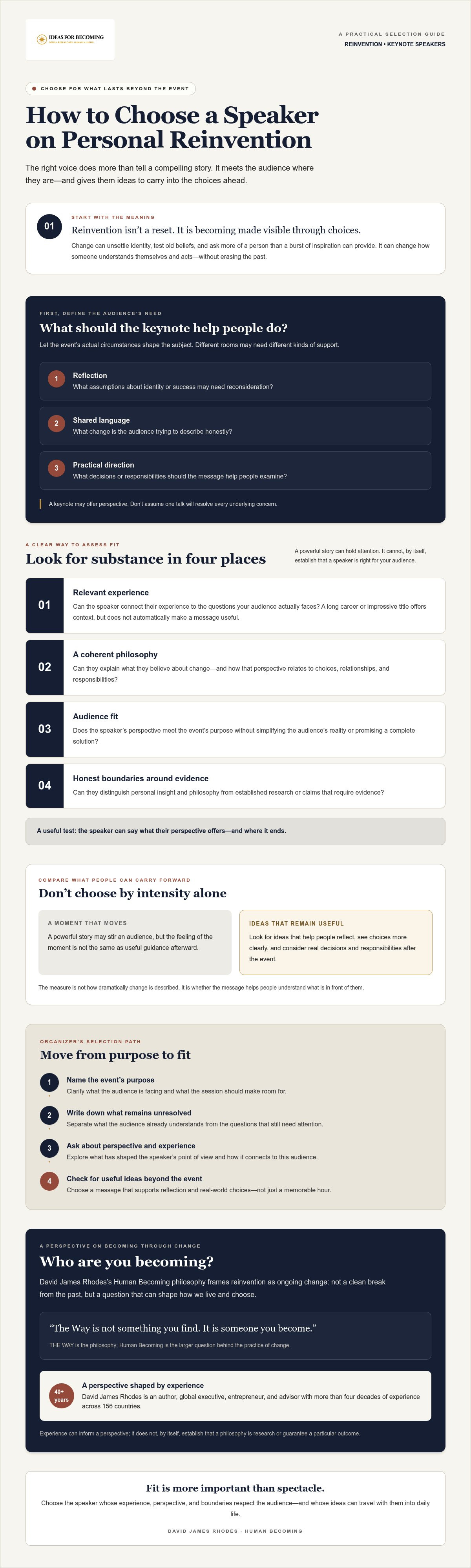
How to Choose a Speaker on Personal Reinvention for Your Event
A clear selection process begins before you review speaker biographies. Define the conversation your event needs to hold. Then assess whether a candidate’s experience, ideas, and boundaries serve that purpose. A Speaker on the journey of personal reinvention should be chosen for relevance, not simply for a compelling story or a promise of inspiration.
What should organizers clarify before approaching a speaker?
Write down the audience’s current challenge and what you want the event to make possible: reflection, a shared language for change, or direction for choices ahead. Name the emphasis that fits, such as leadership, recovery, or human potential. Set realistic expectations, too. A keynote can offer perspective and invite useful questions; it shouldn’t be expected to resolve complex personal or organizational issues.
What questions help test speaker and event fit?
Use these steps to move from a broad topic to a grounded decision:
- Define the purpose. Describe the audience’s situation and the conversation the event should open.
- Identify the needed perspective. Decide which parts of the speaker’s experience and philosophy relate directly to that purpose.
- Ask for the connection. How does the speaker’s central idea apply to this audience, rather than to a general idea of change?
- Clarify claims. Which points come from personal perspective, established research, emerging evidence, or contested interpretation? Ask how uncertainty and differing circumstances will be handled.
- Review relevant work. Read or listen to material that shows how the speaker treats identity and change. For a professional perspective, Harvard Business Review’s article on reinventing your personal brand offers a useful reference point.
- Agree on scope. Confirm what the keynote can address and avoid implying it will deliver outcomes that haven’t been established.
These questions help you determine whether the speaker’s message belongs in your event, and whether its limits are as clear as its purpose. David James Rhodes’s work connects leadership and change to Human Becoming, with the question, “Who are you becoming?” His perspective is expressed through The Way, a philosophy of becoming rather than a guaranteed formula for change.
If that perspective aligns with your event’s purpose, explore David’s keynote speaking.
David James Rhodes and The Way: A Perspective on Becoming Through Change
David James Rhodes is an author, global executive, entrepreneur, and advisor whose perspective has been shaped by more than four decades of experience across 156 countries. His work brings together questions of leadership, recovery, and meaning through a larger idea: Human Becoming. The focus is not on finding a final, perfected identity. It is on how a person’s choices and conduct shape who they become.
How does Human Becoming shape David’s perspective on reinvention?
Human Becoming treats identity as something that continues to develop. A person may change direction without leaving every part of their past behind. They still have relationships, responsibilities, and circumstances to meet. Reinvention, in this view, isn’t an effortless reset. It is a way of paying attention to what a person is becoming through the life they are living.
The Way is not something you find. It is someone you become. This is the central idea of David’s philosophy and the question beneath it: “Who are you becoming?” The Way is a philosophy, not a guaranteed method, clinical guidance, or claim of scientific proof. David’s observations and experience offer context for his thinking. They shouldn’t be mistaken for established research.
For an audience facing leadership change, this perspective may invite reflection on how decisions and responsibilities shape identity. Where recovery is relevant to the event, the conversation can include the work of building a life beyond immediate disruption, without treating a keynote as treatment or a substitute for professional care. The emphasis should follow the audience’s needs, not be added simply because the topic is personal change.
When should organizers explore David’s keynote speaking?
David may be a fit for audiences seeking a serious conversation about leadership, recovery, or human potential, particularly when the event can make room for reflection as well as practical questions. His keynote speaking draws on the same larger inquiry as his writing: how do people meet change, and what are they becoming through their choices? His book The Way, released September 15, 2026, presents this philosophy; it is available as a book, not a promise of a particular audience outcome.
A useful final test is simple: can your event’s purpose meet the question at the heart of Human Becoming? If so, explore David’s speaking and advisory work and consider whether his perspective fits the conversation your audience needs.
Choose a Voice That Respects the Work of Change
The right reinvention keynote begins with your audience, not the speaker’s story. Define the conversation your event needs, then assess whether the speaker brings relevant experience, a coherent philosophy, and honest boundaries around what their message can promise. A Speaker on the journey of personal reinvention should make room for real decisions and complexity, not just a moment of inspiration.
David James Rhodes’s perspective draws on more than four decades across 156 countries and experience in international finance, leadership, entrepreneurship, and behavioral health. His work connects these experiences to Human Becoming and the question, “Who are you becoming?” The Way, his book expressing this philosophy is available following its September 15, 2026 release.
If your event calls for a thoughtful conversation about leadership, recovery, or human potential, explore David James Rhodes’s speaking work. Choose a voice that helps your audience face change with clarity, and leaves them with a question worth carrying forward.
Frequently Asked Questions
What does a speaker on the journey of personal reinvention talk about?
A speaker on the journey of personal reinvention explores how people respond to change in identity, direction, or conduct. The conversation may touch on choices, relationships, leadership, and the responsibilities that remain during a transition. A thoughtful speaker won’t suggest people can erase their histories or promise a clean break. Instead, they help an audience consider how change is taking shape in its real circumstances.
How do I choose the right personal reinvention speaker for an event?
Start by defining your event’s purpose and what your audience is facing. Then assess whether a speaker’s experience and central ideas relate to those needs. Ask how they distinguish personal perspective from research-based claims, and what the audience can reflect on or apply afterward. A strong fit respects the complexity of change and doesn’t promise that one keynote will resolve deeper personal or organizational challenges.
What makes a reinvention keynote different from a motivational speech?
The distinction is less about the label and more about the substance. A keynote on reinvention may include an uplifting story, but it should also offer a clear perspective on change and connect that perspective to the audience’s purpose. Look for specific ideas, honest limits, and room for uncertainty. A moving response during an event can show that a message resonated, but it doesn’t prove lasting change.
Can a speaker on personal reinvention address leadership and identity?
Yes. A speaker can explore how identity develops through decisions, conduct, and responsibility, and connect those ideas to leadership. For example, an audience might consider how a leader’s values show up in difficult choices or periods of uncertainty. David James Rhodes’s Human Becoming philosophy centers on the question, “Who are you becoming?” It offers a reflective perspective, not a formula or a substitute for established research.
How can I tell whether a speaker’s claims are grounded in evidence?
Ask the speaker to identify the basis for important claims. Personal experience and philosophy can provide perspective, while claims about broader effects or causes may require research support. Notice whether the speaker names uncertainty and avoids treating an individual story as proof that everyone will have the same experience. A credible speaker can explain what is established, what remains uncertain, and what is their own interpretation.
What should event organizers ask a reinvention speaker before booking?
Ask how the speaker’s central message connects to your audience and event purpose. Explore which experiences inform their perspective and whether they can distinguish personal observation from research or contested interpretation. Ask what questions the audience might carry into their decisions afterward. Also clarify the keynote’s scope: what it can address, what it cannot promise, and how the message will respect the audience’s real circumstances.
Is personal reinvention the same as starting over?
No. Starting over can suggest leaving the past behind, while personal reinvention can involve changing direction or conduct while carrying history, relationships, and responsibilities forward. It isn’t necessarily a dramatic break or a new identity created all at once. The process may be gradual and shaped by the choices a person makes in existing circumstances. Reinvention means change, not erasure.
Frequently Asked Questions
Related Articles

Educational Leadership Consulting: Choose Support That Develops Leaders
Educational leadership consulting should connect strategy with the people doing the work. Learn practical ways to assess advisors and choose support that fits.

Books on Leadership Principles and Core Values: Essential Reading for Genuine Character
Discover books on leadership principles and core values that bypass corporate jargon to build authentic character and shape who you are becoming as a leader.

Inspirational Life Purpose Speaker: Event Planner's Guide
Book an inspirational speaker for finding life's purpose who delivers lasting depth, not stage hype. Here is how event planners evaluate real perspective.