
Integrity is easiest to praise when nothing is at stake. In global leadership, the test comes when a deadline, a local expectation, or pressure to deliver makes compromise seem practical. Integrity in global leadership can’t mean imposing one cultural template everywhere. But cultural difference can’t become an excuse to abandon honesty, accountability, or respect. Holding both truths is the work.
You may recognise the tension: personal principles feel clear until they meet competing obligations, unfamiliar norms, or a target that seems to justify questionable means. Integrity can sound like a slogan unless people can see it in a leader’s choices. This article offers a working definition and a practical way to examine difficult decisions, including who may bear their consequences.
We’ll look at how core principles can remain steady while their expression adapts across cultures, and how repeated choices shape trust and character. The aim isn’t to offer an easy answer for every situation. It’s to help you decide with greater clarity under pressure and consider a deeper question: who are you becoming through the way you lead?
Key Takeaways
- Define integrity through the alignment of principles, decisions, and conduct, not reputation or a values statement alone.
- Practise integrity in global leadership by listening for context without stereotyping cultures or excusing harmful conduct.
- Make principles observable by considering who a decision affects and how you will demonstrate accountability.
- Use a five-step reflection process to examine difficult choices, their consequences, and your responsibility for the outcome.
- Notice how repeated decisions shape your character, relationships, and the leader you are becoming.
What Integrity in Global Leadership Means Beyond a Code of Conduct
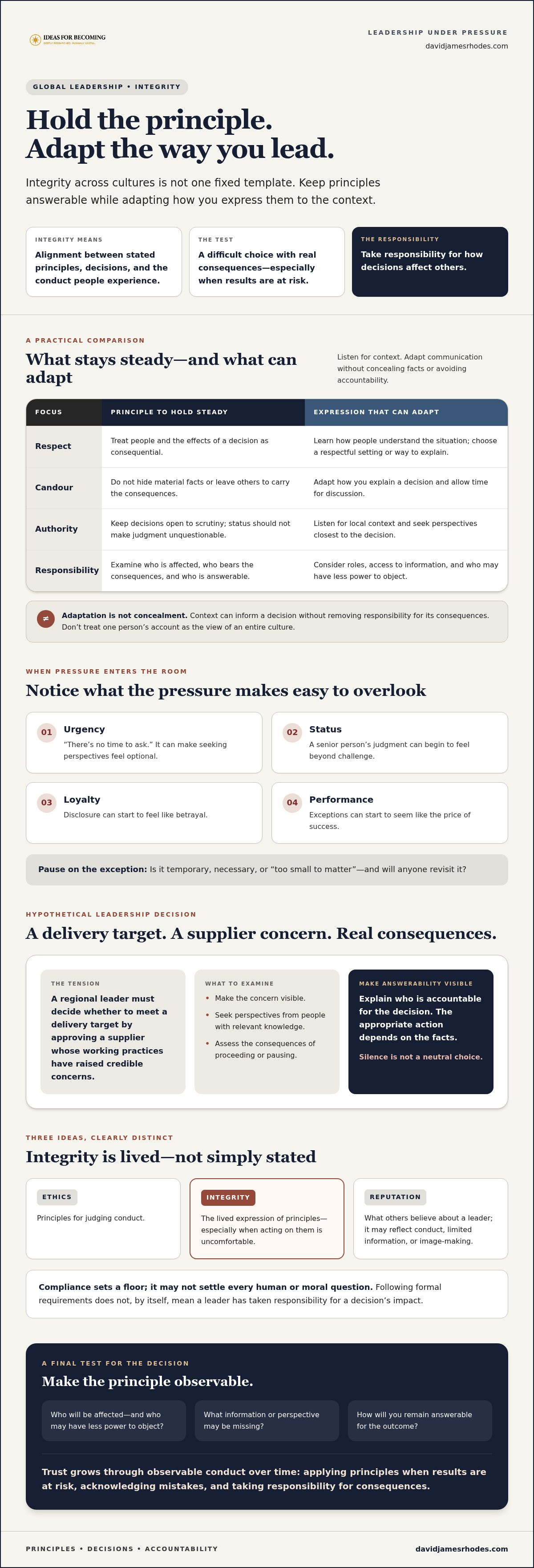
Integrity is alignment between the principles a leader states, the decisions they make, and the conduct people experience. It is not a polished statement on a wall. It is what happens when a difficult choice carries real consequences.
Integrity is keeping faith with your principles while taking responsibility for how your decisions affect others. That definition offers direction, not a universal checklist. In global leadership, people may interpret respect, candour, authority, or responsibility differently. Listen for context and adapt how you express principles without using cultural difference to excuse foreseeable harm.
Integrity also differs from compliance. Rules set a floor for conduct, but they may not resolve every human or moral question. A leader can follow formal requirements and still avoid responsibility for a decision’s impact. Consistency matters, but it doesn’t mean repeating the same action everywhere. Applying the same principle thoughtfully may call for different actions in different circumstances.
How Is Integrity Different from Ethics or Reputation?
Ethics provides principles for judging conduct. Integrity is their lived expression: the choice to act in keeping with those principles, especially when doing so is uncomfortable. Reputation is what others believe about a leader. It can reflect conduct, but it can also be shaped by limited information or careful image-making.
Personal sincerity matters, but it isn’t enough. A leader may genuinely believe a decision is right and still ignore foreseeable harm. Integrity asks for more than good intentions or a consistent public image. It asks whether the leader examines consequences, hears those affected, and remains answerable when the decision is questioned. Work such as the School for Ethics and Global Leadership reflects an interest in developing ethical thinking alongside leadership. The institution itself is not proof of a single formula for integrity.
Why Does Integrity Matter in Global Leadership?
A decision made in one office can shape the working lives of people across teams, institutions, and cultural contexts. Its effects may differ for people with different roles, access to information, or ability to speak up. Don’t assume that one announcement will land the same way everywhere. Nor should cultural difference end the inquiry into who bears the consequences.
Hypothetical example: A regional leader must choose whether to meet a delivery target by approving a supplier whose working practices have raised credible concerns. The target matters. So do the people affected by the supplier’s practices. An integrity-led response would make the concern visible, seek perspectives from people with relevant knowledge, assess the consequences of proceeding or pausing, and explain who is accountable for the decision. The appropriate action depends on the facts. Silence is not a neutral choice.
Trust is built through observable conduct over time, not self-description alone. People notice whether leaders apply stated principles when results are at risk, acknowledge mistakes, and take responsibility for consequences. The expression may vary across cultures. The responsibility to make choices answerable remains.
Why Global Leadership Tests Integrity Across Culture and Pressure
Integrity is tested when a leader must answer to more than one set of expectations. Local relationships may call for tact. An organization may reward speed or results. Personal principles may demand a pause, a hard conversation, or a refusal. These forces can pull in different directions, and no single cultural template resolves every tension.
Context can inform a decision without removing responsibility for its consequences. Cultural awareness means learning how people understand a situation, not assuming everyone in a region or community thinks alike. It also doesn’t require accepting harm as inevitable or treating a familiar practice as beyond question.
Pressure often arrives dressed as reason. Urgency says there’s no time to ask. Status suggests a senior person’s judgment shouldn’t be challenged. Loyalty makes disclosure feel like betrayal. Performance demands turn exceptions into the price of success. In those moments, integrity in global leadership depends on noticing not only what is being asked, but what the pressure makes easier to overlook.
How Can Leaders Respect Cultural Context Without Abandoning Principles?
Start by seeking the perspectives closest to the decision and those most likely to be missing. Ask who will be affected, who has less power to object, and what information hasn’t reached decision-makers. Listen before deciding what a custom, silence, or disagreement means. Don’t confuse one person’s account with the view of an entire culture.
Then distinguish adaptation in communication from concealment. You may change how you explain a decision, allow time for discussion, or choose a more respectful setting. That is different from hiding material facts, avoiding scrutiny, or leaving others to carry the consequences. The difficult question is often not whether to adapt, but where adaptation stops serving understanding and starts undermining accountability.
What Pressures Make Ethical Consistency Difficult?
Results, status, important relationships, and institutional reputation can all make compromise appear protective. A leader may tell themselves an exception is temporary, necessary, or too small to matter. If no one revisits it, the exception can become an informal expectation. People learn what the organization truly rewards from what leaders permit, not only from what they announce.
Hypothetical scenario: A leader is asked to soften a project update so an overseas team does not appear to have missed a commitment. The request may be framed as preserving a relationship or avoiding embarrassment. Before agreeing, clarify what is accurate, ask who will rely on the update, and consider whether respectful wording can preserve dignity without changing the facts. The answer may depend on the circumstances. Responsibility for the choice does not disappear.
A useful pause is to ask: What am I protecting? Whose voice is absent? Would I defend this choice if its effects were visible to everyone involved? These questions don’t supply an automatic verdict. They help bring pressure into view before it quietly becomes permission. David James Rhodes’s reflections on leadership and human becoming offer a broader lens on the character shaped by such choices.
Integrity in Global Leadership: Principles, Actions, and Accountability
A principle becomes meaningful when it changes how a decision is made. “We value transparency” is a beginning, not evidence of integrity. The practical questions are: What information was shared? Who had a chance to challenge the decision? What happened when new evidence emerged?
Cultural complexity doesn’t make integrity purely subjective or impossible to assess. It calls for careful judgment, not a rigid checklist. Examine whether actions show honesty, responsibility, and attention to consequences while recognising that communication and expectations may differ across contexts.
| Stated principle | Observable action | Affected people | Accountability |
|---|---|---|---|
| Transparency | Explains the basis for a decision | People who rely on that information | Corrects the record if facts change |
| Respect | Invites relevant perspectives | People affected by the decision | Responds to concerns without retaliation |
| Responsibility | Names foreseeable risks | Those who may bear the consequences | Addresses harm and reports progress |
Use this table to examine conduct, not to score a person’s entire character. One action can’t prove who a leader is. Patterns matter: what gets explained, what gets hidden, and whether the same principles remain in view when a decision becomes inconvenient.
How Can You Tell Whether Values Are Reflected in Decisions?
Compare the stated value with the decision itself. If a leader claims responsibility, do they name the risks and accept their part in the outcome? If they value transparency, do they share relevant facts, including those that complicate their preferred position? Pay attention when evidence challenges an earlier judgment. A leader may need to revise the decision, explain why it stands, or acknowledge an error. Defensiveness alone proves little, but refusing to examine evidence weakens the credibility of the stated principle.
What Does Accountability Look Like Across Borders?
Accountability means making a decision understandable to the people it affects. Explain the reasoning in language they can follow, and give them a meaningful way to raise concerns. If an error occurs, acknowledge it plainly. Correct preventable harm where possible, then report what has changed and what remains unresolved.
Accountability makes principles visible by showing who accepts responsibility when decisions have consequences. That responsibility can’t be transferred to “the culture,” a policy, or a subordinate simply because each influenced the situation. Context may help explain how a choice arose. It doesn’t erase a leader’s role in examining the choice, responding to its effects, and learning from what followed. That is one practical measure of integrity in global leadership: not perfection, but conduct that remains open to scrutiny and correction.
A Practical Reflection Framework for Difficult Leadership Decisions
Some decisions need more than a quick instinct. This five-step reflection process is a practical aid, not a validated scientific instrument or a guarantee of the right answer. Use it to slow down, make assumptions visible, and take responsibility for what follows.
- Name the choice. State the decision plainly. Separate the choice you control from the pressures surrounding it.
- Examine the principles. Identify what matters here, then ask whether you’d use the same reasoning if the outcome offered you no personal advantage.
- Hear affected perspectives. Ask who benefits, who may be harmed, and whose account has not been heard. Seek context rather than assuming one person speaks for a whole community.
- Assess consequences. Consider likely effects, what remains uncertain, and who bears the risk if your judgment is wrong.
- Own the decision. Decide what you can explain openly, who needs to hear it, and what responsibility you’ll accept if the outcome fails.
Five Questions to Ask Before Making a High-Stakes Choice
Write down what you know, what you’re assuming, and what remains uncertain. Then ask: Which principles are at stake? Would I reach the same decision without personal benefit? Who gains, who may be harmed, and whose perspective is missing? What can I explain openly? If this goes wrong, what responsibility remains mine? A written record helps separate evidence from urgency and gives you something specific to revisit.
Hypothetical cross-border dilemma: A regional leader is asked to approve a delivery plan that meets a central target but depends on a local team accepting a risk it has not had time to assess. Naming the choice makes the trade-off clear. The leader can examine commitments to safety and honesty, hear from the team and others affected, weigh possible consequences, then explain the decision and who will monitor its effects. The best response depends on facts that must be established. The process helps reveal what those facts are and whose interests might otherwise be overlooked.
What Should a Leader Do After Getting It Wrong?
First, name the decision and its effects without minimizing or dramatizing them. Listen to people affected, clarify what needs correction, and take a concrete step to reduce preventable harm where possible. Then review what made the mistake more likely: missing information, a habit of rushing, pressure to protect results, or a process that discouraged challenge. Repair matters. So does changing the conditions that made the error easier to repeat.
Integrity in global leadership is practised not through certainty, but through careful judgment and accountable action. David James Rhodes offers Leadership & Life Advisory for individuals and executives navigating growth, adversity, and the search for meaning. Explore Leadership & Life Advisory.
Integrity, Identity, and the Leader You Are Becoming
A leader’s character is not formed only in moments of crisis. It takes shape in ordinary decisions: whether to share difficult information, listen to a concern, keep a promise, or admit when an earlier judgment was wrong. Repeated choices become habits. Habits influence relationships. Over time, they help shape the person others experience as a leader.
How Do Repeated Choices Shape a Leader’s Character?
Each decision can reinforce a commitment or expose the distance between what a leader says and what they practise. That doesn’t mean one failure defines a person. Nor does recognising a mistake automatically produce change. Growth asks for honesty about what happened, repair where possible, and renewed responsibility in the choices that follow.
Relationships make this practice visible. People learn whether it is safe to raise a concern, whether a leader listens when challenged, and whether responsibility is shared fairly when something goes wrong. Their experience is shaped by patterns, not promises alone. A leader can begin again, but beginning again means doing more than expressing regret. It means changing the conduct or conditions that helped produce the harm.
This is one reason integrity in global leadership reaches beyond any single decision. Leaders work among people whose expectations and circumstances may differ. They need to keep examining how their choices affect others, while remaining willing to learn when their understanding is incomplete. Character is not a fixed possession. It is expressed, questioned, and developed through action.
What Does The Way Add to a Conversation About Leadership?
David James Rhodes’s human-becoming perspective is a philosophy grounded in lived experience, not a research finding or a leadership formula. Its central idea is simple: The Way is not something you find. It is someone you become. A way forward is made through the person you are becoming and the choices you make along the way.
That perspective brings the original question into sharper focus. How can a leader honour principles across cultures and under pressure? Not by expecting perfect certainty or treating one mistake as the end of the story. The work is to keep listening, decide, answer for consequences, and adjust when the facts or effects call for it. It is practical work, and personal work.
Pause over the decisions you’ve made recently. What pattern do they reveal about the leader you are becoming?
If you want to explore this philosophy further, Explore The Way.
Let Your Next Decision Shape the Leader You Become
The next difficult choice will arrive in its own form. Before it does, decide what you want to be able to explain about your conduct when the pressure has passed. That intention won’t remove uncertainty. It can help you meet it without handing your judgment over to urgency, status, or fear.
Integrity in global leadership is not a claim to get every decision right. It is a commitment to keep learning, take responsibility, and make the next choice with greater care. The question is not only what result you will produce. It is what your decisions are teaching the people around you about what matters.
David James Rhodes brings a lived perspective shaped by more than four decades of experience across 156 countries. His philosophy, The Way explores character, action, leadership, and human becoming. It begins with a question that can travel with you into any role or culture: who are you becoming through the way you lead?
To explore the philosophy behind that question, Explore The Way. Your next decision can be a beginning, and you can choose to make it with care.
Frequently Asked Questions
Is integrity in global leadership the same across every culture?
No. People may differ in how they express disagreement, show respect, or expect decisions to be communicated. That doesn’t make integrity meaningless. A leader can adapt meeting formats or communication style while still being truthful about a decision and clear about who is responsible for it. Consider what a commitment requires in practice, then learn how people in that context understand its expression instead of assuming everyone shares one view.
Can a leader adapt to local customs and still act with integrity?
Yes. Adaptation can make communication more respectful and effective. For example, a leader might share a sensitive change in a private conversation before discussing it with a wider group. The boundary is whether adaptation changes the substance: respectful timing is different from hiding information people need to make decisions. Ask whether the adjustment helps people understand the truth or simply makes scrutiny less likely.
How can leaders demonstrate integrity when business goals conflict with their values?
Make the conflict explicit before choosing. Name the goal, the principle at risk, and the consequence of proceeding as planned. Then consider alternatives: change the timeline, revise the method, or explain why the target cannot be met responsibly. If you reject a proposed approach, say what you can support instead. A clear alternative helps colleagues see that values shape decisions rather than merely decorate them.
What happens if a global leader makes a decision that harms a community?
The leader should first understand the harm from the community’s perspective, rather than relying only on internal reports. Pause or change ongoing actions that may deepen it, where possible. Then explain what is known, what remains uncertain, and what steps will address the impact. Follow through and make progress visible. An apology matters, but it cannot substitute for listening, correction, and sustained attention to the people affected.
How do you measure integrity in leadership?
There is no single score that captures it. Look for patterns over time: whether stated commitments appear in difficult decisions, whether leaders correct inaccurate information, and whether they respond constructively to challenge. Compare public explanations with what people affected by decisions experience. One good act or one failure isn’t a complete measure of character. Evidence comes from repeated conduct, including how leaders respond when their choices are questioned.
Why is accountability important in global leadership?
Accountability connects a leader’s authority to responsibility for its effects. In a distributed team, a decision made far from those affected can be misunderstood, delayed, or passed between levels of management. Clear ownership helps prevent that diffusion. People need to know who can explain the decision, address concerns, and report what changes. Without accountability, even a well-intended commitment can lose meaning as it moves across teams and contexts.
Frequently Asked Questions
Related Articles

Navigating Adversity in Business: How to Find a Way Forward
Navigating adversity in business requires clear thinking under pressure. Learn how to separate facts from fear, set priorities, and lead through hardship.

Resilience in Leadership: How to Lead Through Pressure Without Losing Your Humanity
True resilience in leadership means more than absorbing pressure. Learn how to steady your judgment, support your team, and lead without losing your humanity.

Rebuilding Life After Crisis: A Grounded Path Forward
Rebuilding life after crisis is not about who you were. Discover practical, grounded steps to regain agency and shape who you are becoming at your own pace.