
Adversity doesn’t automatically make a business stronger. It tests how clearly its leaders can think when the usual answers no longer fit. Navigating adversity in business often means making consequential decisions with incomplete information while employees, customers, and partners look for signs of what comes next.
The pressure is real. You may need to act quickly, but urgency can make every problem seem equally important. It can narrow your attention and strain trust, too. Advice to “stay resilient” offers little help when you’re deciding what to protect, what to change, and what to tell the people who depend on you.
This article offers a grounded way forward. You’ll learn to separate verified facts from assumptions and fears, identify practical next steps, and communicate honestly under pressure. Drawing on more than four decades of experience across 156 countries, David James Rhodes considers adversity not proof that growth is inevitable, but a test of leadership and character. The question isn’t whether hardship will make you stronger. It’s how you’ll choose to lead through it, and who you’re becoming in the process.
Key Takeaways
- Business adversity calls for consequential decisions, not simply a display of confidence or endurance.
- When navigating adversity in business, separate verified facts from assumptions and fears before deciding what needs attention first.
- Hardship can prompt change, but it doesn’t guarantee growth or make suffering necessary.
- Stabilize urgent concerns, set clear priorities, communicate honestly, and review decisions as circumstances change.
- Repeated choices under pressure shape both the direction of a business and the kind of leader you are becoming.
What Navigating Adversity in Business Really Means
A failed launch can unsettle a team. A lost customer can threaten a carefully built plan. A sudden market change can make yesterday’s assumptions unreliable. Business adversity reaches beyond the immediate problem. It can disrupt confidence, relationships, and the sense that the next step is clear.
Business adversity is a serious disruption or pressure that demands consequential decisions about the business and the people responsible for it. Navigating adversity in business isn’t about appearing fearless or turning every setback into a success story. It begins with seeing the situation clearly enough to respond responsibly.
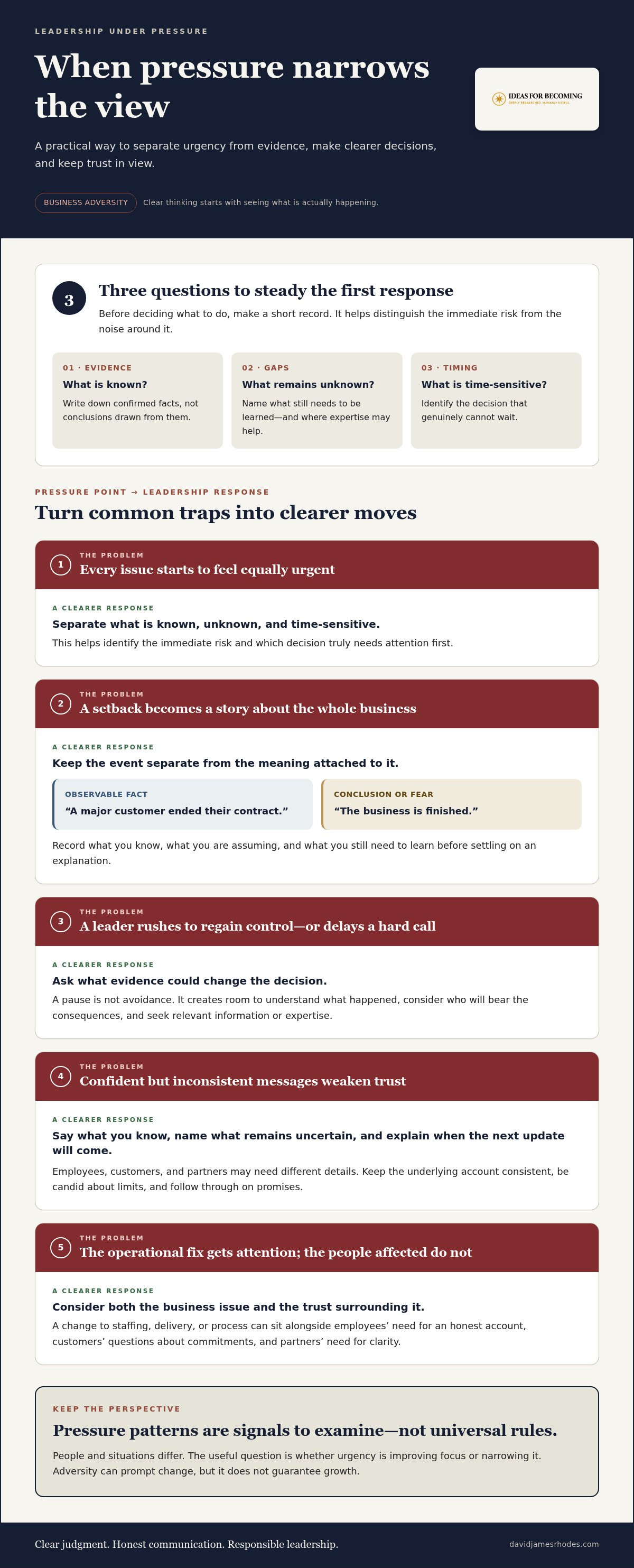
Start by separating the event from the meaning attached to it. “A major customer ended their contract” is an observable fact. “The business is finished” is a conclusion, perhaps a fear, but not yet a fact. Treating those statements as equivalent can lead to decisions based on a story rather than the evidence in front of you.
The difference between a setback and a defining story
A setback belongs to the record of what happened. It doesn’t, by itself, define the business or the leader. A failed launch may reflect a product mismatch, weak timing, unclear communication, or several causes at once. A lost customer deserves attention, but it doesn’t automatically prove every other relationship is at risk.
Before settling on an explanation, write down what you know, what you’re assuming, and what you still need to learn. For example, note the confirmed reason a customer left separately from your interpretation of what it means for future sales. This doesn’t lessen the consequences. It prevents one painful event from becoming a total judgment of your ability or future.
Why the first response matters
Under pressure, urgency can make every problem feel like the problem. A leader may rush to cut costs, change direction, or reassure people before understanding what has happened. A pause is not avoidance. It creates room to identify the immediate risk, who is affected, and which decision cannot wait.
Consider resilience not as invulnerability, but as the capacity to respond and adapt. The broad overview of Resilience includes individual and organizational perspectives, though it cannot tell a leader what a particular business should do. That responsibility remains with the people making the decision. Clarify the situation, seek relevant information, and consider who will bear the consequences of your response. Then act with care, not panic.
How Business Pressure Shapes Judgment, Leadership, and Trust
Pressure can change what a leader notices. A looming deadline may dominate attention while a deeper cash-flow concern, an unresolved customer issue, or a team’s capacity receives less scrutiny. Risk can look different, too. Some leaders move too quickly to regain control. Others delay a difficult decision because its consequences are uncomfortable.
These are patterns to watch for, not a diagnosis or a universal rule. People and situations differ. The useful question is whether urgency is improving your focus or narrowing it.
When urgency narrows a leader’s view
Before acting, make a short record: what is known, what remains unknown, and what is genuinely time-sensitive. Then ask what evidence could change the decision. This can reveal when a response rests on incomplete information or when a critical conversation is being avoided. It may also show where another person’s expertise is needed. Asking for help is not an abdication of leadership. It can be part of responsible judgment.
Business pressure can involve several problems at once. An operational issue may call for a change in staffing, delivery, or process. Alongside it, there may be a question of trust: do employees believe they are being told the truth? Customers may wonder whether commitments still stand. Partners may need clarity about decisions that affect shared work. The operational response matters, but so does the way people experience it.
The effect on people and business relationships
Inconsistent messages can leave employees filling gaps with their own explanations. Customers and partners may lose confidence when expectations shift without a clear account of why. One honest update is often more useful than confident language the leader cannot support.
Clear communication under pressure is responsible leadership: say what you know, name what remains uncertain, and explain when people can expect the next update. This doesn’t require a leader to pretend certainty. It requires accountability for decisions, candor about limits, and follow-through on promises. Different stakeholders may need different details, but the underlying account should remain consistent.
David James Rhodes draws on more than four decades of experience across 156 countries in business and leadership. For a wider view of his thinking on leadership and human development, explore David’s leadership perspective. Under strain, the leader’s task is not to control every reaction. It is to make the situation clearer, invite relevant information, and treat the people affected with respect.
Does Adversity Make a Business Leader Stronger? A More Honest View
No. Adversity can create pressure to change, but it doesn’t guarantee growth. A difficult period may sharpen a leader’s judgment. It may also bring exhaustion, lost revenue, damaged relationships, or decisions that narrow the business’s options. Sometimes the consequences remain unresolved. Calling every hardship an opportunity can dismiss the people and livelihoods affected by it.
There’s a difference between saying, “We can learn from this,” and saying, “This had to happen so we could grow.” The first is a choice about what to do next. The second assigns a purpose to suffering that the facts may not support. Navigating adversity in business calls for honest reflection, not a story that makes every loss seem necessary.
What a difficult period can reveal, and what it cannot
Pressure may expose a process that depended too heavily on one person, priorities that were never clear, or relationships that received too little attention. These are possibilities to examine, not automatic conclusions. A setback doesn’t reveal someone’s entire character or predict how they’ll lead in the future. It gives a reason to review specific decisions and their effects, not to declare that the hardship was worthwhile.
That distinction matters. A business can identify what it might improve without pretending the damage was beneficial. A lost client may point to a gap in communication, but the client may not return. A failed initiative may prompt a better review process, but the time and effort spent are still gone. Learning can coexist with regret. It doesn’t cancel the cost.
Learning requires choices, not hardship alone
Experience becomes useful when people examine it and act differently where the evidence supports a change. That might mean reviewing what assumptions shaped a decision, seeking candid feedback from those affected, or assigning someone to track a risk that was previously overlooked. Reflection is not a verdict. It is a way to make the next decision with greater care.
Time passing, by itself, does not ensure that a leader or organization will change. The same pressures can recur if no one questions the habits or systems that contributed to them. Thoughtful action cannot guarantee a better outcome, either. Some uncertainty remains, and some losses cannot be reversed.
It helps to separate what can be established from what is interpretation. A documented missed target is a fact. The claim that adversity always builds resilience is broader and needs evidence before being presented as a general truth. Whether a particular business or leader becomes more capable is uncertain until choices and outcomes show it. David James Rhodes’s view, informed by experience rather than scientific proof is that hardship doesn’t confer wisdom. Reflection, responsibility, and changed action may help people build it.
A Practical Way to Navigate Business Adversity, Step by Step
There is no single response that fits every disruption. A safety concern, a sudden loss of revenue, and a breakdown in delivery call for different actions. But a clear sequence can help you decide what deserves attention first. For navigating adversity in business, use this as a framework, not a rigid formula. Adapt it to the scale and urgency of the situation.
Separate immediate facts from assumptions
Start by identifying what could cause immediate harm or make the situation worse. Then gather the evidence available, note the questions that remain unanswered, and identify decisions that cannot wait. Be clear about who is affected and what needs protecting first, whether that is people, essential operations, customer commitments, or the business’s ability to continue functioning.
An early assessment is provisional. As new information arrives, revisit it. Operational, legal, financial, and safety matters can carry serious consequences. Seek advice from appropriately qualified professionals when a decision requires expertise beyond your own. Asking for that help is part of taking responsibility.
Choose the next responsible action and communicate it
Once the immediate picture is clearer, limit the response to a short list of priorities. For each action, name an owner, the next observable sign of progress, and any dependency that could delay it. This keeps responsibility visible without pretending every uncertainty can be resolved at once.
Then tell affected people what you know, what remains uncertain, what you’re doing now, and when they can expect another update. Match the detail to the audience. Employees may need to understand changes to their work; customers may need clarity about commitments. Don’t promise an outcome you can’t control.
Review what happened after each action. Did it reduce the immediate risk? What changed? What new information has emerged? Revise the plan when the facts call for it. Changing course after learning more is not failure. Refusing to adjust simply to protect appearances can make a difficult situation worse.
A practical sequence for business adversity:
- Stabilize the most urgent risk.
- Establish what is known, unknown, and time-sensitive.
- Set a small number of priorities and assign responsibility.
- Communicate honestly with the people affected.
- Review the results and adjust the response.
This sequence cannot remove uncertainty or guarantee a good outcome. It can help you make the next decision with care, keep responsibilities clear, and avoid treating the first plan as permanent. For further perspective on leadership under pressure, explore David’s leadership and life advisory.
From Business Adversity to Becoming a More Capable Leader
A business challenge still needs practical attention. The next decision may concern an operating process, a customer commitment, or how to support the people carrying the work. Reflection doesn’t replace those responsibilities. It can help you meet them with greater care.
Pressure can tempt a leader to wait for a perfect answer before moving. But uncertainty rarely disappears on command. Sometimes the responsible course is to identify what can be done now, explain the limits of what you know, and remain willing to adjust as the facts change.
The Way forward is made through character and action
The Way is not a perfect path waiting to be discovered. It is someone you become. In leadership, that becoming takes shape through repeated choices: facing an uncomfortable fact, accepting responsibility, asking for another perspective, or keeping a promise to the people affected by a decision.
Courage matters, but it isn’t the same as certainty. Accountability matters, but it isn’t self-blame. Habits, relationships, and a willingness to learn all influence how a leader responds when the pressure returns. None guarantees a business outcome. They help define the quality of the choices made along the way.
David James Rhodes’s philosophy of human becoming brings the question back to the person leading: Who are you becoming through the way you act? For further reflection on this idea, explore The Way and the process of becoming. It offers perspective on character and action, not a formula for solving business problems.
Carry learning into the next decision
Choose one thing that deserves your attention now. It might be a decision you’ve postponed, a relationship that needs an honest conversation, or a habit that is making it harder for others to contribute. Make the next step specific enough to act on. Then notice what the action asks of you: patience, candor, humility, or resolve.
Leadership does not stop at the office door. The responsibilities of work and life meet in the same person, a theme explored in leadership and the integration of life and work. If you want to explore the larger philosophy behind this way of thinking, spend time with The Way’s approach to becoming.
As you take your next action, who are you becoming?
Choose the Next Responsible Step
Navigating adversity in business begins with clarity, not certainty. Separate what you know from what you fear, identify what needs attention first, and make the next responsible decision. Communicate honestly with the people affected. Then review what happens and adjust as the facts change.
Hardship doesn’t promise growth, and a difficult outcome isn’t proof that you failed as a leader. What matters is how you respond, what you learn, and whether you carry that learning into your next choice. The Way expresses this as a larger idea: a person becomes capable of creating a way forward. It’s a philosophy of character and action, not a guarantee of business success.
David James Rhodes brings a perspective shaped by more than four decades of experience across 156 countries, spanning international finance, leadership, entrepreneurship, behavioral health, and recovery. Explore David James Rhodes’s reflections on The Way and human becoming. The way ahead may not be clear all at once. Begin with the decision in front of you, and take it with care.
Frequently Asked Questions
What does navigating adversity in business mean?
Navigating adversity in business means responding to serious disruption with clear, responsible decisions. Start by distinguishing observable facts from assumptions, then identify what needs attention first and who is affected. The right response depends on the circumstances. A delivery problem, financial pressure, or loss of trust may each call for different actions, and none guarantees growth. The aim is to make the next decision with care, not to pretend uncertainty has disappeared.
How can a business leader stay calm during a crisis?
A leader can create more room for clear judgment by slowing down long enough to identify the immediate risk and the decision that cannot wait. Write down what is known, what remains uncertain, and what information is needed. Invite relevant perspectives rather than carrying every decision alone. Calm doesn’t mean feeling no fear or projecting certainty. It means taking responsibility for a measured response while staying open to new facts.
Does adversity make business leaders stronger?
No. Adversity can prompt reflection or change, but it doesn’t guarantee that a leader will become stronger. A difficult period may also bring exhaustion, financial consequences, or damaged relationships. Learning depends on what people do with experience: review decisions, listen to feedback, and change actions where appropriate. It’s possible to take a useful lesson from a setback without claiming that the hardship was necessary or beneficial.
What should a business do first when facing a major setback?
First, stabilize any immediate risk to people, essential operations, or important commitments. Then establish the available facts, list unanswered questions, and identify which decisions are time-sensitive. Assign responsibility for the next actions so important tasks don’t disappear into general concern. If a decision involves operational, legal, financial, or safety expertise beyond the team’s knowledge, seek appropriately qualified professional advice before acting on assumptions.
How should leaders communicate with employees during business uncertainty?
Leaders should communicate what is known, what remains uncertain, what actions are underway, and when employees can expect another update. Avoid unsupported promises or changing explanations. Employees may not need every detail, but they need an honest account of how decisions affect their work. A leader can acknowledge uncertainty and still be accountable: explain what has been decided, who owns the next step, and how new information will be shared.
How can a business recover after failure?
A business can begin recovery by understanding the consequences of the failure and deciding what must change before normal activity resumes. Review the choices, processes, and assumptions involved. Gather candid feedback from affected employees, customers, or partners where appropriate. Set a small number of priorities, assign clear ownership, and check whether the changes are helping. Recovery may involve difficult trade-offs, and a revised plan should follow evidence rather than a desire to preserve appearances.
How do you find meaning in business adversity?
Meaning doesn’t have to come from believing that hardship happened for a reason. It can emerge from the values a leader chooses to uphold, the responsibilities they accept, and the lessons they carry into future decisions. Begin with one question: what deserves attention now? In David James Rhodes’s philosophy, The Way is not a perfect path to find, but a way forward a person becomes capable of creating through character and action.
Frequently Asked Questions
Related Articles

Resilience in Leadership: How to Lead Through Pressure Without Losing Your Humanity
True resilience in leadership means more than absorbing pressure. Learn how to steady your judgment, support your team, and lead without losing your humanity.

Rebuilding Life After Crisis: A Grounded Path Forward
Rebuilding life after crisis is not about who you were. Discover practical, grounded steps to regain agency and shape who you are becoming at your own pace.

A Meaningful Life After Retirement: Finding Purpose in What Comes Next
Build a meaningful life after retirement through small, intentional choices. Discover practical ways to shape your days and explore who you are becoming next.