
What if rebuilding life after crisis isn’t about returning to the person you were before? Daily routines can feel unfamiliar. Work and relationships may take more effort than others expect, while the future offers no clear map. Rebuilding life after crisis can begin without knowing where the whole road leads.
It makes sense to want certainty, or to feel pressure to show that you’re making progress. But you don’t need a complete life plan to take a meaningful next step. Start with what is manageable: one steady routine, one honest conversation, or one choice that restores a little agency.
This article explores what rebuilding can involve and how to approach it at a humane pace. You’ll find ways to reconnect with daily life and other people, while making room for the possibility that crisis may change you without defining what comes next. The aim isn’t to force a new identity or recover an old one. It’s to begin shaping a life that reflects who you’re becoming.
Key Takeaways
- Rebuilding life after crisis means recovering the ability to make choices and take workable next steps, not erasing what happened.
- Notice how changes to identity, routine, and relationships affect daily life. Small sources of structure can create room to respond.
- Progress doesn’t require returning quickly to your former life or appearing fine. Support and realistic expectations matter.
- Begin with immediate needs, identify available support, then choose one manageable action and adjust as you learn what helps.
- A new chapter doesn’t have to promise a life without difficulty. Repeated choices can help shape who you are becoming.
What Does Rebuilding Life After Crisis Really Mean?
Rebuilding is restoring some ability to choose and creating workable next steps, not erasing what happened or returning life to its former shape. A crisis may affect health, relationships, work, identity, or your sense of time. Tasks that once felt ordinary can become difficult; decisions that once seemed obvious may no longer fit.
People respond to disruption in different ways. One person may want to act quickly; another may need time before considering what comes next. Neither response, by itself, says anything definitive about character. The idea of psychological resilience can help frame how people cope with adversity, but resilience is not a demand to recover neatly or without support.
Why life can feel unfamiliar after a major disruption
Daily life rests on expectations: how a morning begins, what work requires, who you turn to, and what you believe the future will hold. A major disruption can unsettle several of these at once. Familiar roles may feel different when circumstances change. Uncertainty doesn’t mean you have failed. It may mean the assumptions you relied on no longer fit the life in front of you.
Rebuilding is not the same as going back
Some things cannot be restored exactly as they were. A relationship may change; a job or home may be lost; health or responsibilities may shift. Rebuilding life after crisis means recognizing those realities while deciding what remains worth carrying forward. You might preserve a valued connection, adapt a routine, or reconsider a role. Loss doesn’t have to be called a gift for you to make choices within changed conditions.
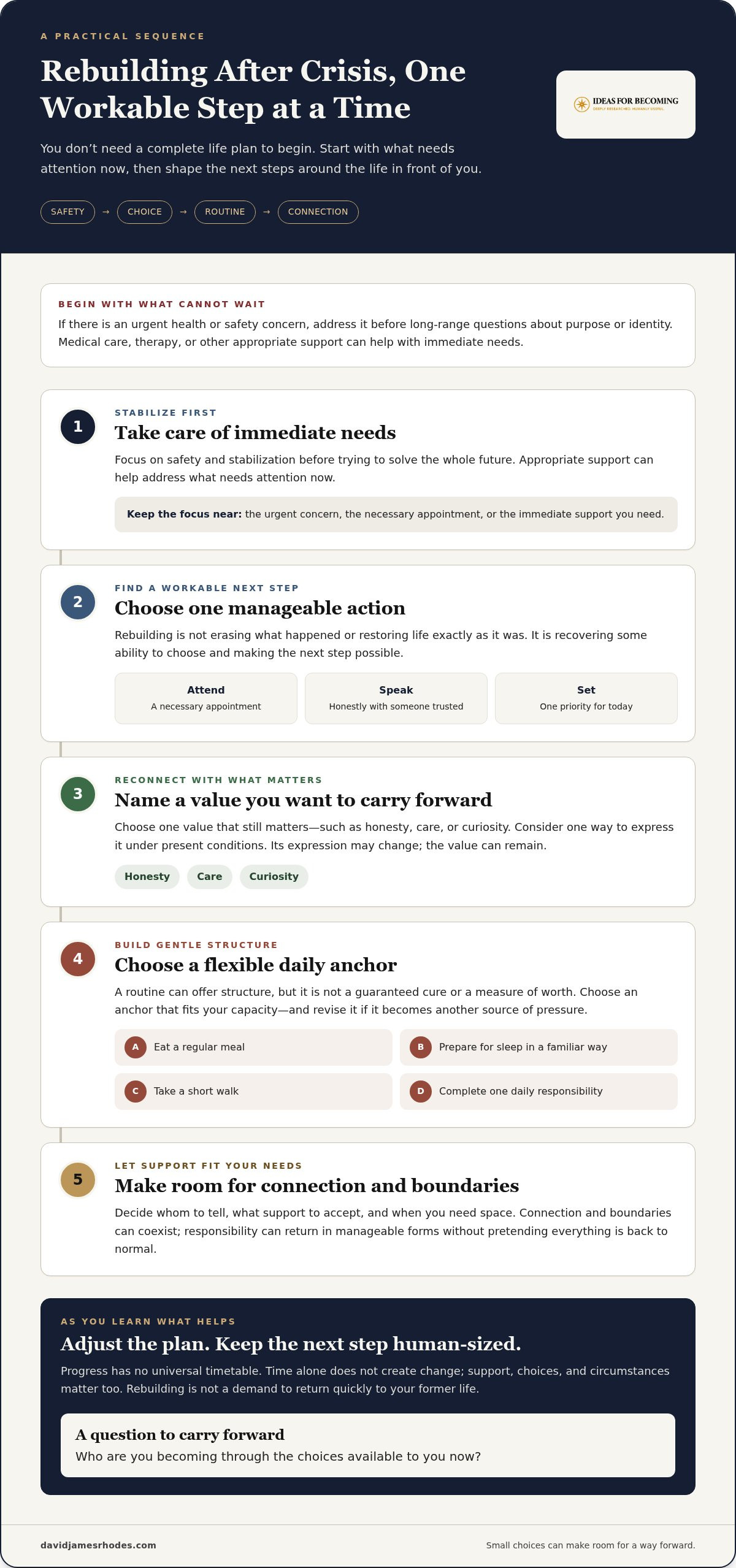
The first task may be immediate safety or stabilization. If there is an urgent health or safety concern, address that before long-range questions about purpose or identity. Medical care, therapy, or other appropriate support can help with immediate needs. Rebuilding is the wider work that may follow or happen alongside that care: restoring routines, connection, responsibility, and the ability to make choices over time.
That distinction matters. Stabilization addresses what cannot wait. Rebuilding asks what can become workable now. The answer may be modest: attending a necessary appointment, speaking honestly with someone you trust, or setting one manageable priority for the day. These steps don’t undo the crisis. They can help you respond to life as it is, while leaving room to decide who you are becoming.
How Identity, Routine, and Relationships Shape Life After Crisis
A disruption can alter more than circumstances. It can change the roles through which you understood yourself: your work, your place in a family, the plans you were pursuing, or how you showed up for others. Identity is also shaped by commitments and repeated choices. When familiar roles shift, it may take time to see which parts of yourself still feel true and which need to change.
You are more than the crisis you experienced; your identity also lives in the values, relationships, and choices you carry forward. That isn’t a demand to feel strong or find a lesson in what happened. It gives you room to ask, at your own pace, “Who are you becoming?”
Who are you when familiar roles have changed?
If work has been interrupted, responsibility might now mean asking for help or considering a different direction. If family needs have changed, care may mean setting a boundary as well as offering support. Try naming one value that still matters, such as honesty, care, or curiosity. Then consider one way to express it under present conditions. The expression may change; the value can remain.
Small routines can create room for steadier choices
Routine can provide structure, but it isn’t a guaranteed cure or a measure of worth. Choose an anchor that fits your capacity: eating a regular meal, preparing for sleep in a familiar way, taking a short walk, or completing one daily responsibility. Keep it flexible. If a plan becomes another source of pressure, revise it.
Relationships can offer practical help and connection, but rebuilding doesn’t require unlimited access to you. Choose whom to tell, what support to accept, and when you need space. Connection and boundaries can coexist. Responsibility can return in manageable forms without pretending that everything is back to normal.
Some people describe positive changes after adversity, a subject discussed as post-traumatic growth. That possibility isn’t a promise. It doesn’t mean distress has disappeared or that hardship was beneficial. Your task isn’t to prove you’ve grown. Notice what support, structure, and choices help you live more fully now. If health or emotional concerns persist or feel urgent, qualified professional support may be important alongside everyday routines.
In rebuilding life after crisis, identity isn’t settled in one decision. It takes shape through repeated acts of care, honesty, and connection. For a broader reflection on becoming through changing circumstances, explore David James Rhodes’s perspective on human becoming.
What Helps, and What Gets in the Way, When Rebuilding After Crisis?
Rebuilding life after crisis can be harder when you expect yourself to quickly become the person you were before. That expectation may come from others or from remembering how easily you once handled ordinary demands. But life may have changed, and your capacity may be different for now. Progress has no universal timetable. Time passing matters, but time alone doesn’t create change; support, choices, and circumstances matter too.
Why “getting back to normal” can become an unfair demand
Comparing yourself with a former version of yourself can hide what you need today. So can measuring your progress against someone else’s visible milestones. Responsibilities still matter, but responsibility isn’t punishment. If a full workday feels beyond reach, ask what part of the day is manageable or what support would make the next responsibility possible. Begin with what is necessary and possible today, not with a demand to prove you’re fine.
Structure can make the day more workable. So can a trusted person who listens without insisting you move faster. Isolation, on the other hand, may leave you carrying every decision alone; overextending yourself may use up the energy needed for steadier steps. There is no universal ranking of coping responses. Solitude can be restorative for one person and isolating for another. Action can help, but pushing through every limit can also make things harder. Notice how a choice affects your wellbeing and ability to meet essential needs.
Support is not weakness, and action is not a substitute for care
Support might mean accepting practical help from family, connecting with a community resource, or speaking with a qualified professional. Different forms of care can serve different needs. Treatment can help create safety and stability; it doesn’t have to answer every question about work, relationships, identity, or purpose. Practical steps and professional care aren’t rivals. You may need both.
The American Psychological Association discusses ways of building your resilience, including connection, wellness, and meaning. These are possible areas to explore, not a checklist or guarantee. Keep what is useful and adapt what isn’t. If you’re already receiving care, don’t replace or stop it on the strength of general advice; discuss treatment decisions with your qualified provider.
A more humane measure of progress is whether your next choices support safety, connection, and a life you can participate in. For a wider reflection on finding a way forward, explore David James Rhodes’s perspective on human becoming.
How to Begin Rebuilding Your Life After Crisis: Practical First Steps
You don’t need to decide what your whole future should look like before you begin. A next step can help you meet this moment without settling every question about what comes next. Start with what is urgent, what support is available, and what small choice feels possible now.
Start with safety, essentials, and one steady point
If you or someone else is in immediate danger, or there is an urgent health need, prioritize safety and seek appropriate emergency or professional help. Purpose and long-range plans can wait. First, attend to what cannot wait.
Then choose one steady point, not a complete new routine. It might be preparing a meal, attending an appointment, or handling one essential task. Identify one trusted person or appropriate support resource, too. You don’t have to carry every decision alone.
Turn an uncertain future into a manageable next decision
Some decisions need attention now. Others can wait until you have more information, support, or capacity. Separating the two can keep uncertainty from turning every choice into an emergency.
A short written reflection may help. Make three headings: What matters? What’s possible today? What needs support? Write one answer under each. Keep the action specific and small enough to attempt, then review what happened and adjust. If it wasn’t possible, that’s information about the plan, not a verdict on you.
- Assess immediate needs. Name urgent safety, health, or practical concerns first.
- Identify support. Consider a trusted person, community resource, or qualified professional.
- Choose one manageable action. Make it clear and suited to your current circumstances.
- Review the result. Notice what helped, what was difficult, and what remains unresolved.
- Adjust. Keep, change, or set aside the step based on what you learned.
This sequence isn’t a test or a fixed prescription. Your circumstances may call for a different order, and professional care may be important for ongoing health concerns. The aim isn’t to force certainty. It’s to create enough room for the next considered choice.
For a broader perspective on navigating life after adversity, consider how rebuilding connects with the ongoing work of human becoming. You can also explore David James Rhodes’s thinking on finding a way forward.
Building a Way Forward: From Immediate Steps to Who You Are Becoming
A workable next chapter isn’t a promise that you’ll become untroubled. Some effects of crisis may remain, and uncertainty may return. Rebuilding life after crisis isn’t measured by never struggling again. Over time, progress may mean being able to participate in parts of life that matter to you, accept support, take responsibility where you can, or understand yourself a little more clearly.
Measure progress by what you can practice, not by a perfect outcome
Notice changes that are easy to overlook: answering a message, keeping an appointment, setting a boundary, returning to a responsibility, or asking for help before a problem grows. These moments don’t prove that everything is resolved. They show what you’re practicing.
Plans may need to change. A difficult day doesn’t erase the effort that came before it, and a setback isn’t proof that rebuilding has failed. Adjust the next step to the conditions you face. Growth isn’t guaranteed by adversity, and there is no universal timetable for becoming steadier. What matters is the care and intention you bring to the choices available to you.
The Way: becoming someone able to create a way forward
There is a larger question beneath practical steps: who are you becoming through the choices, relationships, and responsibilities you continue to shape? In David James Rhodes’s philosophy, The Way is not something you find. It is someone you become. This idea doesn’t offer a quick fix or tell you to make meaning from pain. It points toward human becoming: the ongoing work of forming character and direction through real choices, including choices made with help.
That perspective can sit alongside professional care, not replace it. Therapy, medical care, and other appropriate support may be important parts of rebuilding. A philosophy can help you reflect on how you want to live; it cannot substitute for treatment when treatment is needed.
The Way, David James Rhodes’s guide to this broader philosophy, was released on September 15, 2026, and is available. If you’d like to explore the ideas behind it, begin with The Way’s philosophy of becoming. Then explore The Way as a perspective on creating a way forward, not as a promise that life will become easy.
Take One Grounded Step Toward What Comes Next
Rebuilding life after crisis doesn’t require a return to who you were or a complete plan for who you’ll become. Begin with what matters now: attend to immediate needs, accept appropriate support, and choose one manageable action. Routines, relationships, and responsibilities can help restore a sense of agency, but they should serve your circumstances, not become another measure of worth.
Progress has no universal timetable. A changed plan or a difficult day doesn’t erase what you’ve practiced. Over time, choices and connections can help shape a life that reflects who you are becoming, without asking you to pretend the crisis never happened.
David James Rhodes’s perspective draws on more than four decades of experience across 156 countries. This is lived experience and observation, not clinical evidence. His guide The Way, released September 15, 2026, offers a broader philosophy of becoming, not treatment or a quick fix.
Explore The Way and the idea of becoming. Your next step doesn’t need to answer every question. It only needs to be a step you can take.
Frequently Asked Questions
How do I start rebuilding my life after a crisis?
Start by addressing immediate safety and health needs, then identify one source of support and one manageable action. You might arrange an appointment, ask someone you trust to help with an essential task, or return to one simple daily responsibility. Rebuilding life after crisis doesn’t require a complete plan. Choose a step that fits your circumstances, notice what happens, and adjust without treating difficulty as failure.
How long does it take to rebuild your life after a crisis?
There’s no universal timeline for rebuilding. The effects of a crisis, the support available, and a person’s health and circumstances all differ. Time passing can create room for change, but time alone doesn’t determine what changes or when. Rather than judging yourself against a deadline, notice whether you’re gradually finding workable ways to meet responsibilities, accept support, or reconnect with what matters. Seek qualified help if concerns persist or feel urgent.
Can you rebuild your life without going back to who you were before?
Yes. Rebuilding doesn’t require becoming exactly who you were before a crisis. Your circumstances, roles, or priorities may have changed, and some losses cannot be reversed. You can still carry forward what matters, such as a valued relationship, a personal commitment, or a sense of responsibility, while adapting how it fits your life now. The aim isn’t to erase the past, but to shape a workable future.
What should I do when I feel overwhelmed after a crisis?
Reduce the next demand to something immediate and specific. If you’re safe, pause and name what needs attention first: food, rest, an appointment, or one practical task. Ask a trusted person to help you think through the next step. Put off decisions that can safely wait. If you’re in danger or facing an urgent health concern, seek appropriate emergency or professional support rather than trying to manage it alone.
Is it normal to feel like a different person after a crisis?
It can happen. A crisis may disrupt familiar roles, plans, relationships, or assumptions, leaving you unsure how to understand yourself. People respond differently, so there’s no single expected feeling or timetable. Feeling changed doesn’t mean you’ve lost your identity or failed to recover. Give yourself room to notice what still matters and what may need to adapt. If distress is persistent or interferes with daily life, qualified support may help.
How can I rebuild confidence after a major setback?
Build confidence through small, realistic commitments rather than waiting to feel certain. Choose an action within your present capacity, such as completing one necessary task or asking for help with a difficult decision. Afterward, take stock: what did you manage, and what support would make the next step easier? Confidence may grow as you gather experience, but setbacks can still happen. Adjust the plan instead of treating one hard day as proof you can’t move forward.
Should I seek professional help when rebuilding after a crisis?
Consider professional help if emotional or health concerns persist, disrupt daily life, or feel difficult to manage alone. Seek emergency support for immediate danger or urgent health needs. Qualified care can help with safety, stabilization, and specific concerns; it doesn’t mean you’ve failed or that every life question must be solved in treatment. Trusted relationships and practical support may also matter. If you’re already receiving care, discuss changes to it with your provider.
Frequently Asked Questions
Related Articles

A Meaningful Life After Retirement: Finding Purpose in What Comes Next
Build a meaningful life after retirement through small, intentional choices. Discover practical ways to shape your days and explore who you are becoming next.

Redefining Success After 50: What Deserves Your Time Now
Redefining success after 50 is about deciding what deserves your time now. Clarify your values, evolve your identity, and shape an intentional next chapter.

Who Am I Becoming? A Clearer Way to Understand Your Life
Asking who am i becoming? Explore how daily habits and choices shape your character. Learn to understand your life patterns and take intentional next steps.