
A leader’s resilience isn’t measured by how much pressure they can absorb. Under strain, decisions can narrow, communication can become less steady, and a team may look to one person to carry everyone’s uncertainty. Resilience in leadership asks more than endurance: it means staying clear enough to choose well and human enough to notice what pressure is costing others.
If you’ve felt responsible for holding the room together, that responsibility is real. But resilience isn’t a demand to tolerate harmful conditions or pretend everything is fine. It is the capacity to respond rather than react, speak honestly about difficulty, and keep moving without abandoning yourself or your people.
This article explores what leadership resilience requires in practice: how to steady your judgment, communicate through change, and help your team find its next step. We’ll consider character, relationships, deliberate action, and the boundaries that make sustained effort possible. The question isn’t whether pressure will come. It’s who you are becoming as you lead through it.
Key Takeaways
- Resilience in leadership is the ability to adapt under pressure without losing judgment, purpose, or connection with people.
- Before acting, notice the pressure, pause, separate facts from assumptions, and choose a clear next step.
- Resilience should not mean accepting preventable harm. Consider whether workplace conditions, not just individual habits, need to change.
- Build steadier team practice by setting priorities, communicating clearly, inviting perspective, and adjusting as circumstances shift.
- Pressure can reveal your choices, but it does not define you. Use those choices to shape the leader you are becoming.
What resilience in leadership means when pressure becomes part of the work
Leadership carries a particular weight. A decision may affect people who have little control over the circumstances, while the person making it is expected to sound certain. But confidence alone cannot remove uncertainty. Leading through it calls for judgment, honest communication, and a willingness to adapt as new information arrives.
Resilience in leadership is the capacity to respond and adapt under pressure while retaining sound judgment, connection with people, and a sense of purpose. It is not invulnerability. It does not require constant optimism, and it is not a duty to accept every condition without question. A resilient leader can acknowledge difficulty without letting it dictate every response.
The broader idea of psychological resilience offers a useful starting point: people can adapt in the face of adversity, shaped by personal and environmental factors. In leadership, resilience also has a relational dimension. A leader’s response affects whether others can contribute, raise concerns, and stay connected to the work.
How leadership resilience differs from personal toughness
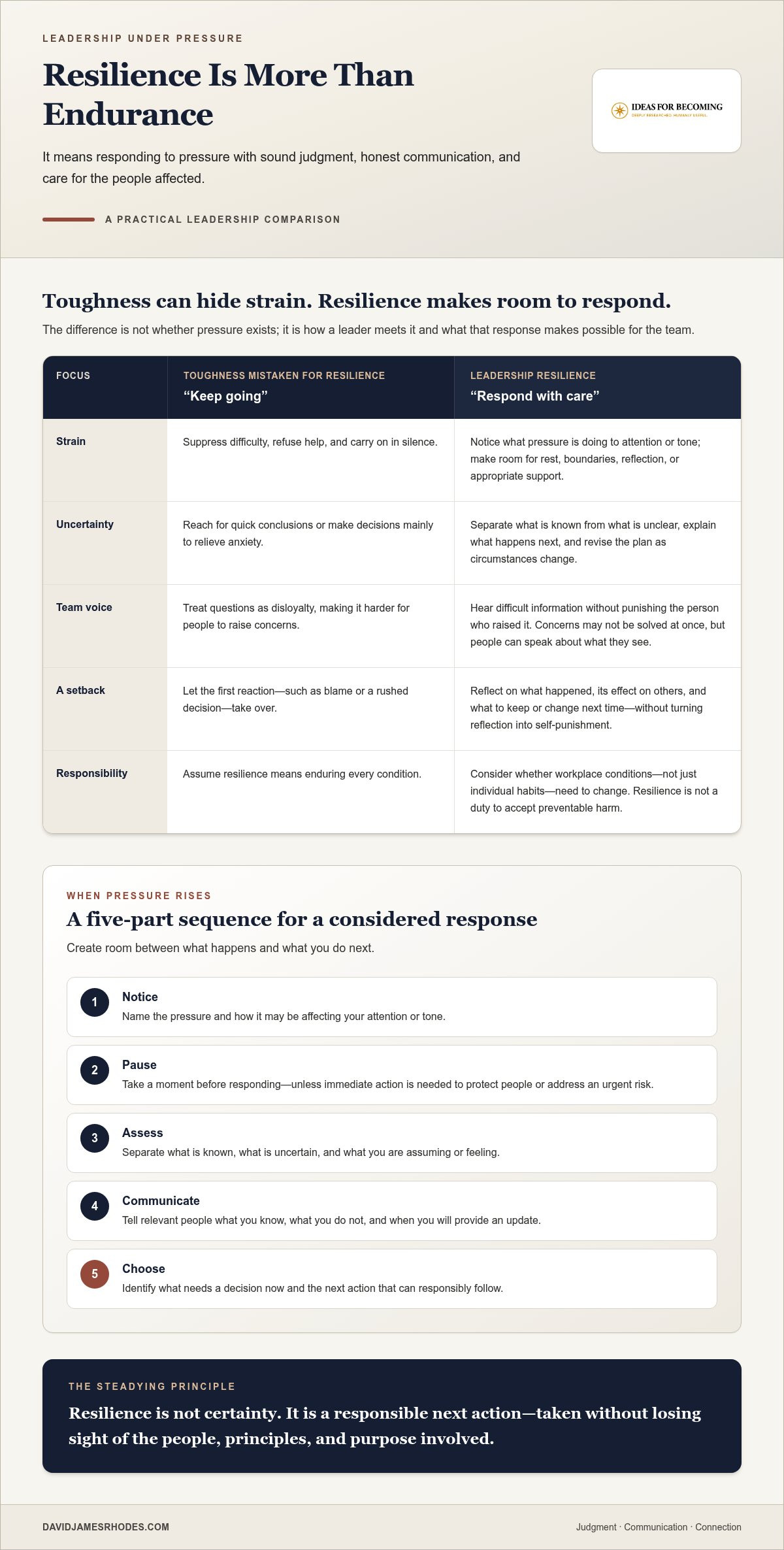
Toughness is often mistaken for silence: suppress the strain, refuse help, keep going. But hiding difficulty can make it harder to notice what is changing or what support is needed. Resilience is more flexible. It can include rest, boundaries, reflection, and asking for appropriate support. These are not withdrawals from responsibility. They can help a leader return to it with greater perspective.
People also notice what leaders do. If questions are treated as disloyalty, a team may learn to withhold them. If a leader can hear difficult information without punishing the person who raised it, honest conversation has room to grow. This does not mean every concern can be resolved at once. It means people can speak about what they see.
Why resilience matters during uncertainty and change
Uncertainty competes for attention. It can lead to quick conclusions, inconsistent messages, or decisions made mainly to relieve anxiety. A leader cannot control every outcome. They can help the group distinguish what is known from what remains unclear, explain what happens next, and revise the plan when circumstances change.
Leadership scenario: A team learns that a major project may be delayed, but the reason and timeline are still uncertain. A steady leader avoids promising an outcome they cannot guarantee. They explain what is known, ask the team to identify immediate risks, and agree on when they will revisit the decision. That is resilience in practice: not certainty, but a responsible next action.
Pressure reveals choices, but it does not define a person. The work is to remain responsive without losing sight of the people, principles, and purpose that make leadership worth carrying.
How resilient leaders respond to stress, setbacks, and uncertainty
Pressure can make the first reaction feel like the only possible response. A missed commitment, a sudden change in direction, or a difficult conversation may invite blame or a rushed decision. Resilient leaders create room between what happens and what they do next. That space cannot guarantee a good outcome, but it gives them a chance to choose with more care.
A pause turns pressure into a considered response when you use it to see clearly, hear others, and choose the next responsible action.
Try this sequence when the stakes feel high:
- Notice: Name the pressure and how it may be affecting your attention or tone.
- Pause: Take a moment before responding, unless immediate action is necessary to protect people or address an urgent risk.
- Assess: Separate what is known, what is uncertain, and what you’re assuming or feeling.
- Communicate: Tell relevant people what you know, what you don’t, and when you’ll provide an update.
- Choose: Identify the decision that needs to be made now and the next action that can responsibly follow.
This sequence can steady your thinking, but it cannot remove risk or make uncertainty disappear. For a further perspective on how leaders can build leadership resilience, Harvard Business School Online offers additional guidance.
How leaders can make clearer decisions under pressure
Before acting, ask: What do I know? What remains uncertain? What requires a decision now? These questions help distinguish urgency from anxiety. Then seek perspectives from people close to the issue. A colleague may notice a missing fact or challenge an assumption you have not had the distance to question. Listening does not transfer your responsibility. It helps you carry it with more information and less isolation.
How reflection and relationships support resilience
After a setback, forced positivity can obscure what happened. Reflection is more useful when it makes room for disappointment and learning. Ask: What did I expect? What actually occurred? What effect did my decision have on others? What would I keep or change next time? The purpose is not to punish yourself. It is to understand the consequences and reconnect with the people affected.
A trusted colleague can help you see blind spots while leaving the decision in your hands. This is practical reflection, not a substitute for clinical care when that is needed. Resilience in leadership grows through deliberate choices and honest relationships, not through pretending that difficulty has no cost.
Leaders looking to explore these questions in their own work can learn more about leadership and life advisory.
Does resilience mean enduring everything? A more honest leadership view
No. Resilience should never become a polite name for enduring preventable harm. If expectations are persistently unclear, workloads cannot be met, or important information is routinely withheld, telling people to become more resilient avoids the harder question: what needs to change?
Resilience helps you adapt to difficult circumstances; it does not require you to accept every circumstance as inevitable. A leader may need to set a boundary, ask for help, raise a concern, or change course. Those actions are not evidence of weakness. They can be responsible responses to reality.
Individual capacity matters, but so do the conditions in which people work. A person can reflect, communicate, and seek support, yet still face constraints beyond their control. Any honest account of resilience in leadership must hold both truths: people have choices, and workplace practices shape which choices are possible.
When individual resilience is not the whole answer
Look for patterns, not just personal reactions. If the same confusion, missed handoffs, or excessive demands recur, the issue may involve how work is organized rather than one person’s ability to cope. Leaders can examine what falls within their influence: clarify priorities, make responsibilities explicit, improve how information is shared, or raise wider concerns with those who can address them. This is not a diagnosis of the team. It is a practical inquiry into what is happening.
Self-awareness and continued learning can help leaders build leadership resilience. But personal development should not become a substitute for examining preventable problems in the environment.
How to respond without denying difficulty
Honest communication can name pressure without turning uncertainty into panic. A leader might say: “The current workload is putting these priorities at risk. Here’s what we know, what remains unclear, and what we can change today.” The message is direct. It does not promise that everything will be fine, and it gives people a clearer basis for action.
Then identify practical limits and available support. What can be paused? Which commitments need to be reset? Who should be involved in resolving the issue? If the decision exceeds your authority, say so and take the concern to the person or group that can act. Boundaries are more useful when paired with clear communication and a responsible next step.
Resilience is not a fixed trait that some leaders possess and others lack. It is an ongoing response shaped by choices, relationships, and circumstances. Sometimes that response means continuing. Sometimes it means asking for help, changing the plan, or naming what cannot continue unchanged. The measure is not how much a leader can silently carry, but whether they can face the conditions clearly and respond with care.
How to build leadership resilience through daily choices and team practice
Resilience is shaped by repeated choices, not a single heroic response. A useful practice can be simple enough to return to when work becomes unsettled:
- Establish priorities: Name what matters most now and what can wait.
- Communicate clearly: Share what has changed, what remains uncertain, and when people can expect an update.
- Invite perspective: Ask those closest to the work what you may be missing.
- Review: Notice what the decision changed for the task and the people involved.
- Adjust: Keep what is working, revise what is not, and clarify the next responsibility.
This is not a formula for controlling outcomes. It is a way to make the next choice more deliberate. Individual habits such as taking time to reflect or seeking support may help some leaders. They are not universal prescriptions, and they cannot replace changes to unreasonable workloads or unclear expectations.
A repeatable practice for the individual leader
At the start or end of a demanding day, consider a brief review: What is placing pressure on me? Which responsibilities are mine? What is the next meaningful action? If you feel isolated, identify one trusted person who can offer perspective or support. Later, notice what has changed and what remains within your control. The aim is not to carry everything alone, but to meet your part with greater clarity.
How leaders can strengthen resilience across a team
Teams are better able to respond when expectations are clear, updates are honest, and difficulty can be discussed respectfully. Shared responsibility matters, too. If every question and decision must pass through one leader, that person becomes a bottleneck and the team has fewer chances to contribute. Invite people to own defined parts of the work, raise risks early, and help shape adjustments.
For example, if a deadline is at risk, a leader could simply demand longer hours. Or they could clarify which deliverables matter most, ask the team what is blocking progress, and agree on what can be delayed. The second choice addresses the task while recognizing the people doing it. It may not remove the pressure, but it gives the team a shared basis for action.
For a deeper look at how work and life intersect in leadership, read this leadership and life integration guide. To explore how these choices relate to your own leadership practice, learn about leadership and life advisory. Resilience in leadership grows through deliberate action, honest relationships, and the willingness to adjust when reality changes.
Leadership resilience and the person you are becoming
Pressure can reveal the choices available to you, but it does not define your character. A difficult decision may go badly. A successful outcome may still come at a cost. Neither moment tells the whole story of a leader. What matters is how you respond, what you learn, and whether you remain willing to take responsibility for the effects of your choices.
What pressure can reveal about leadership and character
Character is not a claim of perfection. It is expressed through repeated choices: whether you tell the truth when the facts are uncomfortable, listen when someone challenges your view, and treat people with respect when control is limited. These choices do not always feel dramatic. Often, they appear in ordinary moments when a leader decides whether to acknowledge uncertainty or conceal it.
Resilience in leadership is not only about recovering your own footing. It is also about how you relate to others while finding it. For a wider reflection on leadership through adversity, consider how setbacks can become part of rebuilding and becoming, without reducing a person to what they have endured.
Resilience as an ongoing process of becoming
No single setback completes a leader’s development. Neither does a success. Each experience offers choices, and each choice can shape how you lead next time. You may become more candid, more attentive to the cost of a decision, or more willing to change direction when new information demands it. Growth does not mean getting everything right. It means staying responsible for what comes next.
This is close to the central idea of The Way, David James Rhodes’s guide to human becoming: the path is not simply something to find, but something a person becomes through character, relationships, and deliberate action. Leadership is one place that idea becomes visible, not in a perfect performance, but in the work of creating a way forward with other people.
Take one recent pressured decision and write down what you knew, how you treated the people affected, and what you would carry into the next decision. If you’d like to explore this larger question of becoming, spend time with The Way. Then pause with the question beneath every leadership choice: Who are you becoming?
Lead through pressure with clarity and humanity
Resilience in leadership is not endless endurance. It is the capacity to respond thoughtfully, stay connected to people, and adapt without treating preventable harm as something everyone must simply tolerate. When pressure rises, a pause can help you separate facts from assumptions and choose a responsible next step.
That work is both personal and shared. Leaders can review their choices, ask for perspective, and set practical boundaries. Teams need clear priorities, honest communication, and responsibility that does not rest on one person alone. Small, deliberate actions can help people move forward without pretending the pressure has no cost.
David James Rhodes’s perspective is informed by more than four decades of experience across 156 countries, spanning leadership, entrepreneurship, international finance, and behavioral health. His work, including The Way, connects leadership with the wider process of human becoming: the character we practise, the relationships we build, and the person we choose to become through our actions.
Choose one pressured decision from this week. Write down what you knew, what you needed to learn, and one action you can take with care. To explore The Way and David’s work, visit David James Rhodes’s website. You don’t have to control every outcome to lead with purpose. Start with the next choice.
Frequently Asked Questions
What does resilience in leadership mean?
Resilience in leadership is the capacity to respond to difficulty with judgment, adaptability, and connection. It does not mean avoiding emotion or being untouched by pressure. A leader might acknowledge uncertainty, seek a trusted colleague’s perspective, and choose a responsible next step. Resilience also means looking honestly at the conditions around the challenge, rather than blaming individuals for problems they cannot control.
Is resilience an innate leadership trait?
No. Resilience should not be treated as a fixed quality that some people have and others lack. Leaders can practise reflection, draw on relationships, learn from experience, and adapt their responses over time. Circumstances matter, too. Clear expectations and supportive working relationships can affect how people respond to pressure. Individual effort can help, but it cannot guarantee success or carry every responsibility for workplace conditions.
Can a leader be resilient without hiding stress?
Yes. Resilience does not require pretending that pressure has no effect. A leader can say what is known, name what remains uncertain, and explain what will happen next. For example, if a decision is delayed, a clear update can acknowledge the impact without suggesting that the outcome is settled. Leaders do not need to share every private concern; they can be honest while protecting appropriate boundaries.
How can leaders build resilience at work?
Start with practices suited to the actual challenge. Clarify priorities, separate known facts from assumptions, communicate changes, invite relevant perspectives, and review what can be adjusted. A brief check-in with a trusted colleague may help reveal a blind spot. These actions support thoughtful responses, but they do not replace addressing unclear expectations, unmanageable demands, or other workplace problems a leader has the authority to change.
Does resilience mean tolerating a toxic workplace?
No. Resilience is not an obligation to accept harmful conditions indefinitely. It may involve setting boundaries, seeking appropriate support, naming a problem, or taking practical steps toward change. Leaders can also examine what falls within their influence and avoid placing organizational responsibility on individuals. The options available depend on the circumstances, but enduring difficulty in silence is not the only possible response.
How can leaders help their teams become more resilient?
Leaders can support teams by setting clear expectations, communicating honestly, listening to concerns, and sharing responsibility. Acknowledge difficulty without promising outcomes you cannot control. For example, if priorities change, explain what is known, invite the team to identify immediate risks, and clarify who owns each next step. No single practice guarantees adaptation, but consistent, respectful communication can help people respond with greater understanding.
Frequently Asked Questions
Related Articles

Rebuilding Life After Crisis: A Grounded Path Forward
Rebuilding life after crisis is not about who you were. Discover practical, grounded steps to regain agency and shape who you are becoming at your own pace.

A Meaningful Life After Retirement: Finding Purpose in What Comes Next
Build a meaningful life after retirement through small, intentional choices. Discover practical ways to shape your days and explore who you are becoming next.

Redefining Success After 50: What Deserves Your Time Now
Redefining success after 50 is about deciding what deserves your time now. Clarify your values, evolve your identity, and shape an intentional next chapter.