
Life can change before a person is ready to name what has changed. The themes in the Life After Anything guide meet that reality: choices shape a life, but they don’t have to define every step that follows.
After disruption, readers often wonder whether happiness, hope, or a fresh start is still possible. This guide explores those questions without suggesting that change is simple. Its themes include second chances, self-discovery at any age, and the quiet work of deciding what matters now.
Growth isn’t about returning to an earlier version of yourself. It’s about understanding how experience has changed you, choosing how to respond, and becoming someone able to move forward. The guide explores how choices influence direction, why hope can matter after difficulty, and what rebuilding can ask of us. Beneath each theme is a larger question: who are you becoming?
Key Takeaways
- See how choices shape a life without assuming that one decision defines every possibility that follows.
- Consider happiness as something connected to meaning, relationships, and the way you choose to live.
- Understand how hope and second chances can make room for a new direction after disruption.
- Recognize that self-discovery can continue at any age, as experience changes what matters.
- Connect the guide’s themes of rebuilding and growth to the wider question of who you are becoming.
Choices and life paths
Life After Anything is a guide to rebuilding after disruption, not a fictional story about grief. It considers loss through a wider question: how can someone find meaning and direction after life changes?
The guide focuses on the reader’s lived experience, not a named city, historical period, or fictional landscape. A change in work, a strained relationship, or an unexpected loss can each prompt someone to decide what comes next.
Its recurring themes are choice, identity, rebuilding, and meaning. For example, leaving a familiar role may mean reconsidering which values and commitments still guide you.
The tone is reflective and practical, and the genre is nonfiction about rebuilding after disruption. It isn’t a novel with characters, a plot, or a fictional setting.
Rather than rely on reviewer statements or a shared critical verdict, it’s more useful to consider the guide’s themes directly: how people respond to change and shape a way forward.
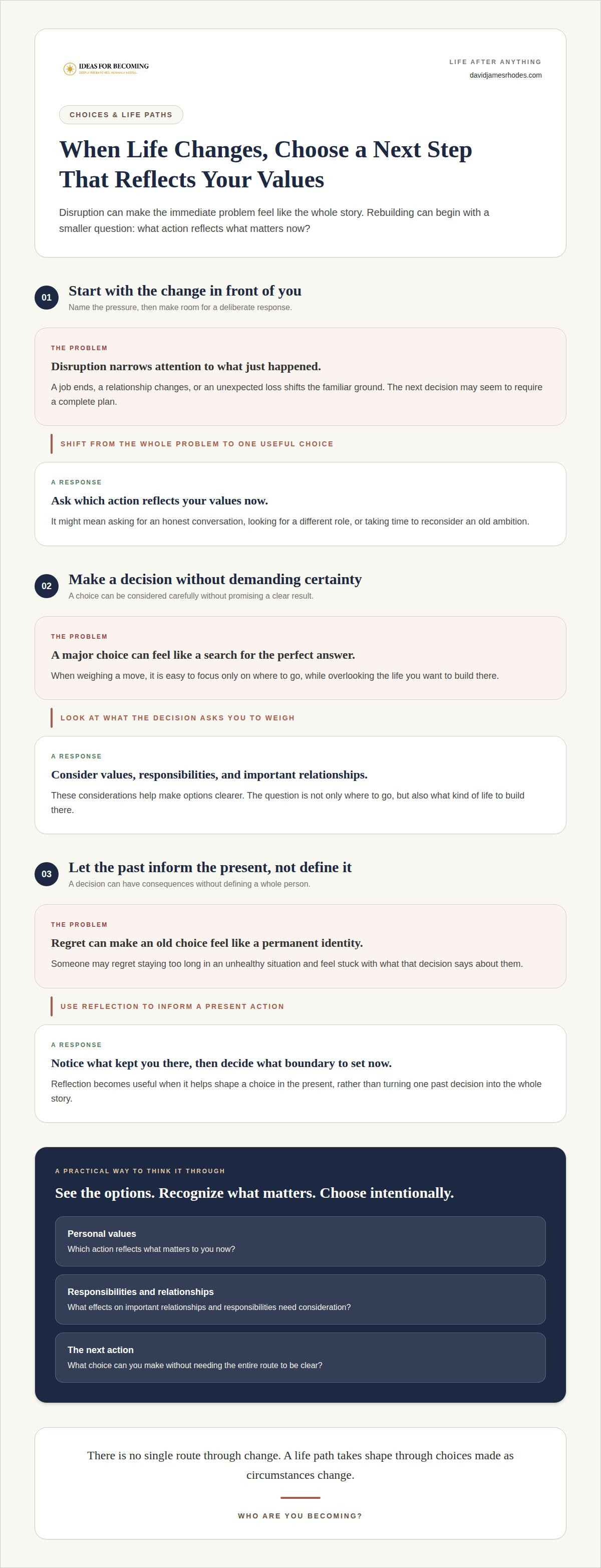
That distinction matters when considering life choices. A guide can explore decisions without promising that every choice will produce a clear result. Someone weighing a move, for instance, might consider personal values, responsibilities, and the effects on important relationships. The question isn’t only where to go, but also what kind of life to build there.
Disruption can narrow attention to the immediate problem: a job ends, a relationship changes, or a familiar identity no longer fits. The next decision may seem to require a complete plan, but rebuilding can begin with a smaller question: which action reflects your values now? It might mean asking for an honest conversation, looking for a different role, or taking time to reconsider an old ambition.
The guide’s focus on becoming also changes how we understand past decisions. A choice can have consequences without defining a whole person. Someone who regrets staying too long in an unhealthy situation can consider what kept them there, then decide what boundary to set now. Reflection becomes useful when it informs action in the present.
There is no single route through change. A parent returning to work, a leader facing failure, and someone grieving a loss may each need to make different decisions. The shared task is to see the options clearly, recognize which costs matter, and choose intentionally. A life path isn’t simply discovered. It takes shape through choices made as circumstances change.
The reviewer estimates that Ursula experiences about 15 different versions of her childhood. That detail offers a contrast to the practical decisions considered here: a life path can be viewed not only through what happens next, but through the ways the past is understood. Different versions of childhood invite attention to identity, memory, and the stories people use to make sense of change. They do not supply a universal route forward; they underline how personal any account of becoming can be.
Finding happiness
After disruption, happiness may feel distant or hard to recognize. Life After Anything considers it alongside meaning, identity, and the life a person chooses to shape. That leaves room for ordinary moments: a quiet breakfast, a friend’s message, or finishing a necessary task can matter even when bigger problems remain unresolved.
Happiness doesn’t have to mean constant pleasure or a return to an earlier life. Someone whose work has ended unexpectedly may still feel uncertain while finding satisfaction in helping a family member, learning a skill, or restoring a daily routine. These experiences don’t erase the loss. They show that difficulty and connection can coexist.
To explore happiness in practical terms, notice what gives an ordinary day meaning. Name one moment that felt worthwhile, such as an honest conversation with a sibling. Then identify what made it matter: honesty, affection, usefulness, or shared attention. That detail offers a clearer guide than an abstract demand to “be happy.” It points to something you can recognize and make room for again.
Meaning varies from one life to another. A parent caring for a child may value a calm evening at home. Someone returning to work after a long absence may find purpose in completing one task with care. Neither example means the circumstances are easy. Both show how happiness can be connected to relationships, contribution, and a sense of taking part in your own life.
The guide’s focus on rebuilding also distinguishes happiness from denial. Someone mourning a relationship doesn’t have to pretend the ending feels welcome. They can miss what was lost and still accept an invitation to dinner. Grief may be present in the afternoon, alongside a moment of warmth with a friend. Honest attention makes room to acknowledge both.
Try a simple reflection at the end of the day: write down a moment of connection, an action aligned with a personal value, and something that needs attention tomorrow. For example, someone might note a supportive call, keeping a promise, and an overdue conversation. This isn’t a formula for guaranteed happiness. It’s a way to notice where meaning already appears and where a deliberate choice might help.
Happiness, then, isn’t a final destination that removes uncertainty. It can be a quality of attention, a valued relationship, or an action that fits the person you’re trying to become. The guide invites readers to notice these quieter sources of fulfillment while rebuilding. The question isn’t whether every day feels good, but whether the life taking shape still makes room for what matters.
Second chances and hope
In Life After Anything, resilience and healing are part of rebuilding after disruption. Hope matters because it helps someone facing a changed life consider what to do next.
Renewal Through Second Chances
A second chance is an opportunity to choose differently after circumstances or earlier decisions have changed your direction. It matters because one painful outcome doesn’t have to determine every future choice. Someone whose career has ended, for example, can reconsider what work means and take a first step toward a different role.
Hope isn’t certainty that a situation will improve. It’s a willingness to act while the outcome remains unclear. Someone rebuilding after separation might arrange a practical conversation, reconnect with a trusted friend, or establish a new routine. Each action makes room for possibility without denying what has been lost.
A second chance also involves responsibility. Someone who regrets withdrawing from family might begin with a sincere apology and a steady effort to listen. Repair may take time, and another person’s response is beyond their control. The value lies in choosing caring conduct now, rather than treating a past failure as the only account of who they are.
Resilience and Emotional Healing
Resilience means continuing to respond to difficulty, while healing involves living with its effects. Both matter because rebuilding takes more than making a new plan. Someone grieving a major change may need to acknowledge sadness, accept support, and still take care of a necessary task that day.
After losing a familiar role, for example, someone might name what feels uncertain, talk with a trusted person, and choose one manageable responsibility. These actions don’t erase grief. They help maintain connection and agency during a period of adjustment. The guide makes space for pain without making it someone’s whole identity.
Healing can also change how someone understands a setback. A decision that went badly may reveal a boundary, a neglected relationship, or a value worth protecting. Reflection becomes useful when it leads to a different choice, such as setting limits at work or asking a sibling for an honest conversation. Resilience isn’t pretending nothing happened; it’s continuing with greater awareness.
Together, hope, resilience, and healing describe a grounded kind of renewal. Someone can acknowledge a loss, identify available support, and make a deliberate choice toward the life they want to build. The next step may be modest, but its importance lies in the direction it represents.
Moving forward involves taking deliberate steps toward a future that is still taking shape. Life After Anything explores second chances, hope, and rebuilding after disruption. This perspective leaves room for change at every stage: someone may find meaning in a small act of care, a renewed connection, or a choice that better reflects who they want to be. The next step needn’t resolve everything. It can simply show a willingness to stay engaged with life, even without certainty. In this way, hope becomes a practice of attention and choice, making room for possibility alongside the reality of loss.
Self-discovery at any age
Life After Anything is a guide to rebuilding, not a novel with fictional characters. It explores how people can rediscover themselves at any age, including after a major change.
Self-Discovery Across Life Stages
Self-discovery is the ongoing work of recognizing what matters as circumstances and responsibilities change. It matters because an old identity may no longer describe the person you’re becoming. A parent whose children have left home, for example, might reconsider how to spend time, contribute, and define a meaningful day.
A change in role can reveal values that routine once concealed. Someone who leaves a demanding job may discover that mentoring colleagues mattered more than status. Someone facing retirement may choose to volunteer, study, or strengthen family ties. These aren’t instructions to abandon past commitments. They show how to consider what still feels important and make choices that fit the present.
Age doesn’t close the question. A younger adult changing direction might reconsider what success means after an early plan falls away. Someone later in life may find that a long-held ambition still matters, or that it belongs to an earlier version of themselves. Either way, self-discovery can begin with a specific observation, such as feeling more engaged while helping others than while pursuing recognition.
Character Change and Growth
Character change describes how a person’s actions and priorities evolve through experience. It matters because self-understanding becomes meaningful when it influences how someone lives. A person who notices a pattern of avoiding difficult conversations, for instance, can choose to speak honestly and listen with care.
This guide has no fictional main characters who change over the course of a plot. Instead, readers can consider their own development through concrete situations: a leader responding to a setback, a parent adapting to an empty home, or someone rebuilding after a relationship ends. Each situation involves changed circumstances and a chance to reconsider identity.
Reflection can make that shift more deliberate. Name a role that has changed, identify a value that still matters, then choose an action that expresses it. A former manager might miss leading a team but find another way to mentor. A caregiver might need to balance family responsibilities with renewed attention to personal interests.
Growth doesn’t require rejecting an earlier self. You can honor past choices while learning from them. Someone who once measured progress through professional achievement may later place greater value on health, friendship, or contribution. The useful question is whether your actions reflect what matters now. Self-discovery remains possible because identity is shaped not only by what happens, but also by how you respond.
Who wrote the Life After Anything guide?
David James Rhodes wrote Life After Anything, a guide about rebuilding after disruption. He is an author, global executive, entrepreneur, founder, and advisor. His work examines how people respond to change, find meaning, and become who they are capable of becoming.
Rhodes’s perspective draws on more than four decades of experience across 156 countries. His work has included international finance, leadership, entrepreneurship, and behavioral health. Those experiences inform his observations about ambition, adversity, and the decisions people face when familiar plans no longer fit.
That background gives the guide a wider frame than one particular kind of loss. Someone might be dealing with a changed career, a disrupted relationship, or a new responsibility. Each situation raises practical questions about identity and direction: what still matters? Which commitments remain meaningful? What action would reflect those values now?
Experience isn’t the same as scientific proof. Rhodes’s global work informs his perspective, but it doesn’t mean every reader will respond to disruption in the same way. One person may find purpose through service, while another needs time to reconsider a role or relationship. The guide is best approached as a reflective perspective, not a universal prescription.
The subject also connects to Rhodes’s broader interest in human becoming. A changed circumstance can unsettle an old definition of success. A leader whose role has ended, for instance, may reconsider whether status, contribution, relationships, or learning matters most. The question shifts from finding a perfect path to becoming someone able to make considered choices.
That focus helps explain why the guide doesn’t rely on fictional protagonists or a plot. Its subject is the reader’s life and the choices that follow disruption. Someone facing a difficult transition can use its themes to consider what has changed, what still matters, and what a meaningful next step could look like.
Rhodes’s authorship may interest readers seeking a perspective shaped by leadership, behavioral health, and the experiences of people rebuilding their lives. It also sets expectations: this is a guide to reflection and rebuilding, not a clinical treatment plan or a promise of easy answers. Readers can consider its ideas alongside the realities of their own circumstances and relationships.
Read with one concrete situation in mind, such as a career change or strained relationship. Identify the question it raises about identity, then consider which value could guide your next decision. This keeps Rhodes’s reflections connected to lived choices and returns to the central work of becoming: deciding through action who you are becoming.
David James Rhodes
David James Rhodes connects rebuilding after disruption to a wider question: who are you becoming? His work treats growth as more than choosing a new direction. It asks what character, purpose, and responsibility can help someone create a way forward.
The Way develops this philosophy for people facing change, pursuing goals, or reconsidering what matters. For readers reflecting on choices after disruption, it offers a broader way to think about identity and action. Keynote Speaking and Leadership & Life Advisory bring related ideas into conversations about leadership, life, and becoming.
These perspectives can be useful when a transition raises questions that a practical decision alone can’t settle. What values should guide the next step? What kind of person do you want your choices to express?
If you’d like to continue the conversation, contact David James Rhodes.
Choose the Person You Become
The themes in Life After Anything point toward a decision each reader must make: how to meet what comes next. A new direction doesn’t need to resolve every uncertainty. It can begin with one choice that reflects what matters now.
That question also connects to David James Rhodes’s wider work on human becoming. The Way explores the philosophy behind the idea, while Keynote Speaking and Leadership & Life Advisory bring related perspectives to conversations about growth, leadership, and change. These offerings are relevant when reflection extends beyond a single transition to how someone leads or lives.
You don’t need a complete map before taking a considered step. Start with the value you want your next decision to express, then give that choice room to shape what follows.
If you’d like to explore the question further, contact David James Rhodes. The next chapter begins with the person you choose to become.
Frequently Asked Questions
What is Life After Anything about?
Life After Anything is a guide by David James Rhodes about rebuilding when life changes. It explores how people can respond to disruption and shape what comes next, rather than treating a difficult event as the end of their story. Someone facing an unexpected career change, for example, might use its ideas to reflect on identity, responsibility, and what they want their next chapter to express.
What are the main themes in Life After Anything?
The central themes include choices, happiness, second chances, hope, resilience, and self-discovery. Together, they invite readers to consider how they want to live after disruption, not only what they want to leave behind. Someone deciding whether to return to a familiar role or explore a new direction might use these ideas to consider which choice better reflects their values and the person they hope to become.
Frequently Asked Questions
Related Articles

Inspirational Books for Holistic Personal Growth and Steady Habits
Explore inspirational books for holistic personal growth, and learn how mindfulness and steady habits support change across daily life in everyday practice.

Books on discovering meaning through adversity: choose a path
Explore Books on discovering meaning through adversity, from purpose and resilience to grief and mortality, and choose a guide that fits what you need now.
Use 'Life After Anything' Exercises to Find Direction
Use Life After Anything practical exercises to explore ambitions, natural strengths, future vision, and life patterns, then take one small step toward direct...