
Rock bottom is not a foundation. It is a clearing. It's the place where the noise of your previous success finally stops. It leaves only a cold, expansive silence. You may feel that your identity was buried under the weight of what you lost. Perhaps you fear that finding purpose after rock bottom is a luxury you can no longer afford. This feeling is common. It's heavy. It's real.
We are often told that hitting bottom is the end of the fall. In reality, it's the beginning of a deliberate, somber evolution. This article deconstructs the myths of the "bottom" to offer a dignified framework for your reconstruction. You'll learn that purpose isn't something you find waiting in the debris. It is something you forge with steady, quiet intent.
We will explore how to move beyond mere recovery into a permanent state of human becoming. We'll examine the silence of transition and the strategic shift from who you were to who you are meant to be. The way back is closed. The way forward is yours to build.
Key Takeaways
- Rock bottom is a threshold, not a floor. It's the clearing where your old identity dissolves to make space for the new.
- Purpose isn't a hidden object waiting in the wreckage. You'll learn the process of finding purpose after rock bottom by forging a new narrative through action.
- High-achievers must learn to exist without their previous labels. Rebuilding requires a framework of dignity that doesn't rely on global titles or past wins.
- Navigation requires radical acceptance. You must look at the current wreckage without judgment before you can begin the intentional process of human becoming.
- The goal is not to return to who you were. It's to move from recovery to a state of being, leading your life with quiet authority.
The Cliché of the Crash: Why "Hitting Rock Bottom" is Misunderstood
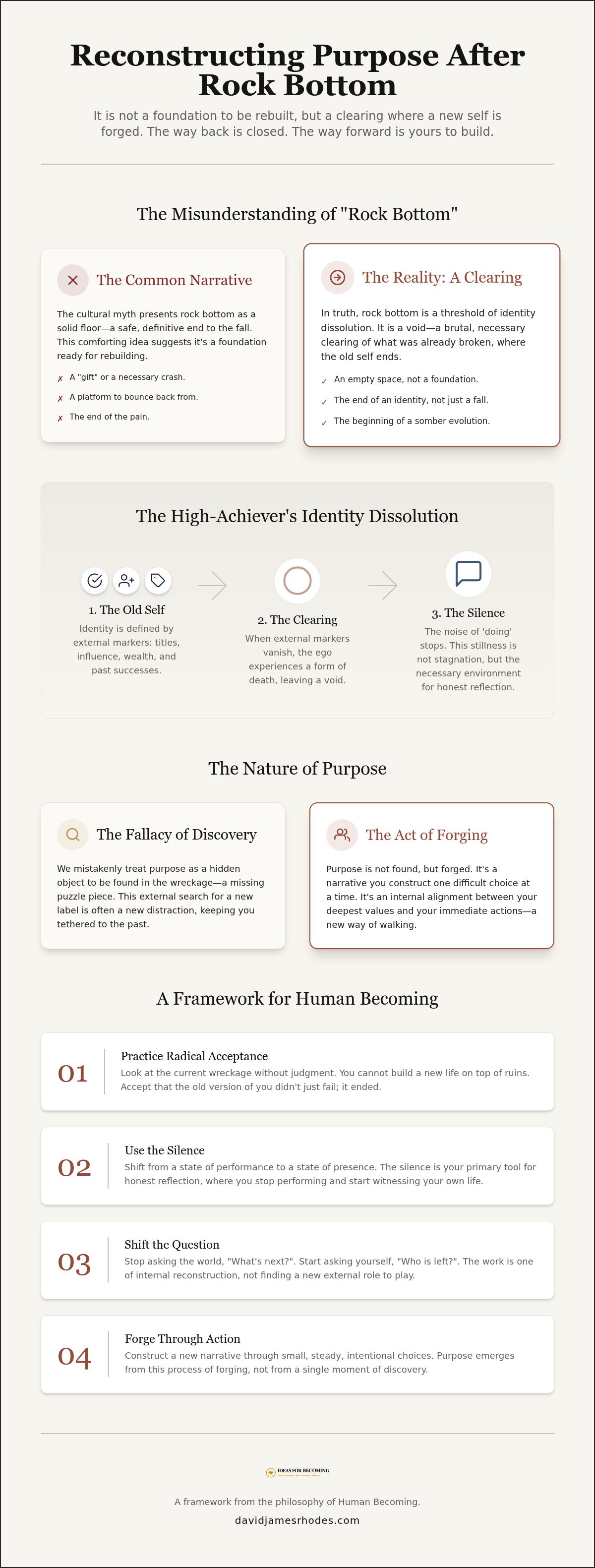
The cultural narrative of "hitting rock bottom" is often sanitized. It's presented as a solid floor where one finally stops falling. This is a comforting, yet dangerous, simplification. Rock bottom is not a foundation. It is a threshold of total identity dissolution. It's the moment when the external structures of your life, your titles, your wealth, and your influence, finally give way. What remains is not a platform for building, but a void.
Motivational tropes often frame this collapse as a "gift." This language is insulting to those standing in the wreckage. A clearing is not a wrapped present. It is a brutal, necessary removal of what was already broken. Standard encouragement fails when the stakes are high because it seeks to bypass the pain. True transformation requires you to sit in the clearing. You must acknowledge that the way back is gone. The process of finding purpose after rock bottom begins here, in the cold reality that the old version of you didn't just fail; it ended.
The Threshold of Identity Dissolution
For high-achievers, identity is often a collection of external markers. When these markers vanish, the ego experiences a form of death. You feel stripped. You feel exposed. This dissolution is painful, but it's essential. You cannot build a new life on top of ruins. The "old you" was designed for a world that no longer exists. To move forward, you must accept the necessity of the clearing. It's the only space where a more authentic self can emerge. This isn't about recovery. It's about evolution.
The Weight of Silence
When the noise of "doing" stops, the silence can be deafening. This isolation is where most people falter. They mistake this stillness for being stuck. They feel paralyzed by the absence of their former momentum. However, there's a profound difference between stagnation and a state of becoming. This silence is your primary tool for honest reflection. It's the environment required for post-traumatic growth to take root. Within this quiet, you're no longer performing for a global audience or a corporate board. You're finally witnessing your own life. This is where the work of finding purpose after rock bottom shifts from a search for "what's next" to an inquiry into "who is left."
Myth: Purpose is a Hidden Object You "Find" in the Wreckage
The search for purpose often begins with a fundamental mistake. We treat it as a destination. We imagine a hidden object waiting to be unearthed from the ruins of a career or a relationship. This is the fallacy of discovery. It suggests that your life is a puzzle with a missing piece. It isn't. Your life is a story that has been interrupted. The search for a "hidden" purpose is often just a search for a new distraction.
When you are standing in the clearing of a major life transition, the pressure to find your calling can be paralyzing. You look for a sign. You wait for an "Aha!" moment that never arrives. This waiting is a form of secondary trauma. It keeps you tethered to the wreckage. It forces you to look backward when you should be looking inward. You cannot find what has not yet been built.
The Fallacy of Discovery
Looking "out there" for a new identity is an act of desperation. It is an attempt to replace one external idol with another. If you were once a global executive and now seek to be a "creator" or a "consultant" just to fill the void, you are still operating from the same ego-driven framework. You have changed the costume. The actor is still wearing a mask. You are simply seeking a new label to hide the dissolution of the old one.
True purpose is an internal alignment between your deepest values and your immediate actions. It is a frequency you tune into, not a prize you win.
Research from the Greater Good Science Center indicates we can renew our sense of purpose by shifting our perspective toward contribution and connection. For the high-performer, this shift must be radical. It requires moving from a state of performance to a state of presence. You must stop asking what the world wants from you and start asking what you require of yourself.
Purpose as an Act of Forging
You do not find purpose. You forge it. It is a narrative you construct one difficult choice at a time. This is the essence of human becoming. In the silence that follows a crash, you are not looking for a new path. You are looking for a new way to walk. You are learning to navigate without a map.
Finding purpose after rock bottom is a process of internal reconstruction. It is about the slow, methodical development of integrity. It asks a different question: who are you becoming through this specific struggle? Character is the byproduct of this friction.
The goal is not to reach a finish line. The goal is to move with quiet authority through the unknown. Purpose is the byproduct of living with intent. For those ready to begin this intentional navigation, the principles outlined in The Way provide the necessary scaffolding. You are not lost. You are currently being formed.
Reconstructing Identity: Rebuilding Without the Old Labels
For the high-performer, identity is often an external architecture. It is a collection of titles, board seats, and global accolades. When this structure collapses, you aren't just losing a career. You're losing the very language you use to describe yourself. The silence that follows is terrifying because it leaves you nameless. You are no longer the "global executive" or the "successful founder." You are simply a person standing in a clearing.
Research from the University of Notre Dame suggests that bouncing back to create a new positive work identity is only possible after this total dissolution of the old self. The collapse is not a failure of character; it is a prerequisite for evolution. Finding purpose after rock bottom requires you to stop grieving the labels you lost and start auditing the person who remains. You must move beyond the reductive categories of "failure" or "addict" to see the expansive reality of your own becoming.
The Inventory of Character
What remains when the assets are gone? Your bank account may be empty. Your professional network may have vanished. Yet, the discipline required to reach those heights remains. The resilience that allowed you to navigate global markets remains. These are not external markers; they are internal virtues. Use this time to list the core qualities that survived the crash:
- Intellectual curiosity that persists without a paycheck.
- The capacity for deep focus and strategic thought.
- Integrity that has been tested by fire.
- The courage to begin again when the world is no longer watching.
These virtues are the raw materials for your reconstruction. They are more permanent than any title.
The Dignity of the New Narrative
Your story is not a tragedy. It is an account of survival and transformation. There is a profound authority that comes from experiencing the extremes of human success and failure. You have seen what most people fear, and you are still here. This gives you a perspective that cannot be taught in a boardroom. The process of finding purpose after rock bottom is about claiming this new narrative with dignity. The person who has nothing left to hide possesses a quiet, indestructible power. You are no longer performing. You are finally, intentionally, becoming.
The Way Through: Navigating the Transition with Intention
The Way is not a map. Maps assume the ground is stable. In the volatile state following a crash, the ground is shifting. You don't need a destination; you need a compass. You need a method of navigation that remains true even when the horizon is obscured. This is the difference between surviving a crisis and the intentional process of human becoming.
Step one is radical acceptance. Look at the wreckage. Don't look away. Don't explain it. Simply acknowledge what is. Judgment is a distraction you cannot afford. Step two is the daily practice of alignment. Purpose isn't a one-time event. It's a series of small, character-aligned choices. You don't arrive. You evolve. Step three involves seeking wisdom over simple motivation. High-stakes reality demands a witness and a strategist, not a cheerleader. Finally, step four is integration. You must weave your past into your present to create a cohesive new narrative. Finding purpose after rock bottom requires this total synthesis of who you were and who you are becoming.
Navigation Over Destination
A fixed plan often fails in the aftermath of a collapse. It's too rigid for the reality of reconstruction. Instead, focus on the rhythm of daily growth. This is the utility of 365 Days of Becoming. It provides the structure for a daily growth practice that doesn't depend on a clear final destination. You move with purpose because of your internal state, not because you see the finish line. The goal is to develop a steady, quiet momentum that can withstand the unknown. Are you moving from a place of integrity? That is the only question that matters.
Integrating the Wreckage
Do not try to forget the past. Transmute it. Your greatest failure is not a stain on your record. It is the cornerstone of your quiet authority. It provides the scale of your resilience and the depth of your insight. The Life After Anything Companion Guide & Workbook serves as the practical tool for this integration. It forces the pause required to look at the ruins and decide what is worth saving. This isn't about recovery; it's about forging a legacy from the remains. For those who require a more personal, strategic approach to this transition, engaging with Leadership & Life Advisory can provide the necessary scaffolding for the climb ahead.
Forging Your Path: Re-entering the World with Quiet Authority
Re-entry is not a celebratory return. It is a somber, intentional step into a world that likely hasn't changed, even though you have. You no longer carry the need to prove your worth through metrics, titles, or the approval of peers. The frantic energy of "doing" has been replaced by the steady gravity of "being." This is the shift from performance to presence. Finding purpose after rock bottom is realized when your external actions finally align with your internal character. You are no longer seeking permission to exist. You are simply existing, with weight.
Leading from the Inside Out
The world does not need more cheerleaders. It needs witnesses. It needs leaders who have navigated the extremes of human experience and returned with a singular, focused insight. When you lead from the inside out, your authority doesn't come from a seat at a table or a global title. It comes from the depth of your scars. You have seen the somber reality of the bottom and survived. This experience allows you to offer a calm, steady presence to those who are currently lost. You are now uniquely positioned to provide Leadership & Life Advisory to others. Your value is no longer in what you can produce, but in the quality of your presence. This is the intersection of elite performance and raw human experience.
The Process is the Purpose
There is a common misconception that there is an end to this journey. We wait for the day we finally "arrive" back at a state of recognized success. This is a ghost. The journey of human becoming has no finish line. It is a continuous, methodical evolution. You must embrace the somber, intentional path ahead without the need for a final destination. Purpose is not the goal. It is the shadow cast by a person who is fully engaged in the process of becoming. It is the byproduct of living with radical integrity in the face of uncertainty. It is the result of choosing the difficult truth over the comfortable lie, every single day.
If you are ready to navigate this unknown with quiet authority, The Way serves as the definitive guide for your reconstruction. It offers the philosophical scaffolding required to move from a state of recovery to a state of permanent evolution. You cannot go back. You shouldn't want to. The path forward is forged by your own feet. Walk it with intention.
The Threshold of Human Becoming
The way back is closed. This is the first truth of the clearing. You've moved beyond the myths of hitting bottom and the fallacy of discovery. You now understand that identity isn't a collection of titles. It's a series of character-aligned choices. Finding purpose after rock bottom isn't about reclaiming what's lost. It's about the somber, intentional work of forging a new legacy from the remains.
This transition requires a witness and a strategist. Drawing on insights from 40 years of global leadership and specialized advisory for high-stakes transitions, David James Rhodes provides the scaffolding for your reconstruction. As the author of the Life After Anything series, he offers a framework for those who must lead and live with a new, quiet authority.
The process of becoming is continuous. It doesn't ask for perfection. It asks for presence. Discover "The Way" and begin your journey of becoming. You aren't at the end of your story. You're at the threshold of your most authentic self.
Frequently Asked Questions
Is hitting rock bottom necessary to find your purpose?
No. While research from the University of Notre Dame suggests that hitting a low point can be a turning point for identity reconstruction, the National Institute on Drug Abuse confirms that change is effective at any stage. You don't need to lose everything to start the process of human becoming. It's a choice to stop living by external labels and start living with internal intent. The clearing is available to anyone.
How do I start finding purpose when I feel completely empty?
You start by accepting the silence without judgment. This emptiness is the primary environment for honest reflection. Instead of searching for a "thing" out there, look at the internal virtues that survived the crash. Finding purpose after rock bottom isn't about filling a void with new tasks. It's about auditing who you are when the noise stops. You must choose one character-aligned action each day to begin the slow work of reconstruction.
What is the difference between finding purpose and the process of "becoming"?
Finding purpose implies a static destination or a hidden object to be discovered. The process of becoming is a continuous, rhythmic evolution of character. One is a prize; the other is a practice. Becoming recognizes that you are never finished. It shifts the focus from what you achieve to who you are while you are achieving it. It is a state of permanent navigation. It requires a commitment to growth over a desire for completion.
Can I rebuild my career after a major professional rock bottom?
Yes, but the goal should be evolution rather than repetition. High-achievers often try to rebuild the old structure. This usually leads to further disappointment. True reconstruction involves using your experience to lead with a new, quiet authority. You move from proving your worth through global titles to expressing your character through strategic contribution. Your greatest failure becomes your most valuable asset. The world needs leaders who have survived the extremes and returned with focused insight.
How long does it take to find meaning after a life crisis?
There is no fixed timeline for the somber work of transition. The 4.1% overall unemployment rate in the U.S. as of August 2026 hides the personal reality of those in high-stakes transitions. Meaning isn't found at the end of a period of time. It is forged through the daily practice of alignment. Some find clarity in months; others spend years in the clearing. The pace is personal. It depends on your willingness to sit in the silence.
What books are best for finding purpose after a major setback?
Focus on texts that provide philosophical scaffolding rather than simple motivation. The Way by David James Rhodes offers a method for navigating the unknown. Life After Anything provides the practical tools for the reconstruction phase. For daily growth, 365 Days of Becoming serves as a rhythmic guide. These books focus on the process of human becoming rather than offering quick fixes. They are designed for those who require a steady, strategic presence during a crisis.
How do I explain my "rock bottom" to others in my professional life?
Speak from a place of quiet authority rather than defense. You don't need to over-explain or apologize for the dissolution of your previous identity. Frame the experience as a necessary clearing that allowed for a more intentional evolution. Your survival and subsequent growth are proof of your resilience. When you stop hiding the wreckage, you invite others to respect the strength it took to navigate it. True leadership is often forged in the fires of personal struggle.
Is purpose something that can change over time?
Purpose is not a static object; it is a frequency that you tune into as you evolve. As you move through different stages of human becoming, your alignment will naturally shift. Finding purpose after rock bottom often reveals that your previous goals were tied to an identity that no longer exists. Embracing this fluidity allows you to remain grounded as your external circumstances change. You are a story in progress, not a finished monument.
Frequently Asked Questions
Related Articles

Best Leadership Guides for Executives: A Thoughtful 2026 Selection
Searching for the best leadership books for executives? Discover thoughtful leadership guides matched to real executive challenges, strategy, and character.

Executive Coach vs. Advisor: Which Kind of Support Does a Leader Need?
Choosing between an executive coach vs advisor? Learn how to match the right support to consequential leadership decisions and the leader you are becoming.

Executive Advisory on Purpose and Fulfillment: A More Human Way Forward
Seek executive advisory on purpose and fulfillment to align leadership choices with values and character. Discover who you are becoming beyond outward success.