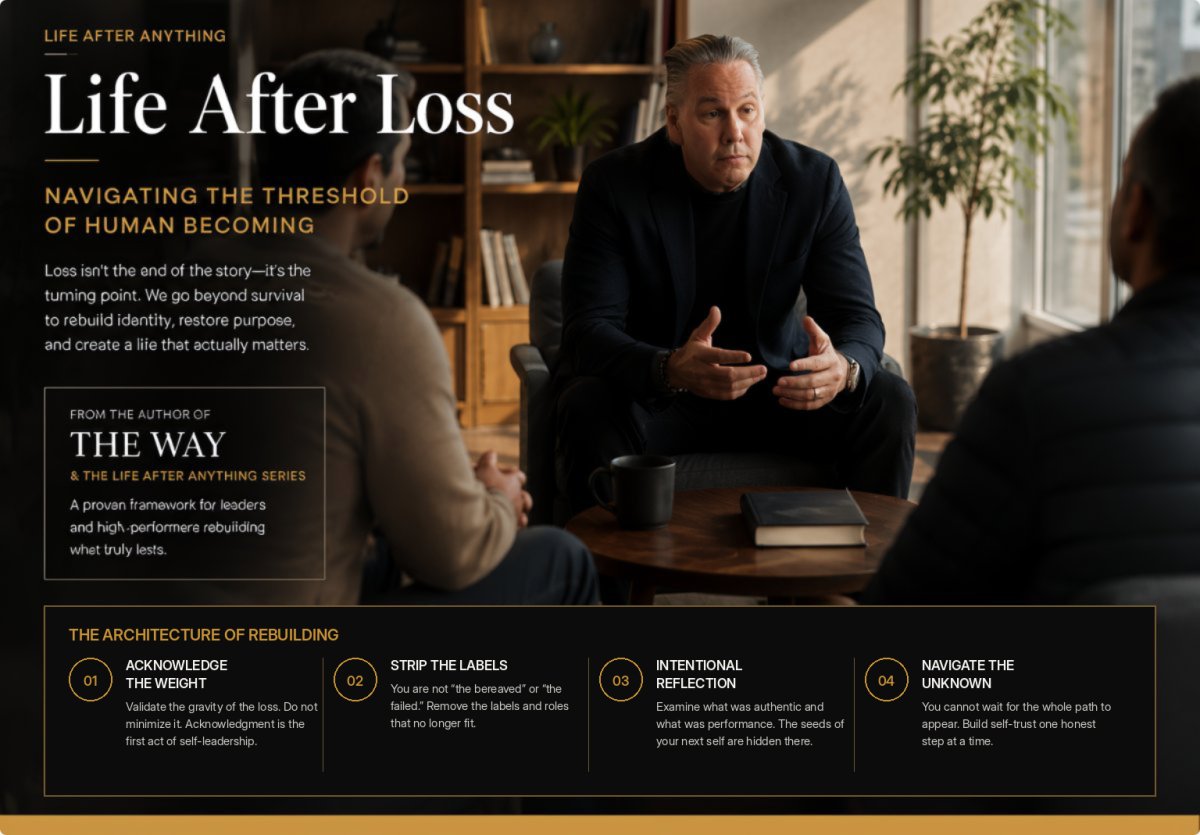
What if the person you were before the loss is gone forever? Most people treat grief like a room they must eventually leave. They wait for a door to open so they can return to their normal lives. But for those who have faced a total loss of identity, there's no going back. You feel stuck in a version of yourself that no longer exists. You're tired of clinical stages of grief that feel like a checklist for a journey you never asked to take. It's a heavy, isolating reality.
We understand that the world's expectation to move on feels like an insult to what you've endured. You're not looking for a temporary fix. You're looking for a way to exist again. This article will show you how to move beyond surviving and begin the profound process of rebuilding your identity. By finding the right life after loss book, you can discover a framework for human becoming. We'll explore how to integrate your history with your future. You'll find practical yet deep guidance for navigating the silence of loss and stepping through the threshold of your new self.
Key Takeaways
- Understand why the pursuit of your old self is a fallacy. True evolution requires crossing a threshold into a new state of being rather than returning to a previous one.
- Identify the limitations of traditional grief stages. Discover a more profound framework for human becoming that honors the complexity of your unique experience.
- Learn how to evaluate a life after loss book based on its capacity to help you rebuild your character rather than just offering temporary comfort.
- Examine the architecture of rebuilding an identity. This process demands a confrontation with existential gravity and the deliberate removal of outdated labels.
- Discover how to integrate your history into a future of purpose. Use the Life After Anything series as a strategic companion for the long journey of self-integration.
The Weight of Silence: Why Traditional Books on Loss Often Fail
Loss is not a problem to be solved. It's a landscape to be inhabited. Most resources treat grief as a temporary malfunction. They suggest that if you follow enough steps, you'll find your way back to the person you were. This is a lie. The person you were died with the loss. Searching for a life after loss book that promises "recovery" is like searching for a map to a city that has been burned to the ground. Recovery implies a return to a previous state. But after a life-altering event, that state is gone. The silence that remains is not an absence of sound. It's the weight of a life that no longer fits.
The Myth of the "Return to Normal"
Normal is a ghost. It's a destination that no longer exists. For the high-achiever, the world demands a swift return to productivity. Society expects you to "get back to work" or "move on" within weeks. This expectation creates a secondary trauma. It forces a mask over a shattered face. Loss is a permanent alteration of the human landscape. It's a tectonic shift in your internal geography. You don't get over it. You go through it. The pressure to return to a version of yourself that has been fundamentally changed only deepens the isolation. You're left navigating a world that looks the same while you feel entirely different. How do you lead when the ground beneath you has vanished?
When Clinical Advice Meets Existential Reality
Clinical models often fail the spirit. The "stages of grief" offer a neat, linear progression that rarely matches the chaotic reality of a broken life. These models address the dimensions of grief from a distance. They lack the grit of real experience. Leaders and high-performers need more than psychological theory. They need a guide who has navigated both the high-stakes pressure of global boardrooms and the quiet desperation of recovery rooms. Typical self-help feels light. It lacks the existential gravity required to anchor a soul in a storm. When the labels of career, status, or relationship are stripped away, an identity void remains. This void cannot be filled with platitudes. It requires a new way of becoming.
The transition from "what happened" to "who am I now" is the true threshold. It's a high-stakes transition that demands a specific kind of life after loss book. You need an advisory that respects the weight of your history while challenging the formation of your future. The old self is gone. The new self is waiting to be built. Are you ready to begin the work of becoming?
Beyond Survival: Defining "Human Becoming" After Loss
Survival is a biological reflex. It is the act of remaining after a storm has passed. But for the human spirit, merely remaining is insufficient. We are designed for more than endurance. We are designed for evolution. When we experience life-altering loss, we often view it as a final destination, a wall that has ended our progress. In reality, loss is a catalytic threshold. It is the moment the old structures of our lives collapse to make room for a more resilient architecture. This is the essence of human becoming.
This perspective isn't born from theory. It's forged through the observation of human struggle across 156 countries. From the boardrooms of global capitals to the quietest corners of personal crisis, the pattern remains the same. Character is not built in the light. It's revealed in the dark. When you seek a life after loss book, you aren't just looking for comfort. You're looking for a strategy to navigate the unknown terrain of your new existence. You're looking for a way to turn the weight of your history into the foundation of your future.
Identity as a Journey, Not a Destination
The popular phrase "finding yourself" suggests that your identity is a hidden object waiting to be discovered. It implies that who you are is static. This is a fallacy. You don't find yourself; you become yourself. Loss is the great editor. It strips away the non-essential layers of our identity, the titles, the roles, and the expectations that never truly belonged to us. What remains is the core of your character. Human becoming is the intentional evolution of character through adversity. It is the choice to move toward the person you're capable of being, rather than clinging to the person you used to be. This transition requires a shift in focus from what was taken to what is being built.
Navigating the "Life After Anything" Philosophy
The term "anything" is the operative word in our philosophy. Loss is relative. Whether it's the loss of a career, a relationship, or a sense of health, the internal mechanics of the transition are universal. The intersection of recovery, leadership, and personal meaning is where the most profound growth occurs. You are the architect of the narrative that follows the loss. You decide if the story ends at the threshold or if the threshold is where the real story begins. This is why choosing a specific life after loss book is about finding a guide for your character. For those seeking a deeper advisory on identity and evolution, the path forward is one of deliberate navigation. You aren't just a survivor of a tragedy. You're an explorer of a new life.
Choosing Your Guide: Comparing Approaches to Grief and Growth
The choice of a guide determines the destination of the journey. Many seek a life after loss book that offers immediate relief. They want the weight lifted. They want the pain to cease. This is tactical coping. It is necessary for survival, but it is insufficient for transformation. There is a fundamental difference between books that help you cope with what was and books that help you lead what is to come. One looks backward to mend. The other looks forward to build. Which direction are you facing?
Tactical Coping vs. Strategic Becoming
Crisis intervention guides serve a specific purpose. They stabilize the spirit in the immediate aftermath of a shatter. However, they often lack the philosophical depth required for the long-term reconstruction of the self. Strategic becoming requires a different set of tools. It demands daily reflection and the courage to engage with the silence. The Life After Anything Companion Guide & Workbook bridges this gap. It moves the reader from passive consumption to active navigation. Reflection without action is merely rumination. Action without reflection is merely distraction. You need both to cross the threshold of your new identity.
The Global Perspective: Why Experience Matters
Authority is not found in academic theory alone. It is found in the dirt and the boardrooms of the world. Witnessing the patterns of recovery and resilience across 156 countries provides a perspective that is both global and intimate. It reveals universal truths about the human condition that transcend culture and geography. A guide who has navigated the extremes of high-stakes leadership and raw human struggle offers more than advice. They offer a witness. They understand that the burdens of a leader are unique, requiring a resilience that is both professional and deeply personal.
The Way serves as a foundational text for this journey. It is not a book of quick fixes. It is an advisory for the soul. When evaluating a life after loss book, ask if the author has stood where you are standing. Have they seen the world from every angle? Have they returned with a singular, focused insight? The weight of their words should match the weight of your burden. Choose a guide who respects the gravity of your situation and challenges you to evolve within it. Your evolution is not a luxury. It is a responsibility.
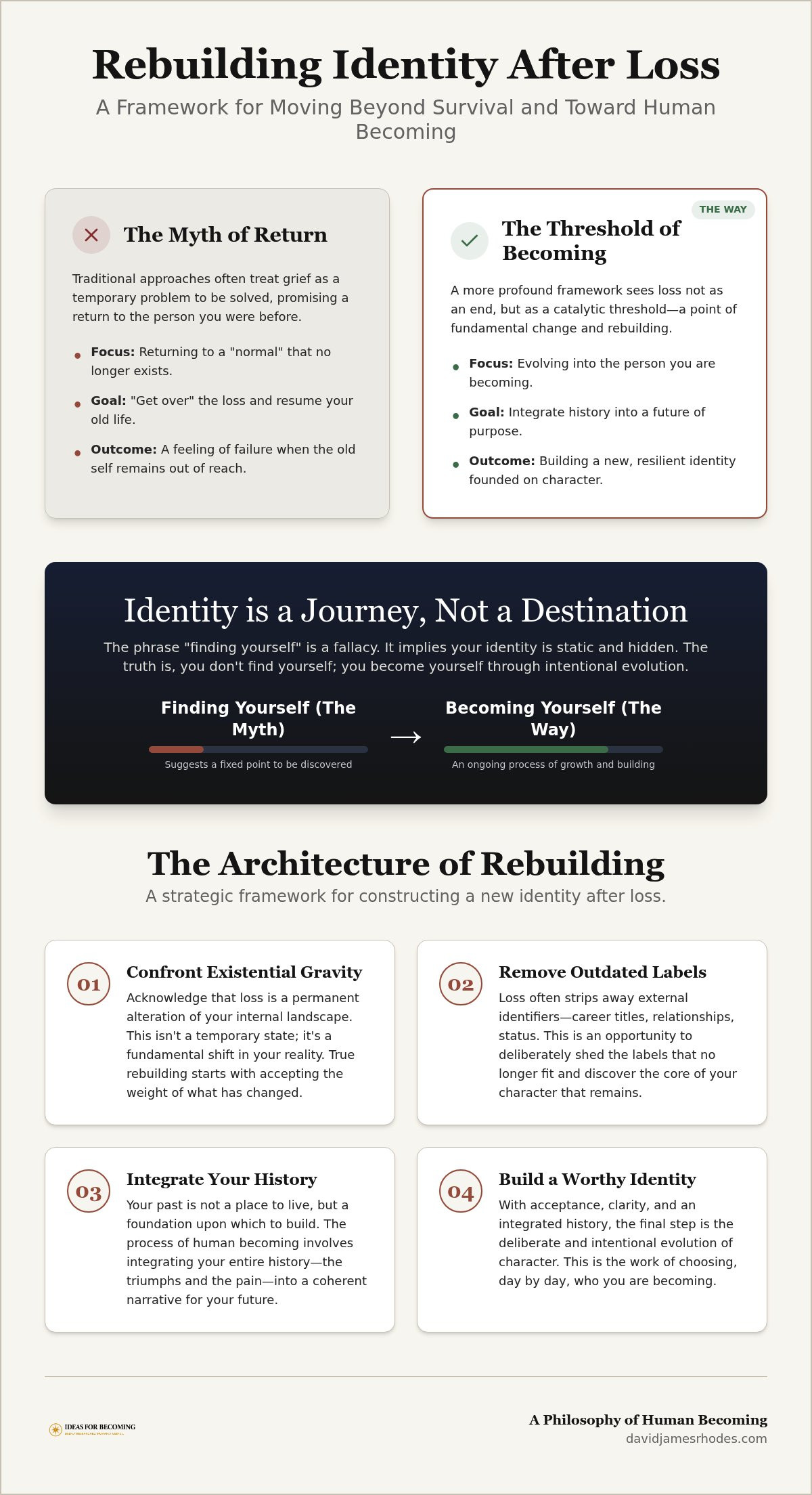
The Architecture of Rebuilding: A Framework for Life After Loss
Rebuilding is not a renovation. It is a new construction on cleared ground. When the structures of your previous life collapse, you are left with a raw site. Most people rush to fill the space with familiar shapes. They want to hide the wreckage. But a strategic life after loss book must provide more than comfort; it must provide a blueprint for a new existence. This process is methodical. It is slow. It requires a level of honesty that most avoid. There are four essential steps in this architecture.
- Step 1: Acknowledge the weight. You must validate the existential gravity of your situation. Do not minimize the impact. Do not pretend the burden is light. Acknowledgment is the first act of self-leadership.
- Step 2: Strip the labels. The world will attempt to define you by your tragedy. You are not "the bereaved" or "the failed." These are external descriptions. They are not your identity. Remove the masks that no longer fit.
- Step 3: Intentional reflection. Use structured inquiry to examine the remains. What parts of your old life were authentic? What was merely performance? The seeds of your next self are hidden in these answers.
- Step 4: Navigating the unknown. You cannot wait for the path to be visible before you walk. You must lead yourself through the fog. This requires a trust in your own character that is built one step at a time.
Engaging with the Silence
The silence that follows a major loss is often the most difficult part to endure. We are conditioned to avoid quiet. We fill it with noise, work, and distraction. Yet, the pause is where human becoming actually happens. It is the laboratory of the soul. Using 365 Days of Becoming provides a daily anchor in these turbulent times. It offers a structured way to sit with the silence without being consumed by it. This is the role of quiet authority. You are learning to govern yourself when the external world has lost its order. To begin your own architecture of change, explore the Life After Anything series and its supporting frameworks.
Reclaiming the Narrative of Your Life
Who is emerging from the wreckage? This is the only question that matters. You must move from a story of what was lost to a story of who is being built. This shift requires the use of provocative, open-ended questions. Instead of asking "Why did this happen?", ask "What does this require of me now?". The transition from being a victim of circumstance to becoming the global sage of one's own internal landscape marks the final crossing of the threshold. You are no longer defined by the event. You are defined by your response to it. This is the ultimate reclamation of power. It is the moment you stop being a character in a tragedy and start being the author of a legacy.
The Way Forward: Integrating Loss into a Worthy Identity
Integration is the final movement of the spirit. It is the act of taking the shattered pieces of your history and weaving them into a new, more resilient identity. Most people try to leave their loss behind. They want to forget. But a worthy identity does not require amnesia. It requires the courage to carry what has happened without being crushed by it. This is where a life after loss book stops being a resource and starts being a companion. The Life After Anything series serves this purpose for the long journey. It provides the language for the unspoken and the structure for the unformed. Choosing a life after loss book that respects this gravity is the first step toward internal sovereignty.
From Recovery to Leadership
True leadership is forged in the fire of personal crisis. When you've navigated the depths of your own soul, you gain a perspective that cannot be taught in a classroom. You develop a quiet authority. This is leading from the inside out. Your influence no longer depends on your title. It depends on your character. Those who have crossed the threshold of loss possess a unique credential. They understand the stakes of the human experience. The Life After Anything Companion Guide & Workbook is a vital tool for this integration. It forces you to translate your reflection into a new model of leadership. How will your struggle inform your service? Who will you become for those who follow you?
Becoming Who You Are Capable of Becoming
The final shift is the most challenging. You must view your loss not as an end, but as a prerequisite. True character is rarely found in those who have never suffered. It is found in those who have been broken and chose to rebuild. This is the promise of human becoming. It is a somber, intentional focus on the person you are capable of being. The struggle has dignity. The pain has purpose. You aren't just surviving a tragedy. You're navigating a transition into a deeper level of existence. This journey requires a steady hand and a clear vision. For those seeking further advisory on leadership and life transitions, the path remains open. The threshold is behind you. The horizon is yours to claim. Will you embrace the evolution?
The Choice to Become
Loss has cleared the ground. The structures of your past life have been removed. You now stand at the most significant threshold of your existence. Will you attempt to rebuild what was? Or will you embrace the evolution of what could be? We have explored the necessity of stripping away labels and the architecture required to integrate your history into a new identity. True character is not found in the absence of struggle. It is forged within it. Finding the right life after loss book is about more than finding comfort. It is about finding a strategy for your own human becoming.
This perspective is shaped by 40 years of global executive experience and insights gathered across 156 countries. It is an authoritative guide for those who refuse to be defined by their tragedy. You have the responsibility to lead yourself through the silence. The path is not yet visible, but your character is. Are you ready to step forward? Begin your journey of becoming with the Life After Anything series. You are not just surviving. You are becoming who you were always capable of being. The horizon is waiting.
Frequently Asked Questions
What makes a life after loss book different from a standard grief guide?
A standard grief guide often focuses on clinical stages and emotional stabilization. A life after loss book like Life After Anything addresses the existential void and the reconstruction of identity. It moves beyond the goal of "getting back to normal." Instead, it provides a framework for human becoming. This approach treats loss as a catalytic threshold rather than a problem to be solved or a detour to be bypassed. Are you ready to evolve?
Can a book really help me rebuild my identity after a major setback?
A book serves as a high-level advisory in written form. It offers a structured space for the intentional reflection required to navigate the silence of loss. While reading alone isn't the whole journey, it provides the roadmap and the vocabulary for a transition that often feels wordless. It challenges you to strip away outdated labels and begin the methodical work of constructing a new, worthy identity. Silence isn't the enemy. It's the laboratory for your evolution.
How do I choose between a practical workbook and a philosophical text on loss?
The choice depends on your current stage of navigation. A philosophical text like The Way provides the foundational perspective needed to understand human becoming. A practical tool like the Life After Anything Companion Guide & Workbook is essential for translating reflection into action. Most find that integrating both allows them to bridge the gap between abstract thought and high-stakes reality. This integration defines a life after loss book that leads to genuine change.
Is "Life After Anything" suitable for those who have lost a career or business?
Yes, because the mechanics of identity loss are universal. Whether you've lost a loved one or a decades-long career, the internal collapse is the same. Life After Anything is designed for any individual facing a total loss of their previous self. For leaders and executives, the loss of a business often triggers an existential crisis that requires a strategic, identity-focused guide rather than a typical self-help resource. You are the architect of what follows.
What is the role of "The Way" in navigating life after loss?
The Way functions as a foundational text for the long journey of self-integration. It provides a roadmap for navigating crisis by focusing on the process of becoming rather than a final destination. This book offers a seasoned, global perspective on how character is forged in the dark. It isn't a book of quick fixes. It's a steady presence for those seeking a deeper path forward. Have you considered what your character is capable of becoming?
How long should I wait after a loss before starting a book on "becoming"?
There's no chronological requirement for beginning this work. The right time is when the world's expectation to "move on" feels insufficient and you realize that returning to your old self is impossible. Some find clarity in the immediate silence, while others wait years. Whenever you feel stuck in a version of yourself that no longer exists, you're ready to engage with the architecture of rebuilding. The threshold is waiting. Will you cross it?
Does this approach work for leaders and executives specifically?
This framework is rooted in 40 years of global leadership and behavioral health. It's specifically designed for high-performers who find typical clinical advice too light for their specific burdens. Leaders often face a unique isolation during major transitions. They need a guide that understands the intersection of elite performance and raw human experience. This approach provides the quiet authority required to lead yourself when the external path is gone. You're not just a survivor; you're a strategist.
Why is a global perspective important when reading about personal recovery?
A global perspective reveals the universal truths of the human condition. Insights gathered from 156 countries show that while the details of loss vary, the process of transformation is a shared human story. This scale helps you see your personal struggle as part of a larger narrative of evolution. It moves the focus from the micro of your pain to the macro of your potential responsibility within the world. You are part of a larger story.
Frequently Asked Questions
Related Articles

Best Leadership Guides for Executives: A Thoughtful 2026 Selection
Searching for the best leadership books for executives? Discover thoughtful leadership guides matched to real executive challenges, strategy, and character.
Executive Coach vs. Advisor: Which Kind of Support Does a Leader Need?
Choosing between an executive coach vs advisor? Learn how to match the right support to consequential leadership decisions and the leader you are becoming.

Executive Advisory on Purpose and Fulfillment: A More Human Way Forward
Seek executive advisory on purpose and fulfillment to align leadership choices with values and character. Discover who you are becoming beyond outward success.