
What if the first step through a major change isn’t choosing your destination, but seeing clearly where you are now? Navigating life transitions can leave familiar roles and routines feeling wrong before a new direction has taken shape. You may feel pressure to make sense of everything at once. You don’t have to.
Uncertainty doesn’t mean you’ve failed to find your way. Some things have changed; others may still be steady. The practical challenge is to tell the difference and decide what needs your attention first.
This article will help you name what has shifted, recognize what remains, and choose a manageable next step without waiting for a complete plan. Small choices can keep you moving while the larger picture is still unclear. Change may unsettle your sense of direction, but it doesn’t erase who you are or determine who you can become.
Key Takeaways
- Separate the event that triggered change from the longer process of adjusting to its effects.
- Distinguish observable facts from conclusions you may be drawing while the future is unclear.
- When navigating life transitions, name the decision, identify your choices, and weigh them against your values, responsibilities, and likely consequences.
- Use a repeatable approach: address immediate responsibilities, identify support, act, and review what has changed.
- Reflect on “Who are you becoming?” while treating practical planning and sound judgment as essential.
Navigating life transitions starts with naming what has changed
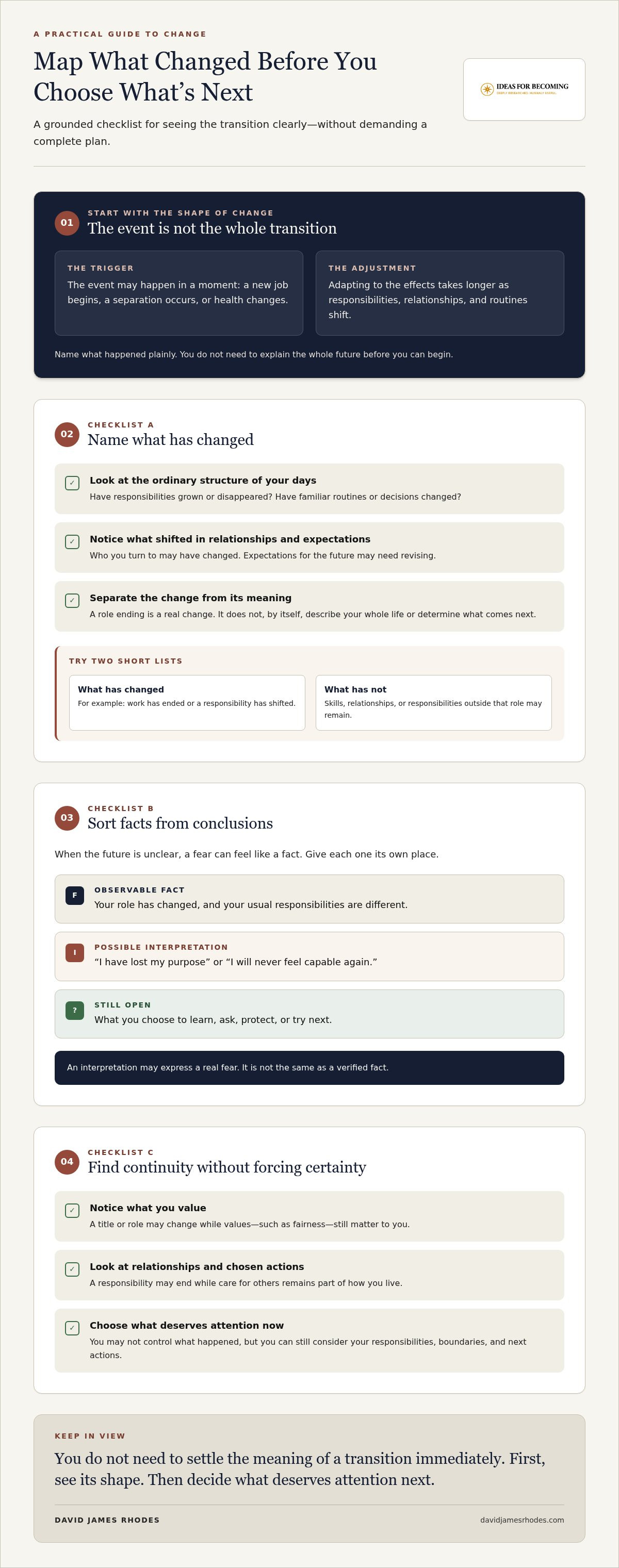
A life transition is a period of adjustment after circumstances, roles, or expectations change. The triggering event may happen in a moment; adapting to its effects often takes longer.
A transition is not the event itself; it is the stretch of life in which you adjust to the event’s consequences. A new job may begin on Monday, but learning its responsibilities, relationships, and measures of success takes longer than the first day. A separation can change a relationship status quickly, while decisions about home, family, and daily routines unfold over time.
Transitions can begin at work, in relationships, or through changes in health. They can also arise as your identity shifts: a role that once felt central may no longer fit, or an unexpected responsibility may become yours. There is no single pattern. The same event can reshape one person’s life while leaving another’s routines largely intact.
How to recognize that you are in a transition
Look at what has changed in the ordinary structure of your days. Your responsibilities may have grown or disappeared. A relationship may have changed who you turn to. Expectations for the future may need revising. Even familiar decisions can feel harder when old assumptions no longer match present circumstances.
These signs don’t mean you are in crisis. Change can be demanding without being a diagnosis. Naming the adjustment gives you a clearer view of what you are responding to.
Expected change and change you did not choose
Some transitions are anticipated, such as beginning a new role, moving, or preparing for a change in family responsibilities. Others arrive without your consent, such as an unexpected job loss or a sudden change in health. Neither kind is automatically easier. Preparation can help with practical arrangements, but it cannot dictate how you will feel.
Before demanding a complete plan from yourself, describe the change plainly. What happened? What is different now? You don’t need to explain the whole future. This gives you a starting point for navigating life transitions without treating the first event as the whole story.
Try writing two short lists: what has changed and what has not. If work has ended, the loss of a role is real. So may be your skills, relationships, and responsibilities outside that role. This isn’t a demand to feel positive. It helps separate the facts of the present from the larger story uncertainty may be telling about your life.
A transition can leave you between what was familiar and what has not yet become familiar. You do not need to settle its meaning immediately. First, see its shape. Then decide what deserves attention next.
Why life transitions can unsettle identity and certainty
A changed role can disturb more than your calendar. Work, caregiving, partnership, or leadership may have shaped how you spent your time and how others relied on you. When that role shifts, familiar answers to “Who am I?” can feel incomplete. Your identity has not disappeared; one part of how you understood your life may no longer describe all of it.
When a familiar role no longer fits
You may leave a leadership position and miss the responsibility, even while feeling ready to move on. A caregiver’s duties may change, altering daily routines and the sense of being needed. A partnership may end, or a role at work may grow beyond what once felt manageable. These changes matter, but a role, however important is not the sum of a person.
Look for continuity in what you value, the relationships you sustain, and the actions you choose. Perhaps your title has changed, but fairness still matters to you. Perhaps a responsibility has ended, but care for others remains part of how you live. This doesn’t mean identity stays fixed. It helps you notice what may endure while circumstances change.
Making room for uncertainty without surrendering agency
Some questions take time to answer. You may not yet know what kind of work you want, how a relationship will develop, or what a new responsibility will require. Not having an immediate answer is not evidence of personal failure. The available facts may not yet support a confident conclusion.
Separate what you can observe from what you fear it means. For example:
- Observable fact: Your role has changed, and your usual responsibilities are different.
- Possible interpretation: You have lost your purpose or will never feel capable again.
- What remains open: What you choose to learn, ask, protect, or try next.
The interpretation may express a real fear, but it is not the same as a verified fact. Holding that distinction can make room to consider options without dismissing how difficult the change feels.
Circumstances may change before your next choice becomes clear. Accepting uncertainty doesn’t mean every outcome is beyond your influence. You may not control what has happened, but you can still make decisions about your responsibilities, boundaries, and next actions. One useful way to approach navigating life transitions is to ask which values you want your choices to express, rather than expecting yourself to already know who you are.
This is a practical invitation, not a scientific finding or a promise that the answer will come quickly. David’s perspective on human becoming explores how people grow and make meaning across changing circumstances.
How to choose a next step when a life transition feels uncertain
You don’t need to solve your whole future to make one sound decision. Start with the choice in front of you. A simple framework can bring order to the question, though no single method fits every person or circumstance. When a decision depends on legal, financial, medical, or other specialist knowledge, seek reliable information from someone qualified to provide it.
Move through these steps in order:
- Name the decision. Make it specific. “What should I do with my life?” is too broad to act on. “Do I accept this role, or ask for more information first?” gives you something concrete to examine.
- Separate facts from assumptions. Write down what is confirmed, what you are predicting, and what remains unanswered. A prediction may point to a real concern, but it is not automatically a fact.
- Identify the available choices. Include waiting for information, asking a question, or taking a temporary step if these are realistic options. Compare the choices against your values, responsibilities, likely consequences, and how reversible each one is.
Separate what you know from what you fear
Keep the lists simple. Facts might include confirmed duties in a role or a date by which you need to respond. Fears might include “I’ll fail” or “I’ll never find another opportunity.” Put unresolved questions in a third list. This won’t necessarily quiet anxiety, but it can show which concern needs evidence, which needs reflection, and which cannot be answered yet.
Choose a useful step, not a perfect life plan
A useful next step is concrete, proportionate, and connected to a value you want to honor. If stability matters, clarify the terms of a new role before deciding. If learning matters, speak with someone who understands the work. Either action can provide information without requiring you to predict every outcome.
Consider someone whose job is changing and who has been offered a different position. The confirmed facts might be the new responsibilities and the response date. An assumption might be that declining means career failure. The choices could include accepting, declining, or requesting clarification. The person can weigh each option against financial and family responsibilities, the likely effect on their work, and whether the decision can later be adjusted.
Ask what has to be decided now and what can remain open. A deadline may require a response, while questions about long-term direction can wait for more experience. Waiting has a cost if it closes an option or leaves an urgent responsibility unattended. Acting too soon has a cost if key information is missing or the consequences are difficult to reverse. Consider both. The aim isn’t to eliminate risk, but to see it more clearly.
A small action can provide useful information. It may reveal what you need to know next or show that a concern rested on an assumption. In my view, navigating life transitions with agency means acting where you can, staying honest about what you don’t know, and letting what you learn inform the next decision. David’s perspective on becoming explores how choices can reflect who you are becoming.
A practical way to navigate life transitions without rushing the answer
A transition rarely calls for one perfect decision. It asks you to keep responding as circumstances become clearer. Try this sequence: attend to immediate responsibilities, identify support, take a proportionate action, then review what changed. Return to it as needed. It’s a way to pay attention, not a schedule you must follow or a guarantee that uncertainty will disappear.
- Attend to what needs care now. Identify pressing responsibilities, such as a deadline, a household task, or a commitment to someone who depends on you. Separate what is urgent from what feels urgent because it is unfamiliar.
- Identify support. Consider who can listen, share a practical task, or offer relevant knowledge. Ask specifically: “Could you help me prepare for this conversation?” is easier to answer than “Can you help me?”
- Act on one manageable matter. Choose an action that fits your current capacity and responsibilities. You might gather information, set a boundary, or make a necessary call.
- Review what changed. Notice what you learned, what remains unresolved, and whether your next step still fits the situation.
The order matters, but the pace will vary. You might need to handle an immediate responsibility before you have the energy to consider long-term direction. Or you may need a conversation before acting. Navigating life transitions doesn’t require treating every problem as equally urgent.
Protect the foundations that make decisions easier
Notice the conditions surrounding your decisions. Are basic responsibilities being met? Is there room for rest, connection, and practical tasks? Familiar routines can offer steadiness, but no single schedule fits every life. Keep the parts that help and adapt those that no longer fit. Tell someone you trust what kind of support would be useful instead of hoping they will infer it. If distress is serious or persistent, or makes everyday responsibilities difficult to manage, seek support from a qualified professional.
Review your direction as circumstances change
Set aside a brief moment at an interval that suits your life to review your commitments, choices, and new information. Ask whether the situation has changed, whether an assumption has been clarified, and whether your current action still serves what matters to you. If important information is missing, pause and gather it. If circumstances have shifted, revise the plan. Continuing automatically is not the same as acting with resolve.
Persistence means staying committed to what matters; it doesn’t mean refusing to adapt. Changing course can reflect attention and learning, not failure. You might ask for more time before accepting a responsibility, or keep a commitment while changing how you carry it out.
This is practical work, not a promise of certainty. A steady routine, a specific request for support, and an honest review can help you keep choosing while the larger answer takes shape. Explore David's perspective on becoming and consider how your next action reflects who you are becoming.
How The Way frames navigating life transitions as becoming
Practical planning helps you decide what to do. It cannot answer every question about who you are becoming. The Way offers a perspective for that deeper work: “The Way is not something you find. It is someone you become.” The idea shifts attention from waiting for a perfect path to the character and choices you bring to the path ahead.
This is a philosophy, not a research finding or a formula that guarantees a particular outcome. It doesn’t replace professional treatment, established evidence, or your own judgment. If a transition raises health, safety, or other specialized concerns, those deserve appropriate expertise. The idea of becoming can sit alongside practical planning, helping you consider not only which option is available, but how you want to meet it.
A way forward is made through choices
Identity is not settled by one decision. It takes shape over time through actions and relationships. You might show courage by asking for clarity instead of pretending to understand. You might take responsibility for a commitment while acknowledging that your capacity has changed. You might choose forgiveness, or decide that a boundary is necessary. None of these choices guarantees an easy result. They are ways to express what matters in circumstances you may not have chosen.
This perspective makes room for change without reducing a person to a role or a difficult season. A career direction can shift. A relationship can alter. Responsibilities can grow or recede. Across those changes, values and connections may still inform your next action. “Who are you becoming?” is not a demand for a polished answer. It can help you notice whether your choices reflect the person you intend to be.
For me, the human work within navigating life transitions is not simply finding a route that removes uncertainty. It is becoming more deliberate about how you act while the route is still taking shape. That is a personal and philosophical view, not a claim that research has proven one life formula.
When a guide can help you keep reflecting
The Way is the name of David James Rhodes’s wider philosophy and flagship guide. It offers a framework for reflection on character, action, relationships, purpose, and becoming. A guide can give you questions to return to; it cannot decide what your circumstances require or promise to resolve a transition for you.
You might use its central question after a conversation, while weighing a choice, or when an old role no longer describes your life. What matters is not producing the right words. It is noticing what your actions make possible, what responsibilities remain yours, and what you want to carry forward.
If this perspective resonates, Explore The Way and David's work as an invitation to consider who you are becoming.
Carry your next choice forward
You may not be able to see the whole road yet. That doesn’t make your next choice meaningless. It can express what you value, how you treat the people around you, and what responsibility you’re willing to carry. The question is not only where this transition will lead. It is also, who are you becoming as you move through it?
David James Rhodes’s perspective on human becoming draws on more than four decades of experience across 156 countries. His work connects leadership, adversity, recovery, and the continuing work of becoming. This is a philosophical perspective, not a guarantee of what any transition will bring. Its value is in offering a question to return to as you make decisions in real circumstances.
If you want to keep reflecting on that question, explore The Way and David’s perspective on becoming. You don’t need certainty to take a thoughtful next step. Begin with the choice in front of you, and let the next one emerge in time.
Frequently Asked Questions
Is there a fixed order to navigating a life transition?
No. The order depends on what the situation requires. If a deadline or immediate responsibility is involved, it may need attention before broader reflection. If there’s no urgent decision, you might first gather information or talk with someone affected. Navigating life transitions is not a test of following steps perfectly. Let urgency, safety, and the people who depend on you help determine what comes first.
How long does it take to adjust to a major life change?
There is no single timetable for adjustment. It can depend on what changed, what demands remain, and what support is available. You might feel settled in one part of life while still adapting in another. Instead of measuring yourself against an expected deadline, notice whether daily responsibilities are becoming more manageable and whether distress is easing, persisting, or worsening. A qualified professional can help assess concerns about your wellbeing.
What should you do when a life transition was not your choice?
Start by acknowledging the loss of choice without blaming yourself for the event. Then identify what still requires a response, such as arranging care, clarifying a changed responsibility, or telling someone what has happened. You don’t have to feel ready or grateful to take a practical step. If the change affects other people, include their immediate needs while recognizing that your own reaction deserves attention too.
Can you keep old goals while navigating a life transition?
Yes, but examine whether a goal still fits your present responsibilities and values. A goal of advancing at work might remain important while its timing or form changes after a family responsibility shifts. Keeping a goal doesn’t require pursuing it unchanged. You can preserve its underlying purpose, revise the route, or set it aside temporarily and reconsider when circumstances allow.
How can you support someone going through a major transition?
Offer specific, manageable help and let the person choose what’s useful. You could ask whether they’d like company at an appointment, help with a practical task, or simply someone to listen without trying to solve the situation. Avoid insisting they should feel a certain way or be “over it” by a particular time. Check in again later, since their needs may change as circumstances unfold.
When should you seek professional help during a life transition?
Consider speaking with a qualified health professional if distress persists, worsens, or makes it difficult to manage work, relationships, sleep, or essential responsibilities. You don’t need to wait until you have a diagnosis or reach a breaking point to ask for support. If you or someone else may be in immediate danger, contact local emergency services or a crisis support service. Professional guidance can help clarify what kind of care is appropriate.
Frequently Asked Questions
Related Articles

Overcoming Burnout for Executives: A Grounded Path to Sustainable Leadership
Overcoming burnout for executives requires more than rest. Discover a grounded approach to clarifying demands, setting boundaries, and leading sustainably.

Integrity in Global Leadership: What It Demands Across Cultures
How do you uphold integrity in global leadership across cultures? Discover practical ways to balance core principles, context, and character under pressure.

Navigating Adversity in Business: How to Find a Way Forward
Navigating adversity in business requires clear thinking under pressure. Learn how to separate facts from fear, set priorities, and lead through hardship.