
What if the performance keeping your organization moving is also concealing the cost of continuing? For executives, overcoming burnout can feel impossible when exhaustion persists, decisions become harder, and admitting strain seems likely to weaken credibility. But sustained performance does not prove that nothing is wrong. It may mean you have learned to carry the strain quietly.
The World Health Organization describes burnout as a syndrome resulting from chronic workplace stress that has not been successfully managed. It is an occupational phenomenon, not simply a difficult week or a personal failure. Recognizing the difference can help you take the problem seriously without reducing yourself to it.
This article looks at what executive burnout can involve, why it may persist, and how to begin changing course without abandoning your responsibilities. You will find practical ways to clarify demands, involve appropriate support, and make boundaries more specific. The aim is not merely to restore your capacity to work as before. It is to build a more sustainable relationship with leadership, performance, and the person you are becoming.
Key Takeaways
- Notice persistent exhaustion, detachment, or reduced effectiveness as signals to examine, not proof of personal failure.
- Overcoming burnout for executives means looking at both personal pressures and workplace conditions. Individual effort alone may not change the system sustaining the strain.
- Rest can create space to recover, but lasting change may also require workload adjustments, role changes, or appropriate professional support.
- Start by addressing immediate demands, making the workload visible, and involving trusted support. Recovery has no guaranteed timeline.
- Sustainable leadership asks not only how to restore performance, but what kind of leader you are becoming.
Overcoming Burnout for Executives Starts with Recognizing the Strain
Senior responsibility can make strain easier to conceal. The organization still needs decisions, reassurance, and direction, so you keep delivering. You answer messages, attend meetings, and carry the consequences. Over time, that steadiness can obscure its cost, sometimes even from you. Overcoming burnout for executives begins with recognizing that visible performance and personal well-being are not the same measure.
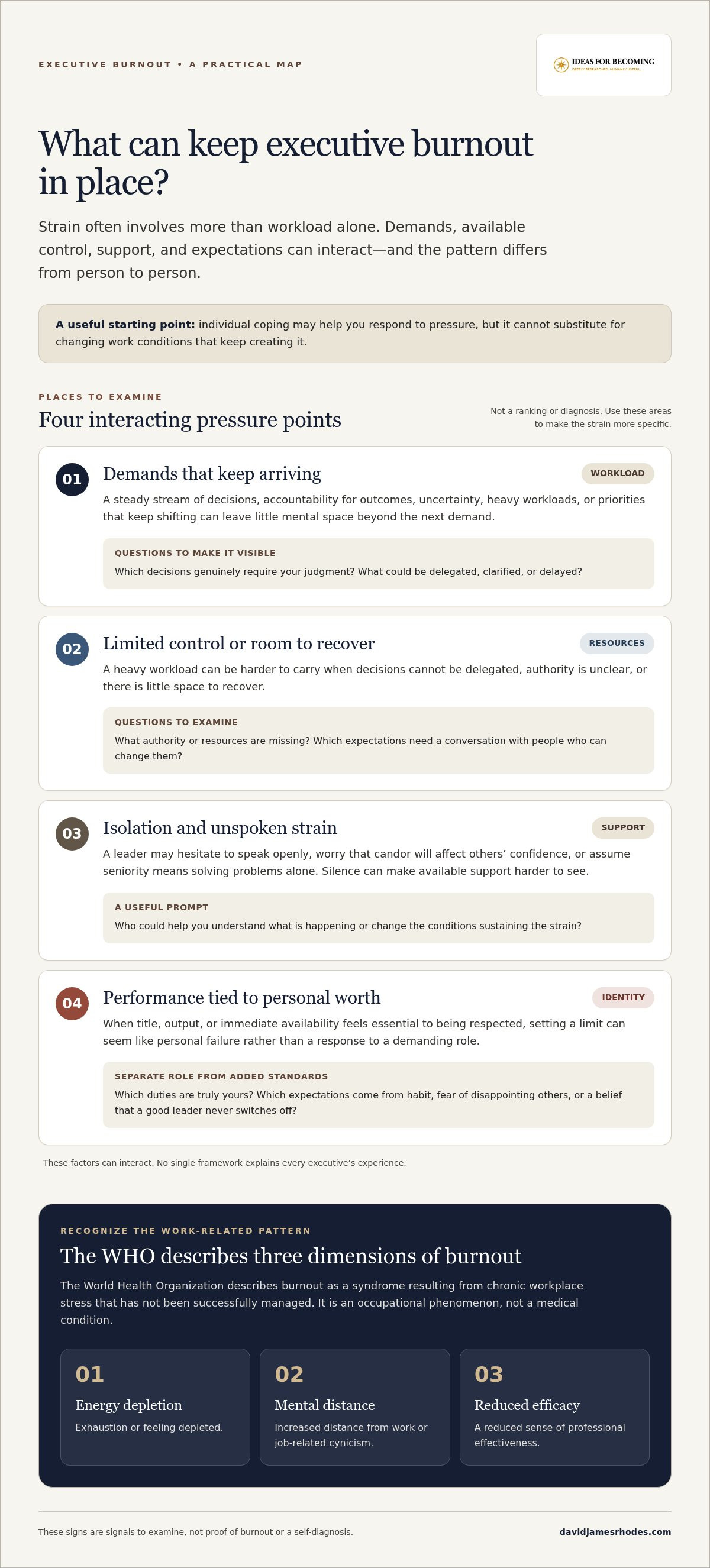
The World Health Organization (WHO) describes burnout as a syndrome resulting from chronic workplace stress that has not been successfully managed. Its description identifies three dimensions: energy depletion or exhaustion, increased mental distance from work or job-related cynicism, and reduced professional efficacy. The definition applies specifically to work. The WHO classifies burnout as an occupational phenomenon, not a medical condition. Understanding Occupational Burnout offers further context on the concept and its use.
In everyday conversation, “burnout” can mean anything from a demanding week to deep, persistent depletion. That informal use can make it harder to distinguish temporary pressure from a pattern that deserves attention. The WHO description is not a self-diagnosis tool. It offers a way to name work-related strain, not a verdict about you.
What burnout can look like in an executive role
The recognized dimensions may show up in ordinary work before they are easy to name. Exhaustion might mean starting the day already depleted. Growing distance may appear as cynicism toward colleagues or indifference to work that once mattered. Reduced professional efficacy can feel like faltering concentration, repeated indecision, or a loss of confidence in familiar judgment.
Some people describe emotional numbness; others notice irritability or difficulty thinking clearly. These signs vary, and none proves burnout on its own. Sleep disruption, physical health concerns, and other pressures can contribute to similar experiences. A qualified professional can help assess what is happening, especially if symptoms persist or interfere with daily life.
Why senior leaders may miss the warning signs
Leadership often rewards composure and availability. When others depend on your judgment, acknowledging strain can feel like risking credibility or unsettling the people around you. You may keep absorbing work because the immediate consequences of stepping back seem obvious, while the cost of continuing is harder to see.
From the outside, the business may look steady: decisions are made, targets are met, and the team keeps moving. Inside, the leader may be struggling to focus, feeling detached, or using more effort to maintain the same output. Continuity is not proof of well-being. Naming the strain is not a character judgment or an admission of failure. It is a responsible first step toward understanding what needs attention.
Why Executive Burnout Persists: Workload, Control, and Identity
Recognizing strain is a beginning. Understanding why it continues requires a wider view. Executive burnout rarely has one simple cause. Ongoing demands, the resources available to meet them, and a leader’s circumstances can interact. A heavy workload may be harder to carry when decisions cannot be delegated, priorities keep shifting, or there is little room to recover. The pattern differs from person to person, so no single framework explains every executive’s experience.
Individual coping can help you respond to pressure, but it cannot substitute for changing work conditions that keep creating it. Reflection, rest, and support may help you identify what is within your influence. They cannot, on their own, resolve an unmanageable workload, unclear authority, or organizational expectations that reward constant availability.
How executive responsibility can amplify ongoing pressure
Some leadership roles involve a steady stream of decisions, accountability for outcomes, and uncertainty that cannot be resolved quickly. Stepping away may feel difficult when a team needs direction or a consequential choice is waiting. These pressures are not universal, and they do not affect every leader in the same way. Together, however, they can leave little mental space beyond the next demand.
Isolation can narrow that space further. An executive may hesitate to speak openly with colleagues, worry that candor will affect others’ confidence, or assume that seniority means solving problems alone. Silence can make available support harder to see. Start by naming the pressure precisely: Which decisions genuinely require your judgment? What could be delegated, clarified, or delayed? Which expectations need a conversation with people who can change them?
When identity becomes inseparable from performance
A role can carry meaning and responsibility. It can also become the measure by which you judge your worth. If your title, output, or immediate availability feels essential to being respected, any limit may seem like a personal failure rather than a feature of a demanding job. That belief can keep an unsustainable pattern in place even when its cost is clear.
Separate the formal responsibilities of the role from the standards you have added yourself. Which duties are truly yours? Which expectations come from habit, fear of disappointing others, or an unspoken belief that a good leader never switches off? You may not be able to change every condition immediately. Seeing the difference can still show where a conversation, boundary, or organizational decision is needed.
Overcoming burnout for executives is not simply about becoming more efficient at enduring pressure. It also means examining the conditions around the work and the identity attached to it. In David James Rhodes’s philosophy, the question “Who are you becoming?” invites reflection on the kind of leader you want to be, beyond performance. It is a perspective, not treatment or a clinical method. His broader thinking on leadership, identity, and becoming offers one way to consider that question.
Does Overcoming Burnout Mean Resting, Quitting, or Returning to Normal?
There is rarely one answer that fits every executive. Rest, workload changes, a different role, and professional support can each serve a purpose, but they address different parts of the problem. The question is not simply how to get back to normal. It is whether the old normal is sustainable. Returning to the same pace and expectations may restore output without changing what made that pace costly.
A short period away can offer distance and relief. It may also reveal how depleted you feel when immediate demands pause. But time away cannot, by itself, redistribute decisions, reduce an unmanageable workload, or reset expectations about being available at all hours. Rest matters, but it may be one part of a response rather than the whole response.
Why a vacation may not resolve the underlying conditions
Consider what happens after time away. If the same volume of work, limited authority, and constant availability await your return, relief may not last. That does not make rest a failure; it clarifies what rest can and cannot change. If symptoms are severe, persistent, or affecting your ability to function, seek guidance from a qualified health professional rather than relying on time off alone.
When changing the role or seeking support may matter
A role may need review when responsibilities exceed the time, staffing, or authority available to carry them well. That could call for clearer priorities, redistributed duties, or a serious conversation about expectations. In some circumstances, a role change or leave may be considered. None is a universal prescription. Clinical support can help you assess your health and options. Seeking it is compatible with responsible leadership.
Each response has a different reach:
Rest: Can create space for recovery and perspective. It cannot guarantee that work pressures will change.
Workload adjustment: Can reduce or clarify demands. It may require decisions and cooperation beyond your personal control.
Role change: Can alter responsibilities or fit. It may not resolve pressures that are organizational or present in a new position too.
Professional support: Can help assess symptoms and guide next steps. It does not replace needed changes to work conditions.
These responses may complement one another, but they are not interchangeable. A conversation with a supervisor, board, or trusted colleague can focus on specific changes: Which decisions can be shared? What work can be deprioritized? What availability is genuinely necessary? For concerns about your health, a qualified professional can help determine what support is appropriate.
Overcoming burnout for executives does not have to mean resignation, nor does it require returning to the exact pace that preceded the strain. A more useful measure is whether the next arrangement supports both your well-being and the responsibilities you choose to carry. Leadership and life advisory addresses growth and meaning alongside the demands of leadership.
A Practical Sequence for Overcoming Burnout Without Rushing Recovery
There is no universal timetable for feeling better, and the steps below are not a clinical treatment plan. Treat them as a flexible way to clarify the situation, reduce immediate strain, and involve people who can help change what you cannot change alone. You may need to adjust as you learn more. That is not failure; it is information.
Stabilize immediate demands and widen support
Begin by sorting current responsibilities into three groups: urgent, deferrable, and shareable. Identify which decisions truly need your attention today and which can wait or be delegated. Then tell a trusted person what you are experiencing. That might be someone close to you, a clinician, or an appropriate contact at work. If distress feels severe or your safety is at risk, seek qualified professional or emergency support promptly.
Make the boundary between personal action and shared responsibility visible. You may be able to protect recovery time, ask for help, or stop accepting nonessential work. Changes to staffing, decision authority, or priorities may require agreement from a board, team, or other organizational decision-makers.
- Within your influence: Record current commitments, identify what can wait, and ask a trusted person to help you see what strain may be obscuring.
- Requires shared action: Raise workload, staffing, decision rights, and availability expectations with the people who have authority to change them.
Redesign routines and review what is changing
Once immediate pressures are clearer, choose a small number of workable adjustments. For example, set a defined end to routine availability, reduce recurring meetings where you have influence, or protect time for rest. Discuss broader changes with relevant decision-makers. Private coping strategies can support you, but they cannot replace organizational action when the work itself needs to change.
Review the effects weekly without treating the review as a test you must pass. A short written check-in can help you notice patterns:
- Which responsibilities drained or restored energy this week?
- Were your availability boundaries respected, and where did they break down?
- What work was completed, deferred, or shared? What still feels unreasonable?
- What support or decision is needed next, and who can help provide it?
Look for changes in concentration, decision-making, and your ability to meet responsibilities, as well as how you feel. A difficult week does not settle the question. If your functioning is not improving or symptoms worsen, consult a qualified professional and reconsider work adjustments with those who can act. Overcoming burnout for executives is not a race back to full output. It is careful attention to what helps you function and what continues to undermine it.
For a perspective on leadership, growth, and meaning as you consider your next steps, explore leadership and life advisory.
From Burnout Recovery to Becoming a More Sustainable Leader
Recovery matters for your health, not only for the work you can return to. If success is measured solely by output, the pressure to recover can become another demand: regain capacity, resume the pace, reassure everyone. But returning to performance is not the same as returning to well-being. More sustainable leadership asks what must change in the work and what kind of life the work is meant to serve.
What does a sustainable definition of leadership require?
Begin with the responsibilities you carry. Which ones reflect your values and need your direct attention? Which have accumulated through habit, unclear expectations, or the belief that you must always be available? These questions do not diminish ambition. They help distinguish meaningful commitment from the assumption that your worth depends on uninterrupted performance.
Some changes may be personal: setting limits, asking for help, or reconsidering what you accept as success. Others require organizational action, such as clearer priorities, better distribution of responsibility, or realistic expectations about availability. Sustainable leadership may depend on both. A leader cannot individually solve every structural problem, but can help make the conditions visible and invite decisions that address them.
There may be no clean line between who you are and what you do. Still, a title is a role, not the whole person. Performance can matter deeply without becoming the sole measure of your value. Consider what you want your leadership to make possible for your team, your organization, and your life beyond work. That reflection can inform practical choices, alongside appropriate professional support when needed.
The Way forward is shaped by who the leader becomes
David James Rhodes’s philosophy turns on a simple idea: “The Way is not something you find. It is someone you become.” This is a philosophical perspective, not a clinical method or a claim established by burnout research. It offers another lens for considering what follows a period of strain. The question “Who are you becoming?” can help you reflect on the character and priorities you want your choices to express.
For one executive, that might mean leading with more trust and sharing decisions. For another, it may mean questioning a role that no longer fits their values or capacity. These reflections do not replace changes to workload, organizational conditions, or clinical care. They can help give direction to choices made alongside them.
Overcoming burnout for executives need not mean becoming the person who can endure the most. It can mean building a way to lead that respects your health, responsibilities, and humanity. For readers who want to reflect further on identity and direction, The Way, David James Rhodes’s guide is available to explore.
Choose a Way of Leading That Can Last
The next step need not be a dramatic decision. It may be an honest conversation, a boundary you keep, or a closer look at what you are carrying and why. Overcoming burnout for executives is not about proving you can endure more. It is about making choices that respect your health and the responsibilities you value.
David James Rhodes’s perspective draws on more than four decades of experience across 156 countries, connecting leadership and adversity with the larger work of human becoming. His philosophy, The Way, begins with a question that reaches beyond title or output: Who are you becoming? It does not offer a clinical answer. It offers a lens for considering the direction your choices are shaping.
Explore The Way and David’s perspective on becoming. You do not need every answer today. A more sustainable way to lead can begin with the next honest choice.
Frequently Asked Questions
Is executive burnout a medical diagnosis?
No. The World Health Organization classifies burnout as an occupational phenomenon, not a medical condition. That distinction does not mean the experience is insignificant or that medical care is never appropriate. Fatigue, low mood, sleep problems, and concentration difficulties can have different causes. A qualified health professional can assess your symptoms, consider other explanations, and discuss appropriate support rather than assuming workplace burnout explains everything.
Can an executive recover without leaving their role?
Yes, some executives remain in their roles while making changes, but there is no single route that suits everyone. The right approach may depend on health needs and whether meaningful adjustments are possible. For example, a leader might remain in post while transferring selected decisions, changing meeting demands, or agreeing on protected time away from routine communications. Discuss options with appropriate professional and workplace support, and reassess if the arrangement is not helping.
How long does it take to overcome executive burnout?
There is no reliable fixed timeline for overcoming burnout for executives. The time needed can vary with the person’s health, the pressures involved, and whether those pressures change. Rather than measuring progress by a target date, notice whether sleep, concentration, mood, and day-to-day functioning are shifting. If difficulties persist or worsen, seek qualified guidance. Recovery should not be treated as a deadline or a test of determination.
What should an executive do first when they suspect burnout?
Start by taking the concern seriously and arranging a conversation with a qualified health professional, particularly if symptoms are interfering with daily life. Beforehand, note what has changed, when it began, and how it affects work and life outside work. This record can make the conversation more specific. If you feel at immediate risk or unable to stay safe, contact emergency services or a crisis resource in your area.
Can burnout affect an executive’s decision-making?
It can. Exhaustion and sustained strain may make it harder to concentrate, weigh options, or feel confident in a decision, though these difficulties can also have other causes. For consequential choices, consider slowing the process where feasible: write down the options, identify what cannot wait, and invite a trusted colleague to test your assumptions. If changes in judgment are persistent or concerning, discuss them with a qualified professional.
Should an executive tell their board or team about burnout?
That depends on your circumstances, the support you need, and who has authority to make relevant changes. You do not have to disclose every personal detail to explain a work adjustment. You might tell an appropriate board member or manager that current responsibilities need review, then describe the specific decisions, priorities, or coverage that need attention. If you are unsure how to approach disclosure, discuss options confidentially with a qualified professional or trusted adviser.
Frequently Asked Questions
Related Articles

Integrity in Global Leadership: What It Demands Across Cultures
How do you uphold integrity in global leadership across cultures? Discover practical ways to balance core principles, context, and character under pressure.

Navigating Adversity in Business: How to Find a Way Forward
Navigating adversity in business requires clear thinking under pressure. Learn how to separate facts from fear, set priorities, and lead through hardship.

Resilience in Leadership: How to Lead Through Pressure Without Losing Your Humanity
True resilience in leadership means more than absorbing pressure. Learn how to steady your judgment, support your team, and lead without losing your humanity.