
Publications on leadership and inner wisdom connect inner development with the everyday responsibilities of leading. They explore how meditation can sharpen awareness, how ethical behavior builds trust, and how empathy and purpose shape decisions. Their central idea is practical: leadership begins not only with what you do, but with the person you are becoming.
That connection matters when pressure narrows your focus and the right answer is not obvious. Reflection can help you pause before reacting, consider who will be affected, and act with greater intention. It does not replace experience or sound judgment. It gives you firmer ground for using both.
This article explores what these publications can offer, from character and purpose to self-awareness and daily leadership practice. You’ll find ways to bring those ideas into everyday decisions, workplace challenges, and relationships. The goal is not to collect wisdom as an abstraction, but to see how it can inform the choices that shape a leader’s character.
Key Takeaways
- Use a brief pause to notice your reactions before responding to a difficult workplace situation.
- Make ethical leadership visible through consistent choices, especially when pressure makes an easier option tempting.
- Let empathy inform decisions by considering how they affect the people who must live with them.
- Build meditation into an existing daily routine so awareness has a place in ordinary leadership, not only moments of crisis.
- Treat leadership development as inner work as well as skill-building: examine the character and purpose behind your actions.
Using meditation to respond to workplace challenges
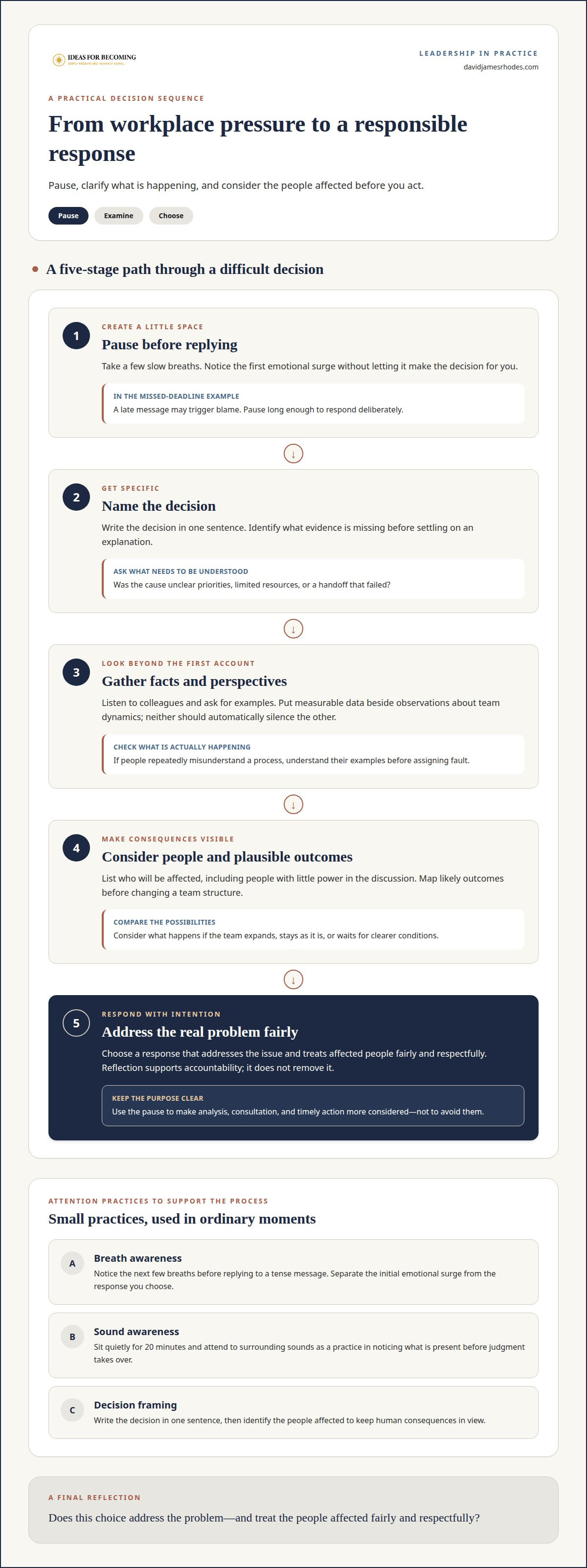
Publications on leadership and inner wisdom often recommend a practical sequence: pause, notice your reaction, examine the facts, then choose a responsible response. In Practical Wisdom in the Age of Technology: Insights, Issues, and Questions for a New Millennium, the central challenge is exercising judgment when technology and information cannot settle every human question. Reflection creates space to consider the people affected, not just the fastest solution.
That space matters when a manager receives a late message about a missed deadline. Blame may feel efficient, but it can obscure the cause: unclear priorities, limited resources, or a handoff that failed. A leader can take a few slow breaths, name the decision to be made, and identify what evidence is missing. Pausing does not remove accountability. It helps direct it toward the real problem.
Lama Chimey’s experience gives meditation a human context. She spent 12 years as an ordained Buddhist nun in the Himalayas and completed a three-and-a-half-year retreat in complete seclusion while training as a Lama. Those details do not make her experience a corporate formula. They point to disciplined attention, a quality leaders can practice in smaller, ordinary moments.
Use these tools to bring reflection to a specific workplace decision:
- Breath awareness: Notice the next few breaths before replying to a tense message. This helps separate the initial emotional surge from the response you choose.
- Sound awareness: Sit quietly for 20 minutes and attend to surrounding sounds. This practice trains attention to register what is present before judgment takes over.
- Scenario planning: Map plausible outcomes before changing a team structure. Consider what happens if the team expands, stays as it is, or waits for clearer conditions.
- Decision framing: Write the decision in one sentence, then identify the people affected. This keeps a complex discussion connected to its human consequences.
- Evidence and intuition: Put measurable data beside observations about team dynamics. Neither should automatically silence the other.
Wisdom Learning: Perspectives on Wising-Up Business and Management Education invites readers to consider how judgment develops in management practice. In a difficult meeting, that means listening to what colleagues say and what their concerns reveal. If people repeatedly misunderstand a new process, ask for examples before assigning fault. Careful listening makes the next step better informed.
These practices do not replace analysis, consultation, or timely action. They help leaders meet those responsibilities with clearer attention. Before a consequential decision, identify the issue, pause, gather perspectives, and consider likely outcomes. Then ask whether the choice addresses the problem while treating affected people fairly and respectfully.
Character development and ethical behavior
Character becomes visible when decisions carry a cost. A leader may face pressure to protect a favored colleague, conceal a mistake, or shift blame. Ethical behavior starts by naming the choice plainly: What happened? Who was affected? What response would remain defensible if everyone involved heard the full account? These questions turn values from slogans into standards for action.
Eugene Brown’s story offers a concrete example of change through responsibility. After serving 17 years in prison for armed robbery, he used chess and coaching to support young people. The 2013 film Life of a King depicts his work. The lesson is not that one difficult history defines a person forever. Brown’s example directs attention toward what someone chooses to do with experience, influence, and responsibility now.
Chess offers a useful way to examine ethical choices because each move shapes what can happen next. Leaders can use the same discipline before acting: identify the immediate objective, consider who bears the consequences, and examine what the decision makes possible. Cutting time for quality checks, for example, may protect a deadline while transferring risk to customers. An immediate gain does not prove a decision is sound.
Use these practical tools to make character more visible in daily leadership:
- Stakeholder map: List the people affected by a decision, including those with little power in the discussion. Use it to expose costs that a narrow performance measure might hide.
- Values-to-actions test: Name the value at stake, then describe the behavior that would demonstrate it. “Respect” becomes specific when a leader gives a colleague time to explain a concern before deciding.
- Decision record: Write down the choice, the reason, and the likely consequences. Revisit it after the outcome appears to learn whether the reasoning held up.
- Accountability conversation: State what went wrong, acknowledge your part, and explain the corrective action. This tool helps restore clarity without disguising responsibility as blame.
Wisdom Learning: Perspectives on Wising-Up Business and Management Education presents wisdom as something management education must cultivate, not merely describe. After a difficult decision, a leader can ask the team to reflect: Which competing duties mattered? Whose perspective was missing? What would we do differently next time? That discussion turns an individual case into a shared standard.
Ethical leadership does not demand perfect judgment. It calls for clear principles, honest explanations, and a willingness to correct course. If a promotion process overlooked a qualified employee, address the process and its effects rather than reflexively defending the outcome. Character develops through repeated choices, and each choice shows a team what leadership rewards.
Empathy and purpose in leadership
Empathy helps leaders understand how decisions affect people beyond the meeting room. Purpose gives those decisions direction. Together, they prompt leaders to consider both who is affected and why they are acting. Restructuring a team, for example is not only a staffing choice: it can change trust, workload, and people’s sense of contribution. A thoughtful response considers those effects alongside organizational needs.
Abraham Zaleznik is a leading voice in leadership writing. His 1977 Harvard Business Review article, “Managers and Leaders: Are They Different?”, examines how leadership differs from administration. Research on spiritual leadership became a scholarly focus in the mid-1990s. One study examined 347 workers from 43 company-owned wholesale distributorships.
Research on wise leadership has limits. Studies using particular workplaces or measures cannot establish a universal recipe for empathy or purpose. A school field experiment examined 229 employees across three elementary schools and one middle school, so its setting matters when interpreting its findings.
Make empathy practical by listening for the concern beneath a colleague’s position. If an employee opposes a new schedule, ask which responsibilities it might disrupt instead of labeling the response as resistance. The answer may reveal care obligations, workload conflicts, or operational details missing from the plan. Understanding a concern does not mean agreeing to every request. It helps you respond to the actual issue.
Purpose also needs a clear connection to daily work. A stated mission becomes credible when employees can see how a decision serves it. If an organization values learning, for example, a manager might set aside time to review a failed project rather than hide its lessons. The connection must show up in action, not just formal language.
Use these tools to bring empathy and purpose into leadership decisions:
- Perspective-taking: Describe how a decision could affect each group involved. Use it to surface burdens that may otherwise go unnoticed.
- Listening loop: Ask an open question, summarize the concern, and invite correction. This checks understanding before a leader responds.
- Purpose-to-action map: Connect the stated purpose to the decision and its likely effects. Use it to identify a gap between declared values and actual conduct.
- Impact review: After a change, ask who benefited, who carried costs, and what should be adjusted. This turns experience into guidance for future decisions.
Empathy without purpose can leave a leader unable to choose. Purpose without empathy can make people feel like instruments. The discipline is to hold both together: understand the human reality, then make a decision you can explain. Record the concern, name the objective, and state why the chosen action serves both responsibly. Your reasoning reveals character, especially when interests conflict.
Integrating meditation into daily leadership
You can weave daily practice into leadership tasks without turning every pause into a formal sitting. Before a difficult negotiation, walk without reading messages. Notice your steps, the room ahead, and the purpose of the conversation. This mindful walk marks a transition and gives your attention a clear focus.
Workdays are often divided by competing demands. You may move from reviewing a proposal to resolving a staffing issue while still thinking about the first task. Try focusing on one task for a set interval: close unrelated tabs, choose a clear objective, and return your attention to it when it wanders. The point is not to finish faster. It is to notice distraction before it takes over.
Physical awareness can also reveal how pressure affects your judgment. Before presenting a difficult decision, notice signs such as a clenched jaw, raised shoulders, or hurried movement. Observe them without treating them as instructions. Tension does not prove a decision is wrong, but noticing it can prompt you to slow down and explain your reasoning more clearly.
These tools fit distinct moments in a leadership day:
- Mindful walking: Attend to footsteps and surroundings while moving between work settings. Use it to create a deliberate transition before entering a consequential conversation.
- Single-tasking interval: Choose one work objective and return attention to it after interruptions. This is useful for reviewing a complex proposal without carrying several unfinished tasks at once.
- Body scan: Notice areas of tension before a presentation or negotiation. Use the information to become aware of pressure, not to treat a sensation as proof.
- Attention reset: After an interruption, state the next action in plain words, such as “review the staffing plan.” This helps restore direction without pretending the interruption did not happen.
- Shared opening pause: Invite a team to take a quiet moment before a planning discussion. This gives participants a chance to arrive mentally without requiring them to adopt a particular practice.
Match these approaches to the demands of the role. A leader who moves between offices may find mindful walking useful. Someone preparing a complex proposal may benefit more from focusing on one task at a time. The practice should support the work, not become another standard employees must meet to earn approval.
Look for changes in observable behavior. Does a proposal receive fuller attention? Does a negotiation begin with a clearer explanation? Can the team start planning without rushing to conclusions? These are practical ways to assess a routine. Meditation in leadership is not a retreat from responsibility. It helps bring your attention back to the responsibility in front of you.
Leadership development and inner development
Leadership development builds the ability to act; inner development examines the judgment behind those actions. Publications take different approaches. A conceptual work may offer a framework for reflection, while empirical research tests defined questions using particular methods and settings. Read each with its purpose in mind. Ask whether it offers ideas to consider, practices to try, or findings from a study.
Modern Organizational Wisdom: Theory and Practice has a publication date of October 15, 2026. Its title signals an interest in connecting wisdom with organizational life, a useful distinction for readers considering how reflective ideas apply at work. Publication date alone does not establish the strength of evidence. Look for the author’s definitions, the method used, and whether conclusions are supported by the material presented.
Peer-reviewed research on spiritual leadership examines leadership at individual, team, and organizational levels. It studies a defined area rather than proving one universal model of inner wisdom. Conclusions depend on what researchers measure and the context they examine. When reading research, distinguish its methods and results from an author’s interpretation or recommendations.
In leadership writing, inner wisdom can mean examining your assumptions, weighing competing concerns, and choosing with awareness of consequences. Self-awareness is part of this process, not a substitute for evidence or accountability. When deciding whether to change a team’s responsibilities, for example, consider your own assumptions alongside employees’ experience and the needs of the work.
Use these tools to connect inner development with leadership practice:
- Reading lens: Mark whether a passage presents an argument, a practical exercise, or a research finding. This helps prevent advice from being mistaken for established evidence.
- Assumption check: Write down what you believe about a decision before acting. Use it to identify beliefs that deserve examination.
- Feedback prompt: Ask a colleague what effect a recent decision had on their work. This can reveal a gap between intention and impact.
- Outcome review: Compare the decision’s stated purpose with what actually followed. Use the difference to guide future judgment.
A leadership theory is useful when it clarifies a real choice rather than making the choice for you. When considering a new management framework, ask what it helps you notice, what evidence supports it, and where its limits lie. This keeps curiosity and discernment together. Inner development matters when reflection changes how you listen, explain decisions, and take responsibility for their effects.
For leaders seeking a setting to examine purpose and responsibility alongside practical decisions, Leadership & Life Advisory connects reflection with the demands of leadership.
Peer-reviewed research on spiritual leadership examines leadership at individual, team, and organizational levels. It studies a defined area rather than establishing one universal model of inner wisdom.
David James Rhodes: Leadership & Life Advisory
Leadership & Life Advisory helps leaders, families, and young people navigate consequential moments and examine the person they are becoming through them. Consider it when reflection has clarified the questions but not the next step, or when purpose and practical demands seem to pull in different directions.
The work connects inner development with the choices leadership requires: how to respond under pressure, act on values, and consider the people affected by a decision. For a broader philosophy of character, action, and meaning, The Way explores the idea that the way forward is shaped by who you become.
Leadership is more than a set of methods. It is a practice of becoming more deliberate about what you serve and how you lead. To discuss Leadership & Life Advisory, contact David James Rhodes.
Carry Wisdom Into Your Next Decision
Publications on leadership and inner wisdom matter most when they change the questions you bring to work. Choose an upcoming decision and decide what you want to understand before acting. Insight may come through a conversation, a careful review, or a willingness to reconsider an assumption.
Then notice what your choice makes possible. Did it help you lead more clearly? Did it reveal something about the leader you want to become? Let the next decision be a beginning, not a verdict on who you are.
If you want to explore those questions in conversation, contact David James Rhodes. Take the next step with care, and keep becoming.
Frequently Asked Questions
What are influential publications on leadership and inner wisdom?
Influential examples include Abraham Zaleznik’s “Managers and Leaders: Are They Different?” and Practical Wisdom, Leadership and Culture: Indigenous, Asian and Middle-Eastern Perspectives. They approach leadership from different angles: one examines the distinction between leading and managing, while the other considers wisdom across cultural traditions. Read with a specific question in mind, such as how leaders can balance organizational demands with responsibility toward people.
Which guides explore the connection between leadership and self-awareness?
Abraham Zaleznik’s Executive’s Guide to Motivating People: How Freudian Theory Can Turn Good Executives into Better Leaders explores motivation through a psychological lens. For a broader organizational perspective, compare it with Wisdom Learning: Perspectives on Wising-Up Business and Management Education. As you read, note whether each work offers a conceptual framework, practical guidance, or research findings. This helps you judge how directly its ideas apply to your leadership decisions.
Are there recent publications on leadership and inner wisdom?
Yes. Integrating Embodied Practice and Transformational Wisdom for Sustainable Organization and Leadership has a publication date of December 26, 2025. Its focus brings embodied practice and organizational leadership into the same discussion. To assess whether a publication suits your needs, look at its publication date, edition details, and stated scope. Then consider whether you want reflective ideas, practical applications, or research evidence.
Where can I find academic articles and guides on leadership and inner wisdom?
Search scholarly databases and university library catalogs by exact title, author, or focused terms such as “practical wisdom,” “spiritual leadership,” and “self-awareness.” To find a particular article, search its full title in quotation marks. Catalog records can help distinguish journal articles from guides and edited collections. Review an article’s abstract and methods before applying its conclusions, since findings from one setting may not transfer directly to another.
Frequently Asked Questions
Related Articles

Inspirational Books for Holistic Personal Growth and Steady Habits
Explore inspirational books for holistic personal growth, and learn how mindfulness and steady habits support change across daily life in everyday practice.

Books on discovering meaning through adversity: choose a path
Explore Books on discovering meaning through adversity, from purpose and resilience to grief and mortality, and choose a guide that fits what you need now.

Use 'Life After Anything' Exercises to Find Direction
Use Life After Anything practical exercises to explore ambitions, natural strengths, future vision, and life patterns, then take one small step toward direct...