
Authority can direct people, but character shapes how that authority serves them. Spiritual growth for leaders means letting faith shape the person behind the role, so leadership expresses humility, purpose, and service, not position alone.
This work is often quiet. It asks leaders to consider not only what needs to be done, but who they are becoming as they do it. If you believe leadership carries responsibilities beyond achievement, this article explores how spiritual leadership connects faith with personal growth and service. It considers what that calling asks of a leader, how to stay spiritually grounded while serving others, and why guidance begins with a willingness to keep learning.
Key Takeaways
- Put character before position: a leader’s faith is reflected in how they treat and guide others.
- Protect regular time for prayer and Scripture so service does not become detached from spiritual roots.
- Use reflection, journaling, and trusted accountability to notice patterns and make room for personal growth.
- Look to Jesus’ example of humility to understand servant leadership as a practice, not a title.
- Let spiritual leadership take shape through practical guidance, empathy, integrity, and a willingness to keep learning.
What Is Spiritual Leadership?
Spiritual leadership joins responsibility with faith, shaping not only what a leader does but how they treat people. In Christian leadership, the role becomes a setting for character formation and service.
Character Development in Christian Leadership
Character development in Christian leadership is the steady formation of conduct around the example of Jesus. It matters because authority without humility can serve the leader’s status instead of the people entrusted to them. Titus 1:7-9 and 1 Timothy 3:1-7 connect leadership with self-control, integrity, and responsible example.
Matthew 5:48 sets a demanding spiritual aim: “Be perfect, therefore, as your heavenly Father is perfect.” Christian leaders can understand this as a call to keep growing, not as permission to claim faultlessness. Character formation asks leaders to examine the person behind the position. The question remains personal: who are you becoming through the choices entrusted to you?
Self-Awareness and Christ-Like Character
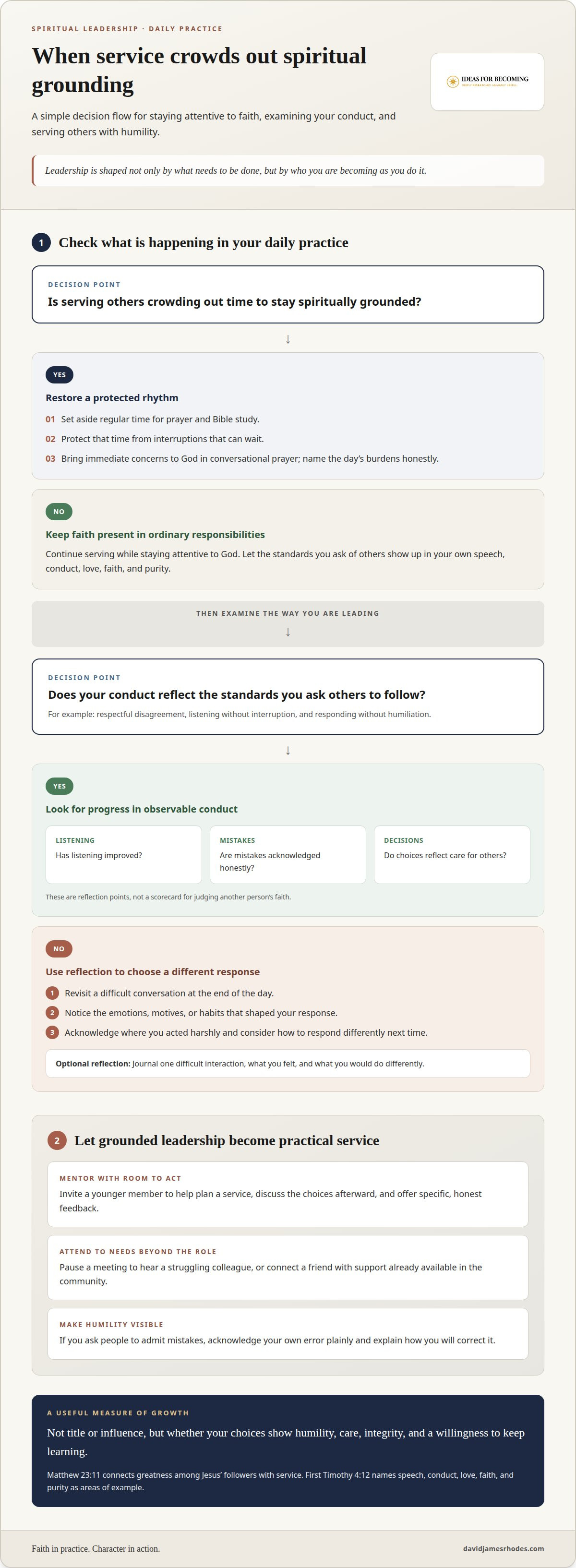
Self-awareness means noticing how motives, emotions, and habits shape your conduct as a leader. Without it, you may repeat patterns such as defensiveness or impatience while believing you are serving well. If you tend to interrupt during disagreements, for example, pause, listen fully, and consider what fear or certainty is driving your response.
Prayer and honest reflection can bring these patterns into view. At the end of the day, a Christian leader might revisit a conversation, acknowledge where they acted harshly, and consider how to respond differently next time. Faith in Christ points toward growth in humility, compassion, and truthfulness. The aim is not to perform perfection, but to face your conduct and choose to change.
Practices and Progress in Spiritual Growth
Spiritual growth for leaders develops through repeated practices that keep faith connected to daily decisions. Prayer, Scripture study, and self-reflection provide a foundation; journaling can help identify recurring emotions, choices, and motivations. A leader might record one difficult interaction, what they felt, and what they would do differently. John 14:26 describes the Holy Ghost as the Comforter sent to teach believers.
Progress is better assessed through observable conduct than titles or influence. Consider whether listening has improved, whether mistakes receive honest acknowledgment, and whether decisions reflect care for others. First Timothy 4:12 names speech, conduct, love, faith, and purity as areas of example. These are useful points for regular reflection, not a scorecard for judging another person’s faith.
Spiritual Traditions and Leadership Growth
Spiritual traditions shape leadership through different teachings and practices. Christian formation looks to Jesus, Scripture, prayer, and service; other traditions may emphasize meditation, study, community responsibility, or ethical conduct. Though these approaches differ, each can prompt leaders to examine how belief shapes the way they treat others.
In the United States, churches and faith-based organizations use leadership programs and retreats to make room for prayer, learning, and reflection. These settings can help leaders step back from routine and consider their responsibilities in light of faith. A retreat is one option, but ongoing practice and changed conduct remain central to spiritual growth.
Maintaining spiritual roots while serving others
Service can take up the attention leaders need to stay grounded. Christian practice holds both responsibilities together: serve people while remaining attentive to God.
Modeling Expected Behaviors
Modeling expected behaviors means practicing the standards a leader asks others to follow. It matters because conduct shapes the daily culture of a church or team more clearly than a stated mission. First Timothy 4:12 names speech, conduct, love, faith, and purity as examples for believers. A leader who expects respectful disagreement can demonstrate it by listening without interruption and responding without humiliation.
Consistency matters most when pressure rises. If a team leader asks people to admit mistakes, they can acknowledge their own error plainly and explain how they will correct it. Matthew 23:11 connects greatness among Jesus’ followers with service. That principle makes humility visible in decisions, not merely in public words.
Mentoring and Serving Others
Mentoring means deliberately helping another person develop judgment, responsibility, and confidence. It matters because a leader can strengthen someone else’s capacity to serve instead of making them dependent on constant direction. A church leader might invite a younger member to help plan a service, discuss the choices afterward, and offer specific, honest feedback.
Service also requires attention to needs beyond a formal role. Mark 10:45 presents Jesus as one who came to serve. In practice, a leader might pause a meeting to hear a struggling colleague, or connect a friend with support already available in the community. Mentoring works best when guidance includes listening, clear expectations, and room for the other person to act.
Daily Habits and Growth Challenges
Daily spiritual habits are small, repeatable acts that keep a leader’s faith present amid responsibility. Set aside time for Bible study and prayer, and protect it from interruptions that can wait. Conversational prayer can also bring immediate concerns before God during an ordinary day. John 15:5 describes believers as branches connected to the Vine, a reminder that service depends on a deeper source.
Workload, distraction, and the pressure to appear capable can crowd out reflection. Moving from meeting to meeting, a leader may notice impatience only after it has affected a colleague. One practical response is to set a regular time for prayer and name the day’s burdens honestly. This is not another performance measure; it makes room to attend to faith before reacting.
Growth, Ethics, and Workplace Culture
Spiritual growth can help leaders examine their motives, the consequences of their choices, and their responsibilities to others. This matters when convenience conflicts with fairness. For example, a manager addressing a mistake can seek the full account, apply standards consistently, and avoid making one person a public example.
Daily conduct also teaches people what a workplace truly values. A leader who welcomes difficult feedback makes it safer for colleagues to raise concerns; one who excuses favoritism teaches a different lesson. Matthew 23:11 places service at the heart of greatness. Applied to work, that means using authority to protect dignity, explain decisions, and help others contribute responsibly.
Personal growth and a leader’s calling
A calling is more than a role to perform. It asks a leader to keep learning, discern where service is needed, and stay open to correction. In Christian ministry, personal growth helps leaders respond with courage and care instead of relying only on habit or authority.
Spiritual growth for leaders begins with attention to what shapes the day. A leader can give God the first moments of the morning before turning to a phone or computer. A brief prayer can fit alongside an existing habit, such as making breakfast or reading Scripture. Proverbs 3:5-6 calls believers to trust in the Lord rather than rely solely on their own understanding.
Courage develops through the Word of God and time in prayer, not through certainty about every outcome. A pastor facing conflict in a congregation, for example, can pray for wisdom, listen to those involved, and consider whether a response serves people or merely protects reputation. Ellen G. White wrote on Nov. 1, 1892, that people need power beyond themselves to be restored to the likeness of God. That belief places growth within dependence, not self-sufficiency.
Reflection can help you see where your calling feels clear and where it needs attention. Each week, consider what is thriving, what is difficult, what feels confusing, and what seems missing. These questions can become a check-in with God, not a verdict on your worth. In an evening examination, the aim is awareness and direction, not self-condemnation.
Make room for growth beyond ministry duties, too. Setting aside regular time for a healthy habit creates a deliberate pause. Where responsibilities allow, some leaders may also plan time each day without scheduled commitments. Enjoying God apart from ministry matters: your relationship with faith is larger than public service or a congregation’s needs.
Growth may also call for a new form of service. Isaiah 43:19 offers an image of God doing a new thing; a ministry leader might test a different gathering format or begin by asking how to reach one person with the gospel. A mentor, peer network, or trusted friend can provide accountability. Leaders can also step back from directing and participate as learners, listening to the people they serve.
Humility keeps a calling responsive. In Testimonies, volume 7, page 144, Ellen G. White describes God seeking people humble enough to be taught and willing to represent Him. A leader who receives feedback, changes a harmful pattern, or learns from someone they lead gives that principle practical form. The measure is not constant certainty. It is a willingness to keep growing in service.
Biblical foundations of servant leadership
In the Gospels, authority is measured by how a leader serves, not by status. John 13:1-17 gives this principle a physical form: Jesus washes his disciples’ feet. The act reverses expected roles. A pastor can carry that example into a church by taking on necessary work, listening without defensiveness, and treating each person with dignity. Service becomes a practice, not a claim of virtue.
Matthew 20:26-28 makes the distinction explicit: greatness among Jesus’ followers means becoming a servant. This does not erase responsibility or require a leader to avoid difficult decisions. It changes the purpose behind authority. A pastor may need to set a clear boundary, correct harmful conduct, or make an unpopular choice. Servant leadership asks whether that decision protects people and supports the community, rather than the leader’s comfort.
Jesus’ example also shapes the relationship between leadership and discipleship. Matthew 28:19-20 directs his followers to make disciples and teach them to observe his commands. Leaders, then, remain learners within the faith they guide. A church leader who teaches forgiveness must also be willing to seek reconciliation after causing harm. A leader who teaches responsibility must accept accountability for their own decisions.
Philippians 2:5-8 points to Jesus’ humility and self-giving as a pattern for his followers. For a leader, that pattern can mean sharing credit, admitting uncertainty, or making space for another person’s contribution. Humility is not self-erasure. It is the refusal to use authority for personal importance. In a team meeting, for example, a leader can invite quieter members to speak before settling on a plan.
These passages hold service and guidance together. Romans 12:8 describes leadership as a responsibility carried with diligence, while 1 Corinthians 12:28 names gifts that include helping and guiding. A spiritual leader therefore does more than complete tasks or offer instruction. They notice what a person needs to grow, provide direction where it is useful, and step back when others can take responsibility. The biblical pattern is demanding: influence should strengthen the people being led.
That pattern has practical consequences for trust. If a church community sees a pastor use authority to listen, serve, and make fair decisions, the leader’s words gain credibility through conduct. If words and actions diverge, trust weakens. John 13:1-17 offers a continuing test: does leadership make room for humble service, even when the task carries little recognition?
The biblical pattern also appears in Matthew 23:11, Mark 10:45 and Luke 22:27, where Jesus modeled servant behavior. The Word of God and time in prayer are identified in Christian teaching as foundations for developing godly courage. These passages offer a spiritual basis for service and leadership; they do not establish that reading more causes people to achieve more.
Spiritual leadership as service and guidance
Spiritual leadership becomes visible in how a leader guides people through ordinary needs and serious disruption. Romans 12:8 describes leadership as a responsibility to exercise diligently. The role is more than setting direction. It includes noticing who needs care, offering wise counsel, and helping a community move toward its shared purpose. A church leader may show this by hearing a member’s concern before deciding what support is needed.
Guiding others takes more than authority. Spiritual leadership draws on maturity, empathy, compassion, integrity, communication, vision, humility, and mentoring. These qualities reinforce one another: vision helps name a direction, while humility keeps it open to learning. A pastor planning a new ministry, for example, can explain its purpose, invite questions, and adapt when community members identify needs the plan missed.
Prayer matters because leadership decisions can exceed a person’s experience or insight. The Acts of the Apostles, page 360, states that ministers can fulfill their mission only by receiving wisdom and power from above. That conviction does not replace practical judgment. A leader can pray, gather relevant perspectives, and consider the effects of each option. In a conflict, this may mean seeking truth without treating either party as disposable.
Service also means recognizing when a scheduled task must give way to an urgent human need. A leader may need to pause preparation or devotional work to respond to a serious emergency. That does not mean rejecting spiritual discipline. It means recognizing that caring for someone in immediate distress may be the work required in that moment. Discernment involves seeing the need clearly and responding with compassion and responsibility.
First Corinthians 12:28 describes different gifts in the church, including helping and guiding. That range matters: spiritual leadership is not limited to one personality or public role. Romans 16:3-5 identifies Priscilla, alongside Aquila, as an early Christian leader who helped guide believers and offer counsel. Her example points toward leadership expressed through teaching, relationships, and practical support. A leader can make room for others’ gifts instead of treating influence as a possession.
The result is guidance that strengthens people rather than making them dependent. A leader can clarify a next step, explain why it matters, and then let another person take responsibility. For leaders seeking a thoughtful conversation about purpose, responsibility, and the choices shaping their service, explore Leadership & Life Advisory.
When serving a community, setting aside ministerial or devotional tasks to respond to a serious emergency is part of service, not a failure to value those tasks. An urgent need may require a leader to pause planned work and give someone their attention. This means not allowing a schedule to take priority when people face distress. It also grounds guidance in care: respond to what is needed rather than simply continuing with the planned task. In this way, pausing ministry or devotional work can itself express spiritual responsibility and service.
David James Rhodes: Leadership & Life Advisory
Leadership & Life Advisory offers space to examine how personal values, faith, and responsibility shape the way you lead. It may be useful when a demanding role raises questions about purpose, difficult decisions, or the example you want to set. The work connects leadership with human becoming: not just what you achieve, but who you become through your choices.
David James Rhodes brings a perspective shaped by leadership and life experience across varied settings. His approach helps leaders consider the connection between inner growth and outward service without reducing either to a formula. The practical questions remain: what needs to change in how you lead, and what kind of person will that change ask you to become?
To explore Leadership & Life Advisory, contact David James Rhodes.
Carry the work into your next decision
Spiritual growth for leaders is not a finished state. It takes shape in the decisions ahead: the truth you choose to tell, the responsibility you accept, and the people you make room to serve. You cannot avoid uncertainty; you can choose who you become while facing it.
The Way, a guide centered on human becoming, offers a wider reflection on that question. For a more personal conversation about the demands and direction of leadership, you can contact David James Rhodes to discuss leadership.
Keep learning and serving. Your next faithful step can begin where you are.
Frequently Asked Questions
What does spiritual growth mean for leaders?
Spiritual growth for leaders means continuing to align decisions and relationships with faith and values. It changes how you use authority, especially when pressure or disagreement makes an easy response tempting. Before announcing a difficult organizational change, for example, ask whether the decision is honest, necessary, and attentive to the people affected. Growth shows in examination and correction, not simply in religious language or public identity.
What guides and resources support spiritual growth for leaders?
Useful resources connect reflection with real leadership choices. David James Rhodes’s The Way explores human becoming, while 365 Days of Becoming centers on daily practice. A leader might read a short passage, then use a journal to consider how its ideas apply to a current decision. Discussing that reflection with a trusted peer can bring another perspective and help turn an insight into a considered action.
Frequently Asked Questions
Related Articles

Inspirational Books for Holistic Personal Growth and Steady Habits
Explore inspirational books for holistic personal growth, and learn how mindfulness and steady habits support change across daily life in everyday practice.

Books on discovering meaning through adversity: choose a path
Explore Books on discovering meaning through adversity, from purpose and resilience to grief and mortality, and choose a guide that fits what you need now.

Use 'Life After Anything' Exercises to Find Direction
Use Life After Anything practical exercises to explore ambitions, natural strengths, future vision, and life patterns, then take one small step toward direct...