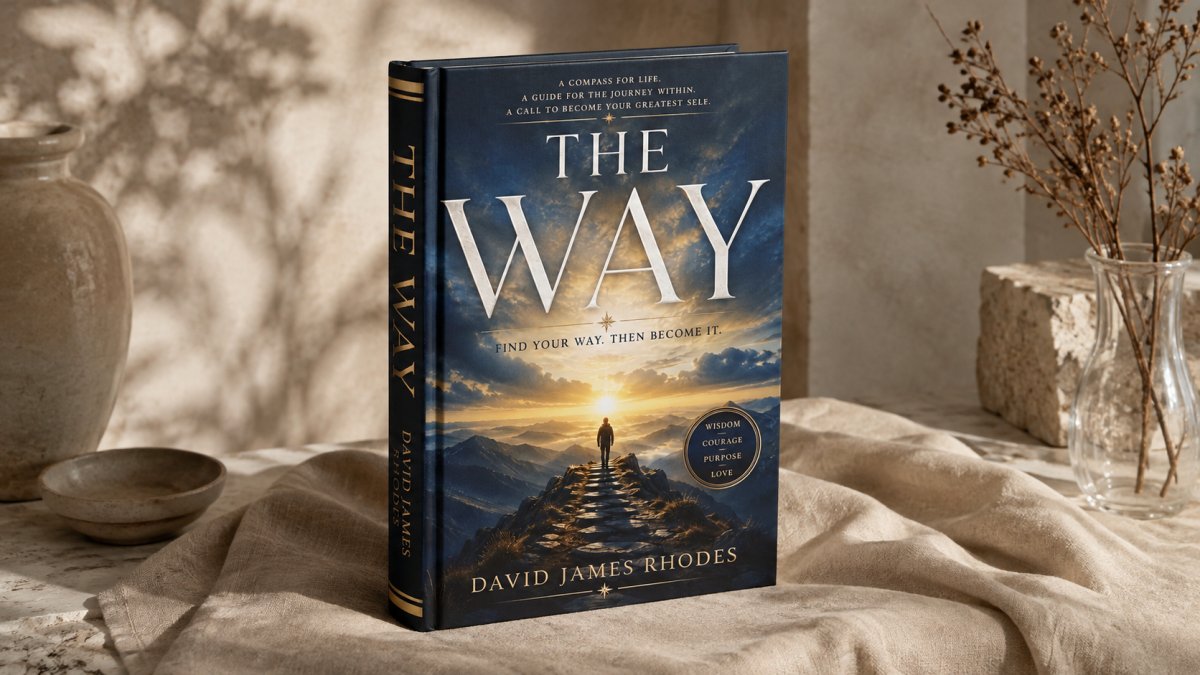
What if the destination you've spent years chasing is actually a mirage? Many high achievers reach their peak only to find the air is thin and the meaning is absent. It's a heavy, quiet realization. You've followed the maps, yet you're still lost. The Way book by David James Rhodes challenges the idea that identity is a fixed point. It suggests that we're never finished. We are always in a state of human becoming.
You've likely felt the weight of a major setback or the hollow success of a reached goal. You know that loud, cheerleader style motivation fails when the stakes are truly high. We agree that these moments of transition require a deeper philosophical grounding. This article provides a clear framework for navigating the silence of recovery and the complexity of leadership. We'll explore how to rebuild your character after adversity and why shifting your focus from being to becoming changes everything. It's time to stop looking for a finish line and start mastering the process.
Key Takeaways
- Shift your perspective from finding a static identity to embracing the fluid, continuous process of human becoming.
- Draw on insights gathered from 156 countries to navigate the universal complexities of transition and personal evolution.
- Apply a structured philosophical framework to rebuild character and meaning in the wake of major life disruptions.
- Utilize the practical strategies within The Way book to establish a rhythmic, daily practice of intentional growth.
- Transform personal insights into leadership excellence through principles designed for high-stakes advisory and keynote settings.
Beyond Finding Yourself: The Philosophy of The Way
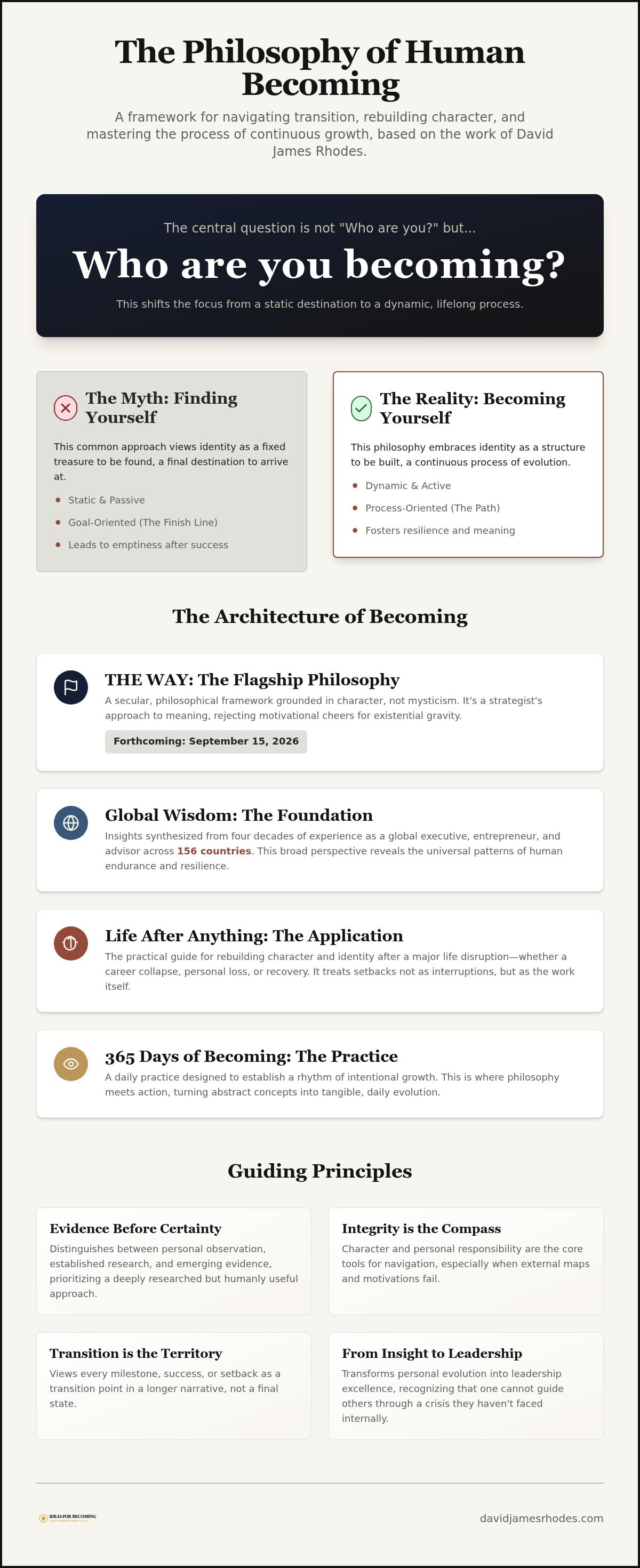
Identity is not a treasure to be found. It's a structure to be built. Most motivational literature promises a destination, a point where you finally arrive at your true self. This is a comforting lie. The Way book rejects the static nature of these promises. It offers instead a philosophy of existential gravity. It doesn't shout. It doesn't cheer. It stands as a witness to the reality of the human condition. Who are you becoming? This is the only question that matters. It's a question that demands an honest inventory of your character and your courage.
The Process of Human Becoming
Human becoming is a continuous state of growth that persists regardless of external success or failure. We're taught to focus on doing. We work. We achieve. We accumulate. When the work is done, we're told to focus on being. But being is too passive. It implies a pause that doesn't exist in nature. The void you feel after reaching a major goal isn't a sign of failure. It's a sign that your identity was tied to a destination rather than the process of human becoming. Evolution is the only constant. If you stop evolving, you start decaying. True leadership requires an understanding that every milestone is merely a transition point in a much longer narrative.
A Secular Path to Meaning
The title The Way book often invites comparisons to ancient religious texts. While it shares their weight, this framework is strictly secular. It's grounded in the raw experience of a global executive who has seen the world from the heights of finance to the depths of behavioral health. It doesn't rely on divine intervention. It relies on character. Integrity is the compass. Transition is the territory. By stripping away the religious dogma, the focus shifts entirely to personal responsibility. How do you navigate the silence of a major setback? How do you lead when the old maps no longer work? This is a guide for those who seek meaning without the need for mysticism. It's a strategist's approach to the soul. It acts as a witness to the extremes of human success and failure, offering a steady hand for those currently navigating the dark.
The Architecture of Becoming: Wisdom from 156 Countries
One hundred and fifty-six countries. Four decades of observation. This is the foundation of The Way book. It isn't a collection of travel anecdotes. It is a synthesis of human endurance across every conceivable border. David James Rhodes has walked the halls of international finance and the corridors of behavioral health. He has seen the same patterns of struggle in both. Why? Because the human condition doesn't change with the currency. He operates as a global sage, a witness to the extremes of human success and the quiet depths of failure. This perspective allows him to integrate the cold logic of global markets with the intimate reality of personal crisis.
Global Lessons in Resilience
Travel at this scale strips away the local noise. It reveals the universal architecture of resilience. In every culture, adversity acts as the primary catalyst for character. It's the friction that creates the heat for change. When we move beyond our immediate surroundings, we stop seeing our setbacks as unique failures. We see them as part of a larger, collective human story. This worldly understanding is essential for anyone seeking a daily practice of evolution. It turns personal pain into a strategic asset. How often do we let our local perspective blind us to our global potential? Rebuilding is not a regional craft. It is a human necessity.
The Intersection of Elite Performance and Personal Struggle
High-stakes leadership is often a lonely endeavor. The pressure to perform can create a disconnect between the public persona and the internal reality. Maintaining integrity under these conditions is not a matter of sheer willpower. It's a matter of internal strategy. The Way book serves as a guide for this internal landscape. It acknowledges the somber reality that performance and struggle are not opposites. They are deeply intertwined. A leader who hasn't faced their own shadows is a leader who cannot truly guide others through a crisis. Have you considered the weight of your own integrity? Many find that engaging with a seasoned advisor provides the perspective needed to navigate these high-stakes transitions. This isn't about motivational cheering. It's about the cold, hard work of character architecture. It's about becoming who you need to be to survive the extremes of both success and failure. The goal isn't just to lead others. It's to lead yourself through the silence of the transition.
Navigating Life After Anything: Rebuilding Character and Identity
Setbacks are not interruptions. They are the work itself. While The Way book establishes the philosophical framework for human becoming, the "Life After Anything" series provides the practical application. It is the sibling to the flagship philosophy, designed for those standing in the ruins of a former life. Whether the collapse was a career, a marriage, or a battle with substance, the challenge remains the same. How do you build a character that can withstand the next storm? This isn't just about recovery. It's about human potential. It's about taking the raw material of a crisis and forging something durable.
Rebuilding After Rock Bottom
Rock bottom is often described as a dark place. In reality, it is a foundation. It is the only place where the ground is solid enough to support a new, worthy narrative. To rebuild, you must first shed the labels that have become your cage. Names like "addict" or "failure" are static. They anchor you to a past that no longer exists. The Way book and Life After Rehab provide the map for this transition, moving the focus from what you were to who you are becoming. Recovery, in this context is not a return to a previous state. It is an evolution into a more resilient version of the self. What would happen if you stopped seeing your history as a burden and started seeing it as a prerequisite for leadership? This perspective is the foundation for high-level advisory, turning raw experience into strategic authority.
Identity in Transition
Transition is the silent space between identities. It is the period after the divorce is final, after the business is sold, or after the loss has been mourned. This silence can be terrifying. Without a structured practice, it's easy to drift. The "Life After Anything" series, supported by 365 Days of Becoming and the Life After Anything Companion Guide & Workbook, offers a methodical rhythm for this period. These tools aren't meant to "fix" you. They're meant to anchor you. Transitions are the most fertile ground for human becoming because the old structures have already fallen. You're left with the raw truth of your own character. Integrity is built in these quiet moments of daily focus. Are you willing to stay in the transition long enough to see what emerges?
Engaging the Work: A Daily Practice of Evolution
Philosophy without practice is merely an intellectual exercise. To move from understanding to evolution, you must engage with the work daily. The Way book is not designed for a single sitting. It is designed for a lifetime of returns. Using it alongside the Life After Anything Companion Guide & Workbook transforms the text from a guide into a mirror. The minimalist and rhythmic structure of the writing is intentional. It mirrors the cadence of a steady breath. It forces you to slow down. It demands a level of attention that modern corporate noise has all but destroyed. This is the foundation of character architecture.
The Power of the Pause
Silence is a rare commodity in leadership. We're conditioned to respond, to react, and to solve. The communication rhythm in David James Rhodes's work disrupts this habit. By utilizing short, staccato fragments, the text creates space. It forces a deliberate pause. This isn't just a stylistic choice. It's a strategic intervention. Each declarative statement is often followed by a provocative, open-ended question. These questions shift the focus from the author's insight to your reality. They don't provide answers. They demand them. In the quiet of that pause, you find the truth of your own character. Can you sit with the silence long enough to hear what it tells you about your evolution? Most cannot. Those who do find a clarity that performance alone cannot provide.
Steps to Daily Becoming
Transformation is a methodical process. It requires a move from passive reading to active implementation. Use this framework to integrate the philosophy into your high-stakes reality:
- Step 1: Confront the current state of "being" with raw honesty. Begin with an inventory. Where is your identity currently anchored?
- Step 2: Engage with a single truth or declarative statement from the text. Select one point from The Way book. Let it sit. Don't rush to the next page.
- Step 3: Journal through the provocative questions provided. Use the Life After Anything Companion Guide & Workbook to record your responses. Writing is the bridge between thought and character.
- Step 4: Commit to one act of character-aligned movement. Identity is forged in action. What is one thing you can do today that reflects who you are becoming?
This daily discipline ensures that the philosophy doesn't stay on the shelf. It becomes part of your internal architecture. If you're ready to move beyond theory and begin the hard work of rebuilding, you can order the companion materials to start your practice today. Evolution is not a destination. It's a daily choice. Every word is chosen for its ability to provoke internal change. The question is whether you're willing to listen.
From Reader to Leader: Advisory and Keynote Insights
Leadership is often mistaken for a set of external skills. It is not. It is a manifestation of character. The Way book provides the philosophical anchor for this realization. For the global executive, this philosophy must translate into high-stakes decision making. David James Rhodes bridges this gap through Leadership & Life Advisory. He doesn't offer life coaching. He offers a steady, authoritative presence for those navigating the extremes of performance. The book is the manual. Advisory is the implementation. It's a partnership rooted in raw human experience and elite performance.
Leading from the Inside Out
The modern leader faces a unique crisis of meaning. Status is no longer enough. The next generation of leaders prioritizes identity over simple accumulation. They demand integrity. This requires leading from the internal landscape outward. In an advisory capacity, David functions as both a witness and a strategist. He has seen the world from 156 countries. He understands the silence of the boardroom and the noise of the market. This perspective is vital when the stakes are high and the outcomes are permanent. How do you maintain your character when the world is watching? True authority comes from having navigated your own transitions with honesty. It's about becoming the person capable of holding the weight of the position.
These principles aren't limited to the individual. They scale. Keynote Speaking engagements bring the process of human becoming to the global stage. It is a somber, intentional challenge to the status quo of motivational speaking. It avoids the exuberant and the hollow. Instead, it offers a rhythmic, methodical framework for entire organizations. The integration of life and work is not a balance to be struck. It is a singular path to be walked. This is the intersection of high-level finance and behavioral health. It's where strategy meets the soul.
The Call to Action
The journey of becoming is a solitary one, yet it requires a guide who has navigated the territory. The full collection of literary works provides the necessary map. From the daily discipline of 365 Days of Becoming to the practical recovery of the Life After Anything series, the path is clearly marked. The work is challenging. It is deliberate. It is essential. Every transition is an opportunity to rebuild your character from the ground up. Are you ready to stop being and start becoming? Explore the full range of advisory services and literary resources to begin your evolution. We invite you to inquire about keynote speaking opportunities that challenge your organization to look deeper.
Discover your path of becoming with David James Rhodes.
The Mastery of the Internal Landscape
Identity is not a prize to be won. It's a structure to be maintained through every transition. We've explored how The Way book serves as the philosophical foundation for this architecture. It turns the silence of a setback into a strategic asset. It shifts the focus from what you've achieved to who you are becoming. This is the work of a lifetime. It demands honesty.
David James Rhodes offers more than just text. He offers the perspective of a seasoned strategist who has navigated the extremes of human experience across 156 countries. As the author of the "Life After Anything" series and a professional leadership advisor, he provides a steady hand for those in the midst of evolution. The maps of the past are no longer sufficient. You need a guide who understands the weight of integrity in a world of constant noise. Are you ready to face the raw truth of your own potential? The process is somber. It is challenging. It is the only path to a character that truly endures.
Begin your journey of human becoming with David James Rhodes.
Frequently Asked Questions
What is the main message of "The Way" by David James Rhodes?
The central message is that identity is never finished. The Way book positions human existence as a perpetual state of becoming rather than a fixed destination. It challenges the reader to move beyond the hollow achievement of goals and focus on the architecture of their character. This shift requires an honest confrontation with one's internal reality. Evolution is the only constant. Are you willing to embrace the process?
How is this book different from religious texts with the same name?
This work is a strictly secular philosophical framework. Unlike religious texts, it draws its authority from four decades of global experience in international finance and behavioral health. It avoids dogma in favor of raw human experience observed across 156 countries. The focus remains on personal responsibility and the development of character in high-stakes environments. It is a strategist's approach to the internal landscape of the modern individual.
Is "The Way" a leadership book or a self-help book?
It operates at the intersection of elite performance and raw human experience. While it provides the grounding necessary for leadership, it's more accurately described as a guide for human potential. Traditional self-help often relies on exuberant, cheerleader-style motivation. This work offers a somber, intentional alternative. It treats leadership as a manifestation of internal character. If the internal structure is weak, the public leadership will eventually fail.
Can "The Way" help me during addiction recovery or after rehab?
Rebuilding identity is the most critical step after rehab. The Way book provides the map for this transition by moving beyond the labels of the past. It treats rock bottom as a solid foundation for a new, worthy narrative. In conjunction with Life After Rehab, it offers a framework for navigating the silence of recovery. The goal isn't to return to who you were. It's to evolve into a more resilient version of yourself.
Who is the primary audience for David James Rhodes’s work?
The work is designed for those who have reached the extremes of success or failure. This includes global executives, high-level leaders, and individuals navigating major life transitions like divorce or career loss. It speaks to those who find traditional motivational content inadequate for the gravity of their situation. If you feel that meaning is missing despite your achievements, this work is for you. It is for the seeker and the strategist.
What is the relationship between "The Way" and "Life After Anything"?
They are two parts of a singular whole. The Way establishes the philosophical framework of human becoming. Life After Anything serves as the practical application for those standing in the ruins of a former life. One provides the why of evolution, while the other provides the how of rebuilding. Together, they create a comprehensive strategy for navigating high-stakes personal and professional transitions. It is an integration of life and work.
Does David James Rhodes offer workbooks to accompany his books?
Yes, the Life After Anything Companion Guide & Workbook is a central component of the practice. It is designed to bridge the gap between reading the philosophy and acting upon it. The workbook utilizes provocative, open-ended questions to force a deliberate pause in the reader's day. This rhythmic engagement ensures that the principles of human becoming are integrated into your daily life. It turns reflection into a methodical discipline for leaders.
How can I book David James Rhodes for a keynote speaking engagement?
Keynote speaking engagements can be arranged through the official David James Rhodes website. These sessions scale the principles of human becoming for organizations and elite teams. The tone is formal, dignified, and challenging. It moves beyond corporate jargon to address the fundamental human elements of leadership and resilience. Each engagement is an opportunity to witness a global sage's perspective on human potential and the necessity of character in a crisis.
Frequently Asked Questions
Related Articles

Best Leadership Guides for Executives: A Thoughtful 2026 Selection
Searching for the best leadership books for executives? Discover thoughtful leadership guides matched to real executive challenges, strategy, and character.
Executive Coach vs. Advisor: Which Kind of Support Does a Leader Need?
Choosing between an executive coach vs advisor? Learn how to match the right support to consequential leadership decisions and the leader you are becoming.

Executive Advisory on Purpose and Fulfillment: A More Human Way Forward
Seek executive advisory on purpose and fulfillment to align leadership choices with values and character. Discover who you are becoming beyond outward success.