
Your roles can change before your sense of self catches up. Books exploring identity beyond external roles trace that unsettled ground through family expectations, grief, parenthood, trauma, major life changes, names, and reinvention. They show how identity is shaped by what people inherit, what they lose, and what they choose to carry forward.
It’s natural to look for yourself in familiar roles: child, parent, partner, leader. But those labels can’t contain a whole life. These stories explore the tension between who others expect you to be and who you are becoming.
You’ll find works about belonging across generations and cultures, the private changes that follow loss or parenthood, and the difficult passage through a disrupted life. Each offers a different lens, not a formula for finding yourself. Together, they invite honest reflection on what remains when a role shifts and what you might choose to make next.
Key Takeaways
- Notice how family expectations and social roles can shape identity, while distinguishing inherited expectations from values you choose for yourself.
- Explore how grief and parenthood can change self-understanding, not simply add new roles to an existing life.
- Consider how memory and trauma influence the stories people tell about themselves, and what rebuilding may involve.
- Use major transitions as a chance to examine what has ended, what is changing, and what you want to carry forward.
- Reflect on how names and reinvention can express a changing relationship with family, belonging, and self.
1. Identity shaped by family and social expectations
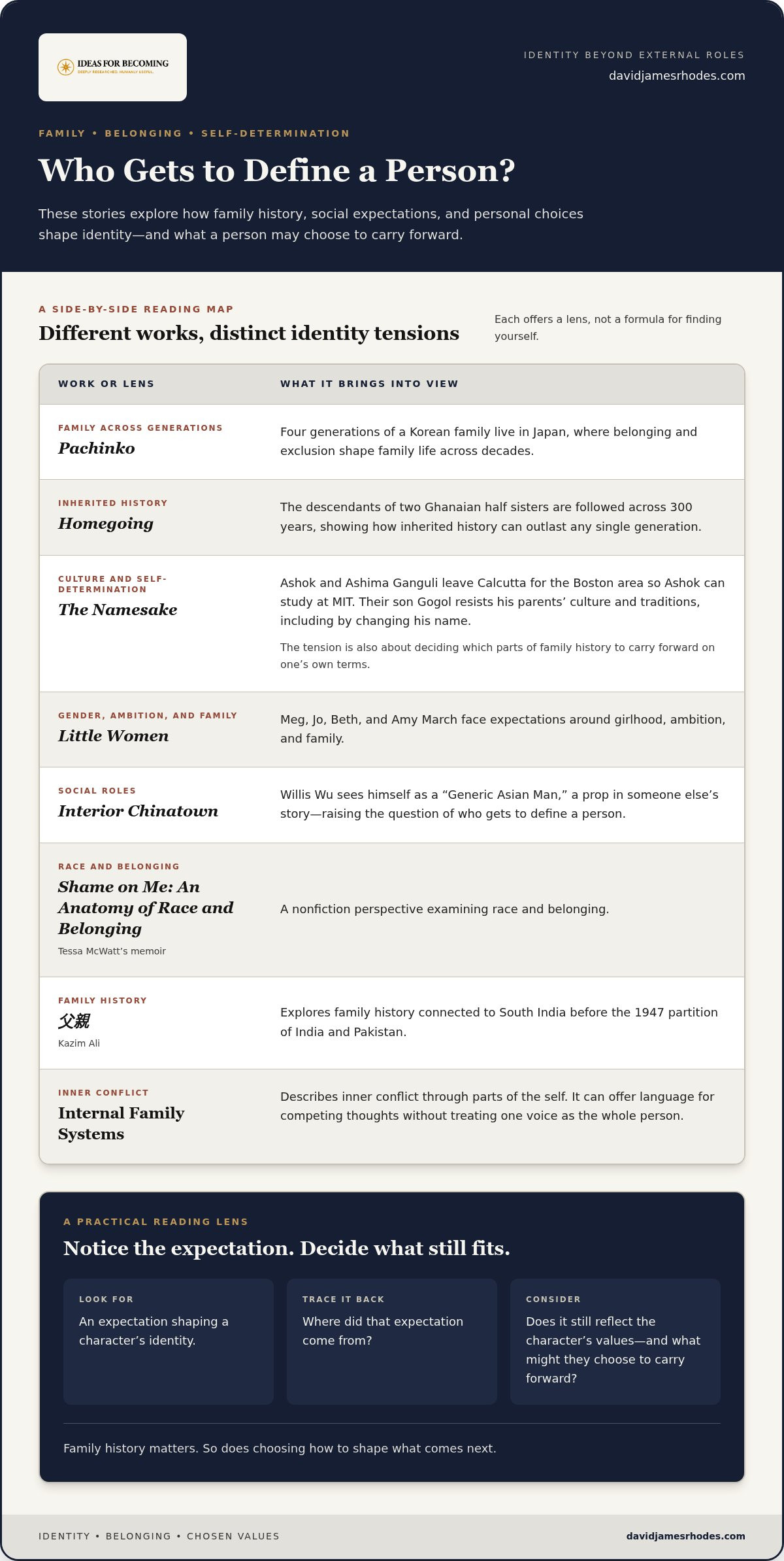
Family gives people their first stories about belonging, duty, and survival. Those stories can protect a child, then feel restrictive when adulthood calls for different choices. Books about identity linger in that tension. Self-improvement guides often focus on changing habits or reaching a goal; identity-focused works ask whose expectations shaped the goal in the first place.
In Pachinko, four generations of a Korean family live in Japan, where belonging and exclusion shape family life across decades. Homegoing follows descendants of two Ghanaian half sisters across 300 years, showing how inherited history can outlast any single generation. These narratives don’t reduce identity to ancestry. They reveal how migration, cultural pressure, and family loyalty influence what people believe they owe one another.
Family relationships also hold conflict between inherited custom and self-determination. In The Namesake, Ashok and Ashima Ganguli leave Calcutta for the Boston area so Ashok can study at MIT. Their son Gogol later resists his parents’ culture and traditions, including by changing his name. The struggle is not simply between family and freedom. It is also about deciding which parts of family history to carry forward on one’s own terms.
Other stories make social roles visible. In Little Women, the four March sisters, Meg, Jo, Beth, and Amy, face expectations around girlhood, ambition, and family. In Interior Chinatown, Willis Wu sees himself as a “Generic Asian Man,” a prop in someone else’s story. Each example asks who gets to define a person: family, society, or the person living that identity.
Nonfiction offers a closer account of that question. Tessa McWatt’s memoir Shame on Me: An Anatomy of Race and Belonging examines race and belonging; Kazim Ali’s 父親 explores family history connected to South India before the 1947 partition of India and Pakistan. For another lens, Internal Family Systems describes inner conflict through parts of the self. It can offer language for competing thoughts without treating one voice as the whole person.
To read these works actively, notice an expectation, where it came from, and whether it still reflects your values. Family history matters. So does choosing how to shape what comes next.
James McBride's mother married a Black man in 1942, a family history that can prompt reflection on how intimate choices meet social expectations. Such context adds another lens on belonging.
2. Grief, parenthood, and self-understanding
Grief can unsettle more than a relationship; it can unsettle the self built around it. Parenthood can do something similar, adding responsibility while changing how someone understands their past. Ta-Nehisi Coates’s Between the World and Me takes the form of a letter to his son. Its structure puts parenthood at the center: a father addresses the next generation, using writing to examine what he wants to tell him.
When reading about grief, notice how a character describes themselves after a loss. Which roles remain? Which feel newly fragile? What do ordinary decisions begin to mean? These questions connect a story to lived experience without treating fiction as a prescription. Coates’s letter also shows how a personal address can explore identity, inheritance, and responsibility.
Queer coming-of-age stories can make self-acceptance visible through friendship and family. Aristotle and Dante Discover the Secrets of the Universe follows two Mexican-American teens exploring friendship, family, and sexuality. It offers a way to consider identity beyond traditional gender expectations: notice how the characters’ relationships influence what they can name about themselves. The story need not offer one answer for every reader.
For a further perspective on gender and identity, Virginia Woolf’s Orlando begins in Elizabethan England with a 16-year-old male nobleman. The story ends in 1928, with Orlando a modern 36-year-old woman. Readers seeking fiction that questions traditional gender roles can follow how the character’s changing identity unsettles fixed assumptions about selfhood across time.
Racial ambiguity and self-authorship also meet in The Vanishing Half, which follows identical twin sisters raised in a small Black community in Louisiana. Their shared beginning invites readers to consider how identity can diverge within one family. Jacqueline Woodson’s Brown Girl Dreaming, published in 2014, depicts childhood in the 1960s and 1970s. Its memoir form makes the author’s act of shaping personal memory part of the reading experience.
Writing can help you notice which story you inherited and which you are composing. After reading, try a brief exercise: write one sentence about a role others recognize, then another about a value that matters apart from that role. The difference may clarify what you want to reclaim. Detransition, Baby offers another fictional lens, centering three women whose lives intersect because of an unexpected pregnancy.
For stories about identity and gender beyond traditional roles, consider Orlando, Aristotle and Dante Discover the Secrets of the Universe, and Detransition, Baby. Each approaches selfhood differently, through changing gender, sexuality, family, or unexpected parenthood.
3. Trauma, memory, and rebuilding identity
Trauma can alter the stories people tell about who they are. Literature gives readers room to notice those stories without reducing a person to one painful event. In Tommy Orange’s There, There, characters’ lives intersect in Oakland at the Big Oakland Powwow. Its structure invites reflection on how separate experiences can meet within a wider community narrative.
Marcelo Hernandez Castillo’s experience brings immigration and family separation into view. His father was deported to Mexico, and Castillo is an undocumented DACA recipient. These facts place identity within forces larger than individual choice. Readers can follow how family, memory, and public labels shape a person’s understanding of home, while resisting the idea that any single label tells the whole story.
Growing up between family histories can also shape how a person navigates belonging. Roof Sweatte describes life as a transracial adoptee moving between two families and two cultures. The experience invites close attention to memory: which traditions feel familiar, which relationships carry expectations, and how someone makes meaning from more than one inheritance. The tension is not a failure to choose. It is part of the story.
For a generational perspective, The Color Purple explores African American women’s lives in the early 20th century. Its historical setting directs attention to how social conditions affect what characters can say, choose, and imagine. Readers can notice where a character must perform an expected role, and where a private thought begins to challenge it. That distinction helps reveal identity as more than outward compliance.
James Baldwin’s The Fire Next Time, published in 1963, consists of two essays. The form matters: an essay can bring personal reflection into direct conversation with public history. Rather than treating memory as a complete record, readers can ask what each narrator emphasizes, questions, or leaves unresolved. This approach helps make room for complexity without claiming that one voice represents every American experience.
Try this reading practice with a memoir or story about painful history. First, identify the label placed on a character by family or society. Next, note a moment when the character’s own words complicate that label. Finally, ask what remains beyond the event or expectation. This keeps attention on the person, not only the harm they endured. It can also clarify how identity is rebuilt through choices, relationships, and meanings that develop over time.
4. Identity crises and major life changes
A major change can remove the structure that once made identity feel settled. A career ends, a relationship shifts, or a familiar community no longer feels like home. Novels let readers observe such changes up close, without reducing them to a simple lesson. Notice what a character loses, what remains dependable, and which choices begin to restore a sense of belonging.
In Like Happiness, Tatum Vega’s life in Chile is upended by a reporter’s call in 2015. The interruption makes an ordinary detail carry new weight: one call unsettles the life she knows. As you read, track how Tatum responds before deciding what the disruption means. Her story can prompt readers to distinguish the event itself from the narrative they build around it.
Bruce Feiler writes that people spend an average of 20-25 years of their lives in phases of major disruption at work, in love, and in community. His transition framework names three phases: the Long Goodbye, the Messy Middle, and the New Beginning. These names can help readers recognize different demands within a change. A goodbye asks what must be released; the middle tests what can be carried forward.
William Bridges’s transition framework offers a related structure: The Ending, The Neutral Zone, and The New Beginning. Read alongside Feiler’s model, it gives readers language for the interval between an old identity and a new one. These frameworks aren’t novels or guarantees. They are lenses for considering what has ended, what feels unresolved, and what new commitments may gradually take shape.
Fiction makes these questions intimate. Americanah follows two young Nigerians, Ifemelu and Obinze, who leave their military-ruled country for life in the West. Their experiences invite close attention to how migration can alter a person’s assumptions about home and belonging. The journey isn’t only geographical. Readers can consider how familiar identities shift under new social expectations.
Other novels locate change in specific periods. Eleanor & Park is set in 1986; Everything I Never Told You is set in the 1970s. Their settings help readers notice the pressures shaping each character’s choices. A useful reading practice is to mark one moment when a character acts from habit, then another when they act from a newly chosen value. That contrast reveals change in motion.
A favorite story may not provide answers. It can still help you examine a transition deeply: name what has ended, identify what remains meaningful, and notice which next action expresses the person you want to become.
5. Identity shaped by names and reinvention
A name can carry family history, cultural expectations, and private memory. It can also become a point of resistance. In Jhumpa Lahiri’s The Namesake, Gogol changes his name as he rebels against his parents’ culture and traditions. The choice matters beyond sound or preference. It reflects a changing relationship with inheritance and asks who has the authority to name a life.
Read Gogol’s decision as a turning point, not a complete reinvention. A new name can change how someone introduces themselves, but it cannot erase relationships or history. Lahiri’s novel makes that tension emotionally clear: personal choice takes place within a family story. Notice what Gogol hopes the change will leave behind, and what follows him anyway.
Names also show how language can hold more than one identity. A name may feel intimate within a family and unfamiliar in wider society. It may reflect a tradition someone values, an expectation they question, or both. In Orlando, Virginia Woolf follows a character whose identity changes across gender and time. The novel invites readers to consider how labels shape recognition, even as a person’s life exceeds any single description.
Reinvention need not begin with a legal or public name change. Someone might reconsider a role, a family label, or the story attached to an old choice. Little Women offers a different example: Jo March’s ambition meets expectations placed on the four March sisters. Her resistance shows how self-definition can emerge through decisions and conduct, not only through a changed name.
To read these stories closely, try three steps. First, note who uses a character’s name and in what setting. Next, mark when the character accepts, rejects, or revises the identity attached to it. Finally, ask what the choice costs and what it makes possible. Applying this method to Gogol in The Namesake can reveal how family ties and personal agency coexist rather than cancel each other out.
These novels don’t offer one rule for reinvention. They show its emotional complexity: a name can honor belonging, resist an inherited expectation, or signal a self still taking shape. Notice which characters define themselves through language and which express themselves through action. The distinction can help readers reflect on the roles they have inherited and the values they want their choices to represent.
David James Rhodes: The Way
The Way offers a next step for readers asking who they are becoming beyond inherited roles or familiar labels. David James Rhodes’s guiding idea is that the way forward is not simply found; it is shaped through the person one becomes. This perspective connects identity with character, choices, relationships, purpose, and action. Turn to The Way when reflection on family, grief, or change raises a broader question about how to live from here. It is a guide to human becoming, not a formula for resolving every conflict or a substitute for care when care is needed. If this way of thinking speaks to you, visit davidjamesrhodes.com.
Let Reflection Become a Choice
Books exploring identity beyond external roles can open a question; your choices give it a life. Reflection matters most when it changes how you meet the day ahead. Notice where an old expectation still directs you. Then choose an action that better reflects your values, even if it feels small.
This is not a demand to discard every role or rewrite your past. It is an invitation to live with greater intention inside the life you have. David James Rhodes’s work centers on human becoming: the ongoing practice of choosing who you are becoming, through action, character, and meaning. If you want to continue that conversation, contact David James Rhodes.
Books about identity beyond external roles can prompt reflection, but your choices give it practical meaning. You don’t need a complete map before taking a meaningful step. Begin with the choice in front of you, and let your actions reflect the person you hope to become.
Frequently Asked Questions
Which works explore identity beyond work, family, and social roles?
For a range of perspectives, consider Americanah, Little Women, and Interior Chinatown. Their characters encounter identity through migration, ambition, or roles imposed by society. Choose based on the question closest to your life: how belonging changes across places, how family expectations shape choices, or how other people’s assumptions can narrow a person’s self-image. Reading across genres can reveal different dimensions of the same tension.
What guides can help readers consider their authentic selves?
The Namesake and Brown Girl Dreaming offer different starting points. The first invites reflection on inherited identity and personal choice; the second uses memoir to examine how memory and self-understanding take shape. Rather than expecting either work to define an “authentic self,” notice moments when a person’s choices align with their values. That distinction can make reading more useful than seeking a single answer.
Which novels explore identity beyond an assigned social role?
The First Rule of Punk follows 12-year-old Malú as she navigates a new school and her Mexican-American identity. In The Leavers, 11-year-old Deming Guo faces the consequences of his mother’s status as an undocumented Chinese immigrant. These novels place identity within childhood, school, and family circumstances. Readers can compare how young characters respond when others define their choices or sense of belonging.
Which works explore identity through philosophy or psychology?
For reflective nonfiction, James Baldwin’s The Fire Next Time offers essays engaging with identity and social experience. For a psychological lens, Internal Family Systems gives readers language for considering inner conflict and differing parts of the self. These approaches serve different purposes: essays examine ideas through argument and reflection, while a psychological framework can help name competing inner perspectives. Neither is a universal explanation for every person.
Which memoirs explore rebuilding identity after major change?
Jacqueline Woodson’s Brown Girl Dreaming uses memoir to shape childhood memories into a considered account of identity. Tessa McWatt’s Shame on Me: An Anatomy of Race and Belonging examines race and belonging through personal reflection. For a useful comparison, notice how each writer selects and orders memories. The form itself can show how someone makes meaning from experience without presenting identity as fixed.
Which popular identity-focused works can US readers consider?
A US reading list can include fiction, memoir, and essays, such as The Vanishing Half, Between the World and Me, and Orlando. These works approach identity through family, parenthood, and changing gender. To choose a starting point, decide whether you want an intimate character narrative, a direct address to a child, or a work that challenges fixed categories across time. Availability can vary by format and seller.
Frequently Asked Questions
Related Articles

Executive Guidance on Ethical Leadership Principles for Building Trust
Executive guidance on ethical leadership principles shows how honesty, fairness and accountability build trust, credibility and guide everyday decisions.
Purpose-Driven Life Advisory for Professionals: Work With Purpose
Purpose-driven life advisory for professionals connects your values to leadership and daily work, helping you pursue meaningful goals and lasting fulfillment.

Mentorship for Aspiring Global Leaders: Track Outcomes and Impact
Mentorship for aspiring global leaders builds practical skills and sound judgment. Learn to set goals, make cross-cultural matches, and assess impact.