
Most corporate values are just decorative text printed on breakroom posters. When crisis hits, those slogans fracture under the weight of real human pressure. Searching for books on leadership principles and core values often yields formulaic business guides promising quick tactical fixes, yet they leave you stranded when you must align personal integrity with relentless, high-stakes decisions. The fundamental problem isn't that you lack rules. It's that you can't outsource your character to a corporate handbook.
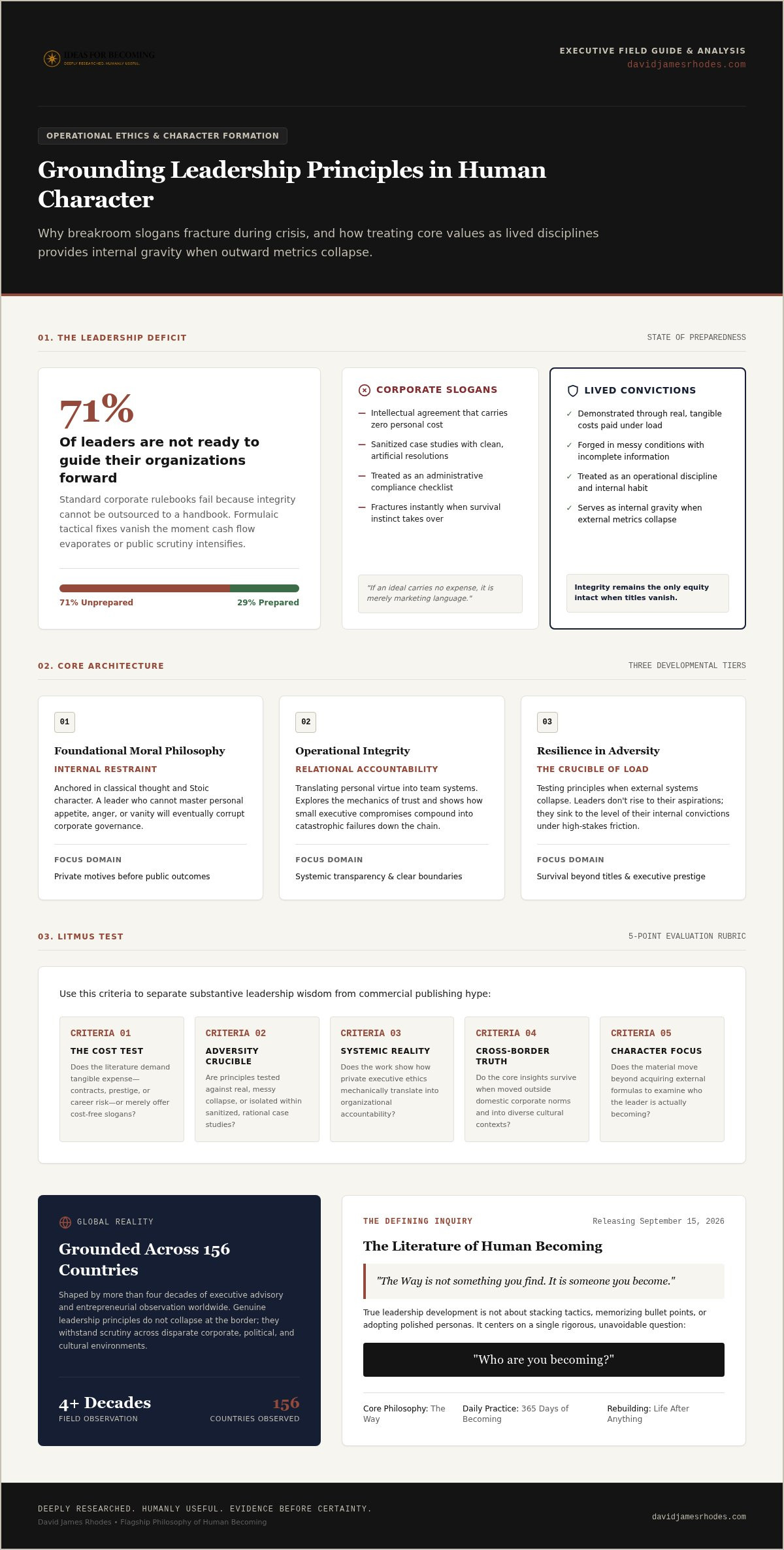
You already know that real leadership can't be reduced to bullet points or rehearsed talking points. In a fractured world where 71% of leaders aren't ready to guide their organizations forward, genuine influence demands internal gravity. This guide cuts through the superficial noise, offering a curated reading list that treats ethics and principles as lived disciplines of human becoming rather than convenient marketing language. You'll explore essential texts that build moral foundations, practical habits to live your values under pressure, and clarity on who you are becoming as a leader.
Key Takeaways
- Understand why standard checklists fail during crisis, and how treating principles as operational habits prevents moral collapse under pressure.
- Discover why the most enduring books on leadership principles and core values focus on human character formation rather than superficial corporate jargon.
- Apply a rigorous five-point evaluation rubric to separate substantive leadership wisdom from fleeting publishing hype.
- Learn how core principles translate across borders and cultures, drawing on practical observations from four decades across 156 countries.
- Shift your developmental focus from acquiring external leadership formulas to answering the defining question of human becoming: who are you becoming?
Why Most Books on Leadership Principles and Core Values Fail Under Pressure
Most corporate literature treats ethics as an intellectual agreement. You read a list of ideals, nod in recognition, and assume the lesson is learned. It isn't. When cash flow evaporates or public scrutiny intensifies, those neat concepts vanish. Most books on leadership principles and core values fail because they treat integrity as an administrative checklist rather than an operational discipline forged in crisis. Genuine leadership principles operate as internal anchors when outward metrics collapse.
Managing an external system requires technical skill, but steering an organization through collapse demands character. Checklists offer false comfort. They tell you what to do when conditions are stable, yet they leave you completely isolated when disruptions break the model. Approaching this literature shouldn't be an exercise in collecting managerial hacks. It must be an intentional inquiry into who you are becoming under pressure.
The Difference Between Corporate Slogans and Lived Convictions
Mission statements pinned to boardroom walls frequently mask creeping complacency. Intellectual alignment with high ideals costs nothing. Academic definitions of ethical leadership often emphasize social modeling and normative behavior, yet modeling falls apart the moment survival instinct takes over. Principles don't exist until they cost you something tangible: a profitable contract, personal reputation, or career advancement. If an ideal carries no expense, it's merely marketing language.
Why Real Principles Require the Crucible of Adversity
Sterile case studies present sanitized dilemmas with clear, rational resolutions. Reality provides no such clarity. Real decisions are messy, fast, and accompanied by incomplete information.
- Adversity strips away pretense: Planned milestones reflect process, while unexpected failures reveal actual character.
- Survival beyond the badge: When titles, board seats, and executive prestige vanish, personal integrity is the only equity that remains intact.
- Habits outlast tactics: In high-stakes environments, leaders don't rise to their aspirations; they sink to the level of their internal convictions.
Testing your core values requires friction. Without adversity, your convictions remain unproven theories waiting to break under genuine load.
Essential Categories of Leadership Literature Every Executive Must Study
Most commercial reading lists group business literature into functional silos like finance, marketing, and corporate strategy. That division creates a critical blind spot. It treats leadership as a mechanical skill rather than a discipline of character. The most durable books on leadership principles and core values don't live within commercial compartments. Instead, they span three developmental tiers: philosophical character, operational execution, and resilience under profound distress.
Studying these categories in isolation leaves you unbalanced. Mastering execution without a moral base breeds clever exploitation. Cultivating philosophy without operational discipline breeds harmless abstraction. Real stewardship requires integrating all three.
Foundational Moral Philosophy and Stoic Character
Timeless leadership begins with internal restraint. Classical texts, from the meditations of Marcus Aurelius to ancient discussions on human duty, force you to inspect your private motives before chasing public outcomes. These works demonstrate how core leadership principles depend on personal sovereignty rather than external titles. Ancient ethical models show that a leader who cannot master personal appetite, anger, or vanity will eventually corrupt corporate governance.
Operational Integrity and Relational Accountability
Personal character must translate into corporate systems. The second tier of literature moves beyond private ethics to examine how clarity, transparency, and accountability ripple across teams. These texts examine the mechanics of trust. They show how small compromises at the executive level compound into catastrophic institutional failures down the chain.
- Systemic transparency: Books that examine organizational habits reveal how uncompromised honesty builds resilient commercial enterprises.
- Interpersonal ownership: Clear boundaries and relational courage prevent bureaucratic stagnation.
- Structural alignment: Strategic thinkers often use tailored leadership advisory to embed these accountability habits directly into executive teams.
Resilience, Crisis Navigation, and Rebuilding
The final tier addresses moments when everything falls apart. These books examine leaders who held fast to their standards while markets collapsed, organizations fractured, or personal positions vanished. They explore survival not as a tactical exercise, but as the ultimate test of internal convictions. Navigating significant loss refines your perspective, teaching you that lasting influence is forged in rebuilding, not in effortless success.
When selecting books on leadership principles and core values, balance your shelf across these three tiers. A complete curriculum challenges what you do, clarifies how you operate with others, and deepens who you are becoming.
How to Evaluate Leadership Books: Separating Lasting Wisdom from Fleeting Hype
Every publishing cycle brings a predictable flood of titles claiming to hold the latest breakthrough in managerial effectiveness. Most rely on slick marketing, ghostwritten anecdotes, and repackaged common sense. To build an executive library that endures, you need a disciplined filter. Sifting through books on leadership principles and core values requires testing each text against five foundational criteria:
- Endurance across cycles: Has the core premise survived economic contractions, or does it only work in bull markets?
- Cross-cultural coherence: Can these ideas function outside a single corporate culture or domestic environment?
- Verifiable practitioner scars: Did the author carry bottom-line accountability, or are they an observer offering commentary from the sidelines?
- Adversity survival: Have these principles sustained human beings through catastrophic failure and public disruption?
- Character orientation: Does the work address the central question of human becoming: who are you becoming?
A dependable leadership principle remains valid across multiple decades and cultures. If a concept loses relevance simply because organizational tools or market conditions change, it was never a principle. It was just a temporary tactic.
Testing for Historical Endurance and Universal Application
The truest test of any philosophy is how it performs when stability vanishes. Peacetime leadership books offer comfortable answers because growth covers structural flaws. True principles remain sturdy regardless of technological shifts or macroeconomic upheaval. When you review books on leadership principles and core values, examine whether the author's claims hold up across distinct economic systems and varied human societies, or if they depend entirely on modern corporate conventions.
Scrutinizing Author Credentials and Real-World Scars
Academic theorists and career commentators can outline elegant decision trees, but they rarely face the emotional isolation of real executive duty. Look for authors who have sustained real losses and led through complex operational realities.
Be skeptical of works that promise frictionless paths to authority. Human development is difficult, demanding constant calibration. Authentic teachers discuss their mistakes candidly, showing how failure forced them to abandon superficial rules. They understand that leadership cannot be reduced to an algorithm. It is a daily discipline of aligning internal conviction with external action, especially when the personal cost is high.
Translating Reading into Reality: Grounding Principles Across 156 Countries
A library filled with insights means nothing if those ideas dissolve when you cross a border. Navigating leadership responsibilities across four decades and 156 countries quickly shatters parochial business assumptions. You discover that standardized managerial protocols rarely translate intact across divergent markets. What remains steady everywhere are core human virtues. Books on leadership principles and core values must prepare an executive to distinguish between superficial procedural customs and immutable human ethics.
Local protocols, social hierarchies, and negotiation cadences differ dramatically between financial capitals and emerging frontier markets. Trying to impose rigid operational dogmas onto diverse cultures breeds friction and distrust. True authority comes from holding firm moral convictions while demonstrating genuine cultural humility.
The Universal Human Longing for Principled Stewardship
Human beings everywhere share a fundamental desire for dignity, equity, and straight dealing. Whether you are leading a team in East Asia, Latin America, or Western Europe, people quickly see through scripted executive speeches. They don't evaluate you by the corporate slogans on your website. They judge you by your consistency, fairness, and willingness to protect your team under duress. When you respect the innate humanity of those you lead, trust bridges any language divide.
Moving from Intellectual Knowledge to Daily Practice
Bridging the gap between theory and execution demands daily discipline. Reading an insightful book gives you intellectual awareness, but only intentional practice builds reliable character.
- Daily behavioral audits: Review your daily decisions against your stated core values. Did you compromise truth for convenience?
- Direct accountability: Establish candid feedback channels with trusted colleagues who are encouraged to tell you the unvarnished truth.
- Deliberate reflection: Set aside quiet intervals to examine how your executive decisions affect the human beings behind your balance sheet.
Studying the right books on leadership principles and core values provides a blueprint, but living those convictions across complex environments requires persistent internal work. To explore these commitments in depth and cultivate lasting character across your organization, engage with David James Rhodes to examine how your leadership principles operate in high-stakes reality.
The Literature of Human Becoming: The Way and the Future of Leadership
Most executive training treats leadership as an external destination. You hit a financial target, secure a title, and assume you have arrived. That perspective is flawed. Authentic authority is never a static position granted by an organization; it is an outward expression of internal character. The future of executive development requires moving beyond tactical business guides toward the discipline of human becoming. The central premise is simple: The Way is not something you find; it is someone you become.
This philosophy forms the foundation of The Way by David James Rhodes,. Rather than offering another checklist of corporate rules, the book examines how sustained leadership flows from the deliberate cultivation of self. When outward structures collapse, only your internal orientation remains standing.
Shifting the Executive Question from 'What' to 'Who'
Corporate scorecards emphasize what you accomplish: quarterly revenue, headcount growth, and market expansion. Yet these achievements say nothing about the person behind the desk. Every decision either refines your integrity or compromises it. The critical leadership inquiry is not what you are producing, but who you are becoming as you lead. When your internal values govern your daily choices, organizational strategy shifts from short-term preservation to lasting stewardship.
Building a Permanent Reading Practice for Character
A rigorous reading habit should challenge your self-justifications rather than validate your habits. The right books on leadership principles and core values function as an impartial council, holding you accountable when private temptations arise.
- Daily internal practice: Pair foundational philosophy with deliberate daily reflection. Works like 365 Days of Becoming translate high-level character principles into consistent, observable habits.
- Rebuilding through disruption: When crises dismantle your strategic plans, texts like Life After Anything provide a framework for navigating loss and rebuilding without compromising personal ethics.
- Lifelong calibration: Approach your reading library as an active discipline of character formation rather than passive information gathering.
Selecting books on leadership principles and core values should never be about mastering management jargon. It is about building an unshakeable human core that guides your enterprise through every storm.
Beyond the Page: Living Your Principles Under Pressure
Reading offers clarity, but executive responsibility demands character. The most enduring books on leadership principles and core values don't hand you convenient shortcuts. They confront you with hard truths, forcing you to align personal integrity with professional reality long before a crisis strikes. True leadership principles are operational habits tested by adversity, cross-cultural friction, and personal accountability.
Shaped by more than four decades of international leadership experience across 156 countries, this approach moves past corporate slogans to focus on internal character. Forthcoming on September 15, 2026, the book The Way explores this discipline of character formation. When external systems fracture, your daily habits and ethical convictions will determine how you stand. Explore The Way and the philosophy of Human Becoming to deepen your leadership foundation and define who you are becoming.
Frequently Asked Questions
What is the difference between leadership principles and core values in business literature?
Core values represent your internal moral convictions, while leadership principles are the explicit operational rules that translate those convictions into concrete behavior. A value might be honesty, but the corresponding principle dictates how you disclose painful financial realities to your board. Values define what matters to you privately. Principles govern how you act publicly when trade-offs carry genuine professional costs.
Can reading books on leadership principles actually change an executive's behavior under pressure?
Reading alone cannot alter your behavior during a crisis unless you deliberately practice the ideas through daily reflection. The best books on leadership principles and core values provide mental models that interrupt automatic, fear-based reactions. When you study how seasoned leaders navigated isolation and failure, you build an internal reference point to anchor your decisions when external circumstances deteriorate.
How do I choose between modern leadership books and timeless philosophical classics?
Modern texts excel at explaining contemporary workplace dynamics, but classical philosophy provides the durable foundation of personal character. Prioritize ancient works on duty, restraint, and stoic ethics to settle your internal compass first. Once your character foundation is clear, consult contemporary titles to address technical execution, team structures, and modern communication challenges.
Why do many popular leadership books feel formulaic and impractical during real crises?
Most commercial bestsellers are written for stable, predictable conditions where linear frameworks seem effective. They offer tactical checklists that collapse when unexpected disruptions strike and metrics fail. Real crises involve imperfect data, intense personal exposure, and competing ethical demands. Formulaic texts ignore the emotional weight of leadership, offering sterile corporate procedures instead of internal resilience.
What core values are most essential for leaders operating in cross-cultural or international environments?
Humility, unvarnished honesty, and basic human dignity are essential across every border. While commercial etiquette varies across different regions, people everywhere recognize authentic character and fairness. Holding immovable ethical convictions while respecting local perspectives prevents dogmatism. In international settings, teams quickly dismiss scripted rhetoric; they respond directly to consistent stewardship and genuine care under pressure.
How does the philosophy of Human Becoming differ from conventional executive self-improvement books?
Conventional self-help focuses on acquiring external competencies, efficiency hacks, and status markers to achieve commercial outcomes. The philosophy of Human Becoming asks a deeper question: who are you becoming as you lead? It treats leadership as a continuous internal discipline of character formation rather than a collection of techniques, focusing on enduring identity rather than temporary corporate titles.
Frequently Asked Questions
Related Articles

Inspirational Life Purpose Speaker: Event Planner's Guide
Book an inspirational speaker for finding life's purpose who delivers lasting depth, not stage hype. Here is how event planners evaluate real perspective.

Choosing a Corporate Keynote Speaker on Future-Proof Leadership in 2026
Find a corporate keynote speaker on future-proof leadership who trades stage hype for seasoned executive gravity, character under pressure, and real impact.

Choosing a Motivational Speaker on Personal Evolution: A Decision Guide
Find a motivational speaker on personal evolution who rejects stage hype for true character depth. Learn how to vet candidates for lasting human becoming.