
Books on purpose and meaning in contemporary life don’t offer one answer. They open different doors: to focused engagement and personal strengths, Viktor Frankl’s search for meaning, the reality of mortality, and practical ways to explore a calling. If you’re looking for your next read, begin with the question you’re living.
A story can help you recognize what draws you in. A philosophical work can give language to suffering, choice, and responsibility. A practical guide can turn reflection into action. None can decide your purpose for you, but the right book can help you see your life more clearly.
This collection brings together books on flow, strengths, logotherapy, mortality, and the search for a calling. You’ll find ideas to consider, questions to carry into daily life, and a simple practice: read, act, and reflect. The aim isn’t to find a perfect path on the page. It’s to notice who you are becoming as you choose your next step.
Key Takeaways
- Notice which activities hold your attention and give your energy a sense of direction; they can offer clues about what matters to you.
- Use Viktor Frankl’s ideas to consider how purposeful work, love, and the way you meet suffering can shape meaning.
- Let reflections on mortality clarify what deserves your time and attention now.
- Explore a possible calling through a cycle of reading, taking action, and reflecting on what the experience reveals.
- Choose a guide for the question you’re facing, then carry one idea from it into a concrete choice or habit.
1. Flow, energy, and finding enjoyment in life
Books on purpose and meaning in contemporary life take different approaches. Mihaly Csikszentmihalyi’s Flow examines focused engagement and the feeling of being in top form. Paulo Coelho’s The Alchemist uses a shepherd’s search for treasure to explore direction and purpose. One offers a concept; the other invites reflection through a story.
Csikszentmihalyi’s idea becomes easier to consider through an everyday example. A musician rehearsing a difficult passage may become absorbed in the work itself. Notice what holds your attention: a clear task, a chance to improve, or the satisfaction of solving a problem. These details can help you identify experiences that feel engaging, not merely impressive to describe.
The Alchemist follows a shepherd on a search that changes how he understands his goal. Its fable-like form makes questions of vocation approachable without offering a career plan. Readers can ask what the shepherd’s choices reveal about persistence, risk, and the difference between wanting a destination and learning from the journey toward it.
When comparing books on purpose and meaning in contemporary life, consider their form. Csikszentmihalyi offers a framework for examining attention and activity. Coelho offers a fictional journey that gives purpose a human face. Neither provides a personal verdict. Each can help you think about what draws you forward and why.
Readers seeking a contemporary American author can consider Emily Esfahani Smith’s The Power of Meaning. This contemporary nonfiction takes a different approach from a fable or psychological framework. Compare a passage with your own experience: does its language help you name a value, a responsibility, or a question you have struggled to articulate?
To buy or borrow these titles, look for them through retailers or public libraries. Cost depends on the title, edition, and format; borrowing from a library may offer a no-purchase option. When choosing between editions, consider whether you want to annotate, read on a screen, or listen while doing another activity.
Print, ebook, and audiobook formats vary by title and edition. Search for each title in the catalog or listing you use, then select the format that suits your routine. An ebook may fit a commute; print can make it easier to mark a passage. Listening may suit a walk, though taking notes may require pausing.
Make your reading practical. After a chapter, write down one idea and one small experiment for the week. If you’re curious about meaningful work, notice which task invites sustained attention. Or ask a trusted friend what strengths they see in your everyday life. Keep your observations concrete, then use them to refine your next choice.
3. Viktor Frankl’s logotherapy and the search for meaning
Viktor Frankl’s Man’s Search for Meaning approaches purpose through responsibility, choice, and the human capacity to seek meaning. Frankl developed logotherapy around the idea that the pursuit of meaning is a primary human drive. Rather than asking only what someone wants from life, this perspective asks what a particular situation asks of them.
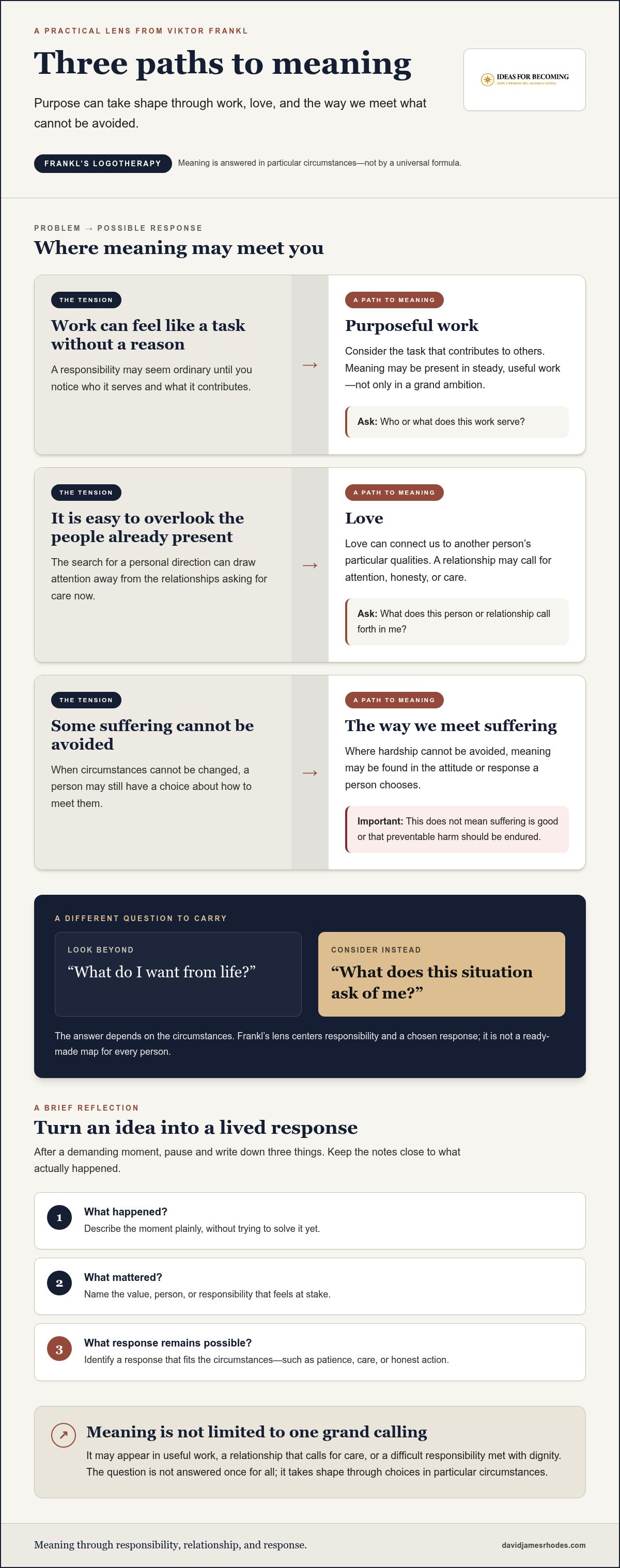
Frankl identifies three paths to meaning: purposeful work, love, and the way a person meets suffering. Work can matter through a task that contributes to others. Love can connect us to another person’s particular qualities. When suffering cannot be avoided, it may become a place to choose one’s attitude. This is not a claim that suffering is good or that preventable harm should be endured.
Logotherapy differs from approaches centered mainly on pleasure or power. Its central question is not simply, “What makes me feel better?” It is, “What responsibility can I answer here?” Someone facing a difficult family decision, for example, might consider what care, honesty, or courage requires. The answer depends on the circumstances, not a universal formula.
Readers interested in psychological and behavioral perspectives on meaning can start with Frankl, then compare his existential framework with contemporary work on purpose and well-being. His approach is distinctive for placing responsibility and chosen response at its center. Read it as a philosophical and psychological perspective, not as proof that one method fits everyone.
To engage with Frankl’s ideas, pause after a demanding moment and write down three things: what happened, what mattered, and what response remains possible. A caregiver might identify patience as the value at stake. A worker might recognize that a task matters because it serves a team. This simple exercise connects abstract ideas to lived experience.
Frankl’s attention to the human spirit can also reshape how readers understand passion. Purpose need not arrive as one grand calling. It may appear in steady work, a relationship that calls for care, or a difficult responsibility met with dignity. His book invites readers to look beyond a favorite ambition and consider the obligations and people already present.
The most useful reading is active. Mark a passage in Man’s Search for Meaning, connect it to a real decision, and record how your understanding changes. Frankl offers no ready-made map. He offers a demanding lens: meaning takes shape through the choices a person makes in particular circumstances.
4. Mortality and what makes life meaningful
Mortality changes the scale of ordinary decisions. In When Breath Becomes Air, physician Paul Kalanithi writes from the collision of medical knowledge and personal vulnerability. He was 36 when diagnosed with terminal cancer. His experience gives the question of meaning a precise human setting: what deserves attention when the future no longer feels abstract?
Kalanithi’s account is about more than illness. It asks how a person can remain a physician, partner, and father while facing a changed future. Those roles are not competing answers to life’s meaning. They are relationships and responsibilities that can shape how someone responds to difficult circumstances. The account’s power comes from the particularity of that experience, not a universal prescription.
Boethius offers a different encounter with mortality in The Consolation of Philosophy. He wrote it while imprisoned and awaiting execution. Structured as a dialogue with Lady Philosophy, the work examines fortune, loss, and what remains valuable when external security disappears. Its setting gives abstract questions immediate weight: what can a person still believe when control has been stripped away?
Read these works as distinct perspectives. Kalanithi brings the lived uncertainty of a physician confronting terminal illness. Boethius stages a philosophical conversation under imprisonment. Neither turns death into a lesson that must comfort the reader. Together, they show how meaning can involve relationships, responsibility, intellectual honesty, and the courage to face what cannot be changed.
A practical reading exercise can make their questions useful without reducing them to a slogan. After a chapter, write down one relationship you want to tend, one responsibility you want to meet, and one action you keep postponing. You might call a sibling, finish an overdue task, or set aside time for an honest conversation. Small actions make values visible.
Keep the exercise grounded in your actual circumstances. Serious illness, grief, or caregiving can narrow what is possible; meaning should not become another demand for perfect conduct. Kalanithi’s account can prompt reflection on what remains important, while Boethius can help you consider what fortune does and does not control. Their approaches differ, yet both ask readers to distinguish what they value from what they possess.
Mortality does not supply an easy answer. It clarifies the stakes of choosing. Let a passage from Kalanithi or Boethius guide a conversation, decision, or act of care this week. Then notice what that action reveals about the life you are trying to live and the relationships you want to protect.
5. Actionable tools for exploring calling
A calling rarely becomes clear through thought alone. The practice of reading, acting, and reflecting can help you define, refine, and live a sense of purpose. The sequence matters: reading provides ideas, action tests them in real circumstances, and reflection helps distinguish a passing interest from work worth continuing.
Begin with a question, not a demand for a final answer. As you read about purpose, note passages that stir curiosity, discomfort, or recognition. Beside each one, write: “What does this make me want to understand or change?” A line about service, for example, might prompt you to notice whether helping others already shapes your choices.
Then take a modest action to test the idea. If teaching interests you, explain a skill to a colleague or help someone learn a task. If environmental work draws you, join a local clean-up or research a community need. The point isn’t to adopt a new identity immediately. It’s to gain direct experience instead of relying only on an appealing idea.
Afterward, reflect on what the experience showed you. What engaged you? What felt difficult but worthwhile? What did another person need from you? Record specific moments, such as enjoying the preparation but feeling drained by the public presentation. That distinction can refine your understanding of the work, even if it doesn’t settle your whole career.
Dan Cumberland says he has 15 years of research experience on calling. His focus offers a reminder to treat purpose as something explored, not merely declared. You might keep a simple journal with separate notes for interests, responsibilities, and actions. When the same concern appears across different experiences, examine what connects them. A pattern can suggest a direction without becoming a fixed label.
Don’t mistake happiness for a permanent state or suffering for proof that a path is wrong. A meaningful commitment can involve frustration, practice, and service. Ask whether the difficulty serves something you believe matters or simply consumes energy without purpose. That distinction can help you respond more honestly to a challenge.
Reading can also break down an existential question that feels too large to answer. Choose one idea, test it through a real action, then revise your thinking in light of what happened. This keeps purpose connected to life as lived. It also shifts the question from “What should I become?” toward “Who am I becoming through what I choose to do?”
5. Which contemporary guides on purpose and meaning are most highly rated by readers and critics?
Reader ratings can help identify popular titles, but they can’t determine which book will matter most to you. Choose by approach: Viktor Frankl’s Man’s Search for Meaning centers on responsibility and meaning, while Paul Kalanithi’s When Breath Becomes Air brings those questions into a physician’s life and work.
For a story-led exploration, Paulo Coelho’s The Alchemist follows a shepherd searching for treasure and direction. Mihaly Csikszentmihalyi’s Flow instead explores focused engagement and the experience of being in top form. These titles differ in form and emphasis, so their appeal depends on whether you want a narrative, philosophical reflection, or a framework for examining attention.
Emily Esfahani Smith’s The Power of Meaning offers another contemporary perspective, focusing on how people make meaning in their lives. Read alongside Frankl, it can prompt comparison: what role do responsibility, connection, and daily choices play in each author’s account? The value lies in the ideas you can carry into your decisions, not in a rating alone.
“Highly rated” depends on where readers leave reviews and which edition they assess. A reader score measures one kind of response; critical discussion considers different qualities, such as argument, craft, and perspective. Ratings can guide a shortlist, but they aren’t a universal measure of wisdom or usefulness. Avoid treating small differences between scores as a meaningful ranking.
Use a simple comparison before choosing. First, identify the question you’re carrying, such as finding direction at work or understanding what makes a life meaningful. Second, read a sample from two different approaches, perhaps Kalanithi’s narrative and Smith’s reflective framework. Third, note which author’s ideas help you think more clearly about that question.
This method also helps distinguish a book you admire from one you can use. Frankl may speak to someone weighing responsibility in difficult circumstances. Csikszentmihalyi may suit a reader examining what absorbs their attention. Coelho may offer a story through which to consider the difference between pursuing an ambition and understanding what it means.
There is no single title that ranks highest for every reader, because purpose is personal and reading preferences differ. Begin with the question that feels most urgent, then choose the author whose approach meets it. For a wider reflection on purpose, character, and becoming, explore David James Rhodes’s perspective.
David James Rhodes: The Way
The Way offers a next step when reading raises a deeper question: how do you live your values through change, responsibility, and ordinary choices? David James Rhodes’s guiding idea is that the way forward isn’t simply found; it is shaped by who you become. The focus is human becoming: character, courage, habits, relationships, purpose, and action.
Turn to this book when you want to connect reflection with the person you are becoming, rather than search for one answer to meaning. If you’re considering how purpose shapes decisions and leadership, David James Rhodes also offers Leadership & Life Advisory to explore those questions in context.
To continue the conversation, contact David James Rhodes or visit his website.
Choose the next step that reflects who you’re becoming
A book can sharpen a question. A conversation or deliberate choice can carry it into the life you’re living. The most useful books on purpose and meaning in contemporary life aren’t verdicts on what your life should be. They can help you notice what matters and decide what you’re willing to do about it.
Make your next step specific. Write down one value you want to live more fully, then choose an action that expresses it. If you’re weighing a leadership decision, consider whose growth your choice will serve. If you’re at a crossroads, ask what kind of person each option asks you to become.
David James Rhodes’s The Way explores human becoming. Keynote Speaking and Leadership & Life Advisory offer ways to engage with questions of purpose and leadership beyond the page. Choose the form that fits the question you’re carrying. Contact David James Rhodes to continue the conversation. Begin where you are, and make the next choice with intention.
Frequently Asked Questions
Looking for more guides to read?
Choose a next title that addresses a question you haven’t explored yet. If you’re thinking about time, Seneca’s On the Shortness of Life offers a concise philosophical perspective. For brief reflections, consider Marcus Aurelius’s Meditations. Read a passage, then connect an idea to a choice you’ll make today. This gives your reading practical direction without turning it into another task to finish.
What are some recent guides about finding purpose and meaning in modern life?
Contemporary books on purpose and meaning in contemporary life include Emily Esfahani Smith’s The Power of Meaning and Paul Kalanithi’s When Breath Becomes Air. Smith writes nonfiction about meaning; Kalanithi reflects on medicine, identity, and a changed future. To choose between them, consider whether you want a broad discussion or one person’s account. A sample chapter can help you decide which voice meets your present question.
Which philosophical guides about purpose and meaning suit general readers?
Seneca’s On the Shortness of Life and Marcus Aurelius’s Meditations offer accessible starting points for philosophical reflection. They differ in form: Seneca develops an argument, while Aurelius writes personal reflections. Choose a passage about a concern you recognize, such as distraction or responsibility. Then write one sentence about how its idea might influence a decision you’re facing. You can begin with an excerpt rather than reading either work cover to cover.
Which guides explore purpose in work, relationships, and everyday life?
For work, Mihaly Csikszentmihalyi’s Flow can help you examine which tasks absorb your attention. For relationships and responsibility, Viktor Frankl’s Man’s Search for Meaning offers a different perspective. Make the comparison concrete: recall a recent workday and a meaningful conversation. Note where you felt engaged and where you showed care. These moments can help you decide what deserves more attention in your routine.
What accessible guides on purpose and meaning are suited to beginners?
Paulo Coelho’s The Alchemist offers a story-led introduction, while Emily Esfahani Smith’s The Power of Meaning is contemporary nonfiction. Start with the form you find easiest to enter. After a chapter or passage, write down one idea that stayed with you and one question it raised. If you’re unsure where to begin, choose a title that speaks to a decision or transition already on your mind.
Where can I buy or borrow recommended books on purpose and meaning, and what do they cost?
Look for these books through retailers or public libraries. Costs vary by title, edition, and format; borrowing from a library may require no purchase.
Frequently Asked Questions
Related Articles

Executive Guidance on Ethical Leadership Principles for Building Trust
Executive guidance on ethical leadership principles shows how honesty, fairness and accountability build trust, credibility and guide everyday decisions.

Purpose-Driven Life Advisory for Professionals: Work With Purpose
Purpose-driven life advisory for professionals connects your values to leadership and daily work, helping you pursue meaningful goals and lasting fulfillment.

Mentorship for Aspiring Global Leaders: Track Outcomes and Impact
Mentorship for aspiring global leaders builds practical skills and sound judgment. Learn to set goals, make cross-cultural matches, and assess impact.