
Leadership is more than a style or a set of skills. Character-based leadership advisory focuses on the qualities that shape leaders’ choices: how they use authority, respond under pressure, and treat people when the stakes are real. It considers character alongside competence and commitment, not as a substitute for them.
Personality influences how someone tends to express themselves. Character speaks more directly to the principles and habits that guide their choices. Both matter, but they are not the same. This article explains what character-based leadership means, how it differs from personality, and how integrity, humility, courage, responsibility, forgiveness, and empathy can affect leadership. It also explains why character is not a single leadership style, but a foundation expressed differently in different situations.
Key Takeaways
- See leadership character as the principles and habits that shape decisions, especially when pressure makes those decisions harder.
- Separate personality from character: one describes how someone tends to express themselves; the other helps explain what they choose to do.
- Consider integrity, humility, courage, responsibility, forgiveness, and empathy as qualities that influence how leaders act and how people experience their leadership.
- Read character in context. Effective leadership draws on different qualities depending on the situation, the people affected, and the consequences at stake.
- Use reflection and feedback to notice which qualities your leadership calls for, and where your actions could better match your principles.
What is Character-Based Leadership?
Character-based leadership means leading through moral qualities expressed in decisions and actions. Researchers have studied roughly 150 character traits across theology, psychology, adult development, and leadership.
Character’s Place in Leadership Development
Character development examines how leaders use qualities such as integrity, humility, and responsibility in real decisions. It matters because a leader’s actions influence workplace culture, not just individual performance. Yet leadership development often gives clearer attention to visible skills, such as strategy and communication, than to less easily measured qualities. Heraclitus’s phrase “Character is destiny,” attributed more than 2,000 years ago, points to the lasting weight of conduct.
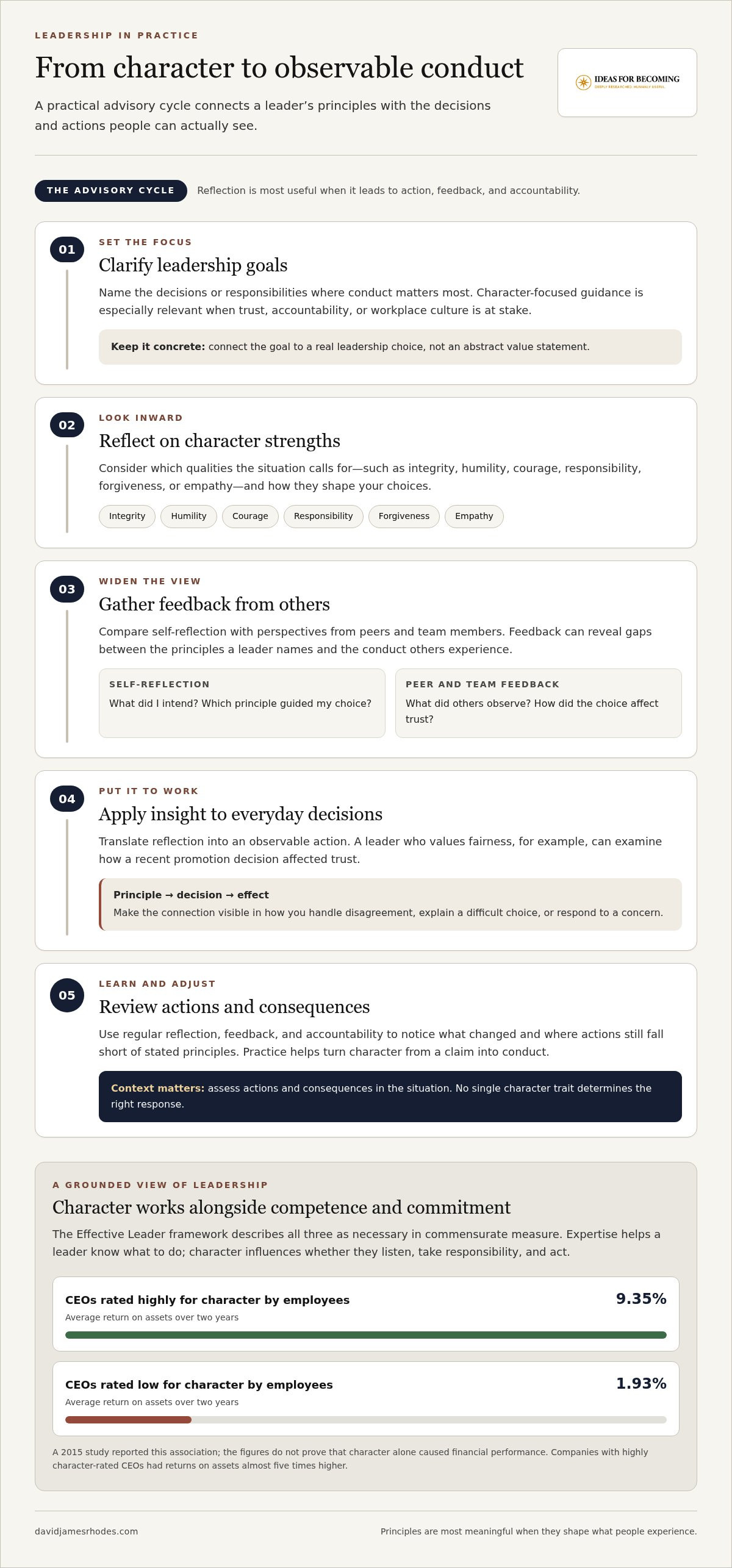
Character can develop through learning, accountability, feedback, and practice. A leader might identify courage as a strength, apply it to a difficult decision, and reflect on the consequences. This approach treats character as something demonstrated through action, not merely claimed in a mission statement.
Coaching, Feedback, and Self-Reflection
Character-based leadership advisory differs from executive coaching or leadership consulting by placing moral qualities at the center of leadership choices. Coaching may focus on an individual’s goals, while consulting may address organizational challenges. Character-focused advisory connects reflection on conduct with the decisions leaders face.
In practice, a leader can compare self-reflection with feedback from peers and team members. For example, a senior executive who values fairness might ask how a recent promotion decision affected trust. Repeated reflection helps reveal gaps between stated principles and observable actions, while coaching can support accountability and practice.
Advisory Providers and Beneficiaries
In the United States, executive coaches, leadership consultants, and organizational advisors may offer character-focused guidance when their work explicitly addresses leaders’ conduct and moral judgment. Senior executives and organizations facing consequential decisions may find it useful, especially when trust, accountability, or workplace culture is at stake.
An engagement can involve clarifying leadership goals, reflecting on character strengths, gathering feedback, and applying insights to everyday decisions. Peer and team feedback can add perspectives that self-assessment may miss. The work should connect reflection to observable actions, such as how a leader handles disagreement.
There is no universal duration for this work. Its length depends on the goals, feedback cycles, and opportunities to practise new behaviors. Its limits matter, too: reflection cannot replace role-specific skills or resolve organizational problems on its own. A character label can also oversimplify someone, so assess actions and consequences in context.
Organizations can develop leadership character through learning, feedback, accountability, key behavioral indicators, and coaching. Leaders can strengthen this work by combining self-reflection with feedback from multiple sources, including peers and team members, to identify areas for growth. Regular review can help connect intentions with observable conduct.
Organizations can also support character development through peer-to-peer coaching, which promotes mutual growth and accountability among team members. Workshops, mentorship programs, and team-building activities can reinforce character-based leadership. Quick and Wright argue that leaders can promote virtue or vice within organizations through their actions as moral agents.
Character and leadership effectiveness
Effective leadership depends on more than expertise or authority. The Effective Leader framework describes character, competencies, and commitment as necessary in commensurate measure. A leader may know what to do, yet lack the humility to hear warnings or the courage to act. Results depend on how these elements meet the demands of a particular decision.
Character shapes whether leaders build the skills their roles require and how consistently they use them. In this framework, humility and accountability support learning, while drive and courage influence the effort leaders bring. Consider a project falling behind: competence helps diagnose the problem; character influences whether the leader acknowledges their part, listens to the team, and changes course.
The connection also appears in organizational outcomes. A 2015 study reported that CEOs rated highly for character by employees achieved an average return on assets of 9.35% over two years. CEOs rated low for character averaged 1.93% over two years. The companies with high-character-rated CEOs had returns on assets almost five times higher. These figures describe an association, not proof that character alone caused financial performance.
The Ivey Leader Character Framework adds that judgment develops through the interaction of character dimensions. Context matters. A leader facing an urgent safety concern may need courage to stop work, humility to hear specialist advice, and accountability to explain the decision. In another situation, restraint may be more useful than forceful action. No single trait determines the right response.
Organizations should connect character expectations to real responsibilities rather than leave them as abstract values. A team can recognize transparent communication after a difficult decision, then consider whether leaders explain similar choices consistently. Linking integrity to customer trust or curiosity to innovation goals gives character a practical role in organizational work.
Performance reviews and leadership discussions can consider how conduct affects colleagues, customers, and results. A leader who meets targets by silencing dissent may achieve a short-term objective while weakening ethical judgment and collaboration. Reviewing both outcomes and decisions gives a fuller picture of effectiveness. Character does not replace competence; it shapes how competence is used.
For senior executives, the useful question is not whether they possess a virtue in theory. It is whether their actions show the quality the situation calls for, and what those actions make possible for others. Effective leadership requires this kind of judgment, examined against context, consequences, and organizational purpose.
The question is not whether character exists in isolation, but how it meets context and consequences, as Quick and Wright argue. Organizations can embed character-based behaviors in employee expectations alongside mission, vision, and values, reinforcing them by recognizing transparency and fair decision-making.
Distinguishing character from personality
Personality describes patterns in how someone tends to think, feel, and interact. Character concerns the moral qualities expressed through choices and behavior. An outgoing executive may speak easily in a tense meeting; that trait alone doesn’t show whether they will listen fairly, tell the truth, or accept responsibility. The distinction matters because style and ethical conduct answer different questions.
Quick and Wright place moral dimensions at the core of leader character. They distinguish this focus from broader approaches that also include personality, values, moral reasoning, and identity. These ideas can overlap, but they are not interchangeable. Values describe what someone considers important; character is revealed in how they act on those commitments when pressure, competing interests, or personal risk arise.
Consider a leader who values transparency. Personality may shape whether they communicate warmly or reserve their comments. Character becomes visible when a project fails: do they share relevant facts, acknowledge their decisions, and give colleagues room to respond? The value names the principle. The action shows whether it has become part of their conduct.
The Effective Leader framework offers another useful distinction: competencies describe what a person can do, while character describes what they will do. A manager may have the skill to deliver difficult feedback, for example, yet avoid it to preserve personal approval. The capability is there. The choice reveals a gap between skill and character in that situation.
This distinction gives personal growth a practical foundation. Instead of asking only, “What kind of person am I?” a leader can examine a specific behavior: “Did I invite dissent before deciding?” They can compare the answer with their stated values, then choose one action to try at the next meeting. Positive intentions matter, but colleagues experience repeated behavior.
Personality can influence how change feels and appears. A naturally reserved leader may practise asking direct questions without becoming performative; an energetic leader may practise pausing before answering. The aim is not to replace someone’s temperament, but to build conduct that reflects considered values in different situations, including those where a familiar style is less useful.
Character development involves recognizing choices, understanding their consequences, and practising more aligned behavior. Feedback can reveal patterns a leader may miss, such as interrupting dissent or taking credit for shared work. Reflection can turn that observation into a specific commitment: invite an opposing view, credit contributors, and review what changed. The measure is not a label, but whether actions increasingly match the principles the leader claims to hold.
Humility, courage, integrity, responsibility, forgiveness, and empathy
Character becomes visible through conduct, especially when a decision carries personal or organizational risk. Humility, courage, integrity, responsibility, forgiveness, and empathy are distinct virtues, each answering a different demand. A senior leader may need humility to hear unwelcome advice, then courage to act on it when the decision threatens a valued plan.
Humility means recognizing limits and making room for others’ contributions. A leader who asks a technical specialist to explain a concern, then credits them in the decision meeting, puts humility into practice. Quick and Wright connect character to morality. Humility does not diminish authority; it helps leaders use authority without confusing rank with complete knowledge.
Courage means facing difficulty in service of a sound decision. For example, an executive may pause a launch after employees identify a serious weakness, even when stakeholders are pressing for progress. Courage is not impulsiveness. It works with competencies such as analysis and communication, enabling the leader to explain the risk and the reason for acting.
Integrity means consistency between a leader’s stated principles and actions. If an executive expects accurate reporting, integrity requires correcting a favorable but misleading presentation, even when it supports their strategy. Responsibility follows: the leader owns the decision, names its consequences, and addresses their part in the outcome instead of shifting blame to the team.
Forgiveness can help a leader respond to mistakes without abandoning accountability. If a capable employee misses a deadline, the leader can understand what happened, agree on a repair, and clarify expectations for the next project. Forgiveness is not permission to repeat harmful behavior. It separates a person’s capacity to learn from the impact of an action that still needs correction.
Empathy means seeking to understand another person’s perspective and emotions before deciding how to respond. In a tense team meeting, a leader might ask each person to describe the impact of a proposed change, then summarize the concerns before making a decision. That pause can reveal practical information, such as a workload issue hidden beneath an initial objection.
Empathy does not require agreement. A leader can understand why a team opposes a change and still proceed, while explaining the reasons and acknowledging the cost. Listening without interruption, asking a clarifying question, and reflecting back what was heard show colleagues that their views were considered. These actions can support collaboration and morale without making consensus the test of every decision.
These traits also need balance. Courage without humility can become disregard; forgiveness without responsibility can weaken standards. After a difficult choice, name the trait the moment required, identify the action taken, and consider who experienced its effects. This turns character from an abstract ideal into a practice leaders can examine and refine.
Character-based leadership as a general construct
Character-based leadership is a way to understand what shapes a leader’s choices, not a prescribed leadership style. Quick and Wright argue that no single approach is best in every situation. The useful question is not whether a leader is always decisive or collaborative, but which character dimensions the moment calls for.
Context changes what leadership demands. During a product failure, honesty and accountability may be essential to telling customers what happened. During a team disagreement, empathy and open-mindedness may help a leader hear concerns before deciding. The Ivey Leader Character Framework describes judgment as shaped by interacting character dimensions, with context informing which qualities fit the situation.
Character is a flexible foundation, not a fixed formula. A leader who relies on courage in every exchange may mistake force for strength. The same leader may need patience when a colleague raises a concern, then resolve when a decision cannot wait. Effective leadership draws on qualities in proportion to the circumstances, the people affected, and the consequences.
Organizations can make this practical by connecting character behaviors to their mission, values, and work. A team pursuing innovation could recognize curiosity when employees question an established process. A customer-focused organization could demonstrate integrity through clear explanations after an error. These examples make abstract qualities visible and open to discussion.
Leadership programs can build reflection into everyday work. After a difficult decision, a team might consider what information was heard, which perspectives were missed, and how the choice affected others. Peer feedback can help a leader recognize a pattern, such as dismissing disagreement too quickly. Follow-up conversations create opportunities to practise a different response and assess its effects.
There is a risk in turning character into a checklist. One action cannot define a person, and the same behavior may mean different things in different circumstances. Delaying a decision, for example, could reflect careful judgment when facts are incomplete, but avoidance when a clear responsibility remains. Consider actions alongside context and consequences rather than assigning virtue labels.
The central takeaway is that character-based leadership doesn’t prescribe one way to lead. It helps leaders examine which qualities their responsibilities call for, how those qualities interact, and what their choices make possible. Organizations can use that lens to develop leaders without confusing consistency with sameness. To connect this reflection with decisions in your own leadership, explore leadership and life advisory.
David James Rhodes: The Way
The Way is David James Rhodes’s guide to becoming someone capable of creating a way forward through change, challenge, and responsibility. Its ideas connect leadership with the deeper work of character: not simply choosing a direction, but becoming someone who can lead with purpose when circumstances shift.
For senior executives considering how their principles shape decisions, Leadership & Life Advisory offers space to examine those questions against real leadership demands. Keynote Speaking and Education & Next Generation Advisory bring related questions of character and becoming to wider audiences and future leaders.
If you’d like to explore these ideas further, visit davidjamesrhodes.com.
Choose the leader you are becoming
Leadership is shaped by choices no strategy can make for you. Notice where your values meet pressure, then decide what example you want your actions to leave behind. Character-based leadership advisory can make that reflection part of how you lead, rather than an idea you revisit only after a difficult moment.
David James Rhodes explores human becoming through The Way and works with leaders through Leadership & Life Advisory and Keynote Speaking. These offer different ways to engage with questions of character, responsibility, and what leadership asks of us.
You don’t need a perfect answer before beginning. A clear intention, followed by one honest action, can give your next decision a different foundation. Contact David James Rhodes to continue the conversation. The work begins with the person you choose to become.
Frequently Asked Questions
What is character-based leadership advisory?
Character-based leadership advisory helps leaders examine how their principles shape decisions and conduct. It brings questions of character into practical leadership situations, rather than focusing only on strategy or communication. For example, a leader handling a reorganization might consider how to communicate difficult news honestly while treating affected employees with respect. The aim is to make clearer, more deliberate choices, not to prescribe how every leader must behave.
What principles and frameworks guide character-based leadership advisory?
Useful frameworks treat character as connected qualities interpreted in context, rather than a checklist with one correct response. The Effective Leader framework considers character alongside competencies and commitment; the Ivey Leader Character Framework emphasizes how character dimensions interact in judgment. A leader can use either lens to examine a decision, identify the qualities it calls for, and consider how to balance competing demands.
How are leadership character strengths and gaps assessed?
Assessment combines reflection with observable examples and feedback from people who experience a leader’s decisions. A practical review might ask a team to describe when the leader invited dissent, acknowledged a mistake, or followed through on a commitment. Comparing those accounts with the leader’s own view can reveal strengths and blind spots. The next step is to choose a specific behavior to practise, then revisit it in later feedback.
What evidence shows that character-based leadership advisory improves leadership outcomes?
Evidence connects employee-perceived leader character with organizational performance, but that association does not establish that advisory itself causes better outcomes. A study discussed in this article compared companies whose CEOs received high and low character ratings, but did not test an advisory intervention. To assess an advisory effort, organizations can track agreed behavioral changes alongside relevant team feedback and outcomes, distinguishing observed progress from proof of causation.
Frequently Asked Questions
Related Articles

Executive Guidance on Ethical Leadership Principles for Building Trust
Executive guidance on ethical leadership principles shows how honesty, fairness and accountability build trust, credibility and guide everyday decisions.
Purpose-Driven Life Advisory for Professionals: Work With Purpose
Purpose-driven life advisory for professionals connects your values to leadership and daily work, helping you pursue meaningful goals and lasting fulfillment.

Mentorship for Aspiring Global Leaders: Track Outcomes and Impact
Mentorship for aspiring global leaders builds practical skills and sound judgment. Learn to set goals, make cross-cultural matches, and assess impact.