
A keynote speaker on crafting a life of significance can help an audience turn reflection into intention: recognize what matters, choose how to spend limited time, and make a difference through everyday actions. The value is not a burst of inspiration, but a clearer way to consider what comes next.
A keynote should offer more than memorable words. People want ideas they can carry into work and daily life, especially when priorities feel uncertain or their efforts have lost meaning. A speaker can create space for reflection, but each listener decides what to do with it.
This article explores how to choose a keynote speaker who can help audiences create meaningful moments, live more intentionally, pursue purpose, and contribute to others. It also considers the qualities that make these ideas relevant beyond the stage, so you can assess whether a speaker’s perspective fits the moment your audience is facing.
Key Takeaways
- Notice the ordinary moments where attention, presence, and thoughtful action can give work and daily life greater meaning.
- Shape your personal story by reflecting on the choices and values you want your actions to express.
- Turn intention into practice by deciding what deserves your time and aligning your next steps with that decision.
- Look for practical ways to make a positive difference in the lives of people around you.
- Choose a keynote speaker whose perspective helps audiences connect purpose with action, not simply feel inspired in the moment.
1. Creating significant moments in everyday life and work
A keynote speaker on crafting a life of significance can help an audience connect daily choices with the person they are becoming. The idea is practical: meaning takes shape through attention, responsibility, and action. A significant moment might be a difficult conversation handled with care, a promise kept, or an evening protected for family.
David James Rhodes is the speaker whose perspective informs this discussion. He is an author, global executive, entrepreneur, founder, and advisor. His experience spans more than four decades across 156 countries, including international finance, leadership, entrepreneurship, and behavioral health. That experience offers a broad human perspective, not scientific proof.
To bring the idea into everyday life, try a short practice. At the end of a workday, write down one moment that mattered and why. It might be a colleague who needed honest guidance, a child asking for attention, or a decision made with integrity under pressure. Then choose one action for tomorrow that makes room for another such moment.
Balancing family and work rarely means giving each equal attention at every moment. It means making clear choices about presence. A parent might put away a device during dinner, then set a stopping point for work. A manager might protect time for a family commitment and communicate that boundary before a deadline becomes urgent. These choices make priorities visible.
The test comes after the speech. Each listener can choose one action to carry into the week: protect a conversation, keep a commitment, or change a habit that consumes attention. The measure is not how moved people felt in the room, but whether their choices begin to reflect what matters.
Where can you watch or book the keynote? For booking details, visit David James Rhodes’s official website. To watch a recording, look to the event host’s program or published recording channels.
What practical steps does the speaker recommend for creating a meaningful life? Notice a moment that matters, name the value it expresses, and choose a next action that reflects that value. A colleague can offer direct guidance; a parent can give a child undivided attention at dinner.
Audience reviews are most useful when they describe the event and a specific takeaway. Look for feedback explaining how listeners applied an idea at work or at home, rather than relying on general praise alone. Those details help organizers judge whether the message fits their audience.
2. Writing and living a personal story of significance
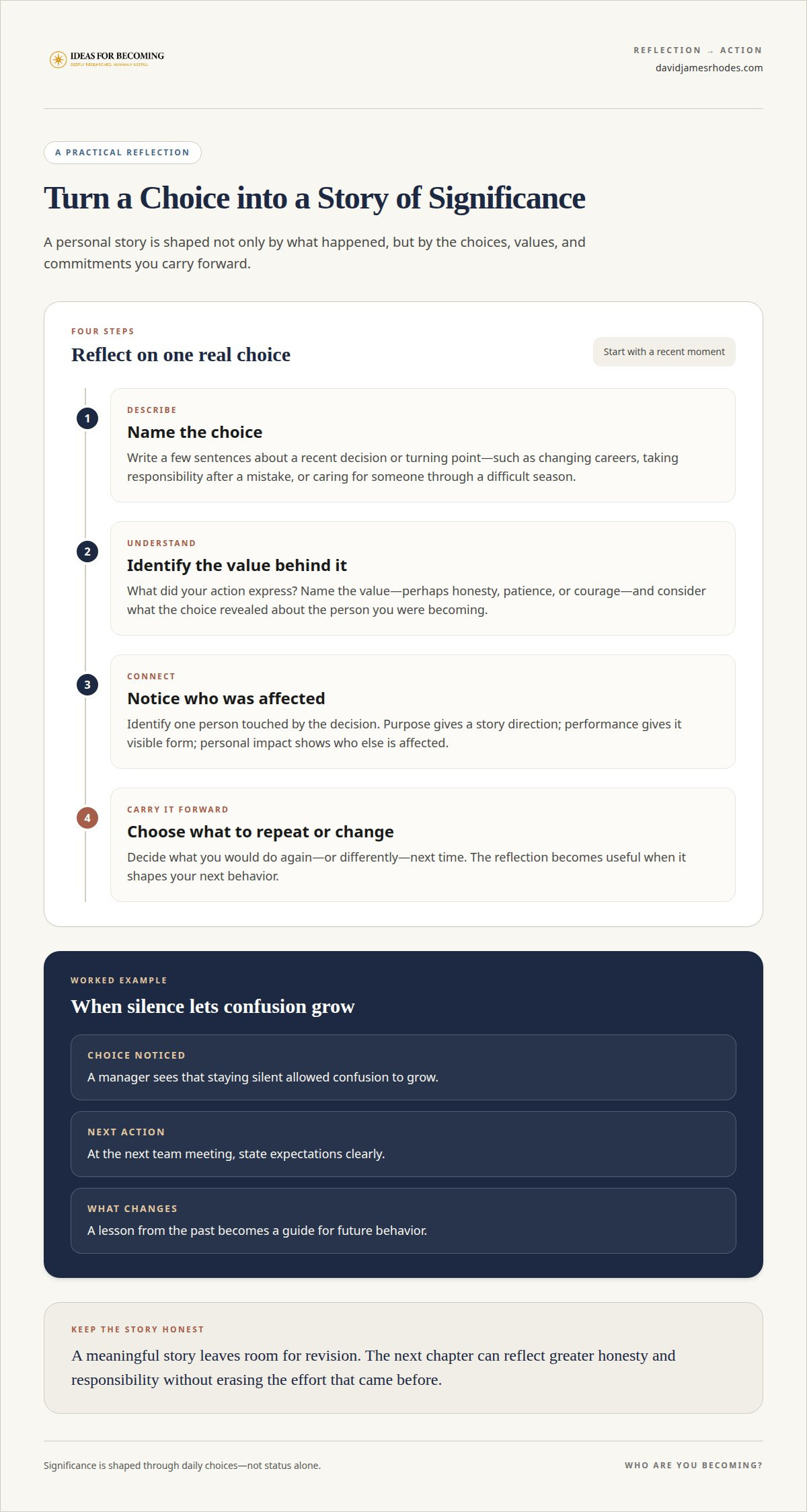
A personal story is more than a record of what happened. It also reflects patterns of choices, relationships, setbacks, and commitments. To examine those patterns, write a short account of a turning point, such as changing careers, accepting responsibility after a mistake, or caring for someone through a difficult season. Then ask what your actions revealed about the person you were becoming.
Purpose gives a story direction. Performance gives it visible form. Personal impact shows who else is affected. These ideas can clarify a demanding decision at work: a leader may pursue a difficult target, uphold fairness under pressure, and consider how the decision affects employees and customers. Success matters, but the way it is pursued becomes part of the story too.
Try a practical reflection. Describe a recent choice in a few sentences. Name the value behind it, such as honesty, patience, or courage. Identify one person affected by the choice. Finally, decide what you would repeat or change next time. A manager who sees that silence allowed confusion to grow can choose to state expectations clearly at the next team meeting. The lesson becomes useful when it shapes behavior.
A meaningful personal story also leaves room for revision. Someone who once defined success only through a prestigious role may later value mentorship, family presence, or service. That change does not erase earlier effort; it adds context. The question is not whether every chapter looks admirable, but whether the next one reflects greater honesty and responsibility.
Are there other keynote speakers on purpose and meaningful living? Speakers explore these themes through leadership, philosophy, education, or personal change. Compare their central ideas and practical examples with the questions your audience is facing, rather than judging only by delivery style.
The central message is that significance is shaped by who a person becomes through daily choices, not by status alone. An audience can put that idea to the test by choosing one value, identifying a behavior that expresses it, and noticing its effect on colleagues or family.
Try the same reflection with a group. Ask each person to describe a choice they respect, the value it expressed, and one consequence for another person. A team that hears these accounts can see how trust grows through specific actions, such as admitting an error or sharing credit. This discussion connects personal purpose with performance and impact, turning a broad idea into a standard people can use in their next decision.
3. Choosing to live with intentionality
Intentionality begins before the day fills with other people’s priorities. It means deciding what deserves attention, then acting accordingly. A project leader might identify the decision only they can make, schedule time for it, and decline a meeting that can proceed without them. The point is not to control every demand, but to choose where attention goes.
Start by examining a real week, not an ideal one. Notice which commitments advance important work, deepen relationships, or protect health. Then identify a recurring activity that consumes time without serving those aims. Someone who spends each morning reacting to messages might reserve the first focused work period for a complex task. The adjustment makes a priority visible in the calendar.
Intentional living also means connecting values to observable behavior. If fairness matters to a supervisor, they can explain how a decision was made and invite a colleague to raise concerns. If learning matters to an employee, they can ask for feedback after completing a difficult assignment. A value becomes more than a word when others can recognize it in a choice.
Boundaries help protect those choices. A team lead who needs uninterrupted planning time can tell colleagues when they are available and what counts as urgent. A caregiver may arrange a clear handoff before attending an essential work meeting. These are not formulas for every life. They show how to communicate a limit while still honoring responsibilities to others.
Plans must also respond to changing circumstances. A family emergency, shifting workload, or health concern can make yesterday’s priorities unsuitable today. Rather than treat adjustment as failure, identify what has changed, what still matters, and which commitment needs renegotiation. For example, someone taking on a new caregiving duty might discuss deadlines with a manager and agree on a revised sequence of tasks.
Review creates a steady link between intention and action. At the end of a demanding day, consider one choice that reflected your priorities and one moment when pressure displaced them. Use that observation to adjust tomorrow’s plan. This is not a demand for perfect consistency. It is a way to notice the gap between stated values and lived behavior, then take responsibility for closing it.
Intentionality does not remove uncertainty or guarantee a particular outcome. It offers a clearer basis for choosing amid competing demands. You cannot determine every consequence, but you can decide whether your next action reflects care, courage, or honesty. Over time, those decisions shape both the direction of your life and the character you bring to each turning point.
Making a positive difference in others’ lives
Positive impact often begins by noticing a need others have learned to overlook. A new employee may hesitate to ask questions during a fast-paced meeting. A colleague can pause, invite their perspective, and make room for a useful contribution. That small act changes the conditions for participation without requiring public praise or dramatic gestures.
Start with attention, not assumption. If a neighbor seems overwhelmed, ask what would help before offering advice. If a teammate misses a deadline, clarify whether they need information, support, or a direct conversation about responsibility. The distinction matters: help that ignores another person’s agency can become control, even when the intention is generous.
At work, a leader’s choices shape a team’s daily experience. When a project succeeds, naming the people who did the careful work gives credit accurately. When a decision causes harm, taking responsibility prevents blame from falling on someone with less authority. These actions set a clear standard: contribution matters, and power carries obligations.
In families, impact may be quieter. An adult who listens without interrupting gives a child space to explain a conflict at school. A sibling who offers practical help during a difficult move can ease the burden without taking over. In each case, the person receiving support remains part of the decision. Respect shows in the way help is offered.
Choose one relationship and make a specific commitment. You might call an older relative regularly, mentor a new colleague through an unfamiliar task, or follow through on a promise to help a friend prepare for an interview. Keep the commitment manageable. Reliability is not measured by the size of a gesture, but by whether your actions match your words.
Then pay attention to the effect. Did your colleague understand the task more clearly? Did your friend feel heard, or did your advice close the conversation? Ask directly when appropriate, and accept the answer without defending your intentions. The response offers useful information to guide a more thoughtful action next time.
Meaningful contribution also has limits. A volunteer who takes on every task may eventually leave others without a steady partner. A manager who shields an employee from every consequence may prevent necessary learning. Before stepping in, consider what kind of support preserves the other person’s dignity, responsibility, and ability to act.
A practical test is simple: identify one person affected by your next decision, consider what they need, and choose an action you can sustain. That might mean sharing context before a change, acknowledging someone’s effort, or listening before proposing a solution. These choices will not resolve every difficulty, but they can make the immediate human encounter more honest, fair, and useful.
5. Pursuing purpose with passion
Purpose gives effort direction; passion can give it energy. Neither requires constant enthusiasm. A nurse who cares about easing fear may still face exhausting shifts. Purpose helps explain why the work matters, while rest, skill, and support help make it sustainable.
Begin by separating purpose from a job title. Write down one contribution you want to make, such as helping young people learn, improving access to care, or creating a dependable team. Then identify where that contribution appears in your present life. A parent who values education might read with a child, even while working outside a school.
Next, connect that contribution to a specific action. If mentoring matters, offer a colleague useful feedback after a presentation. If environmental care matters, choose a practical change at home or work and follow through. The action should be small enough to begin, but meaningful enough to express the value behind it.
Passion also requires discernment. A founder may feel deeply committed to a company yet overlook the strain of constant availability. Before calling exhaustion dedication, examine the demands, the people affected, and the results. Adjusting responsibilities can protect the purpose without treating every sacrifice as proof of commitment.
Set a clear way to review progress. At the end of a project, ask what contribution it made, what it cost, and what you learned. A teacher might see that students understood a lesson but needed more time for questions. That observation can shape the next class more usefully than judging success by effort alone.
Purpose may also change as circumstances shift. Someone who once sought advancement might later prioritize meaningful work, caregiving, or time for creative practice. That shift does not make earlier goals false. It invites a fresh choice: which responsibility fits this stage, and which ambition needs to be released or reshaped?
When enthusiasm fades, rely on a commitment you can keep. A musician who wants to share music with others can practice regularly, arrange a small performance, and learn from the response. The point is not to turn every interest into a career, but to give a valued contribution a place in daily life.
For a useful next step, write one sentence naming the difference you want to make, then choose an action that expresses it this week. Explore reflections on purpose and becoming as you consider what that commitment asks of you.
David James Rhodes: The Way
The Way offers a philosophy for turning reflection on purpose into choices, habits, and character. It returns to a central question: Who are you becoming? For readers considering how to live with greater significance, it can offer a continuing framework beyond a keynote, especially during a transition, a new responsibility, or a moment of uncertainty.
David James Rhodes also offers Keynote Speaking for audiences exploring meaning, leadership, and human becoming. When the need extends beyond a shared event, Leadership & Life Advisory or Education & Next Generation Advisory may be relevant.
If these ideas speak to the questions you’re facing, visit davidjamesrhodes.com.
Choose the next action that reflects who you are becoming
A meaningful event can open a door, but the life beyond it is shaped by what you choose to do next. Before your next meeting, conversation, or family commitment, pause and name the quality you want to bring: courage, patience, honesty, or care. Then make that quality visible through a deliberate action.
For an audience or organization facing change, a keynote speaker on crafting a life of significance can create space for reflection and a shared sense of direction. The lasting work remains personal. Each person must decide what matters, what deserves their attention, and how to carry that decision into ordinary days.
If you’re considering a meaningful next step for yourself or your audience, contact David James Rhodes. Start with the question that matters: who are you becoming? Let the answer guide what you do next.
Frequently Asked Questions
What does the speaker say about purpose, values, and service?
Purpose becomes meaningful when values shape how a person serves others. In David James Rhodes’s perspective, becoming matters more than simply finding a perfect path. For example, a team responding to a customer complaint can choose transparency over convenience, then take responsibility for resolving the issue. That decision gives a value practical form. Service is not self-erasure; it means using your abilities with care while respecting others’ dignity.
What reviews or audience feedback are available for the keynote?
Useful audience feedback describes the event and a specific takeaway, including how listeners applied an idea at work or at home.
What is the keynote title and when was it delivered?
The keynote is titled The Way.
Frequently Asked Questions
Related Articles

Executive Guidance on Ethical Leadership Principles for Building Trust
Executive guidance on ethical leadership principles shows how honesty, fairness and accountability build trust, credibility and guide everyday decisions.

Purpose-Driven Life Advisory for Professionals: Work With Purpose
Purpose-driven life advisory for professionals connects your values to leadership and daily work, helping you pursue meaningful goals and lasting fulfillment.

Mentorship for Aspiring Global Leaders: Track Outcomes and Impact
Mentorship for aspiring global leaders builds practical skills and sound judgment. Learn to set goals, make cross-cultural matches, and assess impact.