
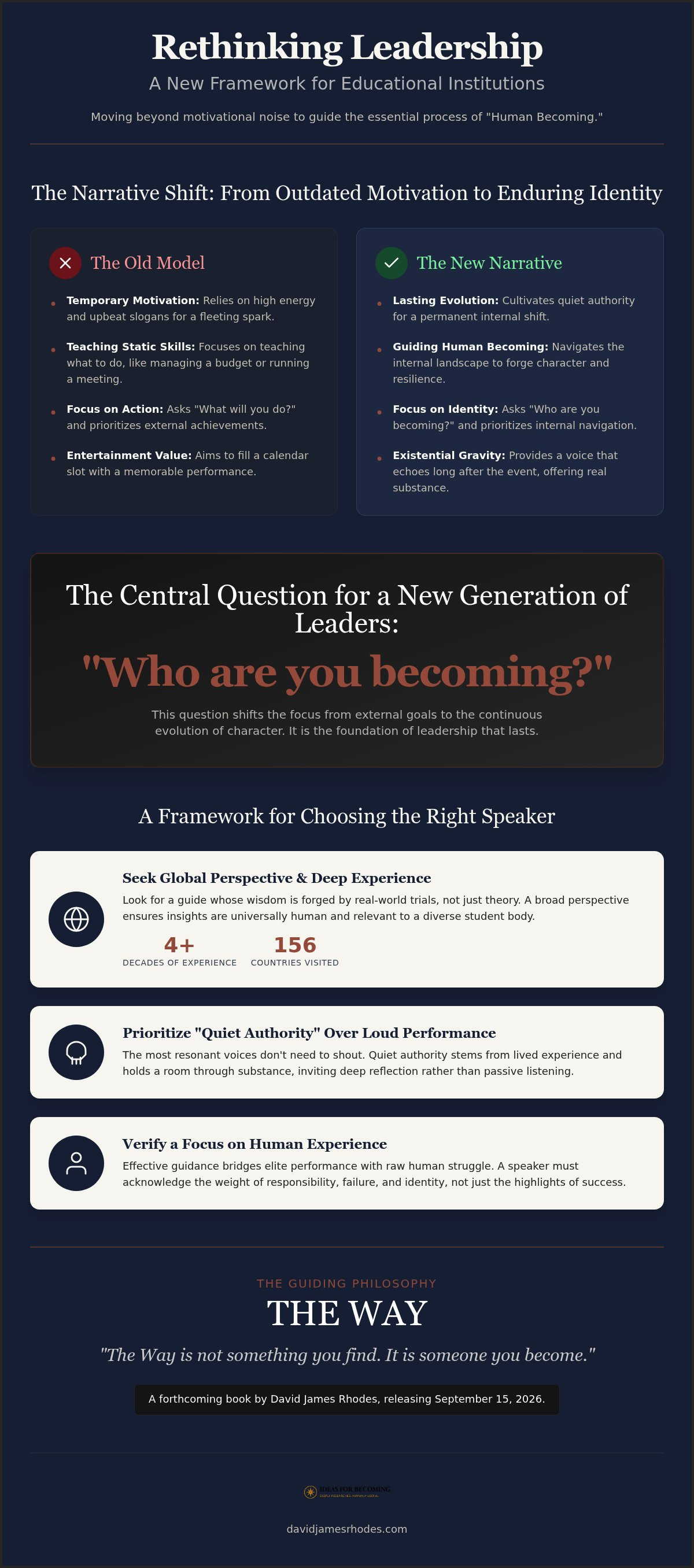
What if the loudest voice in the room is the one least worth hearing? Most motivational talks leave a room feeling briefly warm and permanently unchanged. Students and faculty are exhausted by the noise. They recognize the hollow ring of generic advice. When you seek a leadership speaker for educational institutions, the goal shouldn't be a momentary spark. It should be a lasting evolution.
You likely know that leadership isn't taught through a slide deck or a set of upbeat slogans. It's a weight. It's a responsibility. You want a guide who has navigated the extremes of success and failure across 156 countries. Someone who understands that the way isn't something you find, but someone you become. This guide explores how to select a speaker who moves beyond tropes to address the internal landscape of identity. You'll learn to find a partner who bridges elite performance with raw human experience. We'll examine how to establish a long-term advisory relationship that helps students navigate their own becoming, a philosophy David James Rhodes explores in his forthcoming book, The Way, releasing September 15, 2026.
Key Takeaways
- Replace hollow encouragement with a narrative of weight. Seek a voice that offers quiet authority over temporary exuberance.
- Choose a leadership speaker for educational institutions who bridges elite global performance with a deep understanding of personal struggle.
- Move from teaching static skills to guiding the process of "Human Becoming." Character is forged through the navigation of identity.
- Use universal insights from four decades of experience across 156 countries to prepare students for the reality of high-stakes leadership.
- Center every engagement on the essential question: Who are you becoming? This shift moves the focus from what people do to who they are.
Beyond Motivation: Why Educational Institutions Need a New Leadership Narrative
The cheerleader is dead. The high-energy, fist-pumping style of motivational speaking no longer resonates on campus. It feels performative. It feels thin. Students and faculty are facing a reality that is complex and often heavy. They don't need a distraction from that weight. They need a way to carry it. A new leadership narrative is emerging in the academic world. It is one rooted in existential gravity rather than temporary excitement. This shift is necessary because trust is fragile. Research from the Lumina Foundation-Gallup 2026 State of Higher Education Study shows that only 55% of students believe their school's leadership acts in their best interests. The gap between expectation and reality is widening.
Finding the right leadership speaker for educational institutions requires looking past the highlights. It requires seeking someone who has operated at the intersection of elite performance and raw struggle. Real leadership isn't found in the absence of difficulty. It's found in the response to it. We must move the conversation from "what you do" to "who you are becoming." This is not a subtle distinction. It is a fundamental change in how we prepare the next generation for a world that does not offer easy answers.
The Crisis of Identity in the Next Generation
The digital landscape is a hall of mirrors. Constant noise makes the search for meaning difficult. Students are often trapped by success metrics that don't satisfy the soul. They hit the targets. They earn the degrees. Then they ask: Now what? A seasoned guide offers a steady, global perspective. They bring the weight of experience from 156 countries to the local campus. They act as a witness to the fact that identity is not a static achievement. It is a continuous evolution. When a leadership speaker for educational institutions addresses this crisis, they provide more than advice. They provide a mirror. Who are you when the external validation disappears?
Leadership as a Process of Human Becoming
Skills are tools. They are necessary but insufficient. You can teach a student how to manage a budget or lead a meeting, but you cannot easily teach them how to remain steady in a crisis. That is a matter of character. This is why the philosophy of The Way is vital for emerging leaders. It shifts the focus from external goals to internal navigation. It suggests that leadership is a lifelong process of human becoming. It isn't a destination you reach. It is the person you are becoming through every choice and every failure. This forthcoming philosophy, detailed in the book releasing September 15, 2026, focuses on fostering character over mere competence. It is about the person behind the title.
Evaluation Framework: How to Choose a Speaker for Your Institution
Choosing a leadership speaker for educational institutions is an act of curation. It is not about filling a slot on a calendar. It is about selecting a voice that will echo in the minds of students long after the auditorium lights dim. Most selection committees prioritize fame or high-energy performance. This is a mistake. You need a new approach to evaluating leadership speakers, one that weighs existential gravity over entertainment value. The question is not whether they can speak. The question is whether they have something worth saying.
The "Quiet Authority" test is your most reliable tool. Can the speaker hold a room without shouting? A cheerleader needs a stage, a soundtrack, and a crowd's energy to survive. A sage needs only the truth. This quiet confidence suggests a brand of leadership that doesn't need to prove itself. It is a presence that invites vulnerability and deep reflection. It moves the audience from passive listening to active becoming.
Vetting for Global Perspective
A modern student body is a microcosm of the world. A speaker who relies on local, narrow anecdotes will fail to connect with a globalized generation. Experience in 156 countries matters. It provides a lens that sees beyond cultural borders to the universal human condition. You should look for cross-sector insights that bridge international finance, entrepreneurship, and behavioral health. This depth prevents the speaker from relying on singular, unrepeatable stories. Instead, they offer principles that are "Humanly Useful" regardless of the student's specific career path. They provide a map for navigating transition that is grounded in high-stakes reality.
The Balance of Vulnerability and Authority
Authority without vulnerability is arrogance. Vulnerability without authority is ineffective. You must seek speakers who are willing to share the "rock bottom" as well as the "peak." Students are savvy. They recognize when a speaker is hiding behind a polished persona. Vetting for a "witness and strategist" role ensures the speaker isn't positioning themselves as a guru with all the answers. They should offer evidence-based insights before claiming certainty. This honesty builds the trust necessary for a keynote to evolve into a deeper educational leadership advisory relationship. If you want to explore this philosophy further, you can learn more about David's work in the forthcoming book, The Way, releasing September 15, 2026.
The Identity Shift: Moving from Skill-Building to 'Human Becoming'
Skills are fragile. They are tools. They are not the craftsman. Most leadership training focuses on the tool belt: how to speak, how to manage, how to execute. Yet, when a crisis hits, a spreadsheet does not save a leader. Their identity does. A leadership speaker for educational institutions must bridge the gap between technical proficiency and the internal landscape. We must move beyond the checklist of competencies. We must ask the harder question: Who are you becoming?
This framework is the core of "The Way." It is a shift from what you do to who you are. Leadership development should be an integration of high-level performance and behavioral health. It recognizes that a leader's external impact is limited by their internal clarity. By focusing on identity, we help students developing resilience in young leaders. This is not about toughening up. It is about grounding oneself in a sense of purpose that survives the noise of the world.
Rehabilitating the Concept of Recovery
Leadership often involves rebuilding after disruption. This is the essence of recovery. It is larger than the removal of symptoms or the fixing of a problem. It is about building a life that is worth living. A leadership speaker for educational institutions should address the reality of failure and the necessity of starting over. This process is not a one-time event. It is a daily practice. It is found in the rhythm of 365 Days of Becoming. Identity is forged in the silence of the mundane, not just on the stage of the exceptional.
Character Over Credential
The obsession with credentials often masks a hollow center. An Ivy League degree is a marker of access, not a guarantee of character. We must challenge the idea that a title equals authority. True authority comes from the process of becoming. It is found when the old identity no longer fits and the new one has not yet arrived. These transitions are the most critical stages of growth. They require a guide who has navigated these voids across 156 countries. Leadership is found in the navigation of these silences. It is the person who remains when the credentials are stripped away. This is the philosophy at the heart of The Way, releasing September 15, 2026.
From 156 Countries to Your Campus: Lessons in Global Leadership
156 countries. This is more than a travel log. It's a vast collection of human data points gathered over four decades. When you select a leadership speaker for educational institutions, you're looking for more than a set of stories. You're looking for universal truths that survive the transition from an international boardroom to a domestic lecture hall. These truths aren't bound by geography. They're bound by the shared reality of human becoming. Leadership is the ability to remain steady when the map no longer matches the terrain. It's a skill forged in high-stakes international finance and tempered by a deep understanding of behavioral health.
The goal is to translate elite performance into human potential. Students often view success as a distant, polished peak. They don't see the jagged rocks beneath the surface. A global executive view demystifies this process. It shows that the person in the corner office and the student in the back row are navigating the same internal landscape. They're both asking: Who am I becoming? By sharing lessons from the extremes of success and failure, we provide students with a framework for their own evolution. We bridge the gap between global markets and personal character.
The Value of a Global Witness
Resilience is a global language. 40 years of international experience teaches us that the capacity to rebuild is a fundamental human trait. It's the same in a crisis zone as it's after a failed exam. A global witness helps students see themselves as part of a larger human story. They aren't alone in their struggle. They're part of a long lineage of individuals who have faced disruption and chosen to continue. This perspective shifts the focus from local anxiety to global possibility. It provides the existential gravity needed to ground a wandering identity.
Practical Wisdom for the Next Generation
Leading from the inside out is the only sustainable path in a complex world. Career planning is often taught as a series of destinations. This is a mistake. It should be taught as a process of navigation. The world changes too fast for fixed points. An effective leadership speaker for educational institutions must provide the tools for students to find their own way through the silence and the noise. You need a speaker on youth leadership and identity who understands this global scale. If your institution is ready to move beyond the shallow and embrace the weight of global experience, contact David James Rhodes for keynote speaking and advisory. This philosophy is explored further in the forthcoming book, The Way, releasing September 15, 2026.
Partnering with David James Rhodes: A Way Forward
Choosing a leadership speaker for educational institutions is a choice to move beyond the temporary. It is a decision to embed a philosophy of growth within the fabric of an institution. The engagement should not end when the speaker leaves the stage. It should be the beginning of a sustained practice. A single keynote provides a spark. A partnership provides a framework. This is about the long-term navigation of identity for both students and the leaders who guide them. We move from the spectacle of the event to the reality of the ecosystem.
This partnership is grounded in the belief that leadership is not a destination. It is the person you become while walking the path. David James Rhodes brings the weight of four decades of experience across 156 countries to this process. This global perspective is not used for entertainment. It is used as a witness to the universal challenges of transition and character. By integrating this experience into your campus, you offer students more than just advice. You offer them a map for their own becoming.
The Philosophy of 'The Way'
The flagship philosophy, "The Way," serves as a guide for the process of human becoming. This is not about finding a path. It is about the person the student becomes while walking it. This philosophy is centered on a forthcoming work, The Way, releasing September 15, 2026. On campus, this philosophy manifests through daily practice. 365 Days of Becoming offers a rhythmic approach to growth for faculty and students alike. It turns the abstract concept of character into a tangible habit. The Life After Anything series addresses the reality of setbacks. It provides a structure for rebuilding after the disruptions that inevitably occur in a high-stakes academic environment. These resources turn a single speech into a campus-wide movement of self-reflection.
Next Steps for Educational Leaders
Integrating this framework into student life programs requires intentionality. It begins with an inquiry into keynote engagements or specialized Education & Next Generation Advisory. This is not generic coaching. It is a strategic partnership. Leaders can prepare for the September 15, 2026 release of David’s flagship work by establishing these foundations now. The process involves several key steps:
- Specialized Advisory: Tailoring the "Human Becoming" framework to the specific needs of your faculty and student body.
- Sustained Practice: Utilizing 365 Days of Becoming to create a consistent language of growth across the institution.
- Crisis Navigation: Applying the principles of Life After Anything to help students rebuild their identities after personal or academic failure.
The goal is to move from symptom removal to identity construction. Every interaction serves as a door into the central question of the brand. Who are you becoming? This is the way forward for institutions that value character as much as credentials.
The Way Forward for Next Generation Leaders
Leadership is not a destination. It is a process of navigation. Most campus events prioritize temporary excitement over lasting character. To truly serve students, we must move from simple skill-building to the deeper work of human becoming. This requires a leadership speaker for educational institutions who has witnessed the extremes of human performance and struggle. It demands a guide who values evidence before certainty and character over credentials.
David James Rhodes brings four decades of executive experience across 156 countries to this conversation. His work provides a framework for navigating the silence between major life stages. Whether addressing elite performance or rebuilding after disruption, the focus remains on the central question: Who are you becoming? This philosophy is the foundation of his forthcoming book, The Way, releasing September 15, 2026. You are invited to inquire about David James Rhodes for your next educational event. There is a steady path through the noise. It begins with the decision to become something more.
Frequently Asked Questions
What makes a leadership speaker effective for college students?
Effectiveness is found at the intersection of high-stakes reality and raw human experience. Students value a witness who has navigated failure. They are fatigued by generic slogans. A speaker who brings the weight of four decades of experience across 156 countries offers the quiet authority they crave. It is about moving from a performance to a serious conversation. This approach respects their intelligence and the complexity of their personal growth.
How do we move beyond motivational speaking to something more substantial?
Substantial engagement requires shifting the focus from temporary emotion to internal evolution. Instead of seeking a spark, look for a philosophy like The Way that challenges the listener's identity. A leadership speaker for educational institutions should provide a framework for navigation rather than just a destination. This involves moving beyond what you do to the central question of who you are becoming in the face of transition.
Can a leadership speaker also address student mental health and recovery?
Leadership development is most effective when it integrates behavioral health. Recovery is larger than symptom removal. It is the process of building a life worth living after disruption. Speakers who understand this can address setbacks through the lens of Life After Anything. They bridge the gap between stabilization and sustainable growth. A student's internal clarity is the primary driver of their external leadership capacity and resilience.
What is the 'Human Becoming' framework in educational leadership?
The Human Becoming framework treats leadership as a lifelong process of evolution rather than a static goal. It is driven by the question: Who are you becoming? In an educational context, this means moving beyond credentials to focus on character. It suggests that the person behind the title is the true source of authority. This philosophy, explored in David’s flagship work releasing September 15, 2026, emphasizes that we are always in transition.
How do we choose between a celebrity speaker and a subject matter expert?
Choose the voice that carries the most existential gravity. Celebrity speakers often provide prestige but lack the depth to address complex student needs. A subject matter expert with four decades of global executive experience provides practical wisdom grounded in reality. They offer more than a name. They offer a strategy for navigation. Prioritize a witness who has operated in high-stakes environments over someone who simply possesses fame without weight.
What should we look for in a speaker's global experience?
Look for a speaker whose experience spans diverse cultures and sectors. True global perspective is measured by the ability to find universal human truths across six continents. Someone who has operated in 156 countries can bridge the gap between a boardroom and a classroom. This breadth ensures that their lessons are not limited by local anecdotes. It provides students with a lens that sees beyond cultural borders to the shared human condition.
How can a keynote speaker support long-term student development goals?
A keynote should serve as the entry point into a sustained practice of becoming. It supports long-term goals when it introduces a daily practice, such as 365 Days of Becoming. This turns a single speech into a recurring habit of self-reflection. By establishing a long-term advisory relationship, a leadership speaker for educational institutions helps integrate these philosophical frameworks into existing student life programs. It moves the focus from a one-time event to an ongoing evolution.
When is the best time to book a speaker for the academic year?
Plan for major engagements at least six to nine months in advance. This allows for the integration of the speaker's philosophy into the broader curriculum. For institutions looking to align with the release of David’s flagship work, The Way, planning should center on the September 15, 2026 date. Early booking ensures the speaker can tailor their advisory to the specific identity crises and transitions your student body is currently facing.
Frequently Asked Questions
Related Articles

Beyond Motivation: Finding a Speaker on Youth Leadership and Identity
Choose a speaker on youth leadership and identity who focuses on who students are becoming, not just what they can do. Move from empty motivation to real cha...

Educational Leadership Advisory: Navigating the Process of Becoming
Our educational leadership advisory shifts focus from systems to the leader. Learn how to navigate pressure and isolation by asking: Who are you becoming?

Developing Resilience in Young Leaders: The Quiet Strength of Becoming
Stop training youth to perform and start mentoring them to become. Learn a new way of developing resilience in young leaders that builds character, not just ...