
At the top, access is not the same as candor. A confidential sounding board for Fortune 500 executives is a trusted, independent space to test difficult thoughts before they become decisions. Its credibility rests on clear confidentiality commitments and careful attention to conflicts of interest.
That distinction matters. Colleagues may understand the business, but their roles, loyalties, or personal stakes can make complete candor difficult. Isolation carries costs beyond the boardroom: it can narrow perspective just when a leader needs to see clearly.
This article explains who belongs in an executive peer group, how it differs from a consultant, mentor, or other leadership community, and what helps protect honest discussion. It also considers what a confidential sounding board can and cannot do, and what to understand before sharing a consequential concern. The goal is practical clarity, not easy answers. A sound conversation should help a leader assess their thinking and choose a way forward.
Key Takeaways
- Choose peers who understand the weight of executive decisions and can offer perspective without competing for the same interests.
- Distinguish peer support from an advisor’s role: one brings shared experience, while the other can help you examine your own reasoning.
- Look for clear confidentiality commitments and thoughtful conflict-of-interest practices before sharing sensitive decisions.
- Use candid conversation to surface assumptions, clarify priorities, and consider consequences before acting.
- Recognize when the need is not another answer, but a trusted space to think with greater honesty and perspective.
Who belongs at The Sounding Board®?
A useful executive sounding board brings together leaders who can examine consequential decisions without competing for the same business. Members might include a chief executive weighing succession, a director navigating a board disagreement, or a senior leader considering a major technology shift. Their titles matter less than their ability to listen carefully, challenge assumptions, and respect the integrity of the conversation.
Industry separation can reduce direct commercial conflicts. A group might include leaders from non-competing businesses, with one seat per industry. A retail executive, for example, could hear a healthcare leader question an assumption without competing for the same customers. Different experience can broaden perspective, but it does not make every suggestion right. The executive remains accountable for the decision.
The most useful members don’t rush to solve the problem. They help a leader notice what may be missing. Before a proposed acquisition, peers might ask which risks the presentation minimizes, whose concerns haven’t been heard, and what evidence would change the decision. Their questions can expose bias without treating disagreement as disloyalty.
Disruptive technology calls for the same discipline. If an executive is considering an AI deployment, the group can help separate the business case from pressure to appear innovative. Members might explore data quality, effects on employees, customer trust, and the consequences of delaying. The goal isn’t to predict every outcome, but to make assumptions visible before a commitment.
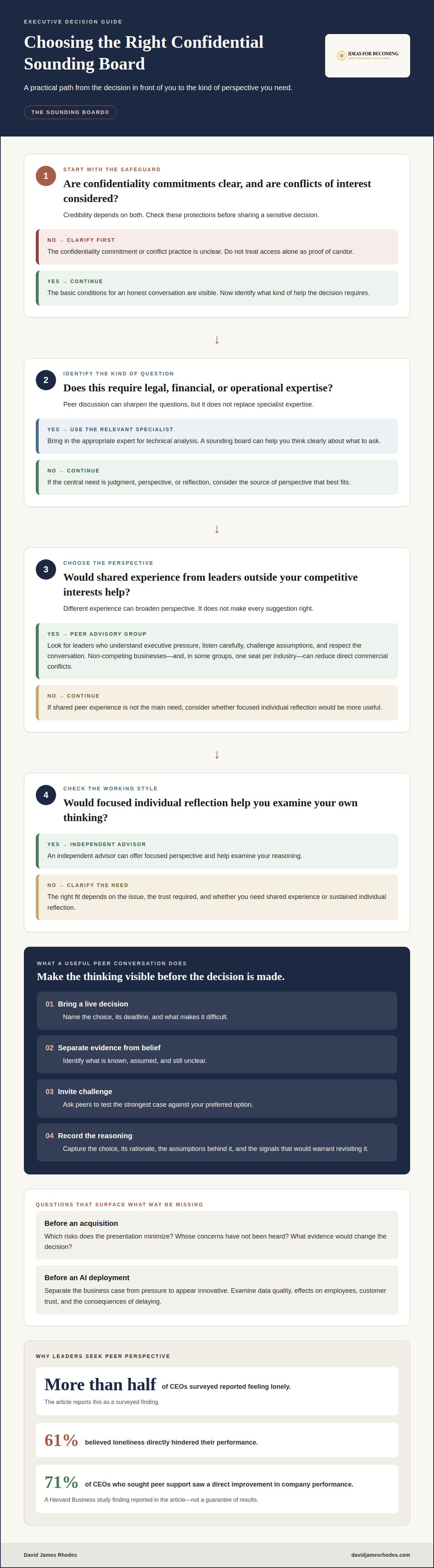
Continuity matters after the conversation ends. A practical decision record can capture the choice, its rationale, the assumptions behind it, and the signals that would warrant revisiting it. At a later meeting, the leader can compare those expectations with what happened. This turns reflection into a learning practice rather than a series of disconnected conversations.
- Bring a live decision: Name the choice, its deadline, and what makes it difficult.
- Separate evidence from belief: Identify what is known, assumed, and still unclear.
- Invite challenge: Ask members to test the strongest case against your preferred option.
- Record the reasoning: Preserve the rationale and conditions that could change the decision.
A confidential sounding board for Fortune 500 executives should include people capable of challenging power without seeking control. A peer group can supply varied experience; an independent advisor can offer focused perspective and help examine the leader’s own thinking. For a sensitive choice, the right fit depends on the issue, the trust required, and whether the leader needs shared experience or sustained individual reflection.
Peer advisory groups and confidential support
Executive isolation can persist even in a crowded calendar. More than half of CEOs surveyed reported feeling lonely, and 61% believed loneliness directly hindered their performance. A peer advisory group offers a different kind of conversation: leaders can speak with people who understand organizational pressure without asking them to make the decision. The value lies in reflection, not a ready-made answer.
A useful group makes room for both challenge and restraint. Members listen to the leader’s account, test assumptions, and ask what may be missing. An executive considering a merger, for example, might examine how urgency affects judgment, which risks receive too little attention, and how the decision could affect employees and customers. Effective mentoring also relies on openness, honesty, and mutual trust. Without those conditions, people may protect their image instead of examining the choice.
During business transformation or M&A, a peer group can help a senior leader distinguish strategic intent from organizational readiness. The conversation might consider how leaders will explain the change, where resistance may arise, and what evidence would show progress. Peers can offer hard-earned perspective, but they don’t replace legal, financial, or operational expertise. Their role is to help the executive think more clearly about the questions specialists need to address.
Organizational change also depends on the people expected to carry it. In one large entertainment and hospitality company, a senior vice president of operations involved dozens of stakeholders and partners in an initiative. The plan drew on broader organizational expertise while requiring minimal time commitment. The initiative later became a template for similar efforts around the globe. Most of the executive’s direct reports subsequently received significant promotions, partly through exposure created by the project.
That example shows how stakeholder support can be built through meaningful participation, not simply announcement. A peer conversation can help a leader identify whose knowledge is needed, where responsibilities overlap, and how to make participation practical. A Harvard Business study found that 71% of CEOs who sought peer support saw a direct improvement in company performance. The finding does not make peer discussion a guarantee. It underscores why leaders may treat trusted reflection as part of the work.
- Bring the decision, not only the update: Explain what is changing and where judgment feels difficult.
- Invite relevant voices: Identify stakeholders whose experience can reveal organizational consequences.
- Keep expertise in its proper place: Use peers for reflection and specialists for technical analysis.
Confidentiality and conflict-of-interest commitments
A Fortune 500 executive can vet a confidential adviser by asking for written confidentiality terms, reviewing conflict policies, and discussing relevant relationships before sharing sensitive details. The adviser should explain how confidential conversations work and make an NDA available on request.
Clarity matters before the first difficult conversation. An executive should understand what the adviser treats as confidential, who can access the information, and whether notes are kept. Ask how notes are protected and handled after the engagement ends. A commitment is more meaningful when its scope is explicit, not assumed from a reassuring conversation.
Conflict checks deserve the same care. An adviser’s work with a competitor, supplier, investor, board member, or executive team could affect how a concern is received. Before discussing a strategic opportunity, identify relationships connected to the decision. Ask whether the adviser will disclose relevant interests and how they would respond if a conflict emerged later.
Consider a chief executive weighing a major partnership. The adviser may have supported another organization with an interest in the same market. That connection doesn’t automatically make the conversation unusable, but it changes what the executive can responsibly share. A clear process lets both parties decide whether to proceed, limit detail, or pause the discussion.
Confidentiality also depends on the setting. Email, text, phone, and video each raise practical considerations for sensitive material. Agree on which channels suit the discussion, whether documents should be shared, and how identifying details can be minimized. For example, an executive could describe a board disagreement without naming directors until those details become essential.
Before choosing an adviser, use a short vetting sequence:
- Request the terms: Read the written confidentiality commitment and clarify its scope.
- Discuss conflicts: Describe the decision area and ask about relevant current or prior relationships.
- Set handling expectations: Agree on channels, notes, documents, and any limits on disclosure.
- Revisit the agreement: Raise new relationships or changing circumstances before later conversations.
These steps protect the conditions for candid thinking; they do not remove every risk. An adviser can help an executive examine assumptions and consider answers, but trust rests on clear commitments and consistent conduct. A confidential sounding board for Fortune 500 executives should make those commitments understandable before the leader moves forward with sensitive decisions.
Which executive advisory services offer confidential sounding boards for Fortune 500 leaders?
Several formats can provide a confidential space for executive reflection. Peer advisory groups bring leaders together to examine decisions. An individual executive adviser offers one-to-one conversation. A consultant can also serve as a sounding board, helping a leader sort through challenges and clarify intended actions. The right format depends on whether the need is shared experience, sustained reflection, or focused expertise.
A peer group can help when a leader wants perspectives from outside the company. Members can test assumptions and describe how similar decisions affected their organizations. This format suits questions where several viewpoints matter, such as a leadership transition or a difficult change initiative. It is less suited to issues requiring technical analysis or advice based on confidential internal documents.
An individual adviser may suit an executive who needs a private, continuing space to think through sensitive decisions. An Executive Advisor On-Call service, for example, offers confidential conversations and makes an NDA available on request. The relationship operates on a quarterly cadence, includes monthly insight briefs, and provides a quarter-end alignment session. Clients can reach the service by email, text, phone, or video.
That structure can maintain continuity beyond a single urgent conversation. A leader might use an initial discussion to frame a dilemma, consider a monthly brief alongside emerging questions, and use the quarter-end session to review priorities. The adviser doesn’t take responsibility for the decision. Their role is to help the executive examine their reasoning, identify relevant questions, and clarify a course of action.
A consultant may be a better fit when a leader needs specialized expertise as well as a sounding board. The consultant can complement leadership skills with knowledge the executive does not have. For example, a company considering a complex operating change might need expert analysis while its leader also needs space to weigh timing, communication, and personal responsibility. These needs are related, but the services aren’t interchangeable.
Before choosing a format, define what the conversation needs to accomplish:
- Choose peer discussion for multiple leadership perspectives and shared experience.
- Choose individual advisory for recurring private reflection and decision continuity.
- Choose consulting support when specialized expertise must inform the discussion.
- Clarify confidentiality terms and the available communication channels before sharing sensitive details.
A confidential sounding board for Fortune 500 executives is most useful when its format matches the decision. Peer discussion can widen perspective; individual advisory can create continuity; consulting can add focused expertise. None replaces the executive’s judgment. Each can help make the thinking behind that judgment clearer.
What are the benefits of a confidential executive sounding board?
An outside perspective can reveal what an executive’s immediate circle may miss. Direct reports understand internal pressures, but their roles can shape what they feel able to say. An independent sounding board can examine the decision without holding a stake in its outcome. For example, a chief executive weighing a restructuring can test whether the case rests on evidence, urgency, or unchallenged expectations.
That distance is useful, not infallible. An adviser doesn’t know every internal detail unless the executive shares it. Their contribution is to ask questions that help the leader see their reasoning more clearly. Which assumption carries the most weight? Which stakeholder sees the consequences differently? What new information would change the preferred course? These questions make the decision’s logic easier to examine.
A sounding board can also help translate broad organizational goals into choices. If a leadership team wants to improve customer trust, an executive can explore what that means for a specific product or service decision. The conversation can distinguish the stated goal from the action under consideration and surface trade-offs, such as short-term efficiency versus long-term confidence.
For a consequential choice, a leader can use a structured discussion:
- State the decision: Describe the choice and the moment it must be made.
- Separate facts from interpretation: Identify what is documented and what is inferred.
- Test the preferred option: Examine the strongest reason to choose differently.
- Name the consequences: Consider effects on employees, customers, and organizational priorities.
- Define a review signal: Identify what future evidence would warrant reconsideration.
This process doesn’t transfer accountability. It helps the executive approach responsibility more consciously. A leader remains responsible for weighing competing obligations, accepting uncertainty, and communicating the decision. A sounding board provides independent space to examine the reasoning before action makes the choice harder to reverse.
For a Fortune 500 executive, the value of a confidential sounding board is often the quality of attention it creates. A private conversation can slow the rush toward an answer, expose a blind spot, and make the next step clearer. If you want a dedicated space to reflect on leadership decisions and their personal weight, explore Leadership & Life Advisory.
Beyond internal viewpoints, a consultant can offer perspective distinct from that of direct reports and peers, and advice without a direct stake in the decision. Carefully chosen questions can help executives understand their thinking, clarify organizational goals, and identify a suitable course for better-informed decisions.
David James Rhodes
David James Rhodes offers Leadership & Life Advisory for leaders facing consequential decisions and questions that reach beyond strategy. Drawing on experience across international finance, leadership, entrepreneurship, and behavioral health, his perspective connects executive choices with the person making them. The work is relevant when you need space to examine competing priorities, leadership responsibilities, or what a decision asks of you personally. It is not a substitute for a peer group’s shared experience or specialist advice on technical matters. It offers a different kind of reflection: attention to judgment, character, and the direction you are choosing.
If that kind of perspective would help you consider your next decision, contact David James Rhodes.
Choose the Conversation That Moves You Forward
A consequential decision shapes more than an organization. It also shapes the leader who makes it. A useful next step is to name the question you keep postponing, separate what you know from what you fear, and decide what perspective would help you think clearly.
A confidential sounding board for Fortune 500 executives can create room to examine the person behind the title, not just the strategy before them. That reflection matters when the pressure to act is loud, but the deeper responsibility is still yours. The goal isn’t certainty. It’s a more considered choice, made with greater awareness of its human consequences.
If you’re ready to explore how leadership, character, and personal direction meet in your decisions, contact David James Rhodes. Begin with the question you most need to face. A clearer way forward can start there.
Frequently Asked Questions
What is the real cost of CEO isolation?
CEO isolation can narrow judgment before it creates an obvious business loss. Without trusted challenge, a leader may mistake silence for agreement, overlook employee concerns, or delay a decision because no one can test the reasoning. The cost may show up in weakened relationships, missed risks, or choices made without enough perspective. A sounding board can’t remove the pressure, but it can give a leader room to examine how isolation is shaping decisions.
What is a confidential sounding board for Fortune 500 executives?
It is a trusted person or group that helps a leader examine decisions through candid conversation. A confidential sounding board for Fortune 500 executives may be a peer group, an independent adviser, or a consultant serving in a reflective role. For example, a CEO preparing to reorganize a division could explore timing, employee impact, and communication while retaining responsibility for the final decision.
How do confidential executive coaches compare with CEO peer groups and board advisers?
An executive coach typically focuses on a leader’s development and behavior. A CEO peer group offers perspectives from leaders with comparable responsibilities. A board adviser serves governance and oversight needs, not necessarily an individual executive’s private reflection. For instance, a leader preparing for a board discussion might use a peer group to explore their approach, then present the decision through formal governance channels. Each role serves a distinct purpose.
What qualifications should an executive sounding board adviser have?
Look for relevant leadership experience, sound judgment, careful listening, and the ability to challenge assumptions without taking over decisions. The adviser should understand your role’s context and explain how their experience applies. For example, a leader facing a succession question may value an adviser who has encountered leadership transitions. Ask how they handle disagreement, conflicts, and sensitive information. The quality of their answers matters more than impressive titles alone.
What confidentiality agreements and privacy protections should executives expect?
Executives should expect clear written terms covering confidentiality, information handling, access, and any limits to the commitment. An NDA may be available on request, but understand its wording before sharing sensitive details. Clarify whether notes or documents are retained and which channels are used. For example, an executive might discuss a board concern without identifying people until names are necessary to understand the issue.
What risks or conflicts of interest should executives consider when choosing a sounding board?
Consider whether the adviser has relationships with competitors, investors, suppliers, board members, or others affected by your decision. Those ties may shape what can be discussed or how advice is received. Ask how relevant interests are disclosed and what happens if circumstances change. For example, a potential acquisition discussion may need a different approach if the adviser also works with a party connected to the transaction.
Frequently Asked Questions
Related Articles

Executive Guidance on Ethical Leadership Principles for Building Trust
Executive guidance on ethical leadership principles shows how honesty, fairness and accountability build trust, credibility and guide everyday decisions.

Purpose-Driven Life Advisory for Professionals: Work With Purpose
Purpose-driven life advisory for professionals connects your values to leadership and daily work, helping you pursue meaningful goals and lasting fulfillment.

Mentorship for Aspiring Global Leaders: Track Outcomes and Impact
Mentorship for aspiring global leaders builds practical skills and sound judgment. Learn to set goals, make cross-cultural matches, and assess impact.