
Strategic advice for cultivating future leaders begins with identifying people who take initiative, accept responsibility, communicate well, and help others succeed. Then give them real opportunities to lead, supported by coaching, clear succession plans, resilience-building, and honest feedback from peers. Strong performance matters, but it isn’t the same as readiness to lead.
Organizations often begin with training or individual mentoring. Both can help, but leadership also develops through relationships: peers offer perspective, challenge assumptions, and make leadership less isolating. A practical approach combines ways to recognize potential, prepare people for broader responsibility, and build peer support into their development. The aim is thoughtful succession planning that helps people grow into leadership, rather than simply giving them a title.
Key Takeaways
- Start succession planning with the roles and capabilities your organization will need, then revisit the plan as priorities change.
- Look beyond strong performance. Initiative, accountability, clear communication, and the ability to support others can signal leadership potential.
- Develop emotional intelligence, adaptability, and resilience alongside technical expertise so emerging leaders can respond to change and guide people through difficulty.
- Turn learning into practice through real responsibility, coaching, and feedback focused on growth, not only evaluation.
- Build peer support into leadership development. Shared perspective and honest discussion can help emerging leaders learn from one another.
1. Assessments and succession planning
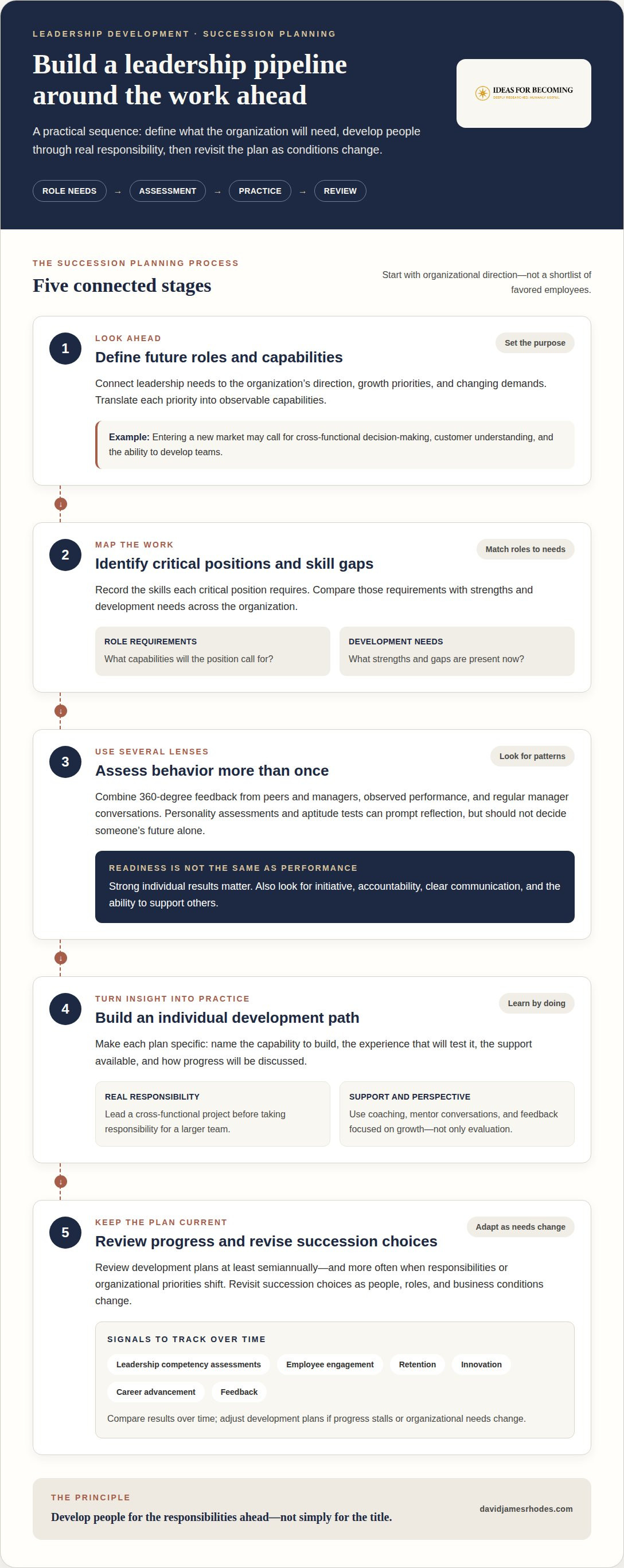
Succession planning should begin with the organization’s direction, not a list of favored employees. Look ahead to the roles and capabilities the organization will need, considering its growth priorities and changing demands. For example, entering a new market may call for leaders who can make cross-functional decisions, understand customers, and develop teams. Translate each priority into observable capabilities, so assessments serve a clear purpose rather than simply labeling people “high potential.”
Next, identify critical positions and the skills required to fill them. Compare those requirements with current strengths and gaps across the organization. Use 360-degree feedback from peers and managers to uncover patterns that one supervisor may miss. Personality assessments and aptitude tests can add useful reflection, but they should inform development rather than determine someone’s future alone. Pair each result with regular manager check-ins and specific examples of behavior.
Turn the findings into individual development plans. Each plan should name the capability to build, the experience that will test it, the support available, and how progress will be discussed. A promising employee might lead a cross-functional project before taking responsibility for a larger team. Mentors can help interpret setbacks and offer perspectives beyond the employee’s immediate department. Review plans at least semiannually, and more often when responsibilities or organizational priorities shift.
- Define the future: connect the organization’s strategic goals to leadership capabilities.
- Map critical roles: record the skills each position requires and possible successors’ development needs.
- Assess more than once: combine 360-degree feedback, observed performance, and manager conversations.
- Build a path: match each development need with practical assignments, support, and review points.
- Revise the plan: revisit succession choices as people, roles, and business conditions change.
How should organizations measure leadership development and succession planning success? Track leadership competency assessments, employee engagement, retention, innovation, career advancement, and feedback. Compare results over time, then adjust development plans if progress stalls or organizational needs change.
What are the risks and common mistakes in cultivating future leaders? One common mistake is promoting top individual performers without assessing their readiness to lead people. Other risks include relying on a single assessment, overlooking succession gaps, and failing to update plans when strategy changes.
How can organizations build a diverse and inclusive leadership pipeline? Use consistent, role-related criteria across teams, and make development assignments and mentoring accessible to people with different backgrounds. Review who receives feedback, visible responsibility, and advancement opportunities. Patterns can reveal where access needs to improve.
Leadership development helps organizations assess who may be ready for supervisory or leadership roles and where further growth is needed. The example company had identified two future leaders.
Assess goals, industry challenges, and stakeholder perspectives to identify development needs; specify critical positions and required skills, support self-assessment through personality assessments, 360-degree feedback, and regular manager check-ins, and update plans as organizational and industry conditions change.
2. Emotional intelligence, adaptability, and resilience
Leadership is tested when plans meet resistance. An emerging leader may need to announce a delayed project, hear frustration, and help the team decide what to do next. Emotional intelligence helps them recognize their own response, understand others’ concerns, and choose a constructive next step. It is not an optional extra: it shapes decisions under pressure.
Build this capacity through observable habits. After a tense meeting, ask an emerging leader to describe what happened, what they felt, and how their response affected the room. Then consider another approach together. This reflection develops self-awareness and emotional regulation without treating emotion as a flaw. The aim is not to suppress discomfort, but to notice it before it takes over the conversation.
Empathy also takes practice. When colleagues disagree, an emerging leader can summarize each person’s concern before proposing a solution. This slows premature judgment and shows people they have been heard. Clear communication and social skills matter too: leaders need to explain decisions, invite dissent, and address conflict directly. Training can introduce these practices, while real conversations show where further development is needed.
Adaptability becomes visible when circumstances change. If a supplier delay threatens a launch, a future leader should clarify what is known, separate assumptions from evidence, identify affected priorities, and communicate revised responsibilities. This turns uncertainty into manageable decisions and shows the team that changing course does not mean abandoning purpose.
Resilience does not mean pretending a setback has no cost. It means regaining enough perspective to learn and act. After a project misses its target, consider what contributed, what the team could control, and what should change next time. Treat difficulty as an opportunity to learn while taking responsibility for preventable harm. A leader who admits an error and explains the correction models accountability while retaining authority.
To make these qualities part of the culture, organizations can:
- Practice reflection: use a short debrief after difficult conversations or decisions.
- Rehearse change: discuss how a team would respond to shifting priorities or incomplete information.
- Invite feedback: ask colleagues which leadership behaviors helped, and which created friction.
- Recognize recovery: notice thoughtful adjustments, honest learning, and steady communication after setbacks.
These habits help develop leaders who adapt without becoming reactive. They stay open to new evidence while acting in ways that give others a steadier basis for their work.
3. Identifying high-potential employees
High potential is not the same as excellent performance. Someone may excel in a familiar role yet struggle with broader responsibility. Strategic advice for cultivating future leaders distinguishes visible achievement from the ability to make sound choices as demands change. The question is not simply who delivers the most, but who can broaden their perspective as the work grows more complex.
Notice how employees understand the wider conditions surrounding their work. Someone who sees that a delay in one team will affect another team’s commitments, and raises the trade-off early, may demonstrate valuable systems thinking. Also observe how people respond to a different interpretation. Curiosity during disagreement can reveal judgment that a polished presentation alone cannot.
To make observations more useful, consider whether an employee:
- Sees connections: explains how a decision may affect teams beyond their own.
- Weighs trade-offs: names what a choice advances and what it may set aside.
- Clarifies ownership: helps a group understand who must act and why.
- Works through ambiguity: identifies what is known before recommending a next move.
- Expands perspective: seeks information beyond familiar expertise when a problem changes.
Assess each signal against the role ahead. If a future leader must coordinate across functions, look for sound judgment beyond their own team. If the role involves difficult resource choices, consider examples of weighing competing needs and explaining the reasoning. “High potential” is a useful label only when tied to real responsibilities and observed behavior.
Fair assessment also means paying attention to visibility. People whose work is more prominent may be easier to remember, while contributions behind the scenes can be overlooked. Compare examples from different settings and seek input from colleagues who have worked alongside the employee. The goal is not to eliminate judgment, but to ground it in evidence rather than familiarity or personal style.
Treat potential as a current assessment, not a permanent verdict. Someone may show strong judgment in one area and need development in another. Record the evidence behind readiness decisions, then revisit them as responsibilities and organizational needs evolve. This keeps talent discussions focused on future work instead of putting a promising person in a fixed category.
Organizations should base leadership development on potential to lead, rather than assuming top performers will automatically become effective leaders. This keeps decisions tied to leadership capacity, not just success in a current role. Look for initiative, accountability, clear communication, and the ability to help others succeed. Consider these qualities alongside evidence of how someone handles broader demands. The key question is whether their conduct supports the responsibilities ahead, not whether they have a polished leadership style.
When discussing candidates, link each quality to specific examples instead of relying on a general impression. This helps distinguish leadership potential from current performance and identify where development is needed. Revisit the assessment as new evidence emerges, keeping the focus on responsibilities the employee may take on.
4. Leadership coaching and practice opportunities
Leadership development takes hold when emerging leaders apply new skills in real work. A course can introduce strategic thinking, decision-making, or conflict resolution; practical assignments show whether someone can use those ideas when priorities compete. Give each participant a meaningful assignment with a clear purpose, defined authority, and access to guidance. For example, they might coordinate a cross-functional project, then review how their decisions affected other teams.
The 70-20-10 framework offers one way to balance development: 70% through doing the task, 20% through mentorship and feedback, and 10% through formal learning. It is a planning model, not a guarantee of results. A useful program connects all three. A short course on decision-making, for instance, can be followed by responsibility for a real project and regular discussion with an experienced manager.
Coaching should focus on the work ahead, not just a past performance rating. Before a stretch assignment, agree on the goal, likely obstacles, decision boundaries, and available support. Afterward, review what happened: Which choices moved the work forward? Where did communication break down? What would the leader change next time? Specific questions connect feedback to future responsibility.
Mentors and sponsors support development in different ways. A mentor can share perspective, ask questions, and help an emerging leader reflect on difficult choices. A sponsor can advocate for access to visible assignments and decision-making opportunities. Both relationships benefit from clear expectations and regular conversations. Learning from an experienced manager can also introduce a developing leader to different approaches.
Small businesses and large organizations can use the same principles in different ways. A smaller organization might rely on direct manager coaching and live projects; a larger one could add structured programs, simulations, and cross-functional pathways. In either case, design development around available resources and the capabilities the organization needs.
How much do leadership development programs typically cost in the United States? Costs depend on the format, duration, participant support, and use of external expertise. Those factors shape each program, so one figure would not represent them all.
How can organizations create effective leadership development programs? Start with the capabilities needed, then combine instruction, real assignments, coaching, and progress reviews. Use participant feedback and observed performance to improve the program over time.
Learning should be connected to responsibility. A well-designed program gives emerging leaders room to act, support when decisions become difficult, and a clear opportunity to learn from the consequences.
5. Leadership interaction and peer support
Leadership can feel solitary, especially when a developing leader must make a decision colleagues may dislike. Peer support gives them a place to examine that responsibility with others facing similar demands. A peer group can compare approaches, question assumptions, and share lessons without turning every conversation into a performance review. Its value is not agreement, but clearer thinking before members return to their teams.
The 70-20-10 development framework assigns 20% of learning to mentorship and regular feedback. Peer collaboration gives that learning a practical setting: participants can bring a difficult decision, describe the context, and hear how others would respond. For example, a new department lead might explain a disagreement over priorities. Peers can identify missing perspectives and help the leader consider how to communicate the final decision.
Structure matters. A useful peer group has a clear purpose, agreed expectations, and enough trust for honest discussion. Members should protect confidentiality, distinguish observation from judgment, and share responsibility for the conversation. A facilitator can keep discussion grounded in a real leadership challenge rather than general advice. End each meeting with an action for the leader to take and a later review of what happened.
Pairing developing leaders with someone a step ahead can make support relevant and accessible. A colleague who recently entered a similar role may remember practical challenges such as earning trust, setting boundaries, or managing a handoff between teams. Senior leaders also matter: they can model integrity and transparency and open doors to experiences peers cannot provide.
Interaction across departments helps future leaders understand how decisions affect an organization. A product lead and an operations lead, for example, may find that their teams define a successful launch differently. Discussing those differences can surface assumptions before they become conflict and build relationships for more direct collaboration later.
- Choose a real case: bring a current decision, setback, or team challenge.
- Ask before advising: clarify the context and the leader’s desired outcome.
- Share responsibility: offer perspectives, not commands, and name relevant experience.
- Return to the result: discuss what the leader tried and what the team learned.
Technology can help distributed peers meet and exchange ideas, but it cannot replace personal attention. A written update may describe an issue; a thoughtful conversation can uncover hesitation, tension, or an unspoken concern. Digital tools work best when they support connection rather than substitute for it.
Organizations strengthen leadership cultures when senior leaders make peer learning visible. They can take part in discussions, acknowledge their mistakes, and invite different views. This makes accountability mutual. Emerging leaders learn not only from advice, but also from seeing how experienced people respond to challenge.
David James Rhodes: Leadership & Life Advisory
Leadership & Life Advisory offers space to examine leadership decisions, personal responsibility, and the future a leader is building. It can be useful when succession planning raises questions about readiness, a leadership role brings unfamiliar pressure, or an organization wants its next generation to grow with purpose. The work connects practical choices with a deeper question: who are you becoming as you lead?
For organizations, this perspective brings attention to the people behind the plan: their judgment, character, and effect on others. For individuals, it creates space to consider what a new responsibility asks of them. Leadership development is not just preparation for a title. It is preparation to carry its consequences.
To explore Leadership & Life Advisory, contact David James Rhodes and begin a conversation.
Choose the kind of leadership you want to leave behind
Strategic advice for cultivating future leaders matters most when it shapes more than a succession chart. It influences what people value, how they treat colleagues, and whether responsibility is shared or guarded. Make those choices visible in daily work. What conduct do emerging leaders see rewarded? Who receives meaningful responsibility? How does the organization respond when someone makes a difficult decision and learns from it?
Leadership is never only about the person who holds the title. It is also about the conditions that person creates for others to grow. David James Rhodes’s work brings leadership into the larger question of human becoming: who are you becoming, and what does your example make possible for those around you? In The Way, his guide to leadership and human becoming, Rhodes explores how we grow into the people capable of creating a way forward. The Way is available. For organizations ready to reflect on these questions, explore Leadership & Life Advisory.
The future takes shape through choices made before anyone calls them leadership. Make the next choice with care, and give others room to become capable of more.
Frequently Asked Questions
What are the best strategies for identifying high-potential future leaders?
Look for consistent evidence that someone can make sound choices beyond their own area of responsibility. Notice who connects daily work to broader priorities, shares credit, and raises concerns early rather than hiding them. Compare observations from different projects and colleagues. Then offer a modest leadership responsibility and assess whether the person learns from its effects, not just whether the task succeeds.
What leadership skills should future leaders develop?
Future leaders benefit from sound judgment, clear delegation, ethical decisions, and the ability to connect daily work to a larger purpose. Delegation is especially revealing: a leader defines the desired result, gives others room to act, and remains accountable without taking over. They also need to distinguish urgent pressure from important work, so immediate demands do not quietly displace long-term direction.
What are effective stretch assignments for developing leadership skills?
Useful stretch assignments give emerging leaders responsibility for a real outcome beyond their usual routine. They might facilitate planning between teams, coordinate a response to customer concerns, or lead a lessons-learned review after a project. Set authority and boundaries beforehand, and agree on what they can decide independently. A manager can offer guidance while letting the emerging leader own the work.
Frequently Asked Questions
Related Articles

Executive Guidance on Ethical Leadership Principles for Building Trust
Executive guidance on ethical leadership principles shows how honesty, fairness and accountability build trust, credibility and guide everyday decisions.
Purpose-Driven Life Advisory for Professionals: Work With Purpose
Purpose-driven life advisory for professionals connects your values to leadership and daily work, helping you pursue meaningful goals and lasting fulfillment.

Mentorship for Aspiring Global Leaders: Track Outcomes and Impact
Mentorship for aspiring global leaders builds practical skills and sound judgment. Learn to set goals, make cross-cultural matches, and assess impact.