
A setback can change the shape of a life without deciding what comes next. Resilience means adapting to and recovering from challenges, stress, or adversity. A speaker on thriving after major setbacks can make that idea practical, not by demanding positivity, but by helping people consider their next step.
It’s reasonable to expect that recovery will take time. It may involve grief, uncertainty, or a changed sense of identity. Moving forward doesn’t mean pretending the loss was small. It means responding to what has changed while making room for what remains possible.
Supportive relationships, manageable goals, healthy routines, and a growth mindset can all help build resilience. Self-reflection can turn experience into learning, while recognizing unhelpful thought patterns can help people respond more deliberately. After vision loss, practical adjustments may also help someone adapt to changed routines. These aren’t shortcuts around hardship, but ways to meet it one decision at a time.
Key Takeaways
- Break an overwhelming goal into manageable steps, and build routines that help restore a sense of direction.
- Let supportive relationships share the weight; resilience doesn’t require facing every challenge alone.
- Use a growth mindset to distinguish what you can influence from what you may need to accept.
- Reflect with self-compassion: setbacks can offer lessons, but recovery has no fixed timeline.
- After vision loss, allow space for difficult emotions while identifying new ways to adapt and move forward.
1. Adaptive strategies and support networks
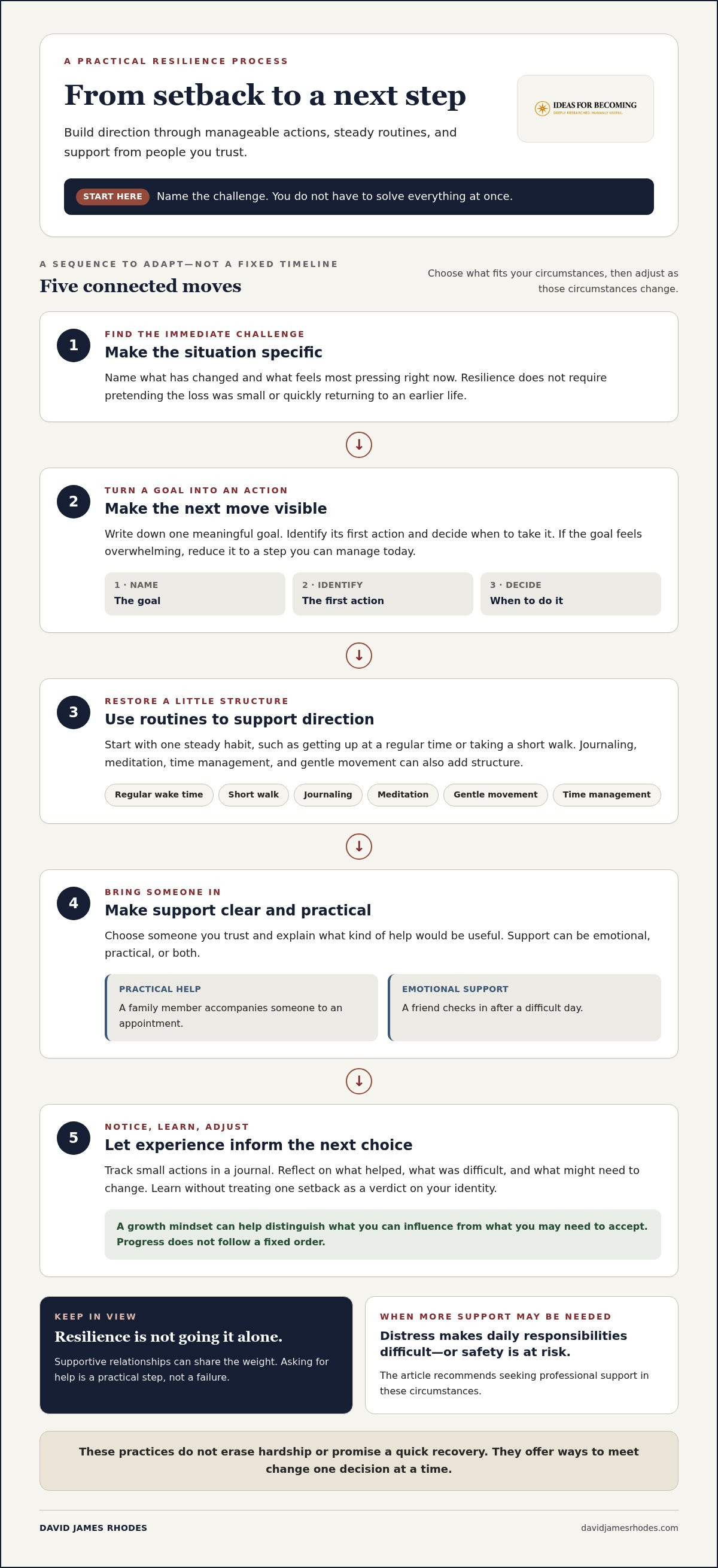
Resilience is the capacity to adapt and recover when adversity changes a person’s situation. It doesn’t require smiling, coping alone, or quickly returning to an earlier life. Start by naming the immediate challenge, then choose one action within reach. That might mean arranging a conversation, making a needed appointment, or setting a small goal for the day.
Large goals can intensify overwhelm when the next move is unclear. Break a meaningful aim into visible steps: write it down, identify the first action, and decide when to take it. Someone rebuilding after a setback might start by restoring one steady routine, such as getting up at a regular time or taking a short walk. Journaling, meditation, time management, and gentle movement can also add structure. These practices don’t erase hardship; they offer ways to engage with it without demanding a complete solution all at once.
How does a speaker’s advice compare with other resilience experts? The practical themes overlap with examples from Albert Lin, who recommends asking what you would pursue if money were no object; Ben Nemtin, who made a list of goals he wanted to accomplish; and Jesse Itzler, who stresses staying connected to close relationships. Their approaches point toward purpose and connection, though what proves useful depends on each person’s circumstances.
To put these lessons into practice, choose one goal that matters and break it into a first step. Identify someone who could offer practical or emotional support, then explain what kind of help would be useful. A family member might accompany someone to an appointment; a friend might check in after a difficult day. Track small actions in a journal and adjust the plan as circumstances change.
For wounded veterans, support can mean listening without pressing for details, helping with everyday tasks, and respecting each person’s choices about when to talk. Families can ask what would help rather than assume. Prayer may offer meaning or companionship to people who welcome it; it should be an invitation, not an expectation. Shared meals, a quiet visit, or help with a practical task can make support tangible.
What strategies does the speaker recommend for resilience and personal growth? Set manageable goals, strengthen supportive relationships, establish routines, and reflect on what the setback asks of you now. Seek professional support when distress makes daily responsibilities difficult or when safety is at risk. Asking for help is a practical step, not a failure. To put the ideas into practice, choose one small action and one person to involve today. To watch talks, use the speaker’s official website or verified video channel; event organizers can use the official speaking inquiry route.
The speaker’s approach is to rebuild through manageable steps: restore a steady routine, work toward small goals, and seek practical or emotional support from trusted people. Journaling and adapting the plan as circumstances change can help sustain progress.
2. Growth mindset and reframing setbacks
A growth mindset sees abilities and skills as qualities that can develop through effort and persistence. It doesn’t mean every outcome is within your control. After a job loss, for example, someone can’t reverse the decision, but can review their experience, seek feedback, or explore a different role. A speaker on thriving after major setbacks can clarify the distinction: hope matters, but it isn’t the same as control.
This distinction also matters for innovation. A setback can reveal an assumption that no longer works. Instead of thinking, “I’ve failed, so I can’t do this,” someone might ask, “What did this attempt teach me about my approach?” A small experiment, such as trying a new routine or asking a trusted colleague to review a plan, turns reflection into action. The aim isn’t to make failure pleasant, but to use what happened to make the next decision more informed.
Signs of recovery and growth are often practical rather than dramatic. Someone might begin making decisions again, return to a meaningful responsibility, or talk about the future without treating one setback as a verdict on their identity. Progress doesn’t follow a fixed order. A person can move forward in one part of life and still struggle elsewhere. Notice what has become possible, then choose a next step that fits the situation.
Post-traumatic growth describes possible changes after severe adversity, such as deeper relationships, new possibilities, greater personal strength, spiritual development, or a stronger appreciation for life. These possibilities should never become expectations. Growth doesn’t make a traumatic event worthwhile, and not experiencing these changes doesn’t mean someone has failed. Chaunté Lowe, a four-time Olympic high jumper, tried out for her fifth Olympics while undergoing chemotherapy. Her example shows commitment amid hardship, not a standard everyone must meet.
How did the speaker recover and rebuild after setbacks? A practical approach is to treat adversity as a moment to reassess: identify what remains within your control, learn from the experience, and decide what kind of person you want to become. That perspective doesn’t turn recovery into a neat victory story. Rebuilding might start with one honest choice, such as asking for help or revising a goal that no longer fits.
What evidence or research supports this approach? These ideas are practical principles, not proof that every setback produces growth. Resilience concerns adapting and recovering; a growth mindset concerns developing abilities through effort. Post-traumatic growth is a possibility, not a guaranteed result. For readers considering how to rebuild after disruption, Life After Anything’s perspective on rebuilding offers a related frame: focus on the life and identity taking shape after change.
3. Self-reflection and learning from past setbacks
Reflection gives experience a second purpose: it helps shape the choices that follow. After a setback, write down what happened, what you felt, and what you know now. Keep those observations distinct. “I lost the opportunity” describes an event; “I’ll never succeed” turns it into a permanent judgment. A speaker on thriving after major setbacks can help audiences make this distinction while leaving room for each person’s own account.
Try a short review once the initial intensity has eased. Ask what was within your control, what depended on other people or circumstances, and what you might do differently next time. A failed presentation, for example, might reveal that the main idea was unclear or preparation time was limited. Let the lesson guide a future action, rather than turning it into another reason to punish yourself.
Self-compassion matters in that review. Treat yourself with the kindness you would offer a close friend facing the same facts. That doesn’t mean avoiding responsibility. If a missed commitment harmed a colleague, strength might mean acknowledging the impact, apologizing, and making a specific repair. A person-centred counsellor can also provide a non-judgemental space to explore difficult feelings when private reflection feels too heavy.
Jeremy Bloom recommends allowing yourself 48 hours to wallow after a crushing setback, then learning from it and trying new things. That is one person’s advice, not a universal recovery schedule. The useful principle is to make room for disappointment without letting it dictate every later choice. Someone might use that pause to name the loss, speak with a trusted person, and identify one question they want to answer before acting.
Physical rehabilitation offers a vivid example of progress measured in small actions. Trent said he had been paralyzed three times by the time he began taking steps in physical therapy. He also said his first walk involved about 20 to 25 steps. Those details don’t provide a template for another person’s recovery. They show how meaningful change can begin with a limited, concrete action and continued rehabilitation.
After a difficult day, try a simple reflection practice: record one fact, one feeling, one lesson, and one next action. For instance, after a rejected application, note the decision, name the disappointment, identify one skill to strengthen, and decide whether to revise your application materials. This grounded reflection can turn a broad message into a practical conversation about what comes next.
Recovery from a major setback isn’t linear, and no reflection exercise guarantees growth. Revisit your notes as circumstances change. What once felt like evidence of failure may later show where you needed support, what mattered most, or which direction no longer fits. Learning isn’t the same as approving of what happened. It means deciding what you’ll carry forward.
4. Recognizing and replacing negative thought patterns
After a setback, a painful fact can become a sweeping judgment. “I didn’t get this job” may turn into “I’ll never succeed.” Notice the shift from a specific event to a claim about your whole future. The distinction matters: the first statement describes a situation; the second treats fear as certainty and can narrow the choices you see.
Catch the thought when it appears. Write down the exact words, then ask what supports them and what they leave out. If a project failed, consider whether other projects have succeeded or whether the outcome depended on factors outside your control. This isn’t forced optimism. It’s an effort to see the challenge more accurately and in perspective.
Cognitive behavioural therapy techniques can help people identify and challenge unhelpful thought patterns related to major setbacks. One practical exercise is to record the situation, the thought, the feeling, and a more balanced response. For example, “My presentation went poorly” might become “I lost my place, but I can practise the opening and ask a colleague for feedback.” The revised thought stays honest while making action possible.
Harsh self-talk, trying to cope alone, becoming overwhelmed, and feeling required to smile can all hinder recovery. Someone who hides distress from family, for example, may miss out on useful support. A person who expects constant positivity may treat ordinary sadness as personal failure. Recognizing these patterns makes it easier to choose a response rather than simply obey the first thought.
Replace a rigid conclusion with a question that opens up a next step. Instead of “I can’t handle change,” ask, “What part of this change needs attention first?” If a setback creates uncertainty at work, the next action might be asking a manager about priorities. If conflict strains a relationship, it might be preparing one clear point for a conversation.
Choose language that separates identity from outcome. “I made a mistake” leaves room for repair; “I am a failure” turns one event into a definition. That distinction can shape whether someone apologizes, learns a new process, or withdraws. A positive perspective doesn’t deny consequences. It acknowledges them without claiming they define every future choice.
When a thought keeps returning, give it a name, such as “the prediction” or “the self-blame.” Then pause, identify the evidence, and choose one useful action. This sequence can help someone engage with difficult thoughts instead of treating each as fact. If a recurring thought pattern repeatedly interferes with daily responsibilities, discussing it with a qualified mental health professional can provide structured support.
5. Adapting to vision loss and reframing setbacks
Vision loss can change familiar routines, work, independence, and a person’s sense of identity. An unexpected diagnosis may bring shock, denial, anger, sadness, or anxiety. These responses aren’t a measure of character. They can come in different combinations, and acknowledging them offers a clearer starting point for deciding how to respond.
Chad Foster lost his sight in his early twenties because of a degenerative eye condition. His experience shows that a changed physical reality doesn’t erase a person’s ability to pursue meaningful aims. It shouldn’t become a demand that everyone respond as he did, either. Each person’s circumstances, resources, priorities, and adjustment are different.
Start with an ordinary task that has become difficult. Identify what makes it challenging, then consider what might make it more manageable. For example, keeping frequently used items in a consistent place can reduce the effort of finding them. This isn’t a cure for vision loss, but a practical adjustment that may help someone move forward in daily life.
Next, identify the support that would make a specific difference. Someone might ask a family member to describe an unfamiliar setting or request help preparing for an appointment. Clear requests preserve choice: “Please tell me where the doorway is” is more useful than assuming what assistance someone wants. Listening matters, too. Support should follow the person’s preferences, not another person’s idea of what they need.
Reframing a setback means changing the question, not denying the loss. Instead of asking, “How do I return to exactly what I did before?” someone might ask, “What matters to me, and how could I approach it now?” Someone who loved cooking could explore which parts remain meaningful, then identify an accessible next step with appropriate support.
Progress might mean asking for assistance, trying a new method, or returning to an important responsibility. It can include difficult days, too. Adaptation isn’t a contest in optimism. Acknowledging grief and making practical changes can happen together. A journal can help record which adjustments work, what remains difficult, and what the person wants to try next.
Families and friends can respond with patience: ask before helping, respect the answer, and avoid treating vision loss as the whole story of someone’s identity. For a deeper reflection on becoming and finding a way forward after disruption, explore David James Rhodes’s perspective.
For a deeper reflection on becoming and finding a way forward after disruption, consider how major life setbacks can bring shock, denial, anger, sadness, and anxiety. Acknowledging these responses can offer a starting point.
David James Rhodes: The Way
The Way is a guide to becoming someone capable of creating a way forward, rather than waiting for life to reveal a perfect path. Its ideas connect resilience with character, courage, action, relationships, and purpose. Turn to it when a setback has unsettled not only your plans, but also your sense of who you are becoming.
For organizations exploring these ideas together, David James Rhodes offers keynote speaking. His Leadership & Life Advisory and Education & Next Generation Advisory also address growth, responsibility, and direction in their respective contexts. These offerings extend the conversation; they don’t replace professional mental health care when that is needed.
If you’d like to explore whether David’s perspective fits your event or advisory needs, contact David James Rhodes.
Choose the next step that belongs to you
A major setback can alter the life you expected, but it doesn’t erase your ability to shape what comes next. The work isn’t to become untouched by hardship. It’s to decide honestly what deserves your attention now and what kind of person you want to become in response.
A speaker on thriving after major setbacks can offer perspective, but no talk can make choices on your behalf. Meaningful change begins when an idea becomes an action: a conversation you’ve been avoiding, a boundary you need to set, or a new direction you’re ready to consider. The next step may be modest, but it still belongs to you.
David James Rhodes explores human becoming through The Way, a guide for people asking how to create a way forward through changing circumstances. If his perspective speaks to the question you’re facing, contact David James Rhodes to continue the conversation. You don’t need the whole path in view to begin moving with intention.
Frequently Asked Questions
What Is Resilience?
In practice, resilience can show in how someone responds when plans change. If an unexpected change makes a former approach impossible, identify which decision remains yours, then choose a response that fits the new circumstances. For example, someone whose work has changed might clarify new priorities before committing to a schedule. The measure isn’t perfection, but a considered response.
Who is the speaker known for thriving after major setbacks?
David James Rhodes is an author, global executive, entrepreneur, and speaker whose work centers on human becoming. A useful entry point to his perspective is its central question: “Who are you becoming?” It shifts attention from simply restoring an earlier life toward the character, purpose, and choices that shape what follows. His experience informs this perspective, but it isn’t presented as scientific proof.
What are the speaker’s most cited talks, guides, or interviews about overcoming adversity?
No substantiated ranking identifies David James Rhodes’s most-cited talks, guides, or interviews. Calling one the most cited would require reliable citation evidence. His work addresses adversity through broader themes of identity, leadership, recovery, and human potential. Readers can use those themes to find material relevant to their situation, while treating claims about popularity or citation rankings cautiously.
Frequently Asked Questions
Related Articles

Speakers on Navigating Significant Life Changes for Leadership Conferences
Hire the right speaker on navigating significant life changes for your leadership event. Learn how to guide teams through disruption with clarity and purpose.

Best Leadership Guides for Executives: A Thoughtful 2026 Selection
Searching for the best leadership books for executives? Discover thoughtful leadership guides matched to real executive challenges, strategy, and character.

Executive Coach vs. Advisor: Which Kind of Support Does a Leader Need?
Choosing between an executive coach vs advisor? Learn how to match the right support to consequential leadership decisions and the leader you are becoming.