
A leadership conference needs more than a story about change. A speaker on navigating significant life changes should help people understand what disruption demands and how to respond with clarity. For organizational change, Lisa Bodell and JP Pawliw-Fry, for example, bring perspectives on simplification, difficult conversations, and leadership under pressure.
Choosing a speaker is not simply a matter of finding the most dramatic story. The subject must fit the moment: a team facing restructuring needs different insight from an audience confronting career change, heartbreak, loss, or personal adversity. This article explores speakers suited to these challenges, including voices on emotional agility, resilience, and reinvention. You’ll learn what each can bring to a leadership conference, how to match a speaker’s experience to your audience’s needs, and what to consider when choosing. The aim is not to make change sound easy, but to help an audience meet it with greater honesty, steadiness, and purpose.
Key Takeaways
- Match a speaker’s lived experience and subject expertise to the change your audience is facing, rather than choosing on reputation alone.
- For career transitions, look for insights that help people turn uncertainty into deliberate choices and meaningful action.
- During organizational disruption, prioritize speakers who can address trust, communication, difficult decisions, and the human impact of change.
- Assess a speaker’s credentials in context: relevant experience, clear boundaries, and the ability to offer practical insight matter more than a dramatic story.
- Consider how a keynote can lead into sustained reflection on character, purpose, and the person each audience member is becoming.
Career changes and personal growth
Career change can unsettle income, identity, routine, and relationships all at once. Motivational advice may help someone take an initial step, but relying on it alone carries risks: it can minimize practical constraints, encourage rushed decisions, or make normal doubt feel like personal failure. Leaving a secure role without considering caregiving or financial commitments, for example, can deepen pressure rather than create room for growth.
A useful speaker helps audiences distinguish uncertainty from paralysis. Consider a manager whose department is being restructured. Rather than promise that disruption will lead to success, a speaker can help the audience identify what remains within their control: clarify priorities, name transferable skills, and choose one conversation or application to pursue. These steps turn a large, frightening change into decisions people can examine and revise.
Sebastian Terry created a list of 100 things he hoped would transform his life. His example can prompt a practical question: what experiences or goals have been postponed because a familiar career feels safer? A list can reveal interests and values, but it becomes useful through action. Choose one achievable item, identify the first task, and set a date to review what the experience taught you.
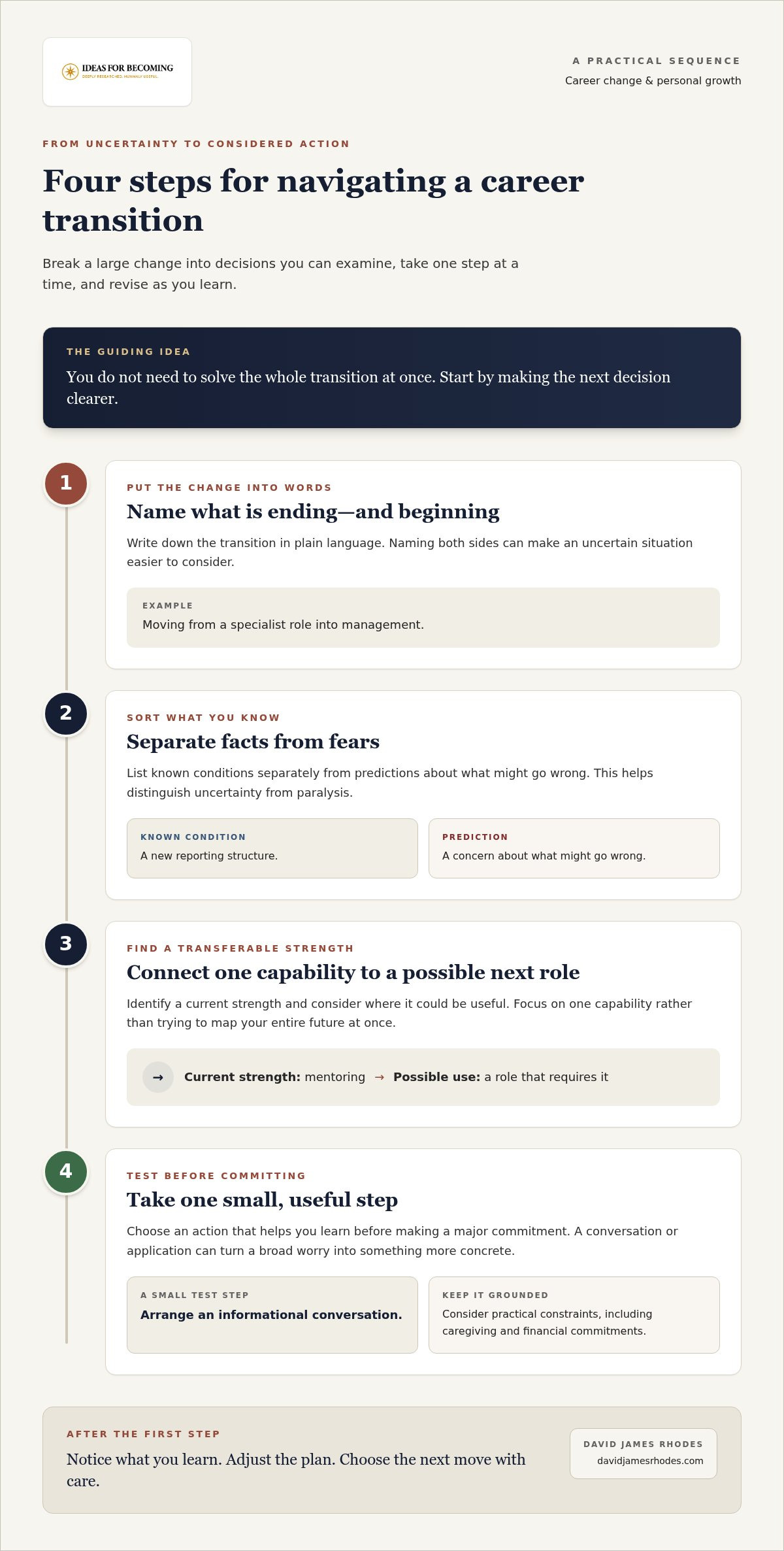
For a career transition, try this sequence:
- Name the change. Write down what is ending and what is beginning, such as moving from a specialist role into management.
- Separate facts from fears. List known conditions, like a new reporting structure, apart from predictions about what might go wrong.
- Identify one capability. Connect a current strength, such as mentoring, to a role that requires it.
- Take a small test step. Arrange an informational conversation before making a major commitment.
A speaker on navigating significant life changes can ground motivation in choices, not applause. Drawing on career examples, a speaker can show how someone learns from a setback, adjusts a plan, and takes responsibility for the next move. The message should respect the audience’s culture and circumstances. Treating every transition as identical can overlook caregiving demands, workplace realities, or different definitions of success.
Personal growth is not the same as constant optimism. Susan David’s work on emotional agility offers a useful lens: people can acknowledge difficult feelings while choosing actions aligned with their values. For someone facing a career change, that might mean admitting fear, then updating a résumé or asking a trusted colleague for candid feedback. The aim is not to erase uncertainty, but to act with care while it remains.
Leadership through uncertainty and disruption
Organizational change can involve digital transformation, a new system, restructuring, or industry shifts. Leaders may need to make decisions before every consequence is clear. During a restructuring, for example, a manager can explain what is changing, what remains undecided, and when employees will hear more. Clear communication does not remove uncertainty, but it gives people a more reliable basis for action.
Leading through disruption also depends on trust. Leaders can communicate effectively, foster resilience, and build trust by explaining the purpose of a change, describing how it affects daily work, and making space for specific concerns. In a new system rollout, an honest account of what is known and unknown is more useful than a motivational message that avoids the difficult parts.
Emotional intelligence matters in those moments because employees experience the same decision differently. One person may welcome a new reporting structure; another may fear losing influence or clarity. A leader can listen without treating every concern as resistance. JP Pawliw-Fry encourages leaders to embrace the last 8% of difficult conversations and decisions that drive change. That means addressing the uncomfortable issue directly, rather than allowing silence to deepen mistrust.
Urgency alone does not sustain employee motivation. A founder introducing a new business model, for instance, can connect the immediate work to its purpose and recognize the practical effort required. Leaders can:
- Explain the reason. Connect a system change to the problem it is meant to solve.
- Make roles clear. Tell each team what decisions it owns during a restructuring.
- Invite useful feedback. Ask employees where a new process creates friction, then respond to what they raise.
- Mark progress honestly. Share what has improved and what still needs attention.
Purpose-driven leadership makes the human stakes visible. If an organization is changing its services, leaders can explain how the shift serves customers while acknowledging its effect on employees. Purpose becomes credible when choices, communication, and daily behavior align. It is not a slogan placed above a difficult decision, but a standard for examining that decision.
A keynote can help leaders and audiences name these responsibilities before pressure rises. Daniel Goleman’s article “What Makes a Leader” was included by Harvard Business Review among its ten all-time essential reads. It raises a practical question for any education or leadership event: how will people’s emotions, judgment, and conduct shape the change they are asking others to carry? The answer should lead to specific commitments, not applause alone.
Resilience and adapting to adversity
Practical steps begin with naming what changed, identifying immediate needs, and choosing a next action. For someone returning to work after illness, that could mean clarifying current abilities, asking for specific support, and reviewing the plan as circumstances shift.
Adapting with Agility
Agility means adjusting a response when new information changes the situation. A team facing a disrupted project can name the obstacle, revise its priorities, and assign work according to current capacity. The goal isn’t to treat every setback as a transformation. It’s to use sound judgment, relevant expertise, and careful thought to decide what should change and what deserves continuity.
Adaptability also shapes human performance. After a tick-borne illness, Nicole Malachowski struggled to speak or walk for almost nine months. Her experience shows how adversity can challenge familiar abilities and routines. A speaker can use such an example to discuss persistence without suggesting that everyone’s recovery follows the same path or timetable.
Resilience does not mean appearing unaffected. Someone rebuilding after a serious setback may need to acknowledge fatigue, reassess responsibilities, and accept help with a concrete task. In a workplace, a colleague returning after illness might agree on priorities with a manager before resuming a full workload. This measured response makes room for both effort and limits.
Practical Steps Through Change
During a personal transition, distinguish urgent needs from decisions that can wait. Someone facing a sudden job loss might first review essential responsibilities, then contact a trusted colleague about options. Embrace change with discernment, not as an order to welcome every loss. A useful next step should fit the person’s actual circumstances.
- Describe the disruption. Write one clear sentence about what has changed, such as a role ending or a health condition altering daily routines.
- Identify immediate needs. Name the support or information required for the next decision.
- Choose a manageable action. Make one call, request one conversation, or complete one necessary task.
- Review and adjust. Consider what the action revealed, then revise the next step.
This approach turns a broad crisis into decisions people can examine. After a family move, for example, a parent might first establish a dependable school routine, then rebuild community ties. Each action provides information for the next choice, without requiring a perfect plan at the outset.
Organizations undertaking change can build adaptable teams, assess outcomes, and sustain progress. A team introducing a new process might gather staff feedback, assess whether the process supports its intended work, and adjust responsibilities. This review helps leaders see whether the change works in practice, not just in a presentation.
A speaker’s value lies in making these practices concrete. Look for examples that respect individual differences and translate resilience into choices people can use. The strongest message leaves the audience with a clear next action and the freedom to adapt it as life changes.
Keynote speakers on navigating change
A keynote speaker addresses a room at a shared moment, while a therapist provides clinical care and a life coach generally supports individual goals. Lisa Bodell, CEO of FutureThink, advocates simplifying organizations to support innovation and change, making her perspective relevant when complexity blocks progress.
These roles serve different needs. A keynote can give an audience language, perspective, and a shared point of reflection, but it doesn’t replace personalized coaching or therapy. Employees processing a restructuring, for example, may benefit from a shared address, while someone seeking ongoing personal support needs a different format.
Start with the change your conference must help people face. A leadership summit introducing a new operating model may need a speaker who connects simplification with organizational change. A gathering for people in career transition may need a speaker whose examples address identity, choice, and uncertainty. Let the event’s purpose shape the speaker’s expertise, not the other way around.
Look beyond an inspiring biography. A speaker’s story matters when it helps the audience understand a decision, a consequence, or a practice they can apply. Ask whether the speaker can address both the visible change and its human effect. A new digital process, for example, changes systems, but employees may also need clarity about responsibilities, learning, and how their work contributes.
Before booking, ask: “What should this audience understand or do differently after the keynote?” and “Which examples will connect with this group’s current change?” Ask, too, how the speaker adapts the address to your event’s culture and goals. Clear answers help distinguish a tailored keynote from a broad motivational message.
Use these criteria to compare keynote speakers:
- Relevance: Can the speaker address the specific transition, such as restructuring or reinvention?
- Practical value: Does the keynote give audiences a usable framework or next step?
- Perspective: Does the speaker explain the limits and complexity of change, not only its opportunities?
- Fit: Can the speaker connect with the audience’s experience without assuming everyone faces the same pressures?
Bodell’s focus on simplifying organizations may suit leaders confronting needless complexity, but a conference centered on grief or personal loss calls for a different emphasis. The right choice is not automatically the most famous or broadly inspiring speaker. It is the one whose perspective meets the event’s actual need, respects the audience, and helps people think and act amid change.
What experience or credentials should a speaker on major life transitions have?
Choose expertise that fits the audience’s challenge. A conference about restructuring may benefit from a speaker with organizational leadership experience, while an event about grief needs someone able to discuss loss with care and appropriate boundaries. Credentials can establish relevant knowledge, but they don’t prove that a speaker communicates clearly or offers useful guidance.
Look for both subject knowledge and a grounded account of practice. Connie Podesta says she worked as a therapist for 30 years. That background may inform her perspective on human behavior, but an event organizer should still consider whether her expertise matches the audience and the event’s purpose. A therapist speaking at a conference is not the same as providing therapy to attendees.
Relevant experience takes different forms. A leader who has guided teams through a merger may speak credibly about organizational disruption. Someone who has rebuilt a career after a major change may offer personal insight into uncertainty and identity. A compelling story matters most when the speaker explains what happened, what they learned, and which lessons may apply beyond their own circumstances.
Assess how the speaker handles complexity. If an audience includes employees facing layoffs, a useful speaker won’t frame every loss as an opportunity. They can acknowledge the strain, distinguish personal experience from established evidence, and offer practical reflection without promising a particular outcome. This balance supports trust and gives people room to think for themselves.
Before you book, use these steps to assess fit:
- Define the need. Name the change, such as a merger, career transition, bereavement, or return after illness.
- Review relevant experience. Match the speaker’s work or lived experience to that specific subject.
- Ask for a practical example. Find out what audiences will be able to consider or do after the keynote.
- Clarify boundaries. Establish whether the speaker is offering education and perspective, rather than individual clinical care.
Consider the audience’s culture and context, too. A keynote for senior executives may address accountability during restructuring; an education event for young adults may focus on identity, choices, and emerging responsibilities. The same speaker may not suit both equally. Ask how they adapt examples and language without weakening the central message.
Expertise, experience, and delivery work together. A speaker’s biography can open the door, but relevance and judgment determine whether the audience can use what follows. Compare each candidate with the event’s actual need, then choose the person who can speak honestly about change and give people a practical way to reflect on their next decisions.
David James Rhodes: The Way
The Way is David James Rhodes’s guide to human becoming: building character, purpose, and a way forward through change. Rather than offering a formula for avoiding hardship, it invites readers to consider who they are becoming through their choices and actions.
Turn to The Way when a transition raises questions beyond the immediate decision: how to lead with integrity, rebuild after disruption, or find meaning in a changed life. For organizations seeking a shared conversation, David’s Keynote Speaking addresses leadership and life transitions. Leadership & Life Advisory offers another way for leaders to work through complex questions.
These perspectives connect practical change with a deeper question of identity. The Way is available following its September 15, 2026 release. To explore whether David’s work fits your event or leadership needs, contact David James Rhodes.
Choose the next step with intention
A leadership conference can create a pause in the middle of change. What matters next is what people carry into their decisions, conversations, and daily conduct. Choosing a speaker on navigating significant life changes means looking beyond the moment on stage: consider what question you want the audience to keep working on afterward. Who are they becoming through the change before them?
David James Rhodes brings that question to his Keynote Speaking and Leadership & Life Advisory. His guide The Way explores human becoming, offering a broader perspective for people leading, rebuilding, or reconsidering their direction. Each offers a different way to engage with change, from a shared conference address to deeper reflection on leadership and character.
If this perspective fits your event or leadership needs, contact David James Rhodes. A thoughtful next step can begin with a clear conversation about the change your audience is facing. Let it be a beginning grounded in purpose, honesty, and the possibility of becoming more deliberate in how you move forward.
Frequently Asked Questions
Which of these speakers is best suited for a leadership conference?
Lisa Bodell may suit a conference where leaders need to simplify complex work and support innovation. For a gathering focused on personal leadership during transition, David James Rhodes offers a broader perspective on leadership, adversity, and human becoming. Start with the conference’s central challenge, such as integrating a new system or clarifying leadership responsibilities, then choose the speaker whose expertise addresses it directly.
Who is a well-known speaker on navigating significant life changes?
David James Rhodes speaks about leadership, adversity, recovery, and human becoming. His perspective draws on more than four decades of experience across 156 countries, including international finance, entrepreneurship, and behavioral health. That breadth can offer a useful lens for audiences considering how identity and responsibility shape a response to change. His work asks a grounding question: who are you becoming through the choices you make?
What topics do life-change speakers cover?
Speakers on life changes may address career reinvention, leadership disruption, grief, loss, resilience, relationships, and finding purpose after adversity. The emphasis varies by event. A university audience might explore identity and choosing a direction, while a management gathering may examine how leaders respond to uncertainty. Clarify whether attendees need perspective on a shared transition, practical ideas for action, or language for discussing a difficult experience.
Where can I find speakers on life transitions in the United States?
You can explore speakers’ official websites and professional profiles, then compare their subjects with your event’s purpose. David James Rhodes offers keynote speaking to audiences across the United States. For example, an organization planning a leadership gathering can review whether a speaker’s stated focus aligns with its current transition, audience, and desired conversation. A clear topic match is more useful than choosing a speaker based on visibility alone.
How can I choose the right speaker for a corporate or community event?
Write a short event brief before comparing candidates: describe the transition, who will attend, and what you want them to consider afterward. After a community closure, for example, the need may be space to discuss loss and future choices. For a corporate event, it may be shared language around leadership. Ask how the speaker will tailor examples, address sensitive realities, and connect the talk to your audience’s context.
Frequently Asked Questions
Related Articles

Best Leadership Guides for Executives: A Thoughtful 2026 Selection
Searching for the best leadership books for executives? Discover thoughtful leadership guides matched to real executive challenges, strategy, and character.

Executive Coach vs. Advisor: Which Kind of Support Does a Leader Need?
Choosing between an executive coach vs advisor? Learn how to match the right support to consequential leadership decisions and the leader you are becoming.

Executive Advisory on Purpose and Fulfillment: A More Human Way Forward
Seek executive advisory on purpose and fulfillment to align leadership choices with values and character. Discover who you are becoming beyond outward success.